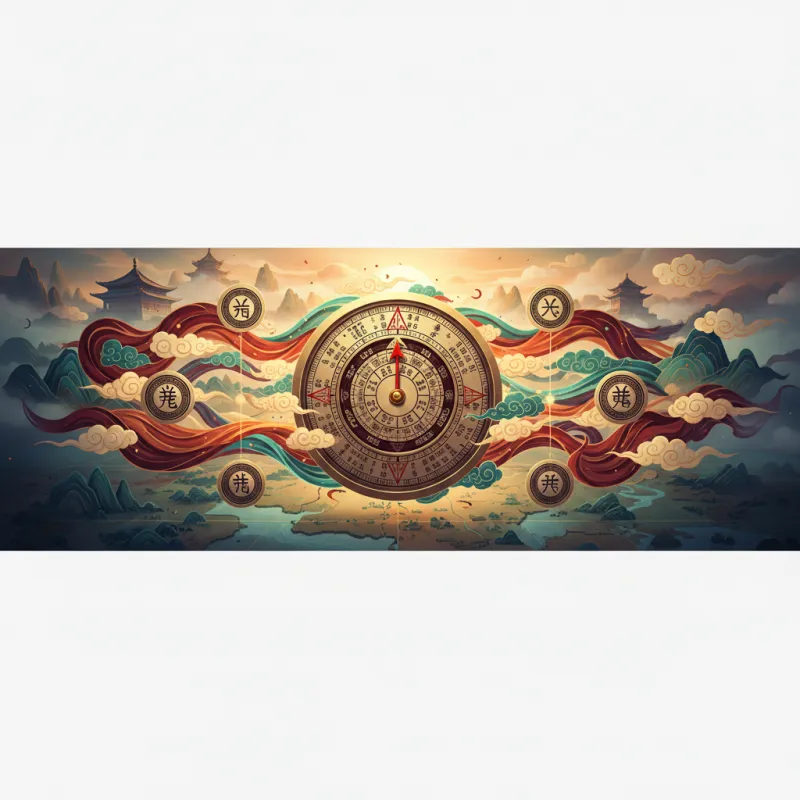
The first time I held a luopan, I nearly dropped it. Not because it was heavy—though it was, solid rosewood and brass—but because the sheer density of information spiraling across its face made my head spin. Dozens of concentric rings, each crammed with Chinese characters, numbers, and symbols that seemed to whisper secrets I couldn't yet understand. It looked less like a compass and more like a mandala designed by an obsessive cartographer.
The 罗盘 (luó pán), literally "net plate" or "encompassing plate," is the primary diagnostic tool of classical feng shui practice. While a regular compass tells you which way is north, a luopan tells you the quality of that north—whether it's auspicious or inauspicious, which element it carries, which star governs it, and how it interacts with time itself. It's not just a directional instrument. It's a cosmological calculator that compresses the entire Chinese metaphysical worldview into a handheld device.
The Anatomy of the Luopan
At the center of every luopan sits the 天池 (tiān chí), the "heaven pool"—a small magnetic compass suspended in liquid. This is your reference point, your true north. Everything else on the luopan is organized around this central axis.
Radiating outward from the heaven pool are anywhere from 3 to 40+ concentric rings, depending on the school and complexity of the luopan. A basic 三合盘 (sān hé pán) used by the San He school might have 17 rings. A 三元盘 (sān yuán pán) from the San Yuan school could have 36. The most elaborate 综合盘 (zōng hé pán)—comprehensive luopans that attempt to incorporate multiple schools—can have over 40 rings, each representing a different layer of feng shui analysis.
The outer square plate, usually made of wood, is called the 地盘 (dì pán) or "earth plate." This represents the earthly realm, the physical space you're measuring. The circular disc that rotates within it is the 天盘 (tiān pán) or "heaven plate," representing the celestial influences. Some advanced luopans also include a 人盘 (rén pán) or "human plate," completing the trinity of heaven, earth, and humanity that underlies all Chinese cosmology.
Two red threads cross at right angles over the heaven pool, forming a crosshair. These are your sighting lines. When you align these threads with a building's facing direction or sitting direction, you can read off the corresponding information from each ring.
The 24 Mountains: The Foundation Ring
The most fundamental ring on any luopan is the 二十四山 (èr shí sì shān), the 24 Mountains. This divides the 360-degree circle into 24 segments of 15 degrees each. These aren't literal mountains—they're directional sectors, each with its own name and character.
The 24 Mountains consist of three types of markers:
The 八卦 (bā guà), the eight trigrams: Qian (乾), Kun (坤), Gen (艮), Xun (巽), Zhen (震), Kan (坎), Li (离), and Dui (兑). These occupy eight of the 24 positions.
The 十天干 (shí tiān gān), the ten Heavenly Stems: Jia (甲), Yi (乙), Bing (丙), Ding (丁), Wu (戊), Ji (己), Geng (庚), Xin (辛), Ren (壬), and Gui (癸). Eight of these appear on the luopan (Wu and Ji are excluded because they represent the center).
The 十二地支 (shí èr dì zhī), the twelve Earthly Branches: Zi (子), Chou (丑), Yin (寅), Mao (卯), Chen (辰), Si (巳), Wu (午), Wei (未), Shen (申), You (酉), Xu (戌), and Hai (亥). All twelve appear on the luopan.
Together, these create a sophisticated directional language. North isn't just north—it might be Zi (子) north at 352.5-7.5 degrees, or Ren (壬) north at 337.5-352.5 degrees, or Gui (癸) north at 7.5-22.5 degrees. Each carries different elemental qualities and interacts differently with the Five Elements system.
The Three Plates: San He vs. San Yuan
Here's where it gets interesting—and contentious. Different feng shui schools don't agree on how to orient the 24 Mountains. The San He school uses three different plates, each rotated slightly from the others:
The 地盘 (dì pán) or Earth Plate is used for measuring the sitting direction of buildings and the physical landforms. On this plate, the Zi (子) position points to magnetic north at 0 degrees.
The 人盘 (rén pán) or Human Plate is rotated 7.5 degrees counterclockwise from the Earth Plate. It's used for measuring water flow and drainage patterns. The Zi position here points to 352.5 degrees.
The 天盘 (tiān pán) or Heaven Plate is rotated 7.5 degrees clockwise from the Earth Plate. It's used for measuring incoming qi from roads and pathways. The Zi position points to 7.5 degrees.
Why three plates? The San He school believes that different phenomena—landforms, water, and roads—interact with qi differently and should be measured on different scales. It's like having three different rulers for measuring three different types of distance.
The San Yuan school, by contrast, uses only one plate and focuses heavily on the temporal dimension through Flying Star feng shui. They're less concerned with the subtle directional variations and more interested in how the nine stars fly through space and time.
I've watched practitioners from different schools argue about this for hours. A San He master once told me, "Using one plate for everything is like using a hammer for every job. Sometimes you need a screwdriver." A San Yuan practitioner countered, "Using three plates is like having three different clocks in your house, each showing a different time. How do you know which one is right?"
Both have a point.
Reading the Rings: Layer by Layer
Once you understand the 24 Mountains, you can start reading the other rings. Each ring adds another layer of information:
The 七十二龙 (qī shí èr lóng), or 72 Dragons, divides each of the 24 Mountains into three sub-sections, creating 72 divisions of 5 degrees each. Each dragon is classified as either auspicious or inauspicious based on the 纳音 (nà yīn) system—a method of deriving elements from combinations of Heavenly Stems and Earthly Branches. Some dragons are "empty" (空亡, kōng wáng) and should be avoided for important orientations.
The 六十透地龙 (liù shí tòu dì lóng), or 60 Penetrating Earth Dragons, uses the 60-combination cycle of Stems and Branches (the same cycle used in Bazi astrology) to further refine directional analysis. This ring helps determine whether a direction is in harmony with the building's construction year or the occupant's birth year.
The 分金 (fēn jīn), or Dividing Gold, is one of the most precise rings, dividing the compass into 240 or even 384 segments. This level of precision—1.5 degrees or less—is used for determining the exact orientation of ancestral graves or important buildings. Get the fen jin wrong, and even an otherwise auspicious direction can turn inauspicious.
The 九星 (jiǔ xīng) rings show the distribution of the nine stars (Tan Lang, Ju Men, Lu Cun, Wen Qu, Lian Zhen, Wu Qu, Po Jun, Zuo Fu, and You Bi) across the compass. These stars, borrowed from Chinese astronomy, represent different types of qi and fortune.
The 二十八宿 (èr shí bā xiù), or 28 Lunar Mansions, divide the sky into 28 segments based on ancient Chinese astronomy. Each mansion has its own character and influences the qi of its corresponding direction.
The Practical Art of Taking a Reading
Theory is one thing. Actually using a luopan in the field is another entirely.
First, you need to find the 坐向 (zuò xiàng)—the sitting and facing directions of the building. The sitting direction is the back of the building, usually where the mountain or support is. The facing direction is the front, usually where the main entrance or the most open side is. This sounds simple until you encounter a building with entrances on multiple sides, or a modern apartment building where everyone enters through an underground garage.
Stand at the center of the building—or as close as you can get to it. Hold the luopan level, with the heaven pool centered. Rotate your body until the magnetic needle aligns with the north marking in the heaven pool. Some luopans have the needle pointing north; others have it pointing south. Know your instrument.
Now rotate the circular disc until the crosshairs align with the facing direction of the building. You're not moving the needle—you're moving the rings around the needle. Once aligned, you can read off the facing direction from the 24 Mountains ring.
But here's the catch: you need to be precise. A difference of just a few degrees can shift you from one mountain to another, completely changing the feng shui analysis. I've seen practitioners take the same reading five times, averaging the results to account for magnetic interference from rebar in concrete, electrical wiring, or even the metal in their belt buckles.
Modern luopans often include a spirit level to ensure you're holding it perfectly horizontal. Some practitioners use a tripod. The most traditional masters I've met can hold a luopan steady by muscle memory alone, their hands as stable as stone.
The Magnetic Declination Problem
Here's something most beginners don't realize: the luopan measures magnetic north, not true north. And magnetic north isn't in the same place as true north—it's currently somewhere in the Canadian Arctic, and it moves about 55 kilometers per year.
The difference between magnetic north and true north is called 磁偏角 (cí piān jiǎo), magnetic declination. In New York City, it's about 13 degrees west. In Beijing, it's about 6 degrees west. In parts of Australia, it's over 12 degrees east.
Do you need to correct for this? Practitioners disagree. Some argue that classical feng shui has always used magnetic north, so that's what matters. The ancient masters didn't know about true north—they used the compass needle, and it worked. Others insist that the 24 Mountains were originally based on astronomical observations of true north, and we should correct for declination to honor the original intent.
I lean toward the magnetic north camp, but I've seen excellent results from practitioners who correct for declination. The truth is, feng shui works on multiple levels, and the practitioner's skill and intention matter more than a few degrees of difference.
Beyond the Compass: Integrating Time and Space
The real mastery of the luopan comes when you integrate spatial information with temporal information. The compass tells you about space—the directions, the mountains, the elements. But feng shui is also deeply concerned with time.
The 三元九运 (sān yuán jiǔ yùn) system divides time into nine periods of 20 years each, cycling through 180-year epochs. We're currently in Period 9, which began in 2024. Each period has a different ruling star, and the same direction can be auspicious in one period and inauspicious in another.
When you take a luopan reading, you're not just measuring the building's orientation—you're measuring how that orientation interacts with the current time period, the year, the month, and even the day. A building facing Zi (子) north might be excellent in Period 8 but problematic in Period 9.
This is where the luopan becomes less like a compass and more like a cosmic calculator. You're cross-referencing multiple rings, considering temporal cycles, factoring in the building's construction date and the occupants' birth dates, and synthesizing all of this into a coherent analysis.
Choosing Your First Luopan
If you're ready to buy a luopan, here's my advice: start simple. Don't buy a 40-ring comprehensive luopan as your first instrument. You'll be overwhelmed and won't use half the rings.
A basic San He luopan with 17-19 rings is perfect for learning. Look for one that's at least 15 centimeters in diameter—smaller ones are harder to read accurately. The disc should rotate smoothly, and the heaven pool should be clear and well-sealed.
Expect to pay $80-300 for a decent quality luopan. The cheap $30 ones on Amazon are often poorly calibrated and won't give accurate readings. The $1000+ antique luopans are beautiful but unnecessary unless you're a serious collector.
Check the calibration before you buy. Bring a regular compass and compare readings. They should match within a degree or two. If they don't, the luopan is either poorly made or has been damaged.
And here's something nobody tells beginners: the luopan is just a tool. I've met masters who can assess a building's feng shui with just their eyes and intuition, barely glancing at their luopan. The compass helps you be precise, but it doesn't replace understanding. Learn the theory first. The luopan will make more sense once you understand what you're actually measuring.
The rings will start to speak to you, each one adding another layer of meaning, until the whole instrument becomes a language you can read as fluently as your native tongue. That's when the luopan stops being overwhelming and starts being indispensable.
Related Reading
- Compass School Feng Shui: When Direction Becomes Destiny
- Eight Mansions vs Flying Stars: Which System Should You Use?
- The Compass School of Feng Shui: Mathematics, Not Magic
- Flying Stars Explained Simply
- Discover the Secrets of Feng Shui: Transforming Your Garden with I Ching and Chinese Metaphysics
- Rainwater Collection and Feng Shui: Catching Wealth from the Sky
- Qigong for Beginners: Start Your Energy Practice
Explore Chinese Culture
- Explore Daoist philosophy and practice
- Explore traditional Chinese customs
- Explore ancient Chinese cosmology