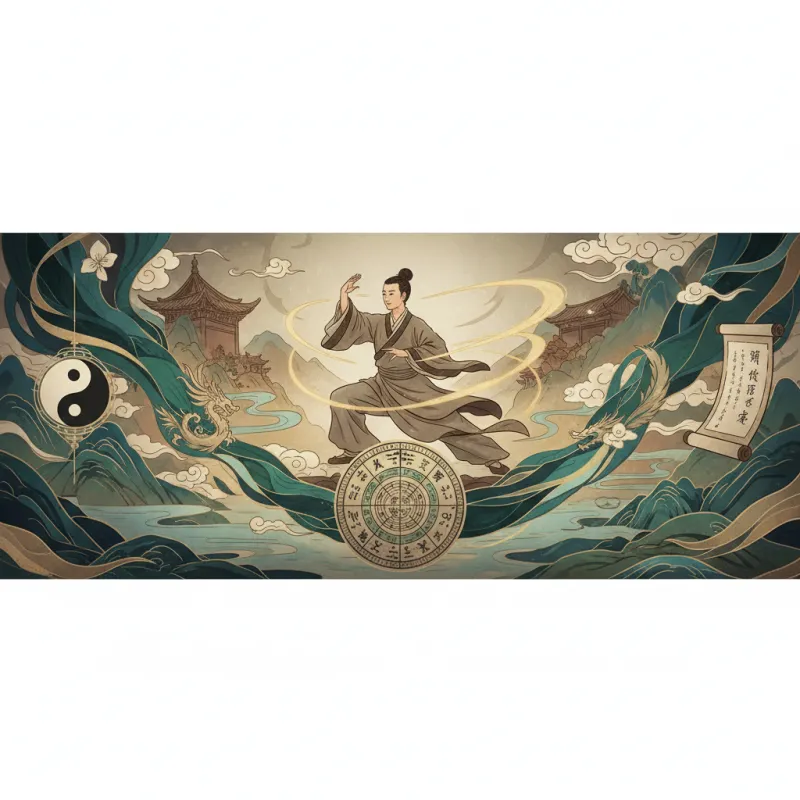
Your hands are trembling. Not from fear or cold, but from something you can't quite name — a subtle vibration, like holding your palms an inch apart and feeling the magnetic push between them. This is your first real encounter with qi (气 qì), and it's happening in your living room on a Tuesday morning, no incense or monastery required.
This is qigong (气功 qìgōng), and it's about to ruin your excuses for not having an energy practice.
The Practice That Predates Your Excuses
Qigong translates literally as "energy work" or "cultivation of breath," and it's been around for at least 4,000 years — longer than written Chinese, longer than the I Ching, longer than the concept of yin and yang as we know it today. Archaeological evidence from the Mawangdui tombs (sealed in 168 BCE) includes silk paintings depicting qigong-like exercises, but the oral tradition stretches back much further, into the mists of the Xia Dynasty.
Here's what makes qigong different from yoga, tai chi, or your morning stretch routine: it's explicitly designed to cultivate and direct qi through your body's meridian system. While feng shui arranges external space to optimize energy flow, qigong does the same thing for your internal landscape. Think of it as interior design for your energetic body.
The practice requires nothing. No mat, no special clothes, no flexibility, no strength, no youth. I've seen 80-year-olds with replacement hips do qigong. I've seen it practiced in hospital beds, office cubicles, and airport terminals. The barrier to entry is so low it's practically underground.
Why Your Body Is Already Doing Qigong (Badly)
Every breath you take is a form of qigong — just unconscious, inefficient, and probably shallow. Most people breathe with their chest, using maybe 30% of their lung capacity, activating their sympathetic nervous system (fight-or-flight) with every inhale. This is like running your car in first gear all day and wondering why you're exhausted.
Qigong breathing engages the diaphragm, fills the lower lungs, and activates the parasympathetic nervous system (rest-and-digest). In Chinese medicine, this is called "breathing into the dantian (丹田 dāntián)" — the energy center located about three finger-widths below your navel. The dantian is considered the body's primary qi reservoir, similar to how the mingmen (命门 mìngmén) point on your lower back is considered the "gate of vitality" in acupuncture theory.
When you breathe into your dantian, you're not literally filling your belly with air (your lungs don't extend that far). You're using diaphragmatic breathing to create abdominal expansion, which massages your internal organs, stimulates your vagus nerve, and signals your body that it's safe to relax. The qi follows this breath, accumulating in your lower abdomen like water pooling in a reservoir.
This is the foundation. Everything else in qigong builds on this single skill: breathing low, slow, and deep.
The Three Regulations That Change Everything
Traditional qigong teaching revolves around the "three regulations" (三调 sān tiáo): regulating the body, regulating the breath, and regulating the mind. These aren't separate practices — they're three aspects of the same unified activity, like the three legs of a tripod.
Regulating the body (调身 tiáo shēn) means finding a posture that's simultaneously relaxed and alert. The classic qigong stance is standing with feet shoulder-width apart, knees slightly bent, tailbone tucked, spine straight, and crown of the head lifting toward the sky. Imagine a string pulling you up from the top of your head while your feet root into the earth. This is the wuji (无极 wújí) stance — the posture of primordial emptiness, the stance before movement begins.
Your shoulders should drop. Your chest should be slightly concave, not puffed out. Your tongue should rest gently against the roof of your mouth, just behind your front teeth — this connects the Governing Vessel (督脉 dū mài) and Conception Vessel (任脉 rèn mài), the two primary meridians that form the "microcosmic orbit" of qi circulation.
Regulating the breath (调息 tiáo xī) means establishing a rhythm that's natural but intentional. Start with a 4-4-4 pattern: inhale for 4 counts, hold for 4 counts, exhale for 4 counts. As you develop capacity, extend to 6-6-6, then 8-8-8. The breath should be silent, smooth, and continuous — no gasping, no forcing, no strain. If you can hear your breath, you're trying too hard.
Regulating the mind (调心 tiáo xīn) is the hardest part and the most important. Your mind should be focused but not tense, aware but not analyzing. In qigong, we use the term "yi (意 yì)" — intention or focused awareness — to describe this state. You're not thinking about qi; you're directing your awareness to where you want qi to flow. Where the yi goes, the qi follows. This principle is identical to the feng shui concept of using intention to activate space.
Your First Practice: Standing Like a Tree
The single most powerful qigong exercise for beginners is zhan zhuang (站桩 zhàn zhuāng), which translates as "standing like a post" or "standing like a tree." It looks absurdly simple: you just stand there. But this "just standing" has been the foundation of martial arts training, medical qigong, and spiritual cultivation for millennia.
Here's how to do it:
Stand with feet shoulder-width apart, toes pointing forward. Bend your knees slightly — just enough that you could slide a piece of paper under your heels if you lifted them. Tuck your tailbone slightly, as if you're sitting on a high stool. Let your arms float up until your hands are at chest height, palms facing your body, as if you're hugging a large tree. Your elbows should be lower than your wrists, creating a gentle downward curve.
Now breathe into your dantian and stand there.
For the first minute, you'll think this is easy. By minute three, your shoulders will start burning. By minute five, your legs will shake. By minute seven, you'll understand why this is called "standing meditation" — your mind will throw every excuse, distraction, and complaint at you to make you stop. This is the practice. You're not just building physical stamina; you're training your yi to remain focused despite discomfort.
Start with 5 minutes daily. Add one minute per week. Traditional practitioners stand for 30-60 minutes, but even 10 minutes of daily zhan zhuang will transform your energy levels, posture, and mental clarity within a month.
The Eight Brocades: Your Complete Beginner Routine
Once you've established a standing practice, the next step is the Eight Pieces of Brocade (八段锦 bā duàn jǐn), also called the Eight Silk Movements. This is the most widely practiced qigong sequence in the world, and for good reason — it's a complete system that works every major meridian, joint, and organ system in about 15 minutes.
The Eight Brocades date back to the Song Dynasty (960-1279 CE), though some sources attribute them to the legendary general Yue Fei. Each movement has a specific therapeutic purpose:
- Two Hands Hold Up the Heavens — regulates the Triple Burner (三焦 sān jiāo), the energetic system that governs metabolism and fluid distribution
- Drawing the Bow to Shoot an Eagle — opens the chest and strengthens the lungs
- Separate Heaven and Earth — harmonizes the spleen and stomach
- Wise Owl Gazes Backward — releases neck tension and prevents the "five taxations and seven injuries"
- Sway the Head and Shake the Tail — clears heart fire and calms the spirit
- Two Hands Hold the Feet — strengthens the kidneys and lower back
- Clench the Fists and Glare Fiercely — builds qi and increases vitality
- Bouncing on the Toes — stimulates all meridians and settles the qi
You can find video demonstrations online, but here's the key: perform each movement 8-12 times, coordinating breath with motion. Inhale during expansion, exhale during contraction. Move slowly enough that an observer could count your breaths. The slower you move, the more qi you cultivate.
What You'll Actually Feel (And What It Means)
Let's be honest about what happens when you start practicing qigong, because the traditional descriptions sound like mystical nonsense until you experience them yourself.
Tingling in your palms and fingers — This is usually the first sign of qi activation. It feels like mild pins-and-needles, or like your hands are wrapped in warm cotton. This happens because you're increasing blood flow and nerve sensitivity in your extremities. In Chinese medicine, the hands are where several major meridians begin and end, so they're particularly sensitive to qi movement.
Heat in your dantian — After a few weeks of practice, you might feel warmth or fullness in your lower abdomen. This isn't your imagination; you're literally increasing blood flow and metabolic activity in your core. The dantian is considered the body's furnace, and you're learning to stoke it.
Spontaneous movements or shaking — Sometimes during standing practice, your body will start to sway, shake, or move on its own. This is called "spontaneous qigong" (自发功 zì fā gōng), and it's your body releasing stored tension and blockages. Don't fight it; let it happen. Your body knows what it needs to release.
Emotional releases — Qigong can trigger unexpected crying, laughter, or anger. In Chinese medicine, emotions are stored in organs: anger in the liver, joy in the heart, worry in the spleen, grief in the lungs, fear in the kidneys. When you start moving qi through these organs, you're also processing stored emotional energy. This is therapeutic, not problematic.
Nothing at all — Some people practice for months without feeling anything dramatic, and that's completely normal. Qi cultivation is cumulative. You're making changes at a cellular and energetic level that might not produce obvious sensations. Trust the process.
The Mistakes Everyone Makes (And How to Avoid Them)
Trying too hard — The biggest mistake in qigong is forcing. You cannot force qi to move; you can only invite it, guide it, allow it. If you're straining, gritting your teeth, or holding your breath, you're doing the opposite of qigong. The practice should feel like 70% effort, 30% relaxation. In Chinese, this is called "song (松 sōng)" — a relaxed alertness, like a cat watching a bird.
Practicing irregularly — Qigong works through accumulation. Five minutes every day is infinitely more valuable than an hour once a week. Your body needs consistent signals to establish new patterns. Think of it like learning a language — daily practice creates fluency, sporadic practice creates frustration.
Ignoring the breath — Movement without breath coordination is just exercise. Breath without movement is just breathing. The magic happens when they synchronize. If you can only focus on one thing, focus on the breath. Everything else will follow.
Comparing yourself to others — Qigong is not competitive. Someone else's tingling hands or glowing aura or mystical experience has nothing to do with your practice. Your body, your qi, your timeline. The person who's been practicing for 20 years had a first day too.
How Qigong Fits Into Your Existing Practice
If you already practice meditation, qigong is meditation in motion. If you practice feng shui, qigong is the internal equivalent of arranging your space. If you study the I Ching or bazi, qigong gives you direct experiential knowledge of the five elements (五行 wǔ xíng) moving through your body.
The five elements aren't abstract concepts in qigong — they're felt experiences. Wood qi feels expansive and rising, like spring growth. Fire qi feels bright and radiating, like summer heat. Earth qi feels stable and centering, like late summer harvest. Metal qi feels contracting and descending, like autumn letting go. Water qi feels deep and flowing, like winter stillness.
As you develop sensitivity to these qualities in your own body, you'll start recognizing them in your environment, your relationships, your life cycles. This is the bridge between internal cultivation and external awareness, between qigong and the broader system of Chinese metaphysics.
Start simple. Stand like a tree for five minutes tomorrow morning. Breathe into your dantian. Notice what happens. That's the practice. Everything else is commentary.
Related Reading
- Qi Gong and Feng Shui: Cultivating Energy Inside and Out
- Chinese Meditation: A Guide to Daoist and Buddhist Practices
- Chinese Breathing Techniques for Energy and Calm
- Designing Feng Shui Meditation Spaces
- Discover the Secrets of Feng Shui: Transforming Your Garden with I Ching and Chinese Metaphysics
- Exploring Feng Shui, I Ching, and Chinese Metaphysics in Bazi Practice
- Bagua Mirror: The Most Misunderstood Feng Shui Tool
Explore Chinese Culture
- Explore Daoist philosophy and practice
- Explore traditional Chinese customs
- Explore ancient Chinese cosmology