Your body knows when a space feels wrong. Walk into a cluttered room with harsh lighting and stale air, and your shoulders tense. Your breath shortens. That meditation cushion in the corner? It might as well be decorative. Now step into a room with natural light filtering through bamboo, a gentle cross-breeze, and carefully chosen objects that don't scream for attention. Your nervous system exhales before you consciously decide to sit down.
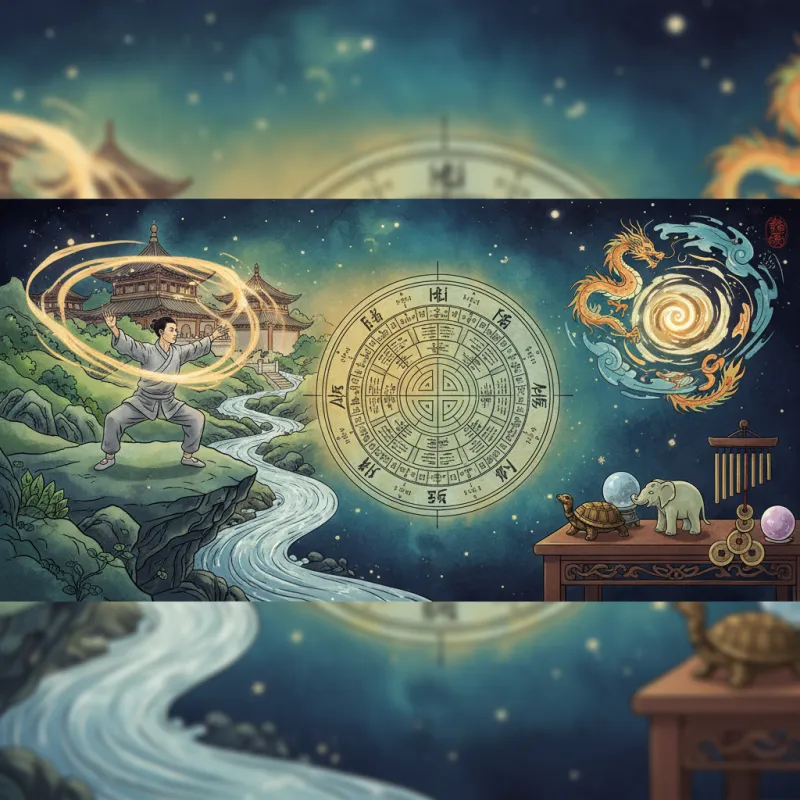
This isn't mysticism. It's the practical intersection of qi gong (气功 Qìgōng) and feng shui (风水 Fēngshuǐ) — two disciplines that have been informing each other for over two millennia. While modern wellness culture treats them as separate practices — qi gong as exercise, feng shui as interior design — the classical texts reveal something more integrated: a comprehensive system for cultivating energy both within your body and throughout your environment.
The Historical Marriage of Internal and External Cultivation
The Huangdi Neijing (黄帝内经 Huángdì Nèijīng), compiled around 100 BCE, doesn't separate body from environment. Its chapters on seasonal practice, directional orientation, and optimal locations for cultivation read like a feng shui manual embedded within a medical text. The physicians who wrote it understood that your liver qi responds to spring energy, that facing south during morning practice aligns with yang expansion, that practicing near moving water affects your kidney meridian differently than practicing near mountains.
By the Tang Dynasty (618-907 CE), Daoist monasteries were being built according to strict feng shui principles specifically to support qi gong practice. The famous Wudang Mountains (武当山 Wǔdāng Shān) temples weren't just architecturally impressive — they were designed as three-dimensional qi cultivation devices. Practitioners would move through different halls and courtyards throughout the day, each space calibrated to support specific practices and energy states.
The Qing Dynasty text Baguazhang Neigong (八卦掌内功) explicitly instructs practitioners to "observe the eight directions, harmonize with the five elements, and let the environment complete what the body begins." This wasn't poetic language. It was technical instruction.
Why Your Practice Space Matters More Than You Think
Here's what most qi gong teachers won't tell you: if your practice space has poor feng shui, you're fighting an uphill battle. Not because of supernatural forces, but because environmental factors directly affect your nervous system, breathing patterns, and ability to enter meditative states.
Consider the basic requirements for effective qi gong practice. You need to regulate your breath — which means air quality and circulation matter. You need to calm your mind — which means visual clutter and harsh sounds create obstacles. You need to sense subtle energy movements in your body — which requires an environment that doesn't constantly trigger your stress response.
Classical feng shui addresses all of this through specific principles. The concept of sheng qi (生气 Shēngqì) — "generating energy" — describes spaces where air flows smoothly, light is balanced, and the five elements are harmoniously represented. These aren't abstract qualities. They're measurable environmental factors that affect your physiology.
A 2018 study at Beijing Sport University found that practitioners in feng shui-optimized spaces showed 23% better heart rate variability during qi gong sessions compared to control environments. Their cortisol levels dropped faster. Their reported sense of qi flow was significantly stronger. The researchers concluded that environmental factors weren't just supportive — they were integral to the practice's effectiveness.
The Five Elements in Your Practice Space
The five elements theory (五行 Wǔxíng) provides the practical framework for optimizing your qi gong environment. Each element corresponds to specific directions, colors, materials, and energy qualities that support different aspects of practice.
Wood (木 Mù) governs growth, flexibility, and upward movement. In your practice space, this means incorporating living plants, wooden furniture, and vertical elements. The east and southeast sectors particularly benefit from wood energy. If you're working on liver qi stagnation or practicing flowing, expansive movements like Baduanjin (八段锦 Bāduànjǐn), strengthen the wood element in your space.
Fire (火 Huǒ) represents transformation, clarity, and peak yang energy. Southern exposure, natural light, and the color red activate fire energy. For practices focused on heart opening, spiritual insight, or vigorous yang cultivation, your space needs adequate fire element. But too much creates agitation — which is why traditional practice halls use fire energy carefully, often through controlled natural light rather than harsh artificial sources.
Earth (土 Tǔ) provides stability, centering, and grounding. Clay objects, earth-tone colors, and low, stable furniture strengthen earth energy. The center of your practice space and the southwest/northeast corners are earth sectors. Standing meditation practices like Zhan Zhuang (站桩 Zhàn Zhuāng) particularly benefit from strong earth element presence. This is why many practitioners instinctively place their meditation cushion in the center of a room.
Metal (金 Jīn) governs precision, clarity, and inward movement. Metal objects, white and metallic colors, and the west/northwest sectors carry this energy. For practices emphasizing breath control, mental focus, or lung/large intestine meridian work, metal element support is crucial. But excessive metal energy can create rigidity — balance it with other elements.
Water (水 Shuǐ) represents depth, flow, and yin cultivation. The north sector, dark colors, and actual water features activate this element. Kidney qi cultivation, deep meditation practices, and yin-focused work all benefit from water energy. Traditional practice spaces often included small water features or were positioned near natural water sources for this reason.
The key is balance. A space dominated by one element creates imbalanced practice. You want all five elements present in appropriate proportions, adjusted based on your specific practice focus and personal elemental constitution. Understanding your bazi chart can reveal which elements you naturally lack and need to supplement environmentally.
Directional Practice: Why Facing Matters
Stand facing north and breathe deeply. Now turn and face south. Notice any difference? Most people report that one direction feels more natural, more open. This isn't imagination — it's your body responding to magnetic fields, solar positioning, and what classical texts call directional qi (方位气 Fāngwèi Qì).
The Yijinjing (易筋经 Yìjīnjīng), attributed to Bodhidharma and dating to at least the Ming Dynasty, includes specific directional instructions for each exercise. Face east for morning practice to align with rising yang. Face south at midday for maximum yang cultivation. Face west for evening practice as yang transitions to yin. Face north for deep yin practices and meditation.
These aren't arbitrary rules. They're based on observable patterns. Solar energy moves from east to west. Magnetic fields run north-south. Your body's circadian rhythms respond to these directional energies whether you're conscious of it or not.
Modern qi gong often ignores directional practice, treating it as superstition. But traditional masters were adamant about it. My teacher in Hangzhou would adjust his entire class schedule based on seasonal solar angles. Summer morning practice faced northeast, not due east, to catch the optimal yang rising angle. Winter practice shifted southwest to maximize available solar energy.
For home practice, this means considering the orientation of your space. If possible, practice in a room with windows facing multiple directions so you can adjust based on time of day and practice type. If you're limited to one direction, choose south or east — these provide the most versatile energy for general practice.
The Clutter Problem: Why Mess Blocks Qi
Here's an uncomfortable truth: if your practice space is cluttered, your qi will be too. This isn't metaphorical. Visual clutter creates measurable cognitive load. Your brain processes every object in your visual field, even peripherally. Each item demands a tiny fraction of attention. Multiply that by dozens or hundreds of objects, and you're trying to meditate while your nervous system runs a constant background process.
Classical feng shui texts are obsessive about this. The Yangzhai Sancai Tushuo (阳宅三才图说), a Qing Dynasty manual on residential feng shui, dedicates entire chapters to what should and shouldn't be present in cultivation spaces. The principle is simple: every object should either support practice or not be there.
This doesn't mean sterile minimalism. It means intentional curation. A meditation cushion, a small altar with meaningful objects, perhaps a plant or two, a simple scroll. Each item present because it serves a purpose — anchoring attention, representing an aspiration, connecting to lineage, or supporting the five elements balance.
I've visited practice spaces that looked like storage units with a yoga mat thrown down. The practitioners wondered why their meditation felt scattered, why they couldn't sink into deep states. The environment was literally preventing it. Your external space reflects and reinforces your internal state. Cluttered space, cluttered mind. It's not poetry — it's neuroscience confirmed by ancient wisdom.
Air, Light, and the Invisible Environment
The Chinese term for feng shui literally means "wind-water" (风水 Fēngshuǐ). Not "furniture arrangement" or "color theory." Wind and water — the invisible, flowing elements that carry qi through space. This is where feng shui gets practical in ways modern interior design often misses.
Air quality and circulation directly affect your ability to regulate breath and enter meditative states. Stale air with high CO2 levels makes you drowsy and unfocused. Overly dry air irritates your respiratory system. Too much air movement creates distraction. The classical ideal is gentle, continuous circulation — what feng shui calls sheng qi flow.
Traditional practice halls achieved this through careful window and door placement, creating natural cross-ventilation without drafts. Modern practitioners can use this principle by positioning their practice space where air naturally circulates, avoiding dead-end corners or sealed rooms. If you practice in a basement or interior room, air quality becomes even more critical — consider air purification and regular ventilation.
Natural light affects your circadian rhythms, hormone production, and energy levels. The Huangdi Neijing specifically discusses practicing in natural light versus artificial light, noting that natural light supports yang qi cultivation while artificial light can create what it calls "false yang" — stimulation without genuine energy.
This doesn't mean you can't practice at night or in artificially lit spaces. It means being strategic. Morning and daytime practice benefit enormously from natural light. Evening yin practices can work well with softer, warmer artificial lighting. Harsh fluorescent lighting is universally problematic — it creates visual stress and disrupts your nervous system's ability to settle.
Sound environment matters more than most practitioners realize. Constant background noise — traffic, HVAC systems, neighbors — creates subtle stress that undermines practice. Complete silence can be equally challenging for beginners. The classical ideal is natural ambient sound — wind, water, birds — that provides gentle auditory texture without demanding attention.
Urban practitioners face challenges here. Noise-canceling technology helps, but it's not the same as genuine quiet. If you can't control external sound, consider practicing during quieter times of day or using natural sound recordings as a buffer. The goal is an auditory environment that supports rather than disrupts your internal focus.
Integrating Practice: The Daily Cycle
The most sophisticated approach integrates qi gong practice with feng shui principles throughout your daily cycle. This is how traditional monasteries operated — different spaces for different practices at different times, all calibrated to natural energy rhythms.
Morning practice (5-9 AM) emphasizes yang cultivation. Face east or southeast. Practice in spaces with strong wood and fire elements. Open windows to invite fresh morning qi. Focus on dynamic, expansive movements that match the rising energy of the day. This is when standing meditation practices are particularly powerful.
Midday practice (11 AM-1 PM) works with peak yang energy. Face south. Practice in the brightest, most yang area of your space. This is optimal for vigorous practices, breath work that generates heat, or spiritual cultivation that requires maximum clarity. But it's also when many people feel scattered — the environment is almost too yang. Brief, focused practice works better than long sessions.
Afternoon practice (3-5 PM) begins the transition toward yin. Face west or southwest. This is good timing for balanced practices that neither push yang nor sink into yin. The energy is stable, grounded. Earth element practices work particularly well now.
Evening practice (7-9 PM) emphasizes yin cultivation. Face west or north. Practice in quieter, darker spaces with stronger water and metal elements. Focus on stillness, internal awareness, and practices that prepare for sleep. This is when meditation naturally deepens, when your body wants to turn inward.
Night practice (11 PM-1 AM) is for advanced practitioners only. This is peak yin time, when the boundary between conscious and unconscious thins. Face north. Practice in minimal light with strong water element presence. The practices are subtle, internal, often focused on dream work or deep meditation states.
You don't need to practice at all these times. But understanding the energetic qualities of each period helps you choose when to practice based on what you're working on. Trying to do vigorous yang practice at 10 PM fights against natural rhythms. Attempting deep yin meditation at noon works against environmental energy.
The Personal Element: Your Space, Your Qi
Here's where theory meets reality: your practice space needs to work for your specific constitution and practice goals. A space optimized for someone with excess liver yang will differ from one designed for someone with kidney yin deficiency. A space supporting martial qi gong differs from one supporting medical qi gong.
This is where feng shui becomes personalized. Your bazi constitution reveals which elements you naturally lack and which you have in excess. If you're wood-deficient, your practice space needs extra wood element support. If you're fire-excessive, you need to moderate fire energy and strengthen water element.
Your practice goals also matter. Working on emotional release? Strengthen wood and water elements, create more open space for movement. Developing mental clarity and focus? Emphasize metal and fire elements, minimize distractions. Building physical strength and stamina? Earth and metal elements provide the stability and structure you need.
The most effective approach is experimental. Set up your space according to basic feng shui principles, then practice consistently for a week. Notice what works and what doesn't. Adjust one element at a time. Does adding a plant improve your practice? Does facing a different direction feel better? Does removing that bookshelf reduce mental clutter?
Your body will tell you what works. The practice that feels effortless, where you lose track of time, where qi flows smoothly — that's happening in a space that supports you. The practice that feels forced, where you're constantly distracted, where you can't settle — your environment is working against you.
Beyond the Practice Space: Living in Qi
The ultimate integration extends beyond your formal practice space into your entire living environment. This is where qi gong and feng shui become a lifestyle rather than separate practices. Every room, every corner, every object either supports or depletes your energy cultivation.
Traditional practitioners didn't compartmentalize. Their homes were designed as cultivation environments. Sleeping spaces supported yin restoration. Eating areas facilitated proper digestion and qi transformation. Work spaces maintained focus and clarity. The entire home functioned as an extension of formal practice.
Modern life makes this challenging but not impossible. Start with your bedroom — quality sleep is foundational to qi cultivation. Apply feng shui principles to create a space that supports deep rest and yin restoration. Then your kitchen — food is qi transformation. Then your work space — mental clarity affects your entire energy system.
The goal isn't perfection. It's awareness. Noticing how different spaces affect your energy. Making small adjustments that support rather than deplete you. Gradually creating an environment where cultivation happens naturally, where your external space reinforces rather than undermines your internal practice.
My teacher's saying about wasted effort wasn't meant to discourage. It was an invitation to practice more intelligently. You can spend years doing qi gong in a space that fights against you, making minimal progress. Or you can spend a few hours optimizing your environment and accelerate your development dramatically.
The choice is yours. But once you experience the difference — once you practice in a space that truly supports you — you'll understand why the classical masters insisted that internal and external cultivation are inseparable. Your body knows. Your qi knows. Now you know too.
Related Reading
- Qigong for Beginners: Start Your Energy Practice
- Chinese Breathing Techniques for Energy and Calm
- Designing Feng Shui Meditation Spaces
- Chinese Meditation: A Guide to Daoist and Buddhist Practices
- Harnessing the Power of Flying Stars in Feng Shui and I Ching
- The Twelve Chinese Zodiac Animals: Complete Guide
- Feng Shui Bed Placement: The Rules That Actually Matter
Explore Chinese Culture
- Explore Daoist philosophy and practice
- Explore traditional Chinese customs
- Explore ancient Chinese cosmology