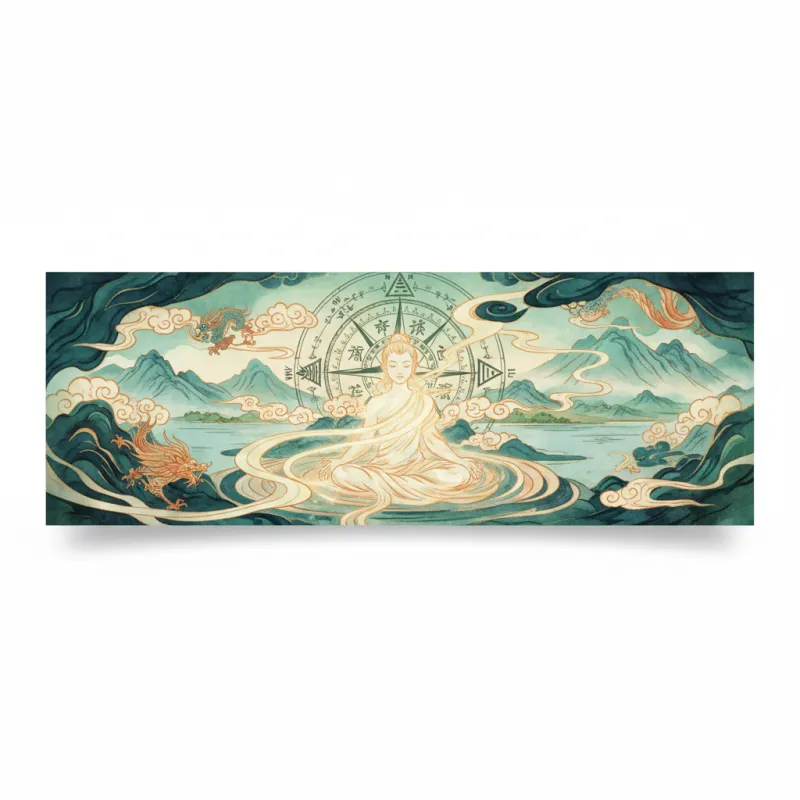
You're sitting at your desk right now, and I'd bet money your shoulders are slightly hunched, your breath is shallow, and you're pulling air into your upper chest like you're perpetually bracing for impact. The Daoists would take one look at you and shake their heads. Not because you're doing something wrong, exactly — but because you're breathing like someone who's forgotten they have a lower body.
For the past three thousand years, Chinese energy cultivation practices have been obsessed with a single anatomical region: the lower abdomen. Not the lungs. Not the chest. The belly. Specifically, a point about three finger-widths below your navel called the dantian (丹田 dāntián), which translates literally as "elixir field" or "cinnabar field." This isn't poetic language. In Daoist internal alchemy, this spot is where you're supposed to cook up your life force like a medieval chemist brewing the philosopher's stone.
The difference between chest breathing and dantian breathing isn't subtle. One keeps you alive. The other, according to Chinese metaphysics, keeps you vitally alive — energized, centered, and connected to the fundamental rhythms of the cosmos. Modern science has caught up enough to confirm that diaphragmatic breathing does, in fact, activate your parasympathetic nervous system, lower cortisol, and improve oxygen efficiency. But the Chinese traditions were never waiting for Western validation. They've been teaching this for longer than most civilizations have existed.
The Dantian: Your Body's Forgotten Power Center
The lower dantian isn't just an arbitrary point on your abdomen. In traditional Chinese medicine and Daoist practice, it's considered the root of your physical vitality, the storage battery for qi (气 qì), and the foundation of your energetic body. The Huangdi Neijing (黄帝内经 Huángdì Nèijīng), the foundational text of Chinese medicine written around 300 BCE, describes the lower abdomen as the "sea of qi" — the place where your body's energy naturally pools and accumulates.
Think of it this way: your lungs are the bellows, but the dantian is the furnace. Breathing into your chest moves air. Breathing into your dantian moves energy. The physical mechanism is straightforward — you're engaging your diaphragm fully, allowing your belly to expand as your lungs fill from the bottom up. But the energetic mechanism, according to Chinese theory, is more interesting: you're drawing qi down from the air, mixing it with the qi you've extracted from food, and storing the refined result in your body's central reservoir.
The location matters. The dantian sits at your center of gravity, the point around which martial artists learn to move. It's also positioned along the Ren Mai (任脉 Rén Mài), the Conception Vessel, one of the eight extraordinary meridians that govern your body's deepest energetic patterns. When you breathe into this area, you're not just filling your lungs — you're activating an entire network of energetic pathways that traditional Chinese medicine considers fundamental to health and longevity.
Abdominal Breathing: The Foundation Practice
The most basic Chinese breathing technique is also the most important: natural abdominal breathing, sometimes called Buddhist breathing or normal breathing (顺呼吸 shùn hūxī). This is the pattern you probably breathed as a baby before stress, posture, and modern life trained it out of you.
Here's how it works: when you inhale, your belly expands. When you exhale, your belly contracts. Your chest stays relatively still. Your shoulders don't rise. The movement is all in your lower abdomen, driven by your diaphragm descending and ascending like a piston.
Sit comfortably or lie down. Place one hand on your chest and one on your belly, just below your navel. Breathe in slowly through your nose, and watch which hand moves. If it's the chest hand, you're doing what most stressed modern humans do. If it's the belly hand, you're breathing the way the Daoists intended. The inhale should feel like you're filling a vessel from the bottom up — lower abdomen first, then mid-torso, then chest, though the emphasis stays low. The exhale reverses the process.
The rhythm matters less than the depth and location. Some traditions recommend counting — four counts in, four counts out, or six counts in, six counts out. But the real goal is to make the breath so natural and effortless that you forget you're doing it. This is "breathing without breathing," as some qigong texts describe it — the breath that happens when you stop trying to control it and simply allow your body to breathe the way it was designed to.
Practice this for ten minutes daily, and you'll notice something shift. Your baseline stress level drops. Your mind quiets. You feel more grounded, literally — like your consciousness has descended from your head into your body. This is the foundation for every other Chinese breathing technique. Master this, and the rest becomes possible.
Reverse Breathing: The Daoist Secret Weapon
Once you've mastered natural abdominal breathing, Daoist traditions introduce something that seems completely backwards: reverse breathing (逆呼吸 nì hūxī), also called Daoist breathing. Instead of expanding your belly on the inhale, you contract it. Instead of relaxing it on the exhale, you expand it. Everything runs in reverse.
This sounds insane until you understand what it's actually doing. Reverse breathing creates internal pressure that forces qi deeper into your body, particularly into the lower dantian and along the microcosmic orbit — the circular pathway that runs up your spine (Du Mai, 督脉 Dū Mài) and down your front (Ren Mai). It's a more active, more forceful method of energy cultivation, used extensively in internal martial arts like taijiquan (太极拳 tàijíquán) and xingyiquan (形意拳 xíngyìquán).
When you inhale with reverse breathing, you draw your belly in and up, creating a vacuum that pulls energy down into your lower body. Your perineum lifts slightly. Your spine lengthens. The sensation is one of gathering and compressing. When you exhale, you release your belly, allowing it to expand naturally as the compressed energy disperses through your body. Done correctly, it feels like you're pumping energy through your system with each breath cycle.
This isn't a beginner technique. Most qigong teachers won't introduce reverse breathing until you've spent months or years with natural abdominal breathing. The reason is simple: if you don't have a stable foundation, reverse breathing can create tension, force energy into places it shouldn't go, and generally make a mess of your internal landscape. But once you're ready, it's remarkably powerful. Martial artists use it to generate explosive force. Meditators use it to deepen their practice and accelerate energy circulation. It's the difference between letting qi flow naturally and actively directing it where you want it to go.
The Microcosmic Orbit: Breathing as Energy Circulation
The most sophisticated Chinese breathing practice isn't really about breathing at all — it's about using breath to circulate energy through specific pathways in your body. This is the microcosmic orbit (小周天 xiǎo zhōutiān), sometimes called the "small heavenly circuit," and it's the cornerstone of Daoist internal alchemy.
The orbit follows two meridians: the Du Mai up your spine and the Ren Mai down your front. Together, they form a complete circuit from your perineum up to the crown of your head and back down to your lower abdomen. The practice involves breathing energy through this loop, using your attention and breath to guide qi along the pathway.
Start seated with your spine straight. Focus on your lower dantian as you breathe naturally for a few minutes, allowing qi to accumulate. Then, on an inhale, imagine drawing energy from your dantian down to your perineum, then up your spine to the crown of your head. On the exhale, guide the energy down the front of your body, through your face, throat, chest, and abdomen, back to the dantian. One complete breath, one complete orbit.
The classical texts are specific about the route. The energy passes through key points: the huiyin (会阴 huìyīn) at the perineum, the mingmen (命门 mìngmén) at the lower back, the jiaji (夹脊 jiājǐ) between the shoulder blades, the yuzhen (玉枕 yùzhěn) at the base of the skull, the baihui (百会 bǎihuì) at the crown, the yintang (印堂 yìntáng) between the eyebrows, and back down through the throat and chest to the dantian. Each point is a gate that must be opened through practice.
This practice appears in texts like the Xingming Guizhi (性命圭旨 Xìngmìng Guīzhǐ), a Ming dynasty manual of internal alchemy, and the Taishang Laojun Neiguan Jing (太上老君内观经 Tàishàng Lǎojūn Nèiguān Jīng), an early Daoist meditation text. It's not metaphorical. Practitioners report distinct sensations — warmth, tingling, pressure — as energy moves through the circuit. Whether you interpret this as qi, bioelectricity, or focused attention doesn't particularly matter. The practice works regardless of your metaphysical commitments.
Six Healing Sounds: Breathing as Organ Therapy
Chinese medicine doesn't separate breath from the organs. Each organ system has its own energetic signature, and in qigong practice, each has its own healing sound — a specific vocalization that resonates with and regulates that organ's qi. These are the Six Healing Sounds (六字诀 liù zì jué), attributed to the physician Sun Simiao (孙思邈 Sūn Sīmiǎo) during the Tang dynasty, though the practice likely predates him.
The sounds are: xu (嘘 xū) for the liver, he (呵 hē) for the heart, hu (呼 hū) for the spleen, si (呬 sī) for the lungs, chui (吹 chuī) for the kidneys, and xi (嘻 xī) for the triple burner. Each sound is exhaled slowly while visualizing the corresponding organ releasing stagnant or excess energy. The pitch, duration, and mouth shape all matter — these aren't random syllables but carefully calibrated vibrations designed to affect specific organ systems.
Take the liver sound, xu. You exhale it with your mouth slightly open, teeth apart, making a "shhhh" sound while visualizing your liver releasing anger, frustration, and heat. The liver, in Chinese medicine, governs the smooth flow of qi throughout the body. When it's congested — from stress, poor diet, or suppressed emotions — you feel irritable, tense, and stuck. The xu sound is supposed to clear that congestion, allowing liver qi to flow freely again.
The practice is simple but specific. Sit or stand comfortably. Focus on the organ you're working with. Inhale naturally into your lower abdomen. As you exhale, make the corresponding sound softly, almost subvocally, while visualizing the organ releasing whatever it's holding. Repeat six to twelve times per organ, or focus on whichever organ needs attention. If you're anxious, work with the lungs (si). If you're exhausted, work with the kidneys (chui). If you're scattered and ungrounded, work with the spleen (hu).
This practice bridges breathing and Chinese medicine in a way that's both practical and strange. You're using sound vibration to affect internal organs, which sounds like pseudoscience until you try it and notice that yes, making these specific sounds while focusing on specific body parts does seem to shift something. Whether that's qi, fascia, nervous system activation, or placebo doesn't change the experiential result.
Embryonic Breathing: The Ultimate Goal
The most advanced breathing practice in Daoist tradition is also the most paradoxical: embryonic breathing (胎息 tāixī), the breath that isn't a breath. This is the breathing pattern of a fetus in the womb — no air moving through the nose or mouth, just energy circulating internally through the umbilical connection. Daoist practitioners aim to recreate this state through meditation, essentially breathing without breathing.
The theory is that when you achieve embryonic breathing, you've transcended the need for external air. Your body has learned to circulate and refine qi so efficiently that the normal respiratory process becomes secondary or even unnecessary. You're breathing through your pores, through your energy body, through some mechanism that doesn't require your lungs to pump air in and out.
This shows up in texts like the Embryonic Breathing Classic (胎息经 Tāixī Jīng), which describes the practice as returning to the primordial state before birth, when you were sustained entirely by your mother's qi. The goal isn't to stop breathing — that would be death — but to make the breath so subtle, so refined, that it becomes imperceptible. Some texts claim that masters of embryonic breathing can be buried alive for days and emerge unharmed, their bodies sustained by internal energy circulation alone.
Practically speaking, embryonic breathing develops from years of deep meditation and breath refinement. You start with natural abdominal breathing, progress to reverse breathing and the microcosmic orbit, and eventually the breath becomes so slow and subtle that it seems to stop. Your attention shifts from the physical breath to the energetic breath — the circulation of qi that continues regardless of whether air is moving through your lungs.
Most practitioners never reach this level. It's the Mount Everest of Chinese breathing practices, the thing that separates casual qigong students from serious internal alchemists. But even approaching it — even making your breath slow enough that it becomes barely perceptible — produces profound effects. Your mind becomes extraordinarily still. Your energy body feels more real than your physical body. You touch something that the Daoists call "returning to the root," the state of primordial unity before differentiation into subject and object, self and world.
Integrating Breathing with Daily Life
The real test of Chinese breathing techniques isn't what happens during formal practice — it's what happens when you're stuck in traffic, arguing with your partner, or facing a deadline. Can you drop into abdominal breathing when stress hits? Can you use the liver sound when anger rises? Can you circulate energy through the microcosmic orbit while sitting in a meeting?
This is where Chinese breathing practices diverge from Western relaxation techniques. They're not just tools for managing stress — they're methods for fundamentally restructuring how you inhabit your body and interact with the world. The goal isn't to breathe deeply for ten minutes and then return to shallow chest breathing for the rest of the day. The goal is to make dantian breathing your default, to rewire your nervous system so completely that you can't help but breathe from your center.
Start small. Notice when you're breathing into your chest and consciously shift to your belly. Use natural abdominal breathing during your commute, while cooking, while watching TV. Practice the Six Healing Sounds when specific emotions arise — xu for anger, si for grief, he for anxiety. Run the microcosmic orbit for a few minutes before bed. The practices are portable and invisible. No one needs to know you're circulating qi while standing in line at the grocery store.
The connection to feng shui principles is worth noting here. Just as feng shui arranges external space to optimize energy flow, Chinese breathing practices arrange your internal space for the same purpose. Your body is a landscape with its own mountains (spine), rivers (meridians), and fields (dantian). Breathing is how you cultivate that landscape, clearing blockages, nourishing depleted areas, and maintaining the smooth circulation that Chinese medicine considers the foundation of health.
Over time, the practices become automatic. Your breath drops into your belly without conscious effort. Energy circulates through the orbit spontaneously. You find yourself naturally making healing sounds when your organs need support. This is the real goal — not to master techniques but to embody them so completely that they disappear into your ordinary functioning. You're not doing Chinese breathing practices anymore. You're just breathing the way humans were always meant to breathe, before we forgot how.
Related Reading
- Designing Feng Shui Meditation Spaces
- Qigong for Beginners: Start Your Energy Practice
- Qi Gong and Feng Shui: Cultivating Energy Inside and Out
- Chinese Meditation: A Guide to Daoist and Buddhist Practices
- Exploring Feng Shui, I Ching, and Chinese Metaphysics in Bazi Practice
- Bedroom Feng Shui: Better Sleep Through Design
- Unlocking the Secrets of Feng Shui: Water Features in Chinese Metaphysics
Explore Chinese Culture
- Explore Daoist philosophy and practice
- Explore traditional Chinese customs
- Explore ancient Chinese cosmology