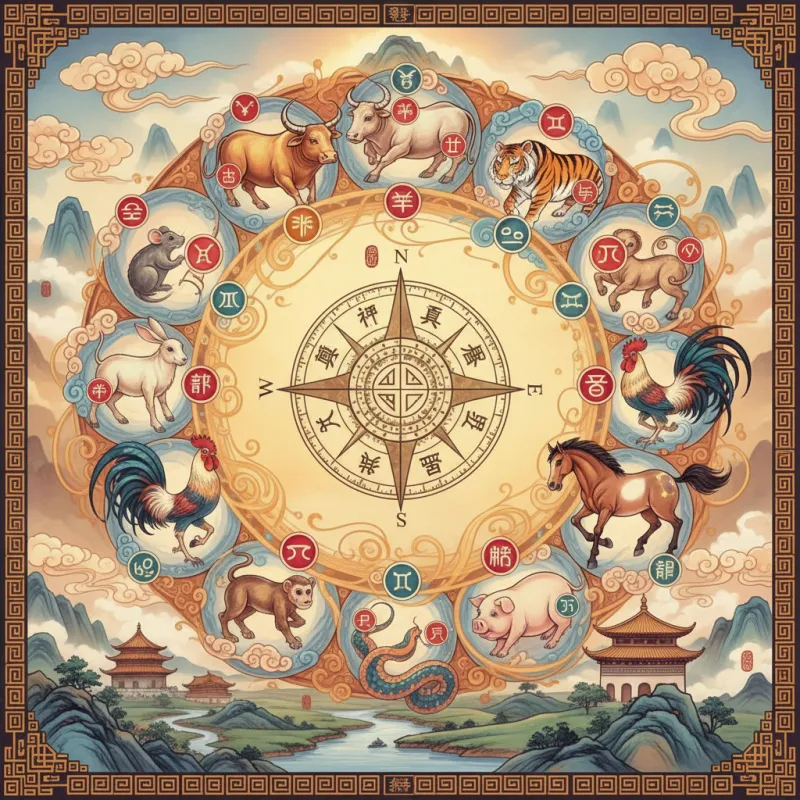
Every twelve years, China experiences a baby boom. Hospitals overflow, maternity wards expand capacity, and young couples time their pregnancies with military precision. The cause? Not government policy or economic incentive, but a single mythological creature: the Dragon. Meanwhile, in Goat years, birth rates plummet so dramatically that demographers can predict the dip years in advance. This is the tangible, measurable power of the twelve zodiac animals (生肖 shēngxiào) — a 2,000-year-old system that still dictates modern life decisions across East Asia.
The Chinese zodiac doesn't just assign personality traits. It functions as a complete cosmological framework that interweaves with the Five Elements, the sexagenary cycle, and the fundamental principles of yin and yang. Your birth year animal isn't merely a fun fact for restaurant placemats — it's a key that unlocks your elemental nature, your compatibility with others, and your position within the grand cycle of terrestrial qi (气 qì).
The Twelve Animals and Their Core Natures
The zodiac cycle follows a fixed sequence: Rat, Ox, Tiger, Rabbit, Dragon, Snake, Horse, Goat, Monkey, Rooster, Dog, and Pig. Each animal embodies specific characteristics that ancient observers noted in both the creatures themselves and the people born under their influence.
Rat (鼠 shǔ) — The first animal, representing cleverness and adaptability. Rats are resourceful survivors, quick-witted and opportunistic. In classical texts, the Rat's position at the cycle's beginning reflects the Daoist principle that wisdom lies in knowing when to act and when to wait. Rat years: 1924, 1936, 1948, 1960, 1972, 1984, 1996, 2008, 2020.
Ox (牛 niú) — Steady, reliable, methodical. The Ox represents agricultural civilization itself — the patient labor that built dynasties. Tang Dynasty records describe Ox-year people as those who "plow through obstacles without complaint." Ox years: 1925, 1937, 1949, 1961, 1973, 1985, 1997, 2009, 2021.
Tiger (虎 hǔ) — Courage bordering on recklessness. Tigers are natural leaders, charismatic and bold, but prone to impulsive decisions. The Shuowen Jiezi dictionary from 100 CE describes the tiger as "the king of beasts," and Tiger-year individuals often display this same commanding presence. Tiger years: 1926, 1938, 1950, 1962, 1974, 1986, 1998, 2010, 2022.
Rabbit (兔 tù) — Gentle, diplomatic, aesthetically refined. Rabbits avoid conflict through cleverness rather than confrontation. The Moon Rabbit legend, where a rabbit lives on the moon making elixirs, captures this sign's association with subtlety and hidden depths. Rabbit years: 1927, 1939, 1951, 1963, 1975, 1987, 1999, 2011, 2023.
Dragon (龙 lóng) — The only mythological creature in the zodiac, representing imperial power, ambition, and supernatural charisma. Dragons are visionaries who think in grand scales. Every Chinese parent wants a Dragon child — the birth rate spike in Dragon years is so pronounced that schools must expand capacity twelve years later. Dragon years: 1928, 1940, 1952, 1964, 1976, 1988, 2000, 2012, 2024.
Snake (蛇 shé) — Wisdom, intuition, and strategic thinking. Snakes are the philosophers of the zodiac, preferring to observe and calculate before striking. Ming Dynasty texts associate the Snake with the trigram Li (离 lí) from the I Ching, representing fire and clarity of vision. Snake years: 1929, 1941, 1953, 1965, 1977, 1989, 2001, 2013, 2025.
Horse (马 mǎ) — Freedom-loving, energetic, and independent. Horses cannot be caged — they require movement and space. The nomadic cultures of northern China revered the horse, and this zodiac sign carries that same restless spirit. Horse years: 1930, 1942, 1954, 1966, 1978, 1990, 2002, 2014, 2026.
Goat (羊 yáng) — Also called Sheep or Ram, this sign represents gentleness, creativity, and sensitivity. Goats are artists and dreamers, but their perceived weakness leads to the birth rate decline in Goat years — a superstition so strong that Singapore's government launched campaigns to counter it. Goat years: 1931, 1943, 1955, 1967, 1979, 1991, 2003, 2015, 2027.
Monkey (猴 hóu) — Clever, mischievous, and innovative. Monkeys are problem-solvers who approach life as a series of puzzles to crack. The Journey to the West character Sun Wukong (孙悟空 Sūn Wùkōng) perfectly embodies Monkey energy — brilliant, rebellious, and impossible to control. Monkey years: 1932, 1944, 1956, 1968, 1980, 1992, 2004, 2016, 2028.
Rooster (鸡 jī) — Punctual, organized, and outspoken. Roosters announce the dawn, and Rooster-year people similarly cannot help but speak their truth. They're natural administrators who notice every detail others miss. Rooster years: 1933, 1945, 1957, 1969, 1981, 1993, 2005, 2017, 2029.
Dog (狗 gǒu) — Loyal, honest, and protective. Dogs are the moral compass of the zodiac, driven by strong principles and unwavering devotion to those they love. Confucian texts praise the dog's righteousness (义 yì), making this a highly respected sign. Dog years: 1934, 1946, 1958, 1970, 1982, 1994, 2006, 2018, 2030.
Pig (猪 zhū) — Generous, optimistic, and pleasure-loving. Pigs enjoy life's comforts without guilt. They're the zodiac's epicureans, finding joy in good food, good company, and simple contentment. The cycle ends with the Pig's satisfied completion. Pig years: 1935, 1947, 1959, 1971, 1983, 1995, 2007, 2019, 2031.
The Elemental Layer: Sixty-Year Cycles
Here's where the system becomes sophisticated. Each animal doesn't just repeat every twelve years — it cycles through five elemental variations (Wood, Fire, Earth, Metal, Water) before returning to its original form. A Wood Rat differs fundamentally from a Fire Rat or a Water Rat.
This creates the sexagenary cycle (六十甲子 liùshí jiǎzǐ) — sixty unique year combinations before the pattern repeats. You're not just a Dragon; you're a Wood Dragon (1964, 2024) or an Earth Dragon (1988, 2048). The Five Elements modify the animal's base nature: Wood adds growth and flexibility, Fire adds passion and volatility, Earth adds stability and practicality, Metal adds strength and rigidity, Water adds adaptability and depth.
A Metal Ox (1961, 2021) is more stubborn and unyielding than a Water Ox (1973, 2033), who adapts more readily to changing circumstances. A Fire Tiger (1926, 1986) burns hotter and faster than an Earth Tiger (1938, 1998), who channels aggression into practical achievement. This elemental overlay transforms the zodiac from twelve categories into sixty distinct personality matrices.
Compatibility: The Hidden Mathematics
Traditional matchmakers (媒人 méirén) consulted zodiac compatibility before arranging marriages, and modern dating apps in China still feature zodiac filters. The compatibility system follows specific patterns based on the animals' positions in the cycle.
Triangle of Affinity — Four groups of three animals form natural alliances. Rat-Dragon-Monkey share ambition and cleverness. Ox-Snake-Rooster value patience and strategy. Tiger-Horse-Dog embody loyalty and courage. Rabbit-Goat-Pig appreciate beauty and harmony. These triangles represent people who understand each other instinctively.
Direct Opposition — Animals positioned six years apart clash: Rat opposes Horse, Ox opposes Goat, Tiger opposes Monkey, Rabbit opposes Rooster, Dragon opposes Dog, Snake opposes Pig. These pairings create friction — not necessarily bad, but requiring conscious effort to harmonize.
Secret Friends — Each animal has one secret ally: Rat-Ox, Tiger-Pig, Rabbit-Dog, Dragon-Rooster, Snake-Monkey, Horse-Goat. These pairings offer mutual support and understanding that others might not see.
The mathematics here aren't arbitrary. They reflect the underlying structure of the twelve Earthly Branches (地支 dìzhī) and their interactions within Chinese cosmology. A Rat-Horse opposition isn't just personality conflict — it represents the cosmic tension between north (Rat) and south (Horse), between midnight and noon, between the beginning of yin's ascent and yang's peak.
Yin, Yang, and the Alternating Current
The twelve animals alternate between yang (阳 yáng) and yin (阴 yīn) in strict sequence. Rat, Tiger, Dragon, Horse, Monkey, and Dog are yang — active, outward-focused, initiating. Ox, Rabbit, Snake, Goat, Rooster, and Pig are yin — receptive, inward-focused, completing.
This alternation mirrors the fundamental rhythm of the universe as described in the Yijing (易经 Yìjīng). Yang years produce people who push forward; yin years produce people who consolidate and refine. The pattern never breaks — yang always follows yin, yin always follows yang, creating the perpetual motion that drives the cycle forward.
Notice that the Dragon, despite being the most yang of all creatures in Chinese mythology, falls in a yang year position. The Rabbit, associated with the yin moon, occupies a yin position. The system's internal logic holds at every level.
The Origin Myth and Historical Reality
The popular story claims the Jade Emperor (玉皇大帝 Yùhuáng Dàdì) held a race to determine the zodiac order. The clever Rat rode the Ox's back and jumped ahead at the finish line, securing first place. The Cat, tricked by the Rat into missing the race entirely, became the Rat's eternal enemy — explaining why cats chase rats.
It's a charming tale, but the historical reality is more complex. The twelve Earthly Branches existed before the animals were assigned to them. Oracle bone inscriptions from the Shang Dynasty (1600-1046 BCE) show the branch system already in use for calendrical purposes. The animal associations likely developed during the Han Dynasty (206 BCE - 220 CE), when the system crystallized into its current form.
Wang Chong's (王充 Wáng Chōng) Lunheng (论衡 Lùnhéng), written around 80 CE, contains one of the earliest complete descriptions of the zodiac animals matched to the Earthly Branches. By the Tang Dynasty (618-907 CE), the system had spread throughout East Asia, with Korea, Japan, and Vietnam adopting it with minor variations.
Living With Your Animal
The zodiac isn't deterministic — it's descriptive. Your birth year animal provides a framework for understanding your natural tendencies, not a prison that defines your fate. A Goat can develop courage; a Tiger can learn patience. The system offers self-knowledge, not limitation.
Chinese tradition holds that your zodiac year (本命年 běnmìngnián) — when the cycle returns to your birth animal — brings challenges and instability. People wear red underwear and red accessories during their zodiac year to ward off bad luck, a practice so widespread that red underwear sales spike predictably every twelve years for each animal.
But here's the deeper truth: your zodiac year represents a return to origin, a completion of one cycle and the beginning of another. It's not inherently unlucky — it's transformative. The discomfort comes from growth, from the universe asking you to level up and embody your animal's highest potential.
The twelve animals aren't just a quaint cultural artifact. They're a living system that continues to shape how millions of people understand themselves and each other. When a Chinese grandmother asks your birth year within minutes of meeting you, she's not making small talk — she's gathering essential data about who you are and how you'll interact with her family. The zodiac remains, after two millennia, a practical tool for navigating human relationships and understanding the rhythms of time itself.
Related Reading
- The Chinese Zodiac: What Your Animal Sign Actually Means
- Chinese Zodiac: The Twelve Animals Are Not What You Think
- The Chinese Zodiac: Complete Guide to All 12 Animal Signs
- The Dragon Year Baby Boom: Why Chinese Parents Plan Pregnancies Around the Zodiac
- Chinese Zodiac Compatibility: Who Gets Along and Who Doesn't
- Discovering the Colors of Feng Shui and I Ching: Their Power and Symbolism
- Creating Bedroom Harmony Using Feng Shui, I Ching, and Chinese Metaphysics
- Qi Gong and Feng Shui: Cultivating Energy Inside and Out
Explore Chinese Culture
- Explore Daoist philosophy and practice
- Explore traditional Chinese customs
- Explore ancient Chinese cosmology