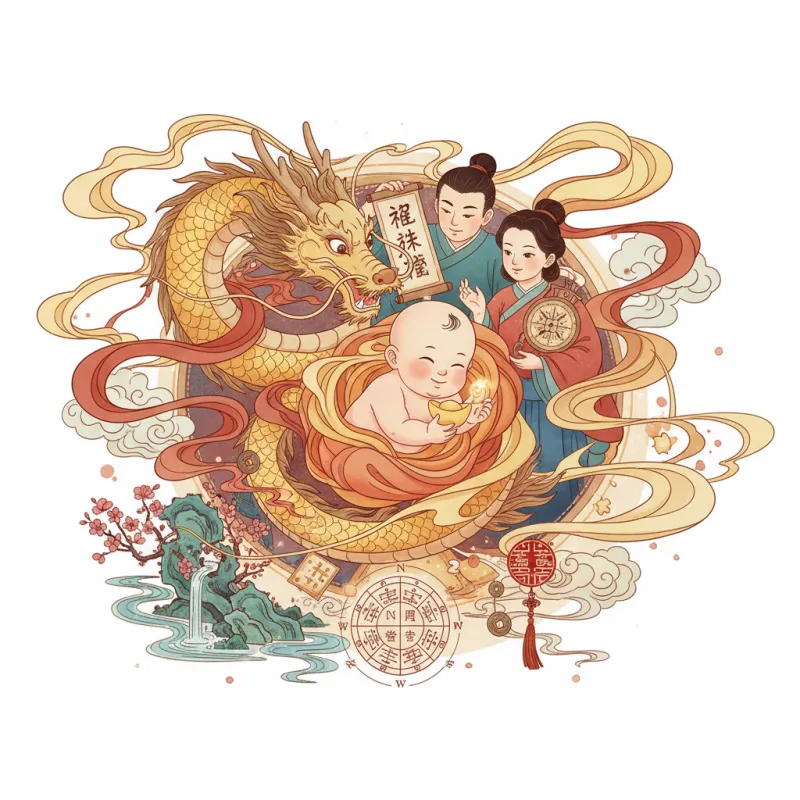
Every twelve years, maternity wards across Asia brace for impact. Hospital beds fill months in advance. Obstetricians cancel vacations. And expectant parents who missed their conception window by a few weeks face a choice: induce early, or resign their child to life as a Snake instead of a Dragon.
This isn't medical drama—it's demographic reality. The Dragon year baby boom is one of the most predictable population phenomena in the world, affecting birth rates from Beijing to San Francisco's Chinatown, from Singapore to Vancouver. In 2012, the last Year of the Dragon, births in China increased by nearly 5% despite the one-child policy still being in effect. Hong Kong saw a 13% spike. Taiwan's hospitals reported turning away expectant mothers because delivery rooms were fully booked nine months in advance.
The cause? A mythological creature that hasn't existed for thousands of years—if it ever existed at all.
Why the Dragon Reigns Supreme
In the Chinese zodiac cycle of twelve animals, the Dragon (龙 lóng) stands alone. It's the only creature that doesn't walk, swim, or fly in the natural world. While the Rat, Ox, Tiger, Rabbit, Snake, Horse, Goat, Monkey, Rooster, Dog, and Pig are all flesh-and-blood animals you could theoretically encounter, the Dragon exists purely in the realm of symbol and myth.
And what a symbol it is.
For over two millennia, the Dragon has represented imperial power in China. Emperors wore robes embroidered with dragons. The imperial throne was called the Dragon Throne (龙椅 lóng yǐ). The emperor's face was the Dragon Face (龙颜 lóng yán). To be born in a Dragon year, according to traditional belief, is to carry a trace of that celestial authority—to be destined for leadership, success, and extraordinary fortune.
This isn't just folk superstition. The association runs deep through Chinese philosophy and metaphysics. In Five Elements theory, the Dragon is linked with the element of Earth in its most yang, dynamic form—the kind of earth that builds mountains and empires. In the I Ching, the Dragon appears in the first hexagram, Qian (乾), representing pure creative force and heaven itself. The commentary describes six stages of the Dragon's journey, from "hidden dragon" to "dragon in flight," mapping the path of the superior person from obscurity to achievement.
Compare this to the Snake, which follows immediately after the Dragon in the zodiac cycle. The Snake (蛇 shé) is considered wise, intuitive, and elegant—but also cold, calculating, and potentially treacherous. Parents who miss the Dragon year by a few months often express genuine distress at having a Snake child instead. The difference in cultural perception is stark.
The Numbers Don't Lie
The demographic impact is measurable and consistent. Research by economists Naci Mocan and Han Yu analyzed birth data across multiple Dragon years and found that Chinese families in the United States were 12% more likely to have a child in Dragon years compared to other zodiac years. In China itself, the effect is even more pronounced.
The 2000 Dragon year—specifically the Golden Dragon, which occurs once every sixty years when the Dragon combines with the Metal element—saw extraordinary planning. Fertility clinics reported couples timing intercourse with precision, tracking ovulation to the hour. Some women underwent fertility treatments specifically to ensure a Dragon birth. Cesarean sections were scheduled en masse for auspicious dates within the Dragon year.
The consequences ripple forward for decades. Dragon year children face more competition at every stage: more applicants per kindergarten spot, more students per classroom, more candidates per university admission slot, more job seekers per entry-level position. A 2015 study by economists found that Dragon year babies in China actually have slightly worse educational outcomes on average—not because of any inherent disadvantage, but simply because they're competing in a more crowded cohort.
Yet parents continue to plan for Dragon births. The perceived advantage of the zodiac sign apparently outweighs the statistical disadvantage of increased competition.
The Mechanics of Zodiac Planning
How exactly do families engineer a Dragon year baby? The logistics are more complex than they might appear.
The Chinese zodiac doesn't follow the Gregorian calendar. Instead, it's tied to the lunar calendar, with each year beginning on the second new moon after the winter solstice—what we call Chinese New Year. This date shifts annually, falling somewhere between late January and mid-February. A child born on February 3, 2024 would be a Dragon, but a child born on February 10, 2024 would be a Snake, because Chinese New Year fell on February 10 that year.
This creates a narrow conception window. To deliver a baby safely within the Dragon year, conception typically needs to occur in the late spring or early summer of the preceding year. Miss that window, and you're either having a Rabbit (the year before Dragon) or gambling on a very early delivery.
Some families take extraordinary measures. In Taiwan during the 2012 Dragon year, hospitals reported a surge in requests for elective cesarean sections scheduled for the final days before Chinese New Year ended. Doctors faced ethical dilemmas: should they perform medically unnecessary procedures to satisfy cultural preferences? Some refused. Others accommodated, reasoning that the psychological benefit to the family outweighed the minimal medical risk.
The pressure intensifies for families consulting bazi fortune-telling, which analyzes the four pillars of destiny based on birth year, month, day, and hour. A skilled bazi practitioner might identify not just a favorable year, but a favorable month, day, and even hour for birth. This leads to even more specific scheduling requests—parents asking for cesarean sections at 2 AM because that's the Hour of the Tiger, which supposedly balances their Dragon child's chart.
The Snake Year Slump
The flip side of the Dragon boom is the Snake slump. Birth rates consistently drop in Snake years, as families who wanted children delay pregnancy to avoid the Snake sign.
The Snake's reputation in Chinese culture is complicated. In some contexts, it's associated with wisdom, beauty, and spiritual insight. The White Snake (白蛇 bái shé) from the classic tale "Legend of the White Snake" is a sympathetic protagonist who pursues love despite heavenly prohibition. But in everyday perception, the Snake carries negative connotations: cold-blooded, untrustworthy, potentially dangerous.
This creates a peculiar demographic valley. In 2013, the year following the 2012 Dragon boom, births in China dropped by 3.7%. Kindergartens that had been bursting at the seams suddenly had empty spots. The pattern repeated in 2001, 1989, and every Snake year before.
Some families who conceive Snake children accidentally express genuine grief. Online forums for Chinese parents contain threads where mothers discuss their disappointment at missing the Dragon year, their worries about their Snake child's future prospects, and their strategies for "compensating" through careful name selection or feng shui adjustments to the child's bedroom.
Is this fair to Snake children? Obviously not. But the belief persists across generations and geography, affecting family planning decisions from Shanghai to Sydney.
Beyond China: The Global Dragon Effect
The Dragon year baby boom isn't confined to mainland China. Anywhere with a significant Chinese diaspora population, the pattern emerges.
In Singapore, where ethnic Chinese comprise about 75% of the population, the 2012 Dragon year saw births increase by 11%. The government, which typically worries about Singapore's low birth rate, welcomed the spike—but also warned parents about the coming competition for school places.
In Vancouver, British Columbia, where Chinese immigrants make up a substantial portion of the population, maternity wards reported similar surges. Real estate agents noted increased demand for family-sized homes in neighborhoods with good schools, as Dragon year parents planned ahead for their children's education.
Even in the United States, where Chinese Americans are a small minority, the effect is measurable. The Mocan and Yu study found that Chinese American families showed the same Dragon year preference, despite being generations removed from China and fully integrated into American society. Cultural beliefs about the zodiac persist even when other aspects of Chinese culture fade.
This suggests something deeper than mere superstition. The zodiac functions as a form of cultural identity, a way of maintaining connection to Chinese heritage even in diaspora. Choosing to have a Dragon child becomes an act of cultural participation, a way of saying: we still value these traditions, we still believe in these symbols.
The Rationality of Irrational Beliefs
From a Western scientific perspective, the idea that birth year determines destiny seems obviously false. There's no mechanism by which the zodiac could influence personality or fate. The Dragon is a mythological creature. The whole system appears to be pure superstition.
Yet the behavior it generates is entirely rational.
If enough people believe Dragon children will be more successful, then Dragon children receive more investment, more encouragement, more opportunities. Parents who deliberately plan for a Dragon birth are likely to be more invested in that child's success—they've already demonstrated commitment by timing the pregnancy. Teachers and relatives who believe in the zodiac may unconsciously favor Dragon children with higher expectations and more attention.
This creates a self-fulfilling prophecy. Dragon children may indeed achieve more, not because of any mystical influence, but because of the social and psychological advantages that come from being labeled as special from birth.
Economists call this a "coordination game." If everyone believes Dragons are lucky, then it becomes advantageous to have a Dragon child, regardless of whether the underlying belief is true. The belief itself creates the reality.
This is similar to how feng shui operates in real estate markets. If enough buyers believe certain house orientations are unlucky, then houses with those orientations become harder to sell and lose value—making the belief economically rational even for people who don't personally believe in feng shui.
The 2024 Dragon: What's Different This Time
The current Dragon year, which began on February 10, 2024, presents a unique situation. It's the Year of the Wood Dragon (木龙 mù lóng), which occurs once every sixty years in the full zodiac cycle that combines the twelve animals with the five elements.
Wood Dragon children are believed to carry special qualities: creativity, growth, flexibility, and humanitarian instincts. The Wood element softens the Dragon's sometimes aggressive yang energy, creating a more balanced personality. In Five Elements theory, Wood represents spring, growth, and new beginnings—auspicious qualities for a child.
But this Dragon year is also occurring in a very different demographic context. China's birth rate has plummeted to historic lows, driven by economic uncertainty, high costs of child-rearing, and changing attitudes toward parenthood among younger generations. The one-child policy may be gone, but its effects linger in the form of a generation that grew up as only children and now hesitates to have even one child of their own.
Will the Dragon year be enough to reverse this trend? Early data from the first half of 2024 suggests a modest uptick in births, but nothing like the dramatic spikes of previous Dragon years. The cultural pull of the zodiac may be weakening, or perhaps economic factors have simply become too overwhelming.
There's also growing pushback against zodiac-based family planning, particularly among educated urban Chinese. Online discussions criticize the practice as outdated, unfair to children born in "unlucky" years, and potentially harmful in creating overcrowded cohorts. Some argue that believing in zodiac destiny contradicts modern values of individual agency and merit-based success.
Yet the tradition persists. Maternity wards are still busier than usual. Parents are still consulting bazi practitioners to find auspicious birth dates. The Dragon's power over the Chinese imagination remains strong, even as other traditional beliefs fade.
What This Reveals About Culture and Choice
The Dragon year baby boom is ultimately a story about how cultural beliefs shape individual decisions, which in turn reshape demographics, which then reshape society. It's a feedback loop where myth becomes reality through collective action.
It also reveals something about the nature of tradition in modern life. We like to think we make decisions rationally, based on evidence and logic. But we're all embedded in cultural systems that provide meaning, identity, and social connection. Choosing to have a Dragon child isn't just about believing in zodiac destiny—it's about participating in a tradition that connects you to ancestors, community, and a sense of cosmic order.
Is it superstition? Yes. Is it rational? Also yes. The two aren't mutually exclusive.
As we move further into the 21st century, it will be fascinating to watch whether the Dragon year effect persists, weakens, or transforms. Will the 2036 Dragon year see another boom? Will Snake children continue to face stigma? Or will younger generations finally break free from the zodiac's demographic grip?
For now, the Dragon still reigns. And somewhere right now, a couple is carefully calculating ovulation cycles, hoping to catch the tail end of the Wood Dragon year before the Snake slithers in.
Related Reading
- The Chinese Zodiac: What Your Animal Sign Actually Means
- The Twelve Chinese Zodiac Animals: Complete Guide
- Chinese Zodiac: The Twelve Animals Are Not What You Think
- Chinese Zodiac Compatibility: Who Gets Along and Who Doesn't
- The Chinese Zodiac: Complete Guide to All 12 Animal Signs
- Exploring Feng Shui, I Ching, and Chinese Metaphysics in Modern Homes
- Harmonizing Life Through Feng Shui, I Ching, and Geomancy: A Cultural Exploration
- Feng Shui Colors: What Every Color Means and Where to Use It
Explore Chinese Culture
- Explore Daoist philosophy and practice
- Explore traditional Chinese customs
- Explore ancient Chinese cosmology