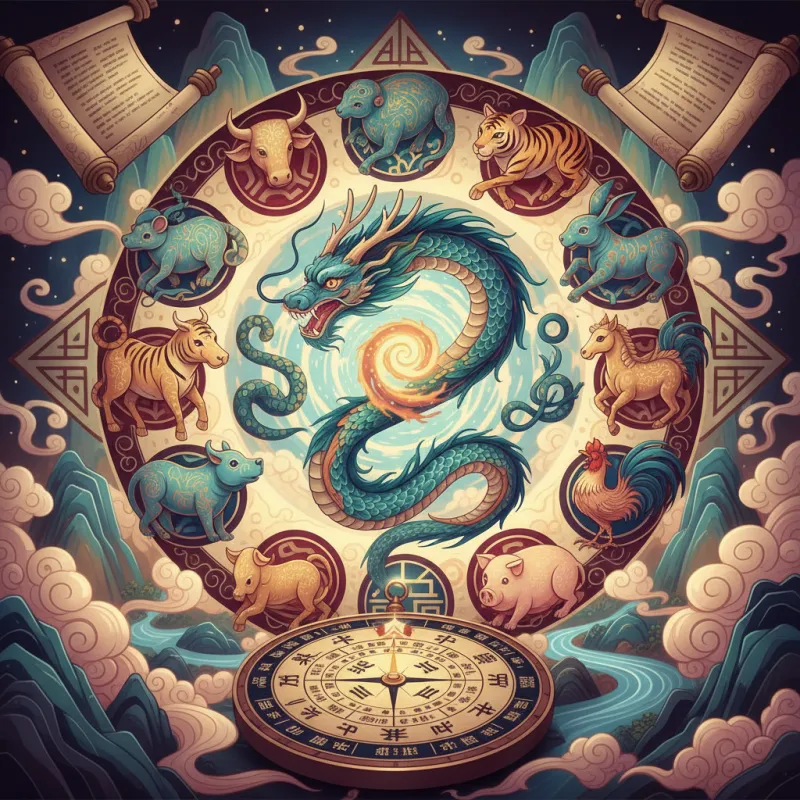
You check your birth year, find your animal, read a paragraph about being "clever and resourceful" or "loyal and honest," and think you understand the Chinese zodiac. You don't. What most people call the Chinese zodiac is actually one-quarter of a system so intricate that imperial advisors spent lifetimes mastering it.
The Four Pillars You're Ignoring
The twelve animals everyone knows—Rat (鼠 shǔ), Ox (牛 niú), Tiger (虎 hǔ), Rabbit (兔 tù), Dragon (龙 lóng), Snake (蛇 shé), Horse (马 mǎ), Goat (羊 yáng), Monkey (猴 hóu), Rooster (鸡 jī), Dog (狗 gǒu), Pig (猪 zhū)—represent only your year pillar. But in bazi (八字), the system of "eight characters" that forms the foundation of Chinese astrology, you have four pillars: year, month, day, and hour. Each pillar has an animal and an element.
Your year animal is the most public-facing aspect of your chart, the one you share with everyone born in your year. It represents your relationship with society, your outer persona, how strangers perceive you. But your month pillar governs your career and adult relationships. Your day pillar—considered the most important—represents your core self and your marriage dynamics. Your hour pillar reveals your legacy, your children, your final years.
Someone born in 1988 is an Earth Dragon by year, but might be a Water Rabbit by month, a Metal Rooster by day, and a Fire Pig by hour. These four animals interact, support, or clash with each other according to the principles of five element theory. The Dragon and Rabbit might clash (earth controls water), while the Rooster and Dragon form a harmonious relationship. This internal ecosystem of animals and elements creates a chart far more nuanced than "you're a Dragon, so you're ambitious."
What the Animals Actually Represent
The twelve animals aren't arbitrary. They map onto the twelve earthly branches (地支 dìzhī), a calendrical system that predates the animals themselves by centuries. The animals were added later, possibly during the Han Dynasty (206 BCE–220 CE), as a mnemonic device to help common people remember the branches.
Each animal corresponds to a two-hour period, a month, a direction, and a season. The Rat governs 11 PM to 1 AM, the darkest hours when yang energy begins its return. It's associated with the north, with winter's beginning, with water. This isn't poetic metaphor—it's cosmological mapping. The Rat's supposed cleverness and adaptability aren't personality traits pulled from observing rodents; they're qualities associated with water element and the midnight hours when survival requires cunning.
The Dragon, conversely, rules 7 AM to 9 AM, the hours when morning mist rises and yang energy surges. It's associated with the east-southeast, with late spring (the third lunar month), with earth element. Dragons in Chinese cosmology aren't the fire-breathing monsters of European fairy tales—they're water deities who bring rain and govern transformation. A Dragon year person isn't "powerful and charismatic" because dragons are impressive; they embody the qualities of ascending yang energy and spring's transformative power.
The Compatibility Myth
You've seen the charts: Rats get along with Dragons and Monkeys but clash with Horses. Roosters harmonize with Oxen and Snakes but fight with Rabbits. These compatibility matrices, plastered across Chinese restaurant placemats and fortune-telling websites, reduce a sophisticated system to playground matchmaking.
The actual compatibility analysis in Chinese zodiac relationships examines how the elements and animals in all eight positions of two people's charts interact. A Rat-Horse couple might struggle if those are their year animals, but if one person's day pillar Horse supports the other person's month pillar element, the relationship could thrive. I've seen marriages between "incompatible" signs last fifty years because their day pillars formed a harmonious combination, and I've seen "perfect matches" divorce within months because their hour pillars created a destructive cycle.
The six combinations (六合 liùhé), six clashes (六冲 liùchōng), and three harmonies (三合 sānhé) are real principles, but they operate across all four pillars, not just the year. A Rat and Horse clash, yes—but this clash can manifest as creative tension rather than destructive conflict, depending on the surrounding elements and the individuals' awareness.
The Element That Changes Everything
Each animal has an intrinsic element, but each year also cycles through the five elements (五行 wǔxíng): Wood, Fire, Earth, Metal, Water. A Dragon year might be Wood Dragon (1964, 2024), Fire Dragon (1976), Earth Dragon (1988), Metal Dragon (2000), or Water Dragon (2012). These aren't minor variations—they're fundamentally different expressions.
The 1976 Fire Dragon combines fire element with the Dragon's earth element, creating a person whose earth is energized by fire—think volcanic soil, fertile and intense. The 2000 Metal Dragon combines metal with earth, creating someone whose earth element is structured and refined—think precious metals mined from mountains. Same animal, radically different manifestation.
This sixty-year cycle (twelve animals times five elements) is called the sexagenary cycle (六十甲子 liùshí jiǎzǐ), and it's the actual framework of Chinese astrology. When someone says "I'm a Dragon," the response should be "which Dragon?" The difference between a Water Dragon and a Fire Dragon is greater than the difference between a Dragon and a Snake.
Why Your Animal Isn't Your Destiny
The most important thing to understand about the Chinese zodiac is that it's descriptive, not prescriptive. Your four pillars describe the energetic conditions at your birth—the cosmic weather, if you will. They indicate tendencies, potential challenges, natural strengths. They don't determine your choices.
Classical texts like the Yuanhai Ziping (渊海子平), written during the Song Dynasty, emphasize that heaven provides the mandate (天命 tiānmìng) but humans create their fortune (人运 rényùn). A chart heavy in water element might indicate someone prone to overthinking and emotional turbulence, but that same person can cultivate fire element through their choices—their career, their home's feng shui, their daily practices—to create balance.
The zodiac animals are tools for self-understanding, not excuses for behavior. "I'm a Tiger, so I'm aggressive" is fortune-cookie thinking. "I have Tiger energy in my year pillar, which means I need to be conscious of how my assertiveness affects others, and I should cultivate the patience of my Ox month pillar" is working with the system as intended.
The Animal Hiding in Your Day
Most people never learn their day pillar animal, which is a shame because it's considered the seat of the self. Your day pillar's heavenly stem and earthly branch together form your day master (日主 rìzhǔ), the reference point for analyzing your entire chart.
Calculating your day pillar requires knowing your exact birth date and consulting a ten-thousand-year calendar (万年历 wànnián lì), because the day pillar doesn't reset at midnight or with the lunar month—it follows the continuous sixty-day cycle that has run unbroken for millennia. This is why serious bazi analysis requires precision. Your day animal might be completely different from your year animal, and it's your day animal that governs your marriage palace, your core identity, your fundamental nature.
I've met Year of the Rat people who are actually Day of the Horse people, and suddenly their restlessness and need for freedom makes sense. I've met Year of the Ox people who are Day of the Monkey people, and their unexpected creativity and changeability stops being a contradiction.
Beyond Personality Traits
The real power of understanding your animal signs isn't reading descriptions of personality traits—it's understanding the elemental dynamics at play in your life. Each animal carries not just an element but a phase of that element. The Rat is yang water (flowing, active), while the Pig is yin water (still, deep). The Tiger is yang wood (growing, expanding), while the Rabbit is yin wood (flexible, rooted).
These distinctions matter when you're trying to understand why two people with the same year animal behave so differently, or why certain years feel harmonious while others feel like swimming upstream. A Wood Rat person entering a Metal year faces the challenge of metal cutting wood—not a disaster, but a year requiring extra effort. A Fire Horse person entering a Water year might feel dampened and frustrated, their natural enthusiasm meeting resistance.
The animals aren't fortune-telling devices. They're a language for describing the constant flux of yin and yang, the eternal dance of the five elements, the way cosmic patterns manifest in individual lives. Learn your four animals, understand their elements, observe how they interact with the animals and elements of each passing year, and you'll have a framework for self-awareness that goes far deeper than "Rats are clever."
Your animal sign isn't what you are. It's the energetic signature of when you arrived, the cosmic weather report of your birth moment, written in a symbolic language that has described the patterns of change for thousands of years. The question isn't what your animal means—it's what you'll do with that information.
Related Reading
- Chinese Zodiac Compatibility: Who Gets Along and Who Doesn't
- Chinese Zodiac: The Twelve Animals Are Not What You Think
- The Chinese Zodiac: Complete Guide to All 12 Animal Signs
- The Dragon Year Baby Boom: Why Chinese Parents Plan Pregnancies Around the Zodiac
- The Twelve Chinese Zodiac Animals: Complete Guide
- Unlocking Office Harmony: The Role of Feng Shui and I Ching in Modern Workspaces
- Feng Shui and TCM Connection
- What Is the I Ching? A Complete Guide to the Book of Changes
Explore Chinese Culture
- Explore Daoist philosophy and practice
- Explore traditional Chinese customs
- Explore ancient Chinese cosmology