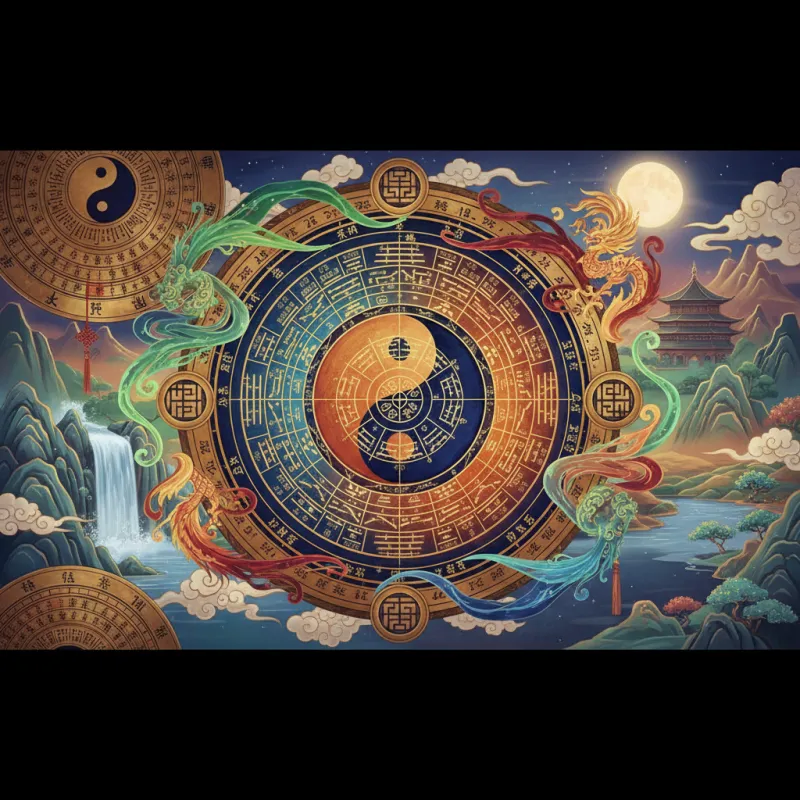
Disclaimer: The I Ching is a philosophical and cultural text. Its use in divination is a cultural practice, not a scientifically validated method.
You're standing at a crossroads. Should you take the job offer? End the relationship? Move to another city? Most of us reach for advice from friends, therapists, or endless Google searches. But for three millennia, Chinese scholars, emperors, and peasants alike have consulted a book that doesn't give answers — it gives patterns. The I Ching (易经, Yì Jīng), or Book of Changes, isn't interested in telling you what to do. Instead, it shows you where you are in the eternal dance of transformation that governs everything from weather patterns to human relationships.
A Book Older Than Philosophy Itself
The I Ching predates Confucius. Let that sink in. While the exact dating remains debated, most scholars place its origins in the Western Zhou Dynasty (1046-771 BCE), with roots stretching back even further to the Shang Dynasty's oracle bone divinations. By the time Confucius (551-479 BCE) encountered it, the text was already ancient — and he reportedly studied it so intensely that he wore out the leather bindings three times.
This isn't just a Chinese curiosity. The I Ching influenced virtually every major school of Chinese thought: Confucianism, Daoism, and even Chinese Buddhism absorbed its concepts. The Five Elements theory and feng shui principles both draw from the I Ching's fundamental understanding of change and balance. When Leibniz encountered the I Ching in the 17th century, he recognized his own binary system in its structure. Carl Jung wrote the foreword to the Wilhelm-Baynes translation in 1949, calling it a method for exploring the unconscious through "synchronicity."
The Architecture of Change: 64 Hexagrams
At its core, the I Ching operates through 64 hexagrams (卦, guà) — six-line figures stacked vertically. Each line is either yang (阳, yáng) — solid and unbroken (——) — or yin (阴, yīn) — broken in the middle (— —). These aren't just abstract symbols. Yang represents the active, bright, hard, masculine principle. Yin embodies the receptive, dark, soft, feminine principle. But here's what Western readers often miss: yin isn't "bad" and yang isn't "good." They're complementary forces in constant flux.
Each hexagram consists of two trigrams (三爻, sān yáo) — three-line figures representing fundamental natural forces. There are eight trigrams total: Heaven (乾, Qián), Earth (坤, Kūn), Thunder (震, Zhèn), Water (坎, Kǎn), Mountain (艮, Gèn), Wind (巽, Xùn), Fire (离, Lí), and Lake (兑, Duì). When you stack two trigrams, you get a hexagram. Heaven over Earth creates hexagram 11, Peace (泰, Tài). Earth over Heaven creates hexagram 12, Standstill (否, Pǐ). Same elements, different arrangement, opposite meanings.
The genius lies in the mathematics. With two trigrams of eight possibilities each, you get 8 × 8 = 64 combinations. These 64 hexagrams map every possible situation in human experience. Hexagram 1, The Creative (乾, Qián), represents pure yang energy — six solid lines, the dragon ascending. Hexagram 2, The Receptive (坤, Kūn), shows six broken lines — pure yin, the mare's endurance. Between these poles, the other 62 hexagrams describe every shade of transformation.
How Divination Actually Works
Forget the fortune-teller stereotype. Traditional I Ching consultation is methodical, almost mathematical. The classical method uses 50 yarrow stalks (actually 49, since one is set aside). Through a complex sorting process taking 10-15 minutes, you generate numbers that determine whether each line is yin or yang, and whether it's "changing" or "stable."
Changing lines are crucial. They indicate transformation in progress — a yin line becoming yang, or vice versa. If you get changing lines, you read two hexagrams: your present situation and the future situation after the changes occur. This isn't prophecy; it's pattern recognition. The I Ching suggests that if current trends continue, this is where you're headed.
Most modern practitioners use three coins instead — faster, but some argue less meditative. Heads might equal 3, tails equal 2. Toss three coins six times, add up the numbers, and odd totals give you yang lines while even totals give yin. A total of 6 or 9 indicates a changing line. The hexagram interpretation then guides your understanding of the situation.
The Text: Poetry, Not Instructions
Here's what surprises first-time readers: the I Ching doesn't speak plainly. Each hexagram comes with a judgment (卦辞, guà cí) and line texts (爻辞, yáo cí) written in archaic, poetic Chinese. Hexagram 3, Difficulty at the Beginning (屯, Zhūn), includes the line: "Horses and carts part. If there are bandits, do not marry." What?
These cryptic statements are intentional. They're not meant to be decoded literally but contemplated. The image of horses and carts parting suggests separation, difficulty in moving forward. Bandits represent danger. The marriage warning? Don't commit to something when the foundation is unstable. The text forces you to think symbolically, to find the pattern that fits your situation.
The Ten Wings (十翼, Shí Yì) — commentaries traditionally attributed to Confucius — add layers of interpretation. The Image (象传, Xiàng Zhuàn) describes the natural symbolism: "Thunder and rain arouse; the superior man renews himself." The Commentary on the Decision (彖传, Tuàn Zhuàn) explains the hexagram's structure and meaning. These commentaries transformed the I Ching from a divination manual into a philosophical text.
Beyond Fortune-Telling: The Philosophy of Change
The I Ching's deepest insight isn't about predicting the future — it's about understanding that change is the only constant. The Chinese title, Yì Jīng, literally means "Classic of Changes." Everything transforms. Summer becomes autumn. Youth becomes age. Success breeds complacency, which invites failure. Failure teaches lessons that enable success.
This isn't pessimism or optimism; it's realism. Hexagram 11, Peace, warns that when things are going well, decline is already germinating. Hexagram 12, Standstill, promises that stagnation contains the seeds of renewal. The wise person doesn't cling to good fortune or despair in bad times. They recognize the phase, act appropriately, and prepare for the next turn of the wheel.
This philosophy deeply influenced Chinese metaphysics and bazi (八字, bā zì), the Four Pillars of Destiny system. Both systems recognize that timing matters. There are moments to advance and moments to retreat, times to speak and times to remain silent. The I Ching teaches you to read these moments.
Why It Still Matters
In 2024, the I Ching remains relevant because uncertainty hasn't gone anywhere. We face the same fundamental questions humans always have: Should I act or wait? Is this relationship worth fighting for? Am I on the right path? Modern psychology might call it "decision fatigue" or "analysis paralysis," but the I Ching offers something different from therapy or self-help books.
It offers a mirror. When you consult the I Ching, you're not asking a supernatural entity for answers. You're engaging in structured reflection. The random process (coins or yarrow stalks) breaks you out of your mental loops. The cryptic text forces you to think metaphorically. The result? You often discover you already knew the answer — you just needed permission to see it.
The I Ching doesn't tell you what to do. It shows you where you are, suggests where current patterns lead, and reminds you that nothing — good or bad — lasts forever. In a world obsessed with control and certainty, that might be the most valuable wisdom of all.
Related Reading
- The 64 Hexagrams: A Complete Overview
- How to Consult the I Ching: A Beginner's Guide
- Unlocking the Mysteries of Feng Shui and the I Ching: A Journey into Chinese Metaphysics
- The I Ching: The World's Oldest Book of Wisdom (And How to Actually Use It)
- Using the I Ching for Decision Making
- Exploring Feng Shui, I Ching, and Chinese Metaphysics in Modern Homes
- Harmonizing Life Through Feng Shui, I Ching, and Geomancy: A Cultural Exploration
- Jade in Chinese Culture: More Than a Pretty Stone
Explore Chinese Culture
- Explore Daoist philosophy and practice
- Explore traditional Chinese customs
- Explore ancient Chinese cosmology