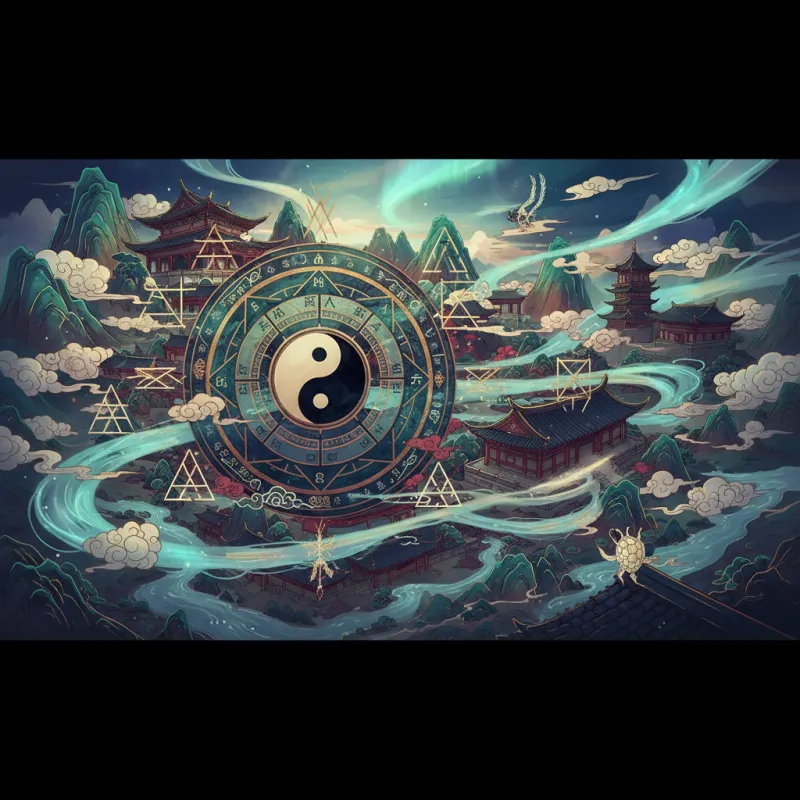
You're holding a book that claims to contain every situation you'll ever face. Not metaphorically — literally. The I Ching (易經 yìjīng, "Book of Changes") maps reality using 64 hexagrams, and its creators weren't being poetic when they said this was complete. They were being mathematical. Six lines, two possible states per line: 2^6 = 64. Every possible pattern. Every possible moment.
The Architecture of Change
Each hexagram is a stack of six horizontal lines, either broken (yin ⚋) or solid (yang ⚊). Read from bottom to top — the Chinese build meaning from the ground up. The bottom line represents the beginning of a situation, the top line its culmination. Middle lines show development. This isn't arbitrary symbolism. It mirrors how situations actually unfold: foundation, growth, resolution.
The first hexagram, Qian (乾 qián), is six solid lines. Pure yang. Creative force, heaven, the dragon. The second, Kun (坤 kūn), is six broken lines. Pure yin. Receptive force, earth, the mare. These two anchor the system — everything else is their interplay. Hexagram 11, Tai (泰 tài), has three yin lines above three yang lines. Earth over heaven sounds backwards until you realize it means heaven's energy rises while earth's descends — they meet in the middle. This is peace, harmony, the ideal state. Hexagram 12, Pi (否 pǐ), reverses this: heaven above earth, energies moving apart. Stagnation.
The trigrams that form hexagrams each carry their own meaning — heaven, earth, thunder, wind, water, fire, mountain, lake — and their combinations create the 64 patterns. When you stack water over fire, you get Hexagram 63, Already Completed. Fire over water gives you Hexagram 64, Not Yet Completed. The I Ching ends with incompletion, suggesting the cycle never stops.
How the Numbers Actually Work
King Wen (文王 Wén Wáng) of Zhou arranged the hexagrams in their traditional sequence around 1150 BCE while imprisoned by the Shang dynasty. His ordering isn't random — it follows a logic of opposites and inversions. Hexagram 1 (pure yang) pairs with Hexagram 2 (pure yin). Hexagram 3, Difficulty at the Beginning, pairs with Hexagram 4, Youthful Folly. Each hexagram has a partner, either its inverse (flipped upside down) or its opposite (all lines changed).
But there's another arrangement. Shao Yong (邵雍 Shào Yōng), a Song dynasty philosopher who died in 1077 CE, created the "binary sequence" ordering that reveals the I Ching's mathematical skeleton. Start with six yin lines (000000 in binary = 0 in decimal). Change the bottom line to yang (000001 = 1). Keep changing lines systematically until you reach six yang lines (111111 = 63). This sequence shows the I Ching as a complete binary system, predating Leibniz's binary mathematics by six centuries.
The hexagram numbers you see in most translations follow King Wen's sequence, not the binary order. This confuses people who expect mathematical progression. Hexagram 1 in King Wen's sequence is actually binary 111111 (number 63 in binary counting). Hexagram 2 is binary 000000 (number 0). The traditional sequence prioritizes philosophical relationships over numerical ones.
Reading the Lines
Each line in a hexagram has its own meaning. The bottom line is called "initial" (初 chū), lines 2-5 are numbered, and the top line is "top" (上 shàng). Position matters enormously. Yang lines in odd positions (1, 3, 5) are "correct" — yang in yang places. Yin lines in even positions (2, 4, 6) are also correct. A yang line in position 2 is "incorrect" — yang in a yin place. This creates tension, opportunity, or danger depending on context.
The fifth line is the ruler's position. In most hexagrams, this line carries the most weight. The second line often represents the minister or advisor. When these two lines have the right relationship — usually a yin line in position 2 responding to a yang line in position 5 — the hexagram suggests good fortune. When they're misaligned, trouble.
Lines also relate to their neighbors and their correspondents (the line in the opposite trigram). Line 1 corresponds to line 4, line 2 to line 5, line 3 to line 6. When corresponding lines are complementary (one yin, one yang), they "resonate." When they're the same, they compete. The changing lines in divination show which positions are active, which relationships are shifting.
The Judgment and the Image
Each hexagram comes with two core texts: the Judgment (彖 tuàn) and the Image (象 xiàng). The Judgment, attributed to King Wen, gives the overall meaning. The Image, attributed to his son the Duke of Zhou (周公 Zhōu Gōng), offers guidance. These texts are cryptic, poetic, often bizarre. Hexagram 21, Biting Through, talks about biting through tough meat with something stuck between your teeth. This isn't metaphor — it's the situation. Something obstructs, you must bite through it, there will be consequences.
The Judgment for Hexagram 29, The Abysmal Water, says: "If you are sincere, you have success in your heart, and whatever you do succeeds." You're in danger (water, abyss, pit), but sincerity — not cleverness, not force — brings success. The Image says: "Water flows on uninterruptedly and reaches its goal: The image of the Abysmal repeated. Thus the superior man walks in lasting virtue and carries on the business of teaching." Water doesn't stop. Neither should you.
Later commentaries, especially the Ten Wings (十翼 shí yì) attributed to Confucius, add layers of interpretation. The Wings explain the philosophical principles, the line relationships, the symbolic meanings. They transform the I Ching from divination manual to philosophical text. Whether Confucius actually wrote them is disputed — they probably date from the 4th to 2nd centuries BCE — but their influence is undeniable.
Hexagrams in Pairs
The traditional sequence pairs hexagrams by relationship. After Hexagram 1 (Creative) and 2 (Receptive) establish the poles, the rest unfold in pairs that show situations and their natural consequences or opposites. Hexagram 3, Difficulty at the Beginning, shows birth — chaotic, dangerous, full of potential. Hexagram 4, Youthful Folly, shows the inexperience that follows birth. You can't have one without the other.
Hexagram 11 (Peace) and 12 (Standstill) are opposites — one has heaven and earth in harmony, the other in separation. Hexagram 63 (After Completion) and 64 (Before Completion) end the sequence by showing that completion immediately becomes incompletion. The moment you finish something, you're at the beginning of what comes next. The I Ching's final hexagram isn't triumph — it's transition.
Some hexagrams are their own opposites. Hexagram 1 flipped upside down is still Hexagram 1. Same with Hexagram 2, and six others. These eight hexagrams are perfectly symmetrical, suggesting situations that don't change when inverted. They're stable, fundamental, archetypal.
Nuclear Hexagrams and Hidden Patterns
Inside every hexagram hides another hexagram. Take lines 2, 3, and 4 as the lower trigram, and lines 3, 4, and 5 as the upper trigram. This creates the "nuclear hexagram" (互卦 hù guà) — the hidden pattern within the obvious one. Hexagram 1's nuclear hexagram is Hexagram 1 (it's self-similar all the way down). Hexagram 11's nuclear hexagram is Hexagram 54, The Marrying Maiden — suggesting that peace contains the seed of new relationships, new complications.
Some practitioners use nuclear hexagrams to understand the inner dynamics of a situation. The main hexagram shows what's visible, the nuclear hexagram shows what's hidden. Others find this overcomplicates things. The I Ching already has 64 hexagrams, six lines each, changing lines, correspondences, and multiple layers of text. Adding nuclear hexagrams might be too much.
But the pattern reveals something important: the I Ching is fractal. Each hexagram contains other hexagrams. Each line contains the whole. This isn't mysticism — it's how complex systems work. The part reflects the whole. The moment contains the pattern.
Why 64 Is Enough
The claim that 64 hexagrams cover all possible situations seems absurd until you understand what "situation" means in I Ching terms. Not specific events — not "should I take this job" or "will this relationship work" — but patterns of change. The I Ching describes how things move, not what things are. Hexagram 24, Return, doesn't mean "you'll go back to your hometown." It means "after reaching the extreme, movement returns to the beginning." That pattern applies to careers, relationships, seasons, dynasties, personal growth.
The five elements theory offers five fundamental forces. The I Ching offers 64 fundamental patterns. Both claim completeness through different mathematics. Five elements interact in cycles — generating and controlling. Sixty-four hexagrams interact through transformation — each line can change, creating a new hexagram. A single reading can move through multiple hexagrams as lines change, showing the path of transformation.
The genius isn't that 64 hexagrams describe everything. It's that they describe change itself. The I Ching isn't a catalog of situations — it's a grammar of transformation. Once you know the grammar, you can parse any sentence reality throws at you.
Related Reading
- How to Consult the I Ching: A Beginner's Guide
- The I Ching: The World's Oldest Book of Wisdom (And How to Actually Use It)
- How to Consult the I Ching: A Practical Guide
- What Is the I Ching? A Complete Guide to the Book of Changes
- The I Ching Is Not a Fortune-Telling Book (It Is Much Stranger Than That)
- Unlocking the Secrets of Feng Shui: Water Features in Chinese Metaphysics
- Unlocking the Wisdom of Feng Shui and I Ching: A Journey Through Chinese Metaphysics
- Rainwater Collection and Feng Shui: Catching Wealth from the Sky
Explore Chinese Culture
- Explore Daoist philosophy and practice
- Explore traditional Chinese customs
- Explore ancient Chinese cosmology