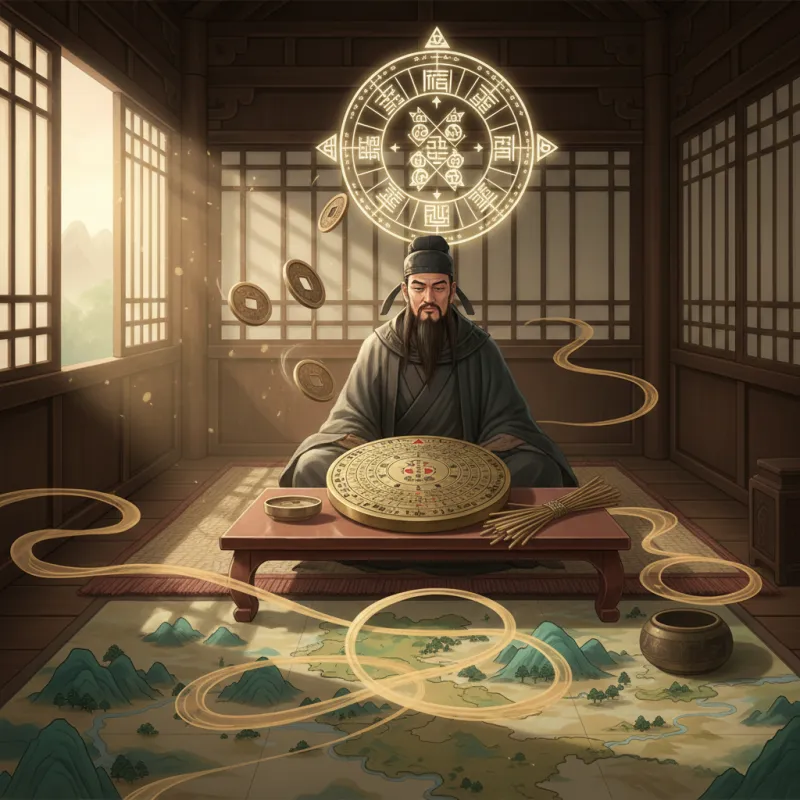
You're holding three coins in your palm, about to ask a question that's been gnawing at you for weeks. Your hand trembles slightly—not from nervousness, but from the weight of what you're about to do. For the next few minutes, you'll be participating in a ritual that has guided emperors, generals, and common people for over three millennia. The I Ching (易經, Yìjīng), or "Book of Changes," doesn't predict your future like a fortune cookie. It mirrors your present moment back to you with such clarity that the path forward becomes obvious.
What Makes the I Ching Different from Fortune Telling
Let's clear something up immediately: the I Ching isn't a crystal ball, and it won't tell you whether to marry your partner or quit your job. What it does is far more sophisticated. The text operates on the principle that change is the only constant in the universe, and by understanding the pattern of change you're currently experiencing, you can align your actions with the natural flow of events. This is why the I Ching has survived while countless other divination systems have faded into obscurity.
The connection to Feng Shui principles runs deeper than most people realize. Both systems are built on the same foundation: the interplay of yin (陰, yīn) and yang (陽, yáng) energies, and the belief that harmony comes from understanding and working with natural patterns rather than against them. When you consult the I Ching, you're essentially taking a snapshot of the energetic configuration of your situation at that precise moment.
The Three-Coin Method: Your Gateway to the Oracle
The most accessible method for beginners is the three-coin method, developed during the Song Dynasty (960-1279 CE) as a faster alternative to the traditional yarrow stalk method. You'll need three identical coins—Chinese coins with square holes in the center are traditional, but any three matching coins work perfectly well.
Here's the process: Assign the heads side a value of 3 and the tails side a value of 2. Hold all three coins in your hands, focus on your question, and toss them six times. Each toss generates one line of your hexagram, building from bottom to top. Add up the values of each toss:
- 6 (all tails): Old yin—a changing line, drawn as ⚋ with an X
- 7 (two tails, one heads): Young yang—a solid line ⚊
- 8 (two heads, one tails): Young yin—a broken line ⚋
- 9 (all heads): Old yang—a changing line, drawn as ⚊ with a circle
The "changing lines" (6 and 9) are crucial—they indicate where transformation is actively occurring in your situation. These lines transform into their opposite (yin becomes yang, yang becomes yin), creating a second hexagram that shows where your situation is heading.
Crafting Your Question: The Art of Inquiry
Most people fail at I Ching consultation before they even toss the coins because they ask terrible questions. "Will I get the job?" is a yes/no question, and the I Ching doesn't do yes/no. It's not a Magic 8-Ball. Instead, ask: "What do I need to understand about my job search right now?" or "What approach should I take regarding this career opportunity?"
The best questions are open-ended and focus on understanding rather than prediction. They acknowledge your agency in the situation. During the Tang Dynasty (618-907 CE), the scholar Kong Yingda wrote that the I Ching responds to sincerity and clarity of mind. If you're distracted, drunk, or asking frivolous questions to test the system, you'll get nonsense in return. The ancient texts are clear on this point: approach with respect or don't approach at all.
Before you begin, sit quietly for a few minutes. Some practitioners burn incense or light a candle—not for mystical reasons, but to create a mental boundary between ordinary consciousness and the focused state needed for consultation. Write your question down. If it takes more than two sentences to articulate, it's probably too complex and needs to be broken into separate consultations.
Reading Your Hexagram: Beyond the Fortune Cookie Interpretation
Once you've generated your hexagram, you'll look it up in an I Ching text. There are 64 possible hexagrams, each composed of six lines. Let's say you've drawn Hexagram 3, Zhun (屯, zhūn), "Difficulty at the Beginning." The traditional image describes a blade of grass pushing through hard earth—growth is happening, but it requires effort and patience.
Here's where most beginners go wrong: they read the judgment and think they're done. The judgment is just the headline. The real wisdom lives in the image, the individual line texts (especially the changing lines), and the commentary. The Richard Wilhelm translation, despite being over a century old, remains the gold standard because it includes multiple layers of interpretation from Confucian scholars across dynasties.
Pay special attention to your changing lines. If you have Hexagram 3 with a changing line in the fourth position, you need to read that specific line text. Then, transform your changing lines to generate your second hexagram—this shows the trajectory of your situation. If Hexagram 3 transforms into Hexagram 60, Jie (節, jié), "Limitation," the reading suggests that your current difficulties will resolve into a situation requiring careful boundaries and moderation.
The Yarrow Stalk Method: For the Dedicated Student
If you're serious about I Ching study, eventually you'll want to learn the yarrow stalk method. This is the original technique, described in the "Great Commentary" (Xici Zhuan, 繫辭傳) section of the I Ching itself. It requires 50 yarrow stalks (though you only use 49) and takes about 15-20 minutes per consultation.
The process is mathematically elegant: through a series of divisions and countings, the yarrow stalks naturally generate the correct probability distribution for the four line types. The coin method, while faster, slightly skews the probabilities—changing lines appear more frequently with coins than with yarrow stalks. This matters because the ancient method was designed to reflect the natural rarity of transformation moments.
I won't detail the full yarrow stalk procedure here (it deserves its own article), but know that the deliberate slowness is part of the practice. The repetitive counting creates a meditative state that many practitioners find produces clearer, more resonant readings. The Song Dynasty philosopher Zhu Xi practiced the yarrow stalk method daily and wrote that the physical ritual helped quiet his analytical mind, allowing intuitive understanding to emerge.
Integrating I Ching Wisdom with Your Feng Shui Practice
The I Ching and Feng Shui applications work together seamlessly because they're both concerned with the flow of qi (氣, qì) and the balance of elemental forces. When you receive a hexagram reading, look at its elemental composition. Each trigram (the three-line units that combine to form hexagrams) corresponds to one of the five elements and a direction.
For example, if your reading emphasizes the trigram Kan (坎, kǎn), associated with water and the north direction, you might enhance the north sector of your home or office to support the energy pattern the I Ching is highlighting. If you're working through Hexagram 29, Kan (the Abysmal Water), which is double Kan, you're dealing with a situation requiring depth, persistence, and the ability to flow around obstacles—qualities you can reinforce through your environmental design.
This isn't superstition; it's environmental psychology informed by ancient wisdom. When your physical space reflects and supports the energetic pattern you're working with internally, you create coherence between inner and outer worlds. This is the essence of both I Ching consultation and Feng Shui practice.
Common Mistakes and How to Avoid Them
The biggest error beginners make is consulting too frequently about the same question. The I Ching is not a slot machine you keep pulling until you get the answer you want. If you receive a reading that troubles you, sit with it for at least a week before consulting again on the same topic. The Ming Dynasty scholar Lai Zhide wrote that excessive consultation reveals not wisdom-seeking but anxiety, and anxiety clouds interpretation.
Another mistake: ignoring readings that don't match your preferences. If you ask about pursuing a relationship and draw Hexagram 33, Dun (遯, dùn), "Retreat," don't immediately toss the coins again hoping for Hexagram 31, Xian (咸, xián), "Influence/Attraction." The I Ching is telling you something important about timing and appropriateness. Wisdom means listening even when—especially when—the message challenges your desires.
Finally, don't treat the I Ching as a substitute for professional advice, therapy, or medical care. It's a tool for self-reflection and understanding patterns, not a replacement for expertise in specific domains. The ancient Chinese consulted the I Ching alongside advisors, physicians, and strategists, not instead of them.
Building a Sustainable Practice
Start with one consultation per week, maximum. Choose a consistent time and place—Sunday morning with tea, or Friday evening after work. Keep a journal of your readings, including the date, question, hexagram, changing lines, and your initial interpretation. Return to these entries after a month or two. You'll be startled by how accurately the readings mapped your situations, even when you didn't fully understand them at the time.
Study one hexagram deeply each week. Read multiple translations—Wilhelm, Huang, Lynn, and Karcher each bring different scholarly perspectives. Notice how the same hexagram appears in different life situations. Hexagram 15, Qian (謙, qiān), "Modesty," might appear when you're considering a job promotion, a relationship conflict, or a creative project, each time highlighting the power of humble, grounded action.
The I Ching rewards patience and genuine inquiry. After six months of regular practice, you'll find that the hexagrams start speaking to you in your own language, through your own life experiences. The ancient text becomes a living conversation partner, offering perspective that's simultaneously 3,000 years old and completely relevant to your modern dilemmas. That's the real magic of the Book of Changes—it changes with you, reflecting back exactly what you need to see at each stage of your journey.
Related Reading
- The I Ching: The World's Oldest Book of Wisdom (And How to Actually Use It)
- How to Consult the I Ching: A Practical Guide
- Using the I Ching for Decision Making
- Unlocking the Mysteries of Feng Shui and the I Ching: A Journey into Chinese Metaphysics
- I Ching Hexagrams Explained: Understanding the 64 Patterns of Change
- Mirrors in the Bedroom: Feng Shui Rules and Reasons
- Unlocking the Ancient Arts: Feng Shui, I Ching, and the Mysteries of Chinese Metaphysics
- Feng Shui Annual Forecast: How the Year's Energy Affects Your Home
Explore Chinese Culture
- Explore Daoist philosophy and practice
- Explore traditional Chinese customs
- Explore ancient Chinese cosmology