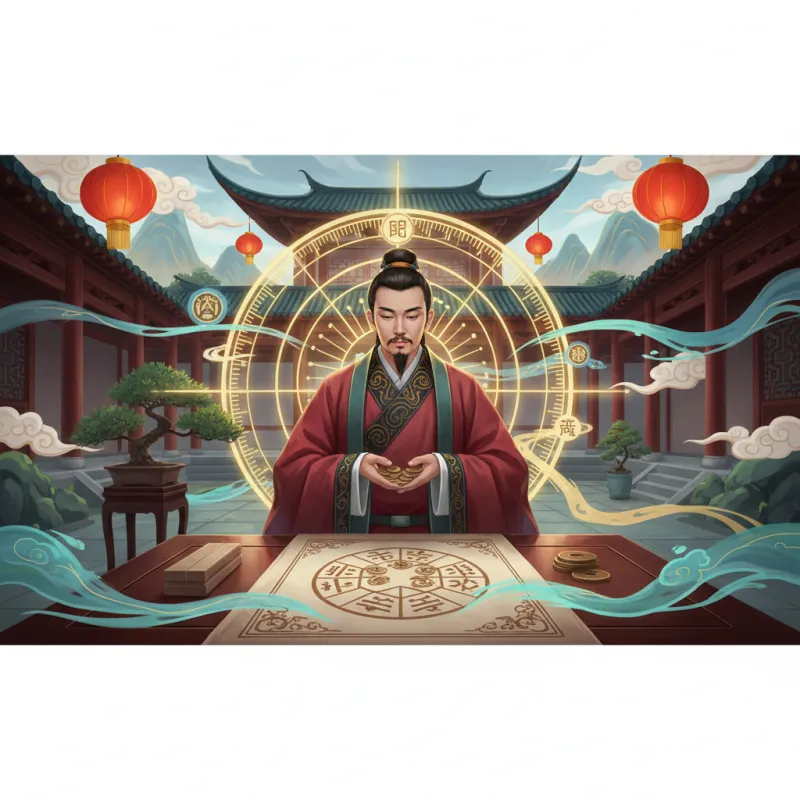
You're standing at a crossroads—literally or metaphorically—and the weight of choosing wrong feels paralyzing. Should you take the job offer? End the relationship? Move across the country? What if I told you that for over three millennia, Chinese sages, emperors, and everyday people have turned to a book of cryptic symbols to navigate exactly these moments? The Yijing 易經 (Book of Changes) isn't just an ancient curiosity gathering dust in university libraries—it's a living decision-making technology that treats uncertainty not as a problem to eliminate, but as the fundamental texture of reality itself.
What Makes the I Ching Different from Fortune Telling
Let's clear something up immediately: the I Ching isn't about predicting the future like some cosmic Magic 8-Ball. When King Wen of Zhou compiled the hexagram judgments while imprisoned by the Shang tyrant around 1150 BCE, he wasn't creating a fortune-telling parlor trick. He was encoding a sophisticated system for reading the patterns of change itself—what the Chinese call shi 勢, the strategic "propensity of things." Unlike Western divination that seeks yes/no answers, the I Ching asks: "Given the current configuration of forces, what's the nature of this moment, and how should I position myself within it?"
The 64 hexagrams aren't random symbols. Each is built from eight trigrams (bagua 八卦) representing fundamental natural forces: heaven, earth, thunder, wind, water, fire, mountain, and lake. When you consult the I Ching, you're not asking it to tell you what will happen—you're using it as a mirror to reflect the energetic pattern of your situation back at you. Hexagram 3, Zhun 屯 (Difficulty at the Beginning), doesn't predict difficulty; it describes a moment when new growth pushes through frozen ground, requiring patience and careful nurturing. The question isn't "Will I succeed?" but "What does success look like in a Zhun moment?"
The Mechanics: How to Actually Consult the Oracle
Traditional consultation uses 50 yarrow stalks in a complex sorting process that takes about 15 minutes per hexagram. The Song Dynasty scholar Zhu Xi (1130-1200 CE) preferred this method because the deliberate slowness forces you to sit with your question, refining it as you work. But most people today use three coins—traditionally Chinese coins with square holes, though any coins work. You toss them six times, building your hexagram from bottom to top.
Here's what matters: the question. Don't ask "Should I marry him?" Ask "What's the nature of this relationship at this moment?" Don't ask "Will my business succeed?" Ask "What approach does this venture require right now?" The I Ching responds to questions about process, timing, and positioning—not outcomes. When Confucius studied the I Ching so intensely that the leather binding broke three times, he wasn't seeking predictions. He was learning to read the grain of reality, the way a master carpenter reads wood.
Each coin toss generates either a yin line (two or three tails) or yang line (two or three heads). But here's where it gets interesting: if all three coins match, you get a "changing line"—a line that transforms into its opposite, generating a second hexagram. This second hexagram shows where the situation is heading. You might draw Hexagram 29, Kan 坎 (The Abysmal Water), with a changing line in the fourth position, which transforms it into Hexagram 48, Jing 井 (The Well). The reading then becomes: you're currently in a dangerous, flowing situation (water), but it's transforming into something stable and nourishing (a well). The changing line's specific text gives you the pivot point—the exact moment where transformation occurs.
Reading the Hexagrams: Beyond Surface Meanings
Each hexagram comes with four layers of text: the Tuan 彖 (Judgment), the Xiang 象 (Image), and six line texts, plus the Dazhuan 大傳 (Great Commentary) that explains the philosophical principles. When the Tuan for Hexagram 1, Qian 乾 (The Creative), says "Supreme success through perseverance," it's not promising you'll win if you try hard. It's describing the nature of pure yang energy—initiating, creative, but requiring discipline to avoid burning out.
The Xiang gives you the visual metaphor. For Hexagram 5, Xu 需 (Waiting), it says "Clouds rise up to heaven"—rain is coming, but it's not here yet. The image teaches you how to wait: not passively, but like a farmer who prepares the field while watching the sky. This connects directly to feng shui principles about timing and environmental awareness—knowing when to act and when to cultivate readiness.
The line texts are where it gets personal and specific. They're often bizarre, poetic, and seemingly random: "A yellow cow's hide. No blame." "The wanderer burns his shelter. He loses his young servant's loyalty." These aren't literal predictions but symbolic descriptions of positions within the hexagram's overall pattern. The second line (from bottom) typically represents the position of the developing person—someone with some skill but not yet in a position of authority. The fifth line represents the ruler, the decision-maker. Where your changing lines fall tells you what role you're playing in this situation.
Integrating I Ching Wisdom with Feng Shui Practice
The I Ching and feng shui aren't separate systems—they're two applications of the same underlying cosmology. Both work with qi 氣 (vital energy), yin-yang dynamics, and the five elements (wuxing 五行). When you consult the I Ching about a decision, you're reading the temporal feng shui of the moment—the energetic landscape of time rather than space.
Consider Hexagram 24, Fu 復 (Return), which appears at the winter solstice when yang energy begins returning after its minimum. If you draw this hexagram when deciding whether to start a new project, it's telling you that you're at a natural turning point—the moment when dormant energy begins to stir. In feng shui terms, this is like identifying the sheng qi 生氣 (generating energy) direction in your space. The I Ching reading tells you the temporal direction; feng shui tells you the spatial direction. Used together, they create a four-dimensional map for decision-making.
The trigrams themselves correspond to the bagua used in feng shui analysis. Kan 坎 (water) relates to career and life path; Li 離 (fire) to recognition and clarity; Zhen 震 (thunder) to new beginnings and family. When you understand these correspondences, an I Ching reading becomes richer. Drawing Hexagram 30, Li 離 (The Clinging Fire), about a career decision suggests you need to focus on clarity, visibility, and proper attachment—clinging to what's correct like fire clings to its fuel. You might then look at the Li area of your home or office (the south, in traditional feng shui) to see if it supports this energy.
Common Pitfalls and How to Avoid Them
The biggest mistake people make is treating the I Ching like a slot machine—asking the same question repeatedly until they get an answer they like. The Tang Dynasty commentator Kong Yingda warned against this in the 7th century CE: "The oracle speaks once. To ask again shows doubt, and doubt clouds the reading." If you get an answer you don't understand or don't like, the work is to understand it, not to re-roll the dice.
Another trap is over-literalism. When Hexagram 56, Lu 旅 (The Wanderer), talks about a traveler burning his shelter, it's not telling you to commit arson. It's describing the psychology of someone who's transient—who destroys their own stability through restlessness or poor judgment. The I Ching speaks in images and metaphors because reality itself is metaphorical—patterns repeat across scales and contexts.
People also forget that the I Ching describes what is, not what should be. If you draw Hexagram 12, Pi 否 (Standstill/Stagnation), it's not judging you or predicting doom. It's saying: "Right now, heaven and earth are not in communication. This is a time when the worthy withdraw and the petty advance." That's valuable information. Maybe you don't launch your business during a Pi moment. Maybe you consolidate, plan, and wait for the energy to shift—which it will, because change is the only constant.
Making Decisions with the I Ching: A Practical Framework
Here's how I recommend actually using the I Ching for real decisions. First, get clear on what you're really asking. Spend time with your question. Write it down, revise it, make it specific but open-ended. "What's the nature of this job opportunity?" is better than "Should I take this job?"
Consult the oracle with proper attention—not while scrolling your phone or half-watching TV. The ritual matters not because the coins are magic, but because ritual creates psychological space for insight. Record your hexagram, all changing lines, and the resulting hexagram if any. Read the texts slowly. Don't just skim for the parts that seem relevant.
Then—and this is crucial—sit with it. Don't immediately act on your interpretation. The I Ching works on you over time, like a seed germinating. I've had readings that made no sense initially but became crystal clear three days later when circumstances shifted. The book is teaching you to perceive patterns, and pattern recognition is a skill that develops with practice.
Finally, integrate the reading with other information. The I Ching doesn't replace practical analysis, market research, or honest conversation. It adds a dimension—the dimension of timing, of energetic configuration, of your own unconscious wisdom speaking through the randomness of coins. When the 11th-century reformer Wang Anshi consulted the I Ching about his controversial policies, he didn't ignore political realities. He used the oracle to understand the deeper currents beneath surface events.
The I Ching as a Mirror, Not a Master
After years of working with the I Ching, I've come to see it less as an oracle and more as a sophisticated mirror—one that reflects not just your face but the face of the moment you're living through. The hexagrams don't contain answers; they contain questions that help you find your own answers. When you're stuck between two choices, the I Ching doesn't pick for you. It shows you what kind of moment you're in, what energies are at play, and what approach the situation calls for.
This connects to the deeper philosophy of I Ching and personal cultivation—the idea that wisdom isn't about knowing the future but about aligning yourself with the present. The sage doesn't control change; the sage rides it like a surfer rides a wave, reading its shape and power, adjusting position moment by moment. Every decision you make is a positioning within the flow of change. The I Ching teaches you to read that flow.
The book's title, Yijing, means "Classic of Changes," but yi 易 has three meanings: change, ease, and unchanging. The paradox is the point. Everything changes, yet the patterns of change remain constant. When you learn to recognize these patterns—in hexagrams, in nature, in your own life—decision-making becomes easier not because you know what will happen, but because you know how to move with what's happening. That's the real gift the I Ching offers: not certainty, but fluency in the language of change itself.
Related Reading
- What Is the I Ching? A Complete Guide to the Book of Changes
- Unlocking the Mysteries of Feng Shui and the I Ching: A Journey into Chinese Metaphysics
- I Ching Hexagrams Explained: Understanding the 64 Patterns of Change
- The I Ching Is Not a Fortune-Telling Book (It Is Much Stranger Than That)
- The 64 Hexagrams: A Complete Overview
- Exploring the Interconnections of Feng Shui, I Ching, and Chinese Metaphysics
- Harmonizing Your Kitchen: The Role of Feng Shui and I Ching in Culinary Spaces
- The Five Elements Are Not Elements (And Why That Matters)
Explore Chinese Culture
- Explore Daoist philosophy and practice
- Explore traditional Chinese customs
- Explore ancient Chinese cosmology