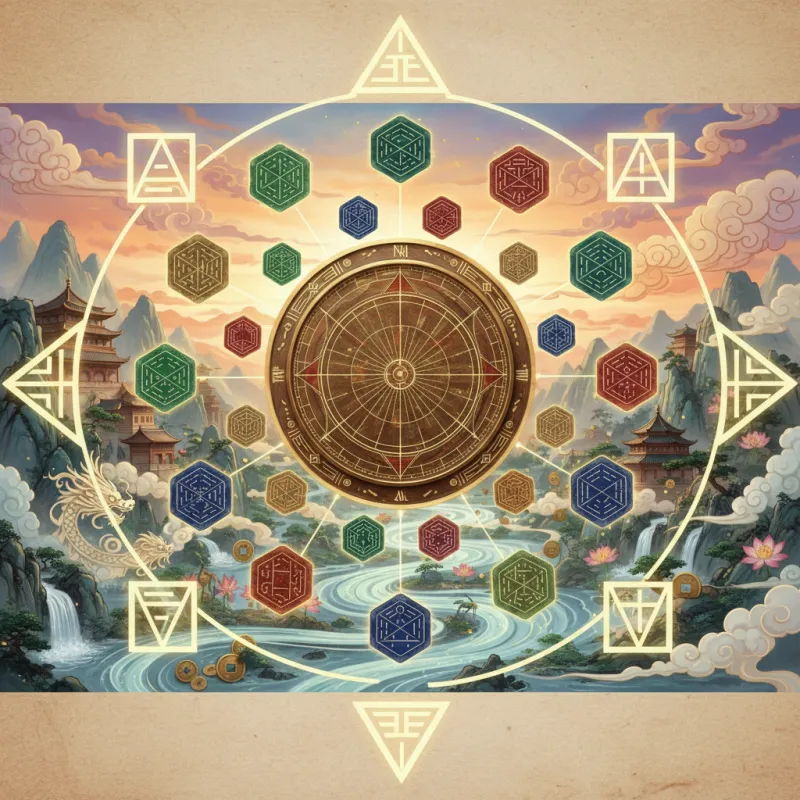
You're holding a book that predates Confucius, survived book burnings, and has been consulted by everyone from Chinese emperors to Carl Jung. The I Ching's 64 hexagrams aren't just ancient symbols—they're a complete map of every situation you'll ever face. Each six-lined figure captures a moment in the eternal dance between stillness and movement, between what is and what's becoming.
The Architecture of Change
The 64 hexagrams emerge from elegant mathematical precision. Start with the eight trigrams (八卦, bāguà)—Heaven, Earth, Thunder, Wind, Water, Fire, Mountain, and Lake. Stack any trigram atop another, and you get 8 × 8 = 64 possible combinations. But this isn't arbitrary numerology. Each hexagram is built from six lines, read from bottom to top, where each line is either broken (yin, ⚋) or unbroken (yang, ⚊). The broken lines embody receptivity, darkness, and the feminine principle. The unbroken lines pulse with activity, light, and masculine energy.
What makes this system brilliant is its dynamic nature. During the Song Dynasty (960-1279 CE), scholars like Shao Yong developed sophisticated methods for understanding how hexagrams transform into one another. When you consult the I Ching through yarrow stalks or coins, certain lines are marked as "changing lines"—they flip from yin to yang or vice versa, generating a second hexagram. You're not getting a static answer; you're witnessing the process of transformation itself.
The first two hexagrams set the cosmic stage. Hexagram 1, Qian (乾, qián), "The Creative," consists of six unbroken lines—pure yang energy, the primal force of heaven. Hexagram 2, Kun (坤, kūn), "The Receptive," shows six broken lines—pure yin, the yielding power of earth. Everything else flows from this fundamental polarity. Understanding these two is like learning the root position in music; every other hexagram is a variation on this theme.
The Eight Houses System
Traditional I Ching scholarship organizes the 64 hexagrams into eight "houses" or families, each headed by one of the eight pure trigrams doubled to form a hexagram. This system, refined during the Han Dynasty (206 BCE - 220 CE), reveals hidden relationships between hexagrams. The Qian house includes hexagrams where the creative principle dominates. The Kun house groups situations where receptivity leads. Each house contains eight hexagrams that share similar energetic signatures.
This isn't just academic classification. When you're working with I Ching divination methods, knowing which house a hexagram belongs to tells you about its fundamental character. A hexagram from the Zhen (Thunder) house carries explosive, initiating energy. One from the Gen (Mountain) house suggests stillness and contemplation. The house system helps you understand not just what a hexagram means, but why it means what it does.
Reading the Layers
Each hexagram operates on multiple levels simultaneously. The judgment (彖辞, tuàncí) attributed to King Wen offers the overall meaning—often cryptic, always profound. Then come the line texts (爻辞, yáocí), traditionally ascribed to the Duke of Zhou, which give specific guidance for each of the six positions. The Ten Wings (十翼, shí yì), commentaries added by Confucian scholars, provide philosophical interpretation.
Take Hexagram 11, Tai (泰, tài), "Peace." The judgment says "The small departs, the great approaches. Good fortune. Success." But the third line warns: "No plain not followed by a slope, no going not followed by a return." This is the I Ching's genius—it gives you the big picture and the granular detail. Peace is auspicious, yes, but within peace lie the seeds of its opposite. The third line, being in the middle of the lower trigram, marks the turning point where ascent becomes descent.
The position of each line matters enormously. Lines one and two are the "earth" positions—foundational but not yet influential. Lines three and four occupy the "human" realm where action happens. Lines five and six belong to "heaven"—positions of leadership and completion. A yang line in the fifth position (the ruler's place) is generally auspicious. The same line in the sixth position might indicate overextension. Context is everything.
Hexagram Pairs and Opposites
The 64 hexagrams aren't randomly ordered in the received text. They're arranged in 32 pairs, each pair exploring complementary or opposite situations. Hexagram 3, Zhun (屯, zhūn), "Difficulty at the Beginning," pairs with Hexagram 4, Meng (蒙, méng), "Youthful Folly." Birth is difficult; the newborn is foolish. Hexagram 11, "Peace," pairs with Hexagram 12, Pi (否, pǐ), "Standstill." What rises must fall; what separates may reunite.
Some pairs are inversions—flip Hexagram 5 upside down and you get Hexagram 6. Others are complete opposites—change every yin line to yang and every yang to yin. This pairing system, likely dating to the Western Zhou period (1046-771 BCE), reveals the I Ching's core insight: every situation contains its opposite. Understanding yin and yang principles means recognizing that extremes naturally reverse themselves.
The Nuclear Hexagrams
Here's where it gets esoteric. Within every hexagram hide two "nuclear" or "inner" hexagrams formed by lines 2-3-4 (lower nuclear) and 3-4-5 (upper nuclear). These reveal the hidden dynamics at work beneath the surface situation. Hexagram 1, pure yang, contains Hexagram 1 as both its nuclear hexagrams—it's yang all the way down. But most hexagrams contain surprising inner structures that modify their meaning.
This technique, developed by Han Dynasty commentators, adds psychological depth to readings. The outer hexagram shows what's visible; the nuclear hexagrams reveal unconscious forces, hidden motivations, or underlying patterns. It's like the difference between what someone says and what they mean. Master diviners in the Tang Dynasty (618-907 CE) would routinely analyze nuclear hexagrams to give readings that penetrated beyond surface appearances.
Practical Navigation
Learning all 64 hexagrams isn't about memorization—it's about recognition. Spend time with the text, and patterns emerge. Hexagrams with yang in the fifth place tend toward success. Those with yin in the second place often counsel patience. Hexagrams where the trigrams conflict (Fire below, Water above) suggest tension. Those where trigrams harmonize (Wind below, Thunder above) indicate natural progression.
The I Ching rewards slow study. Richard Wilhelm, whose 1924 German translation introduced the text to the West, spent decades in China learning from master Lao Naixuan. Wilhelm understood that the hexagrams aren't fortune-telling devices—they're mirrors reflecting the present moment's inherent potential. When you consult the I Ching about a relationship and receive Hexagram 31, Xian (咸, xián), "Influence," you're not being told your future. You're being shown the energetic pattern already present in the situation.
Living With the Hexagrams
The 64 hexagrams form a complete symbolic language for describing change. They appear in feng shui applications, in traditional Chinese medicine's diagnostic systems, in martial arts philosophy, and in landscape painting theory. During the Qing Dynasty (1644-1912), scholars wrote entire books analyzing single hexagrams, finding inexhaustible depth in six simple lines.
What makes the system endure is its refusal to be simplistic. Hexagram 29, Kan (坎, kǎn), "The Abysmal," represents danger and difficulty—but its judgment says "If you are sincere, you have success in your heart." Even in the pit, sincerity creates possibility. Hexagram 63, Ji Ji (既济, jì jì), "After Completion," should be triumphant—everything's accomplished! But it warns that completion is the moment before dissolution begins. The I Ching never lets you rest in comfortable certainty.
The 64 hexagrams aren't ancient superstition. They're a sophisticated system for thinking about change, developed over millennia by some of China's finest minds. Each hexagram is a thought experiment: What happens when creative force meets receptive space? When thunder rises from the earth? When fire and water oppose each other? The answers aren't predictions—they're invitations to see your situation from an angle you hadn't considered. That's why, 3,000 years later, people still consult these six-lined figures when they need wisdom that goes deeper than logic alone can reach.
Related Reading
- I Ching Hexagrams Explained: Understanding the 64 Patterns of Change
- The I Ching: The World's Oldest Book of Wisdom (And How to Actually Use It)
- Unlocking the Mysteries of Feng Shui and the I Ching: A Journey into Chinese Metaphysics
- How to Consult the I Ching: A Beginner's Guide
- Using the I Ching for Decision Making
- Compass School vs. Form School: Two Approaches to Feng Shui
- Harmonizing Your Kitchen: The Role of Feng Shui and I Ching in Culinary Spaces
- ** Exploring the Harmonious Relationship Between Feng Shui and Plants in Chinese Metaphysics
Explore Chinese Culture
- Explore Daoist philosophy and practice
- Explore traditional Chinese customs
- Explore ancient Chinese cosmology