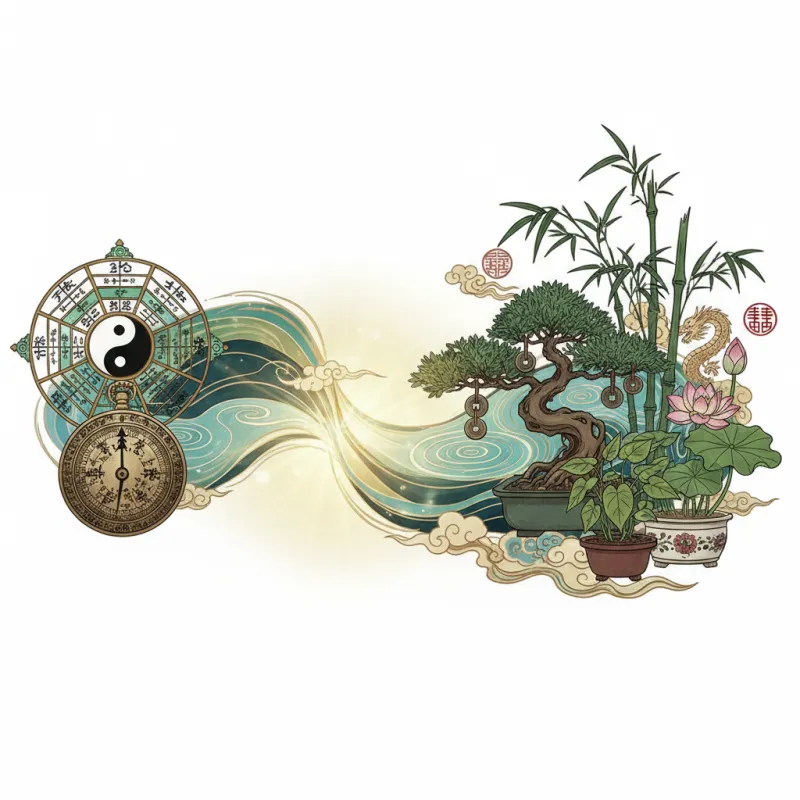
Picture this: A Ming Dynasty scholar sits in his study, surrounded by carefully positioned bamboo shoots and a miniature pine tree. He's not just decorating—he's orchestrating qi (氣, qì), the vital life force that ancient Chinese metaphysicians believed flows through all living things. That scholar understood something we're only now rediscovering: plants aren't passive décor. They're active participants in the energetic ecosystem of our spaces.
The Living Conduits of Qi
When Yang Yunsong (楊筠松, Yáng Yúnsōng), the legendary Tang Dynasty Feng Shui master, wrote his seminal texts in the 9th century, he didn't separate the natural world from human habitation. Plants, in his framework, served as bridges between heaven qi (天氣, tiān qì) and earth qi (地氣, dì qì). This wasn't poetic metaphor—it was practical metaphysics.
The mechanism is straightforward in classical theory: plants breathe. They inhale carbon dioxide and exhale oxygen, creating a literal exchange of energy that mirrors the Daoist concept of yin-yang transformation. But more than this biochemical process, traditional practitioners observed that certain plants seemed to "gather" beneficial qi while others could "disperse" stagnant energy. The weeping willow, for instance, was often planted near water features not just for aesthetics but because its drooping branches were thought to guide descending qi downward into the earth, completing an energetic circuit.
The Five Elements Dance in Your Living Room
Here's where it gets specific. Every plant corresponds to one of the Wu Xing (五行, wǔ xíng)—the Five Elements that form the backbone of Chinese metaphysical thought. This isn't arbitrary symbolism; it's based on observable characteristics that ancient practitioners catalogued over centuries.
Wood element plants are the obvious category—bamboo, most trees, and upward-growing specimens. But the system is more nuanced. A jade plant, with its thick, rounded leaves, actually embodies Earth element qualities despite being botanically "wood." Why? Because its growth pattern is compact and grounding, and its water-storing capacity relates to Earth's consolidating nature. The 16th-century text "Yangzhai Shishu" (陽宅十書, Yángzhái Shíshū, "Ten Books on Yang Dwellings") specifically addresses this, noting that leaf shape, growth direction, and even seasonal behavior determine elemental classification.
Fire element plants are rarer but powerful—anything with red flowers or pointed, upward-thrusting leaves like certain dracaenas. Water element plants include most aquatic species and those with flowing, cascading forms. Metal element plants? Think white-flowering specimens or those with silvery, blade-like leaves such as snake plants. The key is understanding that you're not just placing a plant; you're introducing an elemental force into your space's energetic composition.
Strategic Placement: Where Ancient Wisdom Meets Modern Spaces
The Luopan (羅盤, luópán), the traditional Feng Shui compass, divides space into eight sectors corresponding to the Bagua (八卦, bāguà) trigrams from the I Ching. Each sector governs different life aspects, and plant placement in these zones isn't random.
Southeast, associated with the Xun (巽, Xùn) trigram, represents wealth and abundance. This is Wood element territory, making it ideal for healthy, thriving plants—particularly those with rounded leaves that symbolize coins. I've seen practitioners recommend money trees (Pachira aquatica) here, though this is actually a modern interpretation; classical texts would have suggested bamboo or pine, which represented enduring prosperity rather than quick wealth.
The East sector, governed by Zhen (震, Zhèn) trigram, relates to family and health. Tall, upward-growing plants work here, supporting the rising energy of this Wood-dominant area. But here's a detail most contemporary Feng Shui books miss: the "Zangfu" (臟腑, zàngfǔ) organ correspondence system from Chinese medicine links this sector to the liver, which in Five Element theory is also Wood. Plants here aren't just symbolic—they're meant to resonate with and support the body's Wood element organs.
North, the Water element sector associated with career and life path, benefits from water-loving plants or those with dark, flowing foliage. But avoid placing too many plants here—excessive Wood in a Water sector can drain the Water element's energy, following the controlling cycle where Wood consumes Water. This is where understanding the Five Elements becomes crucial for avoiding energetic imbalances.
The Controversial Question of Spiky Plants
Let's address the cactus in the room. Modern Feng Shui practitioners often warn against spiky plants, claiming they create "sha qi" (煞氣, shà qì)—harmful, attacking energy. But historical texts tell a more complex story.
The "Bazi Mingli" (八宅明鏡, Bāzhái Míngjìng, "Eight Mansions Bright Mirror") from the Qing Dynasty actually recommends certain thorny plants as protective barriers when placed outside homes, particularly near vulnerable entry points. The logic? Sharp energy can deflect negative influences before they enter your space. It's the indoor placement that becomes problematic, where sharp points directed toward seating or sleeping areas can create subtle psychological stress—what we might now call environmental anxiety.
I'd argue the real issue isn't the spikes themselves but their relationship to human activity zones. A small cactus on a distant shelf? Probably fine. A large agave with sword-like leaves pointing at your desk chair? That's going to create tension, whether you believe in qi or simply understand that our nervous systems respond to perceived threats in our peripheral vision.
Seasonal Cycles and Plant Vitality
Here's something most Feng Shui guides overlook: the temporal dimension. Classical practitioners didn't just consider where to place plants but when to introduce them and how to work with their natural cycles.
The "Huangdi Neijing" (黃帝內經, Huángdì Nèijīng, "Yellow Emperor's Inner Canon"), though primarily a medical text, establishes principles that Feng Shui practitioners applied to environmental design. Spring, associated with Wood element and rising yang energy, is the optimal time to introduce new plants or encourage growth. Summer's Fire energy supports flowering and outward expression. Autumn's Metal energy begins the consolidation process, while Winter's Water energy calls for rest and minimal intervention.
This means a plant struggling in winter isn't necessarily a Feng Shui problem—it's following natural energetic cycles. The issue arises when we force growth during dormant periods or neglect plants during their active seasons. A dying plant in your wealth corner isn't just bad symbolism; it represents misaligned timing or care, which reflects broader patterns of how you manage resources and opportunities.
The Bazi Connection: Personal Plant Compatibility
Here's where it gets deeply personal. Your Bazi (八字, bāzì), or Four Pillars of Destiny, reveals your elemental constitution—which elements you have in excess and which you lack. This directly informs which plants will support your personal energy versus those that might create imbalance.
Someone with excessive Fire in their Bazi might feel agitated around red-flowering plants or those with sharp, upward energy. They'd benefit more from Water element plants or those with cooling, downward energy. Conversely, a person deficient in Wood element could thrive with abundant greenery, finding that plants literally help them feel more grounded and vital.
I once consulted with someone who insisted plants "died on them." After examining their Bazi, we found extreme Metal dominance—Metal controls Wood in the Five Element cycle. Rather than avoiding plants entirely, we selected Metal-friendly species (white flowers, silvery foliage) and positioned them in sectors where Metal naturally supports the area's element. The plants thrived, and more importantly, the person reported feeling more comfortable in their space. This isn't mysticism—it's about creating environmental resonance with your constitutional tendencies.
Practical Integration: Beyond Superstition
Let's be honest: placing a lucky bamboo on your desk won't magically fix your finances. But understanding the principles behind these recommendations reveals something valuable about environmental psychology and spatial design.
The reason Feng Shui recommends plants in certain areas often aligns with practical benefits. Southeast corners in Northern Hemisphere homes typically receive good light—perfect for plants and symbolically appropriate for the "wealth" sector. The connection between thriving plants and prosperity isn't supernatural; it's about creating an environment where things grow, which psychologically reinforces abundance mindset.
Similarly, the prohibition against dried flowers or dead plants isn't just about "bad energy"—it's about maintaining spaces that reflect vitality and attention. A room full of dying plants signals neglect, which affects mood and motivation regardless of metaphysical beliefs.
The sophisticated approach integrates classical principles with modern understanding. Use I Ching hexagrams to determine timing for major plant introductions or spatial rearrangements. Consider your personal Bazi when selecting species. But also acknowledge that a plant's primary job is to be healthy and appropriate for its environment—no amount of Feng Shui theory will make a shade-loving fern thrive in a south-facing window.
The Living Practice
What makes the Feng Shui approach to plants compelling isn't its mystical claims but its insistence that our environments are alive, responsive, and interconnected. Whether you interpret qi as literal energy or as a metaphor for environmental quality and psychological impact, the practice demands attention, observation, and adjustment.
Start simple: choose one plant that corresponds to an element you want to strengthen in your life. Place it in the appropriate Bagua sector. Then—and this is crucial—care for it consistently. Watch how its health mirrors your attention to that life area. Notice whether its presence affects how you feel in that space. This isn't about belief; it's about developing sensitivity to environmental factors that influence wellbeing.
The ancient scholars weren't wrong about plants being energetic participants in our spaces. They were observing real phenomena through a different explanatory framework. Modern science confirms that plants affect air quality, humidity, psychological state, and even cognitive function. The Feng Shui tradition simply organized these observations into a systematic practice centuries before we had the instruments to measure them.
Your space is already having a conversation with you through its plants—their health, placement, and species. The question is whether you're listening.
Related Reading
- Kitchen Feng Shui: Cooking Up Prosperity
- Using the I Ching for Decision Making
- Feng Shui Crystals: Which Ones to Use and Where to Place Them
Explore Chinese Culture
- Explore Daoist philosophy and practice
- Explore traditional Chinese customs
- Explore ancient Chinese cosmology