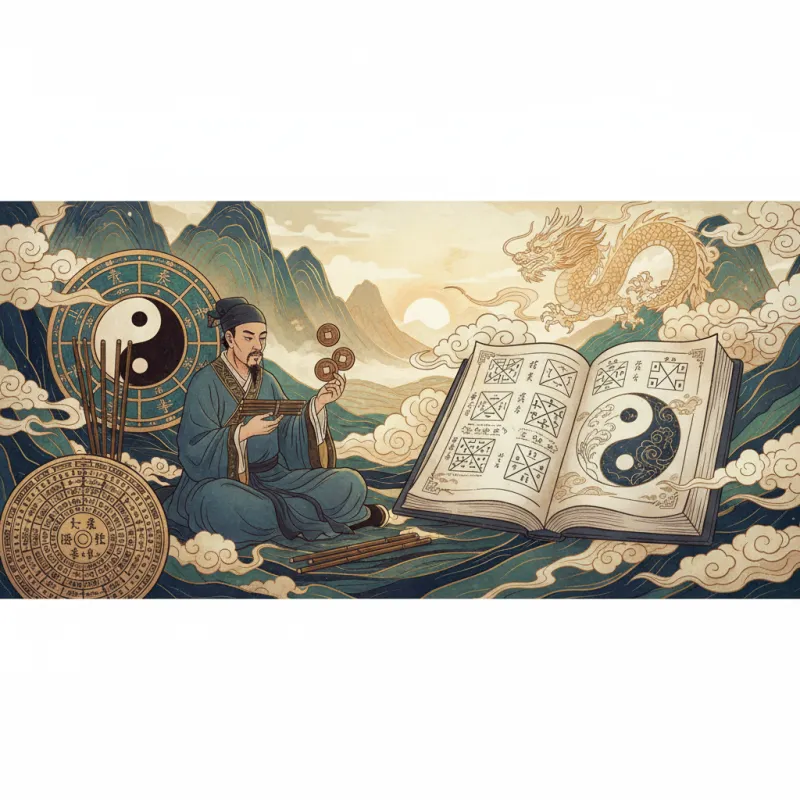
You're standing at a crossroads—literally or metaphorically—and you need guidance. Not the vague "trust your intuition" kind, but something concrete, something that speaks directly to your situation. This is exactly when people have turned to the I Ching (易经 yìjīng) for over three millennia. But here's what most guides won't tell you: consulting the I Ching isn't about fortune-telling. It's about having a conversation with the universe's operating system, and like any sophisticated technology, you need to know how to use it properly.
What You're Actually Doing When You Consult
The I Ching works through synchronicity—the meaningful coincidence between your inner state and the outer world. When you toss coins or sort yarrow stalks, you're not generating random numbers. You're creating a snapshot of the energetic pattern of this exact moment, encoded in one of 64 hexagrams (卦 guà). Each hexagram is a six-line figure made of broken (yin 阴) and solid (yang 阳) lines, representing every possible combination of change and stability.
Think of it like this: if the universe is a vast ocean, the hexagrams are wave patterns. Your question focuses your attention on a specific part of that ocean, and the divination method captures the pattern of the waves right where you're standing. The hexagram you receive isn't predicting your future—it's describing the energetic dynamics already in motion around your question.
This is fundamentally different from Western divination systems. Tarot shows you archetypal images. Astrology maps planetary positions. The I Ching shows you the structure of change itself, the way yin and yang forces are currently configured in your situation. As the Song Dynasty scholar Zhu Xi (朱熹) put it in 1177 CE, "The I Ching is a book about patterns of change, not a book of predictions."
Preparing Your Question
Most people fail at I Ching consultation before they even begin, because they ask the wrong kind of question. "Will I get the job?" is a yes/no question—the I Ching doesn't do yes/no. "Should I take this job or that job?" is a multiple choice question—also not the I Ching's format.
The I Ching responds to questions about the nature of situations and the wisdom of actions. Rephrase "Will I get the job?" as "What is the nature of my current job search situation?" or "What should I understand about pursuing this position?" Suddenly you're asking about patterns, dynamics, and appropriate action—exactly what the I Ching can illuminate.
Before you consult, spend time clarifying your question. Write it down. Make sure it's specific enough to be meaningful but open enough to receive unexpected wisdom. "What do I need to know about my relationship?" is too vague. "What is the current dynamic between me and Sarah, and what approach would be most beneficial?" gives the I Ching something to work with.
The traditional approach involves ritual preparation—lighting incense, clearing your mind, perhaps bowing to the four directions. You don't have to do this, but the principle matters: you're creating a boundary between ordinary consciousness and divinatory consciousness. Even just taking three deep breaths and stating your question aloud shifts your mental state into receptivity.
The Three-Coin Method
The most accessible method for modern practitioners uses three identical coins—traditionally Chinese coins with square holes in the center, but any three matching coins work. You'll assign values: heads = 3, tails = 2. This isn't arbitrary—it reflects the yang (active, odd numbers) and yin (receptive, even numbers) nature of the forces you're measuring.
Hold all three coins in your hands, focus on your question, and toss them six times. For each toss, add up the values. You'll get either 6, 7, 8, or 9. These numbers build your hexagram from bottom to top:
- 7 = young yang (solid line ——)
- 8 = young yin (broken line — —)
- 9 = old yang (solid line changing to broken ——x)
- 6 = old yin (broken line changing to solid — —x)
The "old" lines (6 and 9) are changing lines—they're unstable and about to transform into their opposite. This is crucial: changing lines show you where the energy is most active, where transformation is already happening. They're the I Ching's way of saying "pay special attention here."
After six tosses, you'll have a hexagram. If you have changing lines, you'll also have a second hexagram showing where the situation is heading. For example, if your first toss gives you 8 (young yin), you draw a broken line at the bottom. If your second toss gives you 9 (old yang), you draw a solid line with an X next to it in the second position. Continue until you have all six lines.
The Yarrow Stalk Method
The traditional method uses 50 dried yarrow stalks (蓍草 shīcǎo), though you only manipulate 49 of them—one is set aside to represent the Tao itself, the unchanging source from which all change emerges. This method takes about 15-20 minutes per hexagram and involves a complex sorting process that weights the probabilities differently than coins.
Here's why that matters: the yarrow stalk method produces old yang (9) and old yin (6) less frequently than the coin method, making changing lines more significant when they appear. Many serious practitioners believe this better reflects the I Ching's original design. The Zhou Dynasty diviners who first systematized the I Ching around 1000 BCE used yarrow stalks, and the method's complexity creates a meditative state that deepens the consultation.
The process involves dividing the stalks, counting by fours, and setting aside remainders—a ritual that engages both hands and mind. I won't detail the full procedure here (it deserves its own article), but if you're serious about I Ching study, learning the yarrow stalk method is like learning to grind your own ink for calligraphy. It changes your relationship with the practice.
Reading Your Hexagram
Once you have your hexagram, you need to look it up. Each of the 64 hexagrams has a number, a name, and a traditional text consisting of the Judgment (判辞 pàncí), the Image (象辞 xiàngcí), and line texts for each position. The Judgment, attributed to King Wen (周文王) around 1100 BCE, gives the overall meaning. The Image, attributed to his son the Duke of Zhou (周公), provides a symbolic interpretation. The line texts describe the specific meaning of each position.
Start with the hexagram name and Judgment—this is your situation's overall pattern. Then read the Image to understand the symbolic dynamics. If you have changing lines, read those line texts carefully—they're speaking directly to the most active elements of your situation. Finally, look at the hexagram you're changing into. This shows the natural evolution of your situation if current patterns continue.
Let's say you asked about a business partnership and received Hexagram 8, Holding Together (比 bǐ), with a changing line in the fourth position. The Judgment tells you this is a time for alliance and mutual support, but success depends on sincerity and proper timing. The fourth line warns against late arrivals—if you're going to commit to this partnership, do it wholeheartedly and promptly, or don't do it at all. The changing line transforms
Related Reading
- What Is the I Ching? A Complete Guide to the Book of Changes
- Using the I Ching for Decision Making
- The 64 Hexagrams: A Complete Overview
- The I Ching: The World's Oldest Book of Wisdom (And How to Actually Use It)
- How to Consult the I Ching: A Beginner's Guide
- Harnessing the Power of Flying Stars in Feng Shui and I Ching
- Feng Shui Aquarium Fish: Types, Numbers, and Placement Rules
- Yin and Yang Balance in Home Design
Explore Chinese Culture
- Explore Daoist philosophy and practice
- Explore traditional Chinese customs
- Explore ancient Chinese cosmology