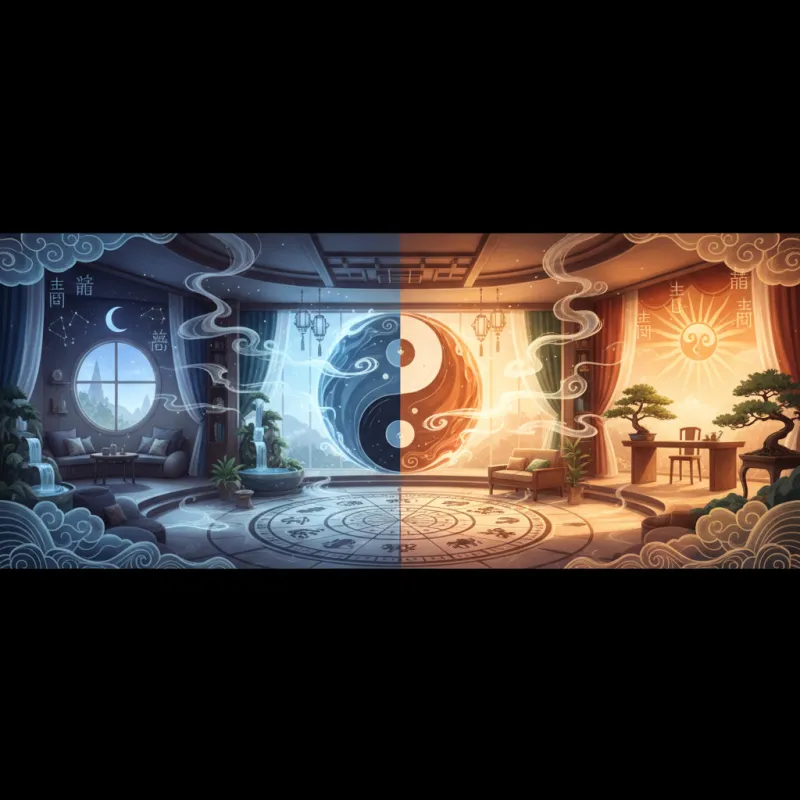
Your living room feels off, but you can't pinpoint why. The furniture is expensive, the colors are trendy, yet something about the space drains you. You might be experiencing what Chinese metaphysicians have understood for millennia: a disruption in the fundamental polarity that governs all existence—阴阳 (yīn yáng). This isn't mystical mumbo jumbo. It's an observable principle that the Huangdi Neijing (Yellow Emperor's Classic of Internal Medicine) documented around 300 BCE, and it's as relevant to your apartment today as it was to Han Dynasty palaces.
What Yin and Yang Actually Mean (Beyond the Symbol)
Everyone recognizes the black-and-white circle, but few Westerners grasp what 阴阳 truly represents. The character 阴 (yīn) originally depicted the shady side of a hill, while 阳 (yáng) showed the sunny side. This isn't about good versus evil or light versus dark in a moral sense—it's about complementary forces that define each other through contrast.
The Daodejing (道德经), attributed to Laozi around the 6th century BCE, puts it bluntly: "Being and non-being create each other. Difficult and easy support each other." In your home, this translates to practical reality. A room that's all yang—bright lights, hard surfaces, angular furniture, vibrant reds and oranges—will feel aggressive and exhausting. Conversely, an all-yin space with dim lighting, soft textures, curved lines, and deep blues will feel stagnant and depressing.
The Yijing (易经, I Ching or Book of Changes) takes this further with its 64 hexagrams, each representing different ratios of yin and yang lines. Hexagram 11, 泰 (tài, Peace), shows yang rising and yin descending—heaven and earth in proper relationship. Hexagram 12, 否 (pǐ, Standstill), reverses this, creating stagnation. Your home operates on the same principle.
The Five Qualities That Define Yin and Yang Spaces
Traditional feng shui texts like the Zangshu (葬书, Book of Burial) by Guo Pu from the Jin Dynasty (276-324 CE) outline specific characteristics. Here's how they manifest in modern homes:
Yang qualities include brightness, height, hardness, angularity, warmth, activity, and expansion. Think of your kitchen during meal preparation—lights blazing, sharp knives on granite counters, the stove radiating heat, people moving purposefully. This is yang energy at work, and it's appropriate for spaces where you need alertness and productivity.
Yin qualities encompass darkness, lowness, softness, curves, coolness, stillness, and contraction. Your bedroom at night embodies this—soft bedding, rounded furniture edges, cool temperatures, minimal light, quiet stillness. This is where yin energy supports rest and restoration.
The mistake most people make is treating their entire home as one energy zone. I've walked into apartments where every room screams yang—white walls, recessed lighting, glass tables, minimal fabric. The residents inevitably complain about insomnia and anxiety. Conversely, I've seen homes so yin-heavy with dark paint, heavy drapes, and overstuffed furniture that the occupants struggle with motivation and depression.
Room-by-Room Balance: Where Yin and Yang Belong
The Yangzhai Sanyao (阳宅三要, Three Essentials of Yang Dwellings) from the Qing Dynasty emphasizes that different rooms require different energy ratios. This isn't arbitrary—it's based on function.
Living rooms should lean slightly yang (60/40 ratio). You gather here for conversation and entertainment, activities that require alertness. Use natural light, but balance it with soft textiles. Hard flooring works, but add area rugs. Choose a mix of angular and curved furniture. The color palette can include warm tones, but temper them with cooler accents.
Bedrooms need yin dominance (70/30 yin to yang). This is non-negotiable if you value sleep. Position your bed away from direct window light. Use blackout curtains or shades. Choose soft, rounded furniture over sharp-edged pieces. Cool colors like blues, greens, and soft grays support yin energy. Remove electronics—their electromagnetic fields and blue light are aggressively yang. I've seen clients resolve chronic insomnia simply by removing the TV and replacing angular nightstands with rounded ones.
Kitchens are naturally yang spaces due to fire (the stove) and sharp implements, but they need yin elements to prevent the energy from becoming chaotic. Wooden cutting boards, fabric dish towels, and rounded bowls provide necessary softness. If your kitchen feels frantic, add more yin: a bowl of water (yin element), rounded containers, or softer lighting over the dining area.
Bathrooms present a unique challenge. Water is yin, but bathrooms serve yang functions (cleansing, preparation). The Bazi (八字, Eight Characters) system, which analyzes personal energy through birth data, often reveals that people with too much water in their chart feel drained by large bathrooms. Keep bathrooms compact, well-lit, and warm to balance the inherent yin of water. For more on how elemental balance affects your space, see Understanding the Five Elements in Feng Shui.
Home offices require careful calibration. You need yang energy for focus and productivity, but too much creates stress. Aim for 55/45 yang to yin. Use task lighting rather than harsh overhead lights. Include plants (living energy that balances both polarities). Choose a supportive chair with soft padding, but keep the desk surface clear and angular for decisive action.
The Seasonal Shift: Adjusting Balance Throughout the Year
Here's something most feng shui books ignore: yin and yang aren't static. The Lüshi Chunqiu (吕氏春秋, Spring and Autumn Annals of Master Lü) from 239 BCE documents how energy shifts with seasons. Summer is maximum yang; winter is maximum yin. Your home should reflect this.
In summer, increase yin elements to counterbalance external yang. Use lighter fabrics, cooler colors, and keep spaces darker during peak heat. Remove heavy rugs. Open windows at night to invite cooler yin energy.
In winter, boost yang to counter external yin. Add warm lighting, heavier textiles, warmer colors, and keep spaces well-lit during dark months. This isn't just aesthetic—it's therapeutic. Seasonal Affective Disorder is essentially a yin-yang imbalance where external yin overwhelms personal yang.
Common Mistakes That Destroy Balance
After consulting on hundreds of homes, I've identified patterns that consistently create problems:
The all-white trap: Scandinavian minimalism looks beautiful in magazines, but pure white is extreme yang. Without yin balance, these spaces feel cold and unwelcoming. Add texture, curves, and warmer accent colors.
The cave syndrome: Some people, reacting against harsh modern design, create overly yin spaces with dark walls, heavy curtains, and dim lighting. They wonder why they can't get motivated. You need yang energy to initiate action.
The mirror overload: Mirrors are yang—they reflect light and create visual activity. Too many mirrors, especially in bedrooms, prevent yin energy from settling. The Yangzhai Shishu (阳宅十书, Ten Books of Yang Dwellings) specifically warns against mirrors facing beds.
Ignoring natural light: Windows are yang portals, bringing active energy inside. Blocking all natural light creates stagnation. But leaving windows uncovered in bedrooms prevents proper yin accumulation for sleep. Use adjustable window treatments.
Electronic invasion: Every device emits yang energy through light, sound, and electromagnetic fields. Bedrooms packed with electronics can't achieve the yin state necessary for rest. This isn't superstition—it's measurable. Blue light suppresses melatonin, the yin hormone that induces sleep.
Testing Your Space: The 24-Hour Energy Audit
Want to know if your home's yin-yang balance is off? Pay attention to how you feel at different times. Do you feel alert in the morning but can't wind down at night? Your home might be too yang. Do you struggle to get motivated and feel perpetually sluggish? You might need more yang energy.
Try this: spend one full day noticing your energy levels in each room. Where do you feel most alert? Most relaxed? Most creative? Most drained? These responses reveal the energetic reality of your space, regardless of how it looks.
The Zhuangzi (庄子), written around 300 BCE, tells of a butcher whose knife never dulled because he worked with the natural grain of the meat, finding the spaces between joints. Your home has an energetic grain too. Work with it rather than against it.
Practical Adjustments: Small Changes, Significant Impact
You don't need to renovate to shift yin-yang balance. Start with these targeted adjustments:
For spaces that feel too yang: add fabric (curtains, throws, cushions), introduce curves (rounded mirrors, oval tables, arched doorways), use softer lighting (lamps instead of overhead fixtures), incorporate water features (fountains, aquariums), and choose cooler colors (blues, greens, soft grays).
For spaces that feel too yin: increase lighting (add lamps, use brighter bulbs), introduce angular elements (square frames, geometric patterns), reduce fabric density (lighter curtains, fewer pillows), add warm colors (reds, oranges, yellows in accents), and incorporate metal elements (frames, hardware, sculptures).
The goal isn't perfect 50/50 balance—that's stagnation. The Yijing teaches that change is constant. Healthy spaces have dynamic balance, with yin and yang in appropriate ratios for each room's function, adjusted seasonally and personally. For deeper understanding of how these principles connect to directional energy, explore The Bagua Map and Your Home Layout.
Your home should support your life's natural rhythms—active yang during waking hours, receptive yin during rest. When you align your space with these fundamental polarities, you're not following ancient superstition. You're applying principles that Chinese scholars observed, tested, and refined over three millennia. The Yijing calls this 中道 (zhōng dào)—the middle way. Not rigid balance, but responsive harmony. That's what transforms a house into a home that actually nourishes you.
Related Reading
- The History of Feng Shui: From Ancient China to Your Living Room
- The Bagua Map: Your Home's Energy Blueprint
- Feng Shui Basics: What It Actually Is (No Mystical Nonsense)
- Feng Shui Colors: What Every Color Means and Where to Use It
- Chi Energy Flow: How to Keep It Moving
- Feng Shui Front Door and Entryway Essentials
- The Chinese Zodiac: What Your Animal Sign Actually Means
- Bagua Mirror: The Most Misunderstood Feng Shui Tool
Explore Chinese Culture
- Explore Daoist philosophy and practice
- Explore traditional Chinese customs
- Explore ancient Chinese cosmology