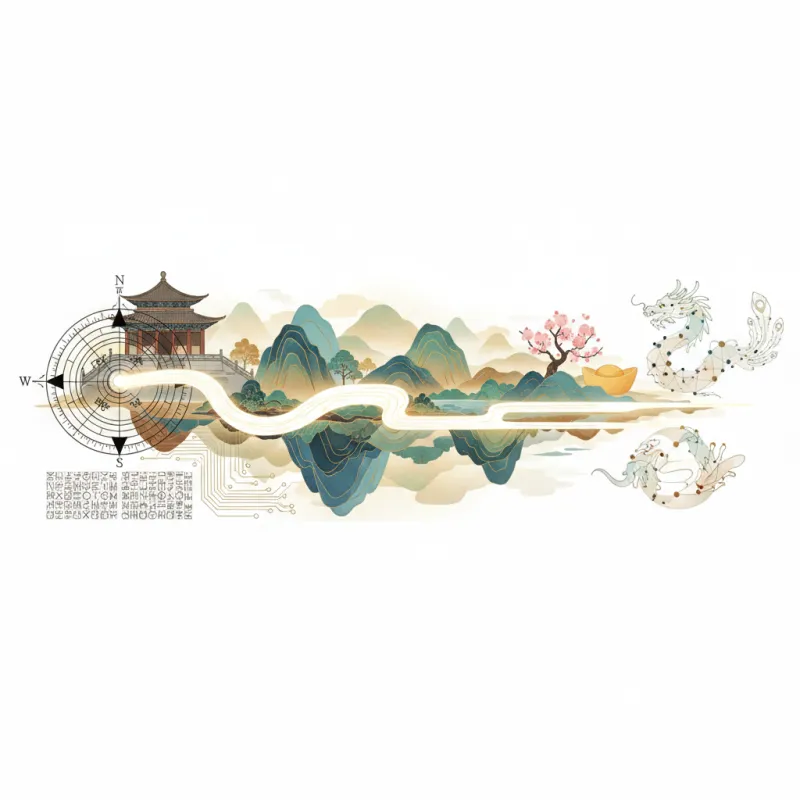
You walk into a room and immediately feel uneasy. Nothing's obviously wrong — the furniture's fine, the lighting's adequate — but something's off. Your friend walks into the same room and feels energized. What's happening? Before you blame mercury retrograde or "bad vibes," consider this: you're both responding to measurable environmental factors that feng shui (风水 fēngshuǐ) has been cataloging for over 3,000 years.
What Feng Shui Actually Measures
Strip away the mystical marketing and feng shui is an environmental assessment system. The name literally means "wind-water" — the two forces that determined whether ancient settlements survived or starved. Good feng shui meant your village had wind protection (so crops didn't blow away), water access (for irrigation and drinking), and proper drainage (so you didn't drown in monsoon season). Bad feng shui meant you were dead by winter.
The earliest feng shui practitioners weren't mystics. They were the people who knew which hillsides got morning sun, which valleys flooded, and which directions the seasonal winds came from. This knowledge was survival-critical in agricultural China, where picking the wrong building site could kill your entire family. The five elements system emerged from observing these patterns: wood grows in spring, fire peaks in summer, metal hardens in autumn, water dominates winter, and earth stabilizes the transitions.
By the Han Dynasty (206 BCE - 220 CE), this practical knowledge had been systematized into texts like the Zangshu (葬书 Zàngshū, "Book of Burial"). But here's where things get interesting: the same environmental factors that affected crop yields also affected human psychology. A room with poor air circulation makes you drowsy. A workspace with no natural light tanks your mood. A bedroom facing a busy street disrupts your sleep. Feng shui practitioners noticed these patterns centuries before we had terms like "circadian rhythm" or "environmental psychology."
The Compass That Changed Everything
Around the Song Dynasty (960-1279 CE), someone had a breakthrough idea: what if we could standardize feng shui assessments? Enter the luopan (罗盘 luópán), the feng shui compass. This wasn't some mystical divination tool — it was a precision instrument with up to 40 concentric rings encoding information about magnetic directions, seasonal solar positions, and local geography.
The luopan let practitioners make consistent measurements across different sites. Instead of relying on vague descriptions like "the mountain should be behind you," they could specify exact compass directions and degrees. This is when feng shui split into schools. The Form School (峦头派 Luántóu Pài) focused on visible landscape features — mountains, rivers, building shapes. The Compass School (理气派 Lǐqì Pài) emphasized directional measurements and temporal cycles.
Both schools were trying to solve the same problem: how do you evaluate a space's potential? The Form School said look at what you can see. The Compass School said measure what you can't see but can calculate. Modern feng shui practitioners typically use both, which makes sense — you need to assess both the visible environment and the invisible factors like magnetic fields and solar angles.
Why Your Bedroom Faces Matter
Let's get specific. In feng shui, bedroom orientation isn't about "energy flow" — it's about circadian biology. A bedroom with windows facing east gets morning sunlight, which suppresses melatonin production and helps you wake up naturally. A bedroom facing west gets harsh afternoon sun, which heats the room and disrupts evening sleep preparation. A bedroom facing north (in the Northern Hemisphere) gets minimal direct sunlight, which some people find restful and others find depressing.
The feng shui recommendation to avoid sleeping with your head pointing north? That's not mysticism — it's about the Earth's magnetic field. Some studies suggest north-south alignment affects sleep quality, though the research is mixed. What's not mixed: sleeping with your head under a window creates drafts that disrupt sleep. Sleeping directly across from a door creates subconscious alertness (you're monitoring the entrance). These are measurable environmental factors dressed up in traditional language.
The bagua map that consultants overlay on floor plans? It's a simplified tool for remembering which areas of your home correspond to which life activities. The back left corner isn't "mystically" connected to wealth — it's typically the quietest, most protected part of a traditional Chinese home, making it ideal for storing valuables and doing focused work like accounting. The front right isn't "magically" about helpful people — it's near the entrance, where you'd naturally receive guests and conduct social business.
What Modern Science Says
Here's what makes feng shui interesting: some of its principles align with current environmental psychology research, even though the explanations differ. Studies confirm that natural light exposure affects mood and productivity. Research shows that views of nature reduce stress. Data proves that air quality impacts cognitive function. Feng shui has been saying these things for centuries, just using different vocabulary.
The 2015 study by Ulrich et al. in Health Environments Research & Design Journal found that hospital patients with windows facing natural landscapes recovered faster than those facing brick walls. Feng shui would call this "good qi flow." Modern medicine calls it "biophilic design." Same observation, different frameworks.
Where feng shui gets weird is the directional stuff — the claims that facing southeast brings prosperity or that northwest corners affect helpful people. There's no scientific mechanism for these specific correlations. But there is a mechanism for the underlying principle: your environment affects your psychology, which affects your decisions, which affects your outcomes. If rearranging your desk makes you feel more confident, you'll take more risks. If your bedroom feels more restful, you'll sleep better and make better decisions. The causation isn't mystical, but it's real.
The Commercialization Problem
Modern feng shui has a credibility crisis because it's been commercialized into absurdity. The traditional practice required years of study — learning to read landscapes, understanding seasonal patterns, memorizing the complex calculations encoded in the luopan. Today's "feng shui consultants" often learn from weekend workshops and sell products: crystals (not traditional), wind chimes (sometimes traditional, usually not), and bamboo plants (definitely not traditional — bamboo was just a common building material).
The worst offenders are the ones who blend feng shui with completely unrelated practices. Feng shui has nothing to do with chakras (that's Indian), nothing to do with sage burning (that's Native American), and nothing to do with manifesting abundance through positive thinking (that's New Age capitalism). These additions aren't "modern interpretations" — they're cultural appropriation and marketing.
Real feng shui is boring. It's about making sure your desk has good lighting, your bedroom has proper ventilation, and your front entrance is clearly visible and welcoming. It's about not putting your bed under a structural beam (which creates subconscious stress about something falling on you). It's about arranging furniture so traffic flow feels natural rather than awkward. These are practical design principles that happen to have Chinese names.
How to Use Feng Shui Without the Nonsense
Start with the basics that have obvious mechanisms. Does your workspace have adequate natural light? Is your bedroom dark and quiet enough for sleep? Can you see the entrance to a room from your main sitting or working position (which reduces subconscious vigilance)? Is your furniture arrangement creating awkward traffic patterns that make you feel cramped?
The traditional feng shui principle of "commanding position" — placing your desk or bed where you can see the door without being directly in line with it — is just applied psychology. You feel more secure when you can monitor entrances. You feel less secure when your back is to the door or when you're in the direct path of traffic. This isn't mystical; it's how primate brains work.
If you want to go deeper, study the I Ching (易经 Yìjīng) and understand the philosophical framework behind feng shui. The I Ching isn't a fortune-telling book — it's a system for analyzing change and cycles. Feng shui applies these patterns to physical space. Understanding the theory helps you distinguish between legitimate principles and made-up nonsense.
The Real Question Feng Shui Asks
At its best, feng shui forces you to pay attention to your environment. Most people sleepwalk through their spaces, never questioning why they feel energized in some rooms and drained in others. Feng shui — stripped of the commercial mysticism — is just a structured way to audit your environment and identify what's working and what's not.
The question isn't whether feng shui is "real" in some mystical sense. The question is whether your environment affects your wellbeing, and the answer to that is obviously yes. You already know this. You've felt the difference between a cluttered room and a clean one, between a dark basement and a sunlit space, between a home that feels welcoming and one that feels oppressive.
Feng shui is just a 3,000-year-old system for cataloging these observations. Some of its principles are brilliant. Some are outdated. Some are pure superstition. Your job is to figure out which is which — and that requires understanding what feng shui actually is, not what Instagram consultants claim it is.
Related Reading
- Feng Shui vs. Superstition: Where's the Line?
- Feng Shui Colors: What Every Color Means and Where to Use It
- Your Feng Shui Is Probably Wrong: Common Mistakes Westerners Make
- Yin and Yang Balance in Home Design
- The Complete Guide to Feng Shui: Ancient Wisdom for Modern Living
- Exploring Feng Shui, I Ching, and Chinese Metaphysics in Bazi Practice
- Discovering the Colors of Feng Shui and I Ching: Their Power and Symbolism
- ** Exploring the Harmonious Relationship Between Feng Shui and Plants in Chinese Metaphysics
Explore Chinese Culture
- Explore Daoist philosophy and practice
- Explore traditional Chinese customs
- Explore ancient Chinese cosmology