Disclaimer: Feng Shui is a traditional Chinese cultural practice, not a science. This article explores it as cultural heritage and philosophical tradition.
You walk into a room and immediately feel uneasy, though nothing is obviously wrong. The furniture is fine, the lighting adequate, yet something feels off. A Feng Shui practitioner would tell you that you're sensing the flow of qi (氣, qì) — the vital energy that ancient Chinese philosophers believed animates all things. Whether you accept this metaphysical explanation or not, the discomfort is real, and Feng Shui offers a framework for understanding and addressing it.
What Feng Shui Actually Means
Feng Shui (風水, Fēng Shuǐ) translates literally as "wind-water," two forces that ancient Chinese observers recognized as fundamental shapers of landscape and climate. The term first appeared in the Book of Burial (葬書, Zàng Shū) by Guo Pu during the Jin Dynasty (276-324 CE), where he wrote: "Qi rides the wind and scatters, but is retained when encountering water." This poetic observation became the foundation of an entire system.
The name itself reveals the practice's origins in agricultural China, where wind patterns determined whether crops would thrive or fail, and water sources meant the difference between prosperity and starvation. Feng Shui emerged as a way to read the land — to identify locations where these forces converged favorably. Over centuries, it evolved from practical geomancy into a complex system incorporating astronomy, mathematics, philosophy, and what we might call environmental psychology.
The Philosophical Foundation
Feng Shui doesn't exist in isolation. It's deeply rooted in three interconnected Chinese philosophical concepts that you need to understand:
Qi (氣, qì) is the animating force or vital energy that flows through everything — landscapes, buildings, bodies. In Feng Shui terms, qi should flow smoothly but not too rapidly. A long, straight corridor creates "rushing qi" (沖氣, chōng qì) that's considered harmful, while a completely blocked space creates stagnant qi. The ideal is gentle, meandering flow, like a stream through a valley.
Yin and Yang (陰陽, Yīn Yáng) represent complementary opposites that must balance. A room that's too yang — bright, loud, active — becomes exhausting. Too yin — dark, quiet, still — becomes depressing. Feng Shui practitioners assess spaces for this balance, adjusting elements to achieve harmony. North-facing rooms naturally lean yin (cooler, darker), so they might need yang enhancements like warm colors or better lighting.
The Five Elements (五行, Wǔ Xíng) — Wood, Fire, Earth, Metal, and Water — form a dynamic system where each element supports, controls, or is controlled by others. Wood feeds Fire, Fire creates Earth (ash), Earth bears Metal, Metal collects Water, Water nourishes Wood. Understanding these relationships allows practitioners to diagnose and correct imbalances. A room dominated by Metal elements (white walls, metal furniture) might feel cold and harsh; adding Wood elements (plants, wooden objects) can soften it through the controlling cycle.
The Two Major Schools
Feng Shui split into two primary approaches during the Song Dynasty (960-1279 CE), and the distinction matters:
Form School (巒頭派, Luán Tóu Pài) is the older tradition, focused on physical landscape features. Practitioners assess mountains, water bodies, building shapes, and their relationships. The ideal site has a mountain behind (providing support and protection), water in front (bringing prosperity), and guardian hills on either side. This school relies heavily on visual observation and intuitive understanding of how landforms affect energy flow. It's more accessible to beginners because you can literally see what you're working with.
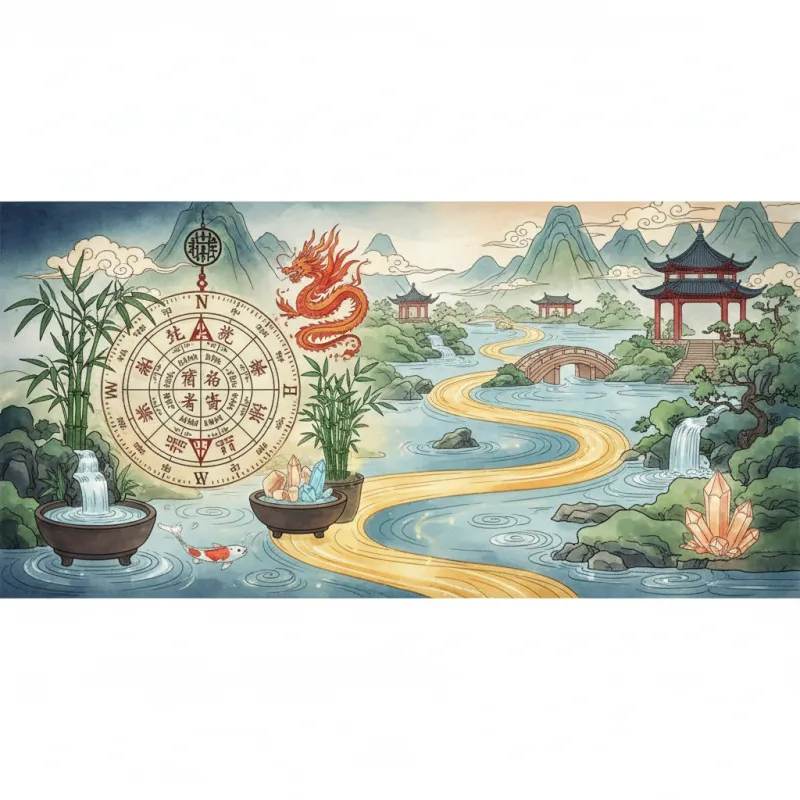
Compass School (理氣派, Lǐ Qì Pài) emerged later, incorporating complex calculations based on the Luo Pan (羅盤) — the Feng Shui compass with up to 40 concentric rings of information. This school uses the Ba Gua (八卦, Eight Trigrams from the I Ching), directional energies, and time-based calculations to determine auspicious orientations and placements. It's more technical, requiring knowledge of Chinese astrology and numerology. Many practitioners today combine both schools, using Form School for overall site assessment and Compass School for fine-tuning.
What Feng Shui Practitioners Actually Do
Forget the stereotype of someone rearranging your furniture and placing lucky bamboo plants. A traditional Feng Shui consultation involves systematic analysis:
First comes site assessment. The practitioner examines the broader environment — nearby mountains, water bodies, roads, neighboring buildings. In urban settings, tall buildings substitute for mountains, and roads function as rivers, carrying energy (and traffic) past your location. A building at a T-junction, where a road points directly at it, faces "arrow qi" (箭氣, jiàn qì) — aggressive energy that needs deflection or mitigation.
Next is directional analysis using the Luo Pan compass. The practitioner determines the building's "sitting" and "facing" directions, which aren't always obvious. These orientations, combined with the building's construction date, determine its energy chart according to systems like Flying Stars (飛星, Fēi Xīng). Different sectors of the building receive different energy qualities that change over time.
Interior analysis examines room functions, furniture placement, color schemes, and element balance. The bedroom gets special attention because we spend a third of our lives there in a vulnerable state. Bed positioning follows specific rules: headboard against a solid wall (providing support), clear view of the door without being directly in line with it, avoiding placement under exposed beams (creating oppressive energy).
Finally comes the recommendations phase. Contrary to popular belief, Feng Shui adjustments aren't always about adding decorative objects. Sometimes the solution is architectural — moving a door, adding a window, changing a room's function. When structural changes aren't possible, practitioners suggest element adjustments through color, materials, shapes, or symbolic objects.
The Misconceptions and Controversies
Let's address the elephant in the room: much of what's marketed as Feng Shui in the West bears little resemblance to traditional practice. The "Black Hat Sect" popularized in America since the 1980s simplified and westernized Feng Shui, removing the compass work and directional calculations, replacing them with a fixed bagua map overlay. Traditional practitioners often dismiss this approach as inauthentic, though it has made Feng Shui more accessible to Western audiences.
The commercialization problem runs deeper. Walk into any "Feng Shui" store and you'll find mass-produced "cures" — crystal balls, coin swords, dragon turtles — marketed as magical solutions. Traditional Feng Shui does use symbolic objects, but they're tools within a larger system, not standalone fixes. A mirror placed without understanding the energy dynamics might create more problems than it solves.
There's also the question of belief. Does Feng Shui "work" because of actual energy manipulation, or because environmental psychology and design principles create measurable effects on mood and behavior? A room with good natural light, proper ventilation, organized space, and calming colors will feel better regardless of whether you attribute it to qi flow or neuroscience. Perhaps the distinction doesn't matter as much as the results.
Why Feng Shui Persists
Despite skepticism and commercialization, Feng Shui remains influential in Chinese communities worldwide and has gained serious practitioners in the West. Major Hong Kong developers still consult Feng Shui masters before breaking ground, and the Hong Kong and Shanghai Bank building's distinctive design incorporated Feng Shui principles at enormous expense.
The persistence suggests Feng Shui addresses something real, even if we debate the explanation. At minimum, it's a sophisticated system for thinking about how built environments affect human wellbeing — something Western architecture and urban planning are only recently taking seriously through concepts like biophilic design and environmental psychology.
Feng Shui also offers something modern life often lacks: a sense of connection between humans and their environment, a framework for creating harmony rather than just functionality. In an age of generic, interchangeable spaces, Feng Shui insists that location, orientation, and design matter deeply. Whether you accept the metaphysics or not, that core insight resonates.
Getting Started
If you're curious about Feng Shui beyond the stereotypes, start with observation. Spend time in different spaces and notice how they make you feel. Which rooms energize you? Which drain you? What physical features might explain these effects — light quality, air flow, spatial proportions, colors, clutter levels?
Read foundational texts like the Book of Burial or the Yellow Emperor's Classic of House Siting (黃帝宅經, Huáng Dì Zhái Jīng) in translation. Study the Five Elements theory and how elements interact. Learn to use a basic compass and understand the eight directions' traditional associations.
Most importantly, approach Feng Shui as a lens for seeing, not a set of rigid rules. The best practitioners adapt principles to specific situations rather than applying formulas mechanically. Your home should feel like yours, not like a Feng Shui showroom. The goal is harmony between you and your environment, however you define and achieve it.
Related Reading
- The Bagua Map: Your Home's Energy Blueprint
- Feng Shui vs. Superstition: Where's the Line?
- Yin and Yang Balance in Home Design
- The Complete Guide to Feng Shui: Ancient Wisdom for Modern Living
- The History of Feng Shui: From Ancient China to Your Living Room
- Water Feng Shui for Wealth: Fountains, Aquariums, and Flow
- Address Numerology in Feng Shui
- Feng Shui 2026 Forecast: Year of the Fire Horse
Explore Chinese Culture
- Explore Daoist philosophy and practice
- Explore traditional Chinese customs
- Explore ancient Chinese cosmology