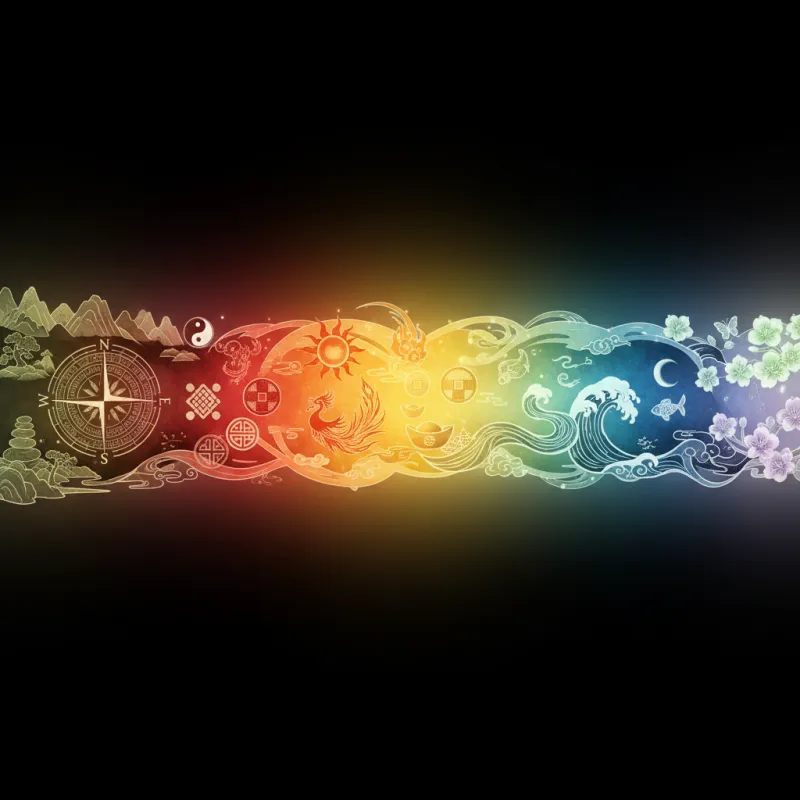
Walk into a room painted entirely in red and your heart rate ticks up. Walk into a room painted pale blue and your shoulders drop. You don't need to believe in feng shui (风水 fēngshuǐ) to feel this — but feng shui figured it out a few thousand years before color psychology became a field.
In traditional Chinese spatial philosophy, colors aren't decorative choices. They're carriers of qi (气 qì), and each color corresponds to one of the five elements (五行 wǔxíng). Using the right color in the right space creates harmony. Using the wrong one creates friction that you might not see but will absolutely feel.
The Five Elements Color Map
Every color in feng shui belongs to an element, and every element has specific qualities. This isn't arbitrary symbolism — it's based on observations of nature that date back to the Warring States period (475-221 BCE), when philosophers were trying to decode the patterns underlying everything from seasons to human temperament.
Wood (木 mù) — Green and Teal
Wood governs growth, expansion, and new beginnings. Its colors are the greens of spring shoots and forest canopies. In the Bagua map, Wood corresponds to the east (family, health) and southeast (wealth, abundance).
Use green in spaces where you want things to grow — literally or metaphorically. Home offices where you're building a business. Children's study areas. Kitchens where you're nourishing your family. The living room's east wall if family relationships need strengthening.
Avoid overusing green in bedrooms. Wood energy is active and rising, which can make it harder to settle into deep rest. A few green accents are fine, but painting all four walls forest green might leave you feeling restless at 2 AM.
Fire (火 huǒ) — Red, Orange, Purple, Pink
Fire is the most yang of the elements — pure activation energy. Its colors range from the deep crimson of lacquered furniture to the soft coral of a sunset. Fire governs recognition, passion, and transformation.
Red is the power color in Chinese culture for good reason. It's been used in imperial architecture, wedding ceremonies, and New Year celebrations for millennia. But here's what most feng shui guides won't tell you: red is exhausting. It demands attention. It speeds everything up.
Use red strategically. A red front door invites opportunity and protects against negative energy — this is classical feng shui, not modern invention. Red accents in the south sector of your home support your reputation and career visibility. A red throw pillow or piece of art in the living room creates warmth without overwhelming.
Don't paint your bedroom red unless you want your relationship to feel like a constant negotiation. Don't use red in meditation spaces. And if you're already anxious or dealing with high blood pressure, minimize red in your daily environment.
Pink and coral are gentler expressions of Fire energy — they activate without agitating. Purple combines Fire and Water, making it useful for spiritual spaces and creative studios.
Earth (土 tǔ) — Yellow, Beige, Terracotta, Brown
Earth is the stabilizing element, the center point in the five-element cycle. Its colors are the ochres and siennas of clay, the warm beiges of sand, the rich browns of soil. Earth governs nourishment, stability, and relationships.
In traditional Chinese homes, earth tones dominated because they created a sense of groundedness that supported family life. The center of your home — often the living room or dining area — benefits most from Earth colors. This is where the family gathers, where relationships are maintained.
Use earth tones in spaces where you need to feel secure. Bedrooms benefit from soft beiges and warm tans. Dining rooms painted in terracotta or decorated with earth-toned pottery encourage longer, more nourishing meals. Home offices can use earth tones to create stability, especially if your work feels chaotic.
The mistake people make with earth tones is going too heavy. A room entirely in dark brown can feel stagnant rather than stable. Mix earth tones with other elements — add green plants (Wood feeds Earth in the productive cycle) or metal accents (Earth produces Metal).
Metal (金 jīn) — White, Gray, Metallic Tones
Metal governs precision, clarity, and completion. Its colors are the whites of polished silver, the grays of stone, the gleam of gold and bronze. Metal energy is contracting and focusing — it brings things to their essential form.
White is tricky in feng shui. In the West, it's associated with purity and cleanliness. In Chinese tradition, it's the color of mourning. But context matters. White walls in a modern home create a sense of spaciousness and clarity that can be beneficial, especially in small spaces or areas where you need to think clearly.
Use Metal colors in home offices, especially if your work requires precision and attention to detail. Bathrooms naturally align with Metal energy (they're about purification and release). The west and northwest sectors of your home correspond to Metal — these areas govern children and helpful people respectively.
Gray has become popular in contemporary design, but too much gray can feel cold and isolating. If you're using gray as your primary color, warm it up with wood tones or earth accents. Metallic finishes — brass hardware, copper pots, silver frames — add Metal energy without the starkness of white or gray walls.
Water (水 shuǐ) — Black, Navy, Deep Blue
Water is the most yin element — it's about depth, mystery, and the wisdom that comes from stillness. Its colors range from the black of a moonless night to the deep blue of ocean depths. Water governs career, life path, and inner knowledge.
Black gets a bad reputation in Western design, but in feng shui, it's the color of potential and possibility. The Dao De Jing (道德经 Dàodéjīng) describes the Dao as "dark and mysterious" — this isn't negative, it's profound. Black represents the void from which all things emerge.
Use black as an accent, not a primary color. A black front door can be powerful if your home faces north (the Water direction). Black furniture or decor in your home office's north sector supports career development. Black frames around mirrors or artwork create definition without heaviness.
Navy and deep blue are more approachable expressions of Water energy. They work well in bedrooms because Water energy is calming and introspective. A navy accent wall behind your bed can improve sleep quality. Deep blue in a meditation space or library supports contemplation.
Avoid too much Water color in kitchens (Water clashes with Fire) or in spaces where you need active, yang energy. And if you're prone to depression or low energy, minimize dark blues and blacks in your daily environment.
The Productive and Destructive Cycles
Here's where feng shui color theory gets sophisticated. The five elements don't exist in isolation — they interact through two primary cycles that determine whether colors will harmonize or clash.
The productive cycle (生 shēng) shows how elements support each other: Wood feeds Fire, Fire creates Earth (ash), Earth produces Metal (minerals), Metal holds Water (condensation), Water nourishes Wood. When choosing colors, following this cycle creates natural harmony. Green and red work together. Earth tones and metallic finishes complement each other.
The destructive cycle (克 kè) shows how elements control each other: Wood depletes Earth, Earth dams Water, Water extinguishes Fire, Fire melts Metal, Metal cuts Wood. This doesn't mean these combinations are forbidden — sometimes you need that controlling energy. But you should use them intentionally.
If your bedroom has too much Fire energy (red walls, southern exposure, lots of electronics), add Water colors to balance it. If your office feels scattered and unstable, add Earth tones to ground the Wood energy. The key is recognizing what's out of balance and using color to restore harmony.
Directional Color Placement
The Bagua map assigns each direction to an element, which means each direction has optimal colors. This is based on the Later Heaven sequence (后天八卦 hòutiān bāguà), which describes the world of change and manifestation.
North is Water — use blacks, navy, and deep blues here to support career and life path. Northeast is Earth — earth tones here support knowledge and self-cultivation. East is Wood — greens support family and health. Southeast is also Wood — use greens and blues for wealth and abundance. South is Fire — reds and purples support recognition and fame. Southwest is Earth — earth tones and reds support relationships. West is Metal — whites and metallics support children and creativity. Northwest is Metal — these colors support helpful people and travel.
You don't need to paint each wall a different color. Small adjustments work. A black vase in the north sector. A red candle in the south. Green plants in the east. The goal is subtle reinforcement, not a rainbow explosion.
Personal Element Considerations
Here's what most feng shui color guides miss: your personal element matters as much as the space's element. In bazi (八字 bāzì) — Chinese astrology based on your birth date and time — you have a day master element that describes your core nature. Some people are Wood types, others are Fire, Earth, Metal, or Water.
If you're a Water day master and you paint your bedroom red (Fire), you might feel constantly drained because Fire consumes Water in the destructive cycle. If you're a Metal day master and you surround yourself with Fire colors, you'll feel melted down and exhausted.
This is why cookie-cutter feng shui advice often fails. The "perfect" bedroom color for one person might be terrible for another. If you know your bazi chart, choose colors that support your day master element. If you don't know your chart, pay attention to how different colors make you feel over time. Your body knows what it needs.
Practical Application Without Repainting Everything
You don't need to repaint your entire home to apply feng shui color principles. In fact, dramatic changes often create more disruption than harmony. Start small and observe the effects.
Add color through textiles — throw pillows, blankets, curtains, rugs. These are easy to change if something doesn't feel right. Use artwork strategically. A painting with strong red tones in the south sector activates Fire energy without committing to red walls. Bring in colored objects — vases, books, decorative items — in the sectors that need support.
Plants are living expressions of Wood energy and they work in almost any space. Flowers add Fire energy through their colors. Stones and crystals bring Earth and Metal energy. Water features obviously add Water element, but even a painting of water or a mirror (which represents Water) can shift the energy.
The most important principle: trust your response. If a color makes you feel anxious, exhausted, or uncomfortable, it doesn't matter what the theory says — change it. Feng shui is about creating harmony between you and your environment, not following rules that make you miserable.
Beyond Decoration to Transformation
Color in feng shui isn't about making your home look good for Instagram. It's about creating an environment that supports your actual life — your sleep, your relationships, your work, your growth. The ancient practitioners who developed these principles were observing how humans respond to their surroundings over generations. They noticed patterns that modern color psychology is only beginning to quantify.
When you choose colors based on feng shui principles, you're not just decorating. You're programming your environment to support specific outcomes. You're using the same principles that shaped imperial palaces and temple complexes. You're working with qi instead of against it.
Start with one room. Notice how the colors currently make you feel. Consider what you want that space to support. Choose colors that align with both the space's function and your personal needs. Make small changes. Observe the effects over weeks, not days. Adjust as needed.
The goal isn't perfection. It's harmony. And harmony looks different for everyone.
Related Reading
- What Is Feng Shui? A Complete Beginner's Guide
- Feng Shui Basics: What It Actually Is (No Mystical Nonsense)
- The History of Feng Shui: From Ancient China to Your Living Room
- Your Feng Shui Is Probably Wrong: Common Mistakes Westerners Make
- Chi Energy Flow: How to Keep It Moving
- Unlocking the Wisdom of Feng Shui and I Ching: A Journey Through Chinese Metaphysics
- Bedroom Feng Shui: Better Sleep Through Design
- Face Reading: The Ancient Chinese Art of Judging Character by Appearance
Explore Chinese Culture
- Explore Daoist philosophy and practice
- Explore traditional Chinese customs
- Explore ancient Chinese cosmology