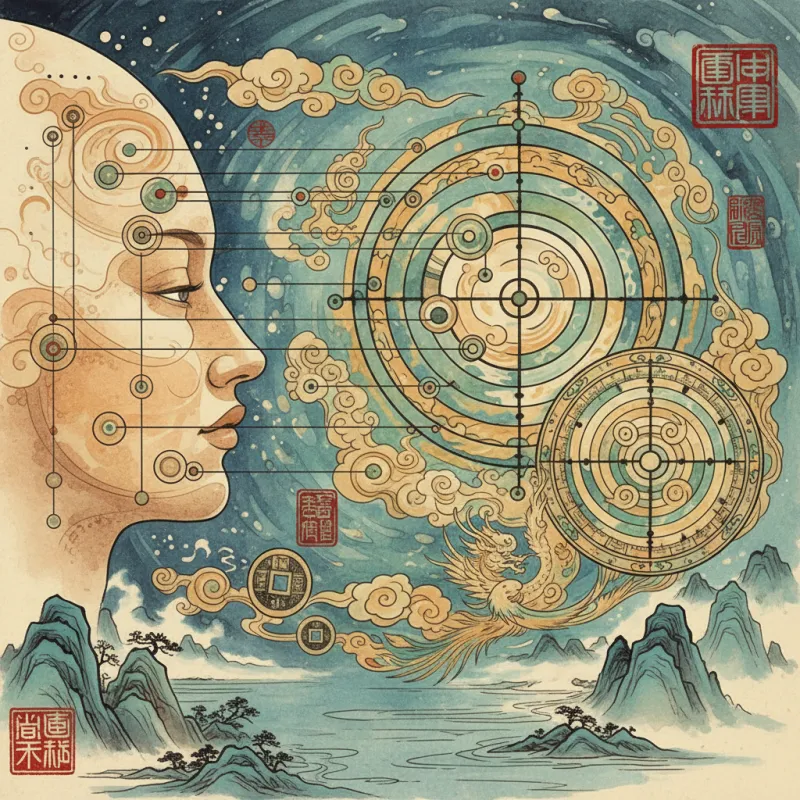
Your grandmother might have warned you never to trust someone with shifty eyes, but in traditional Chinese culture, that intuition has been refined into a sophisticated system spanning millennia. Face reading, or 面相 (miànxiàng), transforms the human face into a detailed map where every curve, line, and proportion reveals not just personality traits, but the trajectory of one's entire life—past fortunes, present circumstances, and future destiny.
The Philosophy Behind the Face
Face reading didn't emerge from superstition but from the same philosophical foundations that gave us Traditional Chinese Medicine and feng shui. The core belief is simple yet profound: your inner nature inevitably manifests in your outer appearance. The Daoist concept of 相由心生 (xiàng yóu xīn shēng)—"appearance is born from the heart"—suggests that decades of thoughts, emotions, and character traits literally sculpt your facial features over time.
This isn't entirely mystical. Modern psychology confirms that habitual expressions create permanent lines—crow's feet from years of genuine smiling, frown lines from chronic worry, a tight jaw from suppressed anger. Ancient Chinese face readers simply took this observation further, developing an intricate system that connects specific facial features to personality traits, health conditions, and life outcomes.
The practice reached its zenith during the Tang Dynasty (618-907 CE), when masters like Yuan Tiangang served as imperial advisors, reading the faces of officials and generals to predict their loyalty and competence. His treatise, still studied today, established many conventions that modern practitioners follow.
The Facial Map: Dividing Life into Regions
Traditional face reading divides the face into distinct zones, each governing different life aspects and age periods. The forehead represents your early years (ages 15-30) and relationship with authority figures. A broad, smooth forehead suggests an auspicious childhood and strong parental support, while a narrow or scarred forehead might indicate early struggles.
The middle face—from eyebrows to nose tip—governs your prime working years (ages 30-50). This is where face readers look for career success, wealth accumulation, and social standing. The nose, positioned at the center, is particularly crucial as the 財帛宮 (cáibó gōng), or "palace of wealth."
The lower face reveals your later years (ages 50 onward) and your capacity for relationships and legacy. A strong, well-defined chin suggests you'll maintain vitality and influence into old age, while a weak or receding chin might indicate diminishing energy or support in later life.
But here's what makes Chinese face reading distinct from Western physiognomy: it's not static. Your face changes as you age, and skilled readers track these changes to predict upcoming shifts in fortune. A mole that suddenly appears, a line that deepens, even subtle changes in skin tone—all carry meaning.
The Five Officers: Your Facial Cabinet
The 五官 (wǔguān), or Five Officers, are the face's most important features, each governing specific life domains like ministers in an imperial court. Get to know these officers, and you'll understand why certain faces inspire immediate trust while others trigger caution.
Eyebrows (眉, méi) serve as the Longevity Officer, revealing your lifespan, sibling relationships, and emotional temperament. Thick, well-shaped eyebrows that follow the eye's natural curve suggest a long life and harmonious family relationships. Eyebrows that meet in the middle (連心眉, liánxīn méi) traditionally indicate a troubled mind prone to overthinking—though modern readers note this feature often appears in deep thinkers and strategists. Those interested in how facial features connect to destiny should explore Face Reading and Destiny: What Your Features Reveal.
Eyes (眼, yǎn) are the Inspecting Officer, windows to your intelligence, integrity, and spiritual depth. Large, clear eyes with visible whites suggest honesty and openness, while small, darting eyes might indicate cunning or anxiety. But context matters—in Chinese opera, the most virtuous characters often have elongated, slightly narrowed eyes, suggesting wisdom and composure rather than deception.
Nose (鼻, bí) functions as the審辨官 (shěnbiàn guān), or Judging Officer, governing wealth, authority, and self-confidence. A straight nose with a rounded tip and full nostrils indicates strong earning power and the ability to accumulate wealth. A nose that's too sharp or hooked suggests money comes and goes, while a flat or collapsed bridge might indicate financial struggles during middle age.
Ears (耳, ěr) are the Listening Officer, representing wisdom, longevity, and your fortune during childhood. Large, well-formed ears that sit high on the head (with the top of the ear above the eyebrow line) suggest intelligence and good fortune from birth. The Buddha is always depicted with elongated earlobes, symbolizing wisdom and spiritual attainment—a feature highly prized in face reading.
Mouth (口, kǒu) serves as the Cashier Officer, governing communication skills, trustworthiness, and your ability to retain wealth. A well-defined mouth with balanced lips suggests eloquence and reliability. Thin, tight lips might indicate someone who guards secrets well but struggles with generosity, while overly large or loose lips could suggest someone who speaks without thinking or has difficulty saving money.
The Twelve Palaces: Specialized Life Domains
Beyond the Five Officers, advanced face reading examines the 十二宮 (shí'èr gōng), or Twelve Palaces—specific facial zones governing everything from career success to romantic relationships. Understanding these palaces transforms face reading from simple feature analysis into a comprehensive life assessment system.
The 命宮 (mìng gōng), or Life Palace, sits between your eyebrows at the印堂 (yìntáng) point. This tiny area reveals your overall fortune and life trajectory. A smooth, slightly raised yìntáng suggests a blessed life with few major obstacles, while a sunken or scarred area might indicate persistent challenges. Many Chinese people instinctively avoid injuries to this area, understanding its significance.
The 夫妻宮 (fūqī gōng), or Marriage Palace, occupies the outer corners of your eyes. Smooth, unblemished skin here suggests harmonious relationships, while crow's feet, moles, or scars might indicate romantic turbulence. Interestingly, modern face readers note that laugh lines in this area—caused by genuine joy—are actually auspicious, suggesting a happy marriage despite the traditional interpretation.
The 財帛宮 (cáibó gōng), or Wealth Palace, centers on your nose, particularly the nostrils and nose tip. Full, rounded nostrils that don't flare excessively suggest you can both earn and retain wealth. Visible nostrils when viewing the face straight-on traditionally indicate money flowing out as fast as it comes in—though some modern practitioners argue this feature simply suggests generosity rather than poor financial management.
Reading Beyond Features: Color, Luster, and Qi
Here's where face reading transcends simple feature analysis and enters the realm of energetic assessment. Skilled practitioners don't just examine your bone structure—they read your 氣色 (qìsè), the color and luster of your skin, which reveals your current fortune and immediate future.
A face with 光澤 (guāngzé), or healthy luster, suggests good fortune is flowing. The skin appears vibrant and slightly luminous, regardless of actual complexion. Dull, ashen skin indicates blocked energy and potential misfortune ahead. Experienced readers can predict job losses, relationship breakups, or health crises weeks in advance by detecting subtle changes in facial color and vitality.
Different colors carry specific meanings. A yellowish tint around the yìntáng suggests worry and overthinking. Redness might indicate upcoming conflict or inflammation. A grayish cast warns of potential health issues. Dark circles under the eyes don't just mean you're tired—they suggest depleted kidney energy and potential reproductive or urinary system problems, following Traditional Chinese Medicine principles.
This aspect of face reading requires years of practice and can't be learned from books alone. It's why traditional masters took apprentices who would observe thousands of faces under their guidance, developing the subtle perception needed to detect these energetic shifts.
The Controversy: Destiny Versus Free Will
Face reading raises an uncomfortable question: if your features reveal your destiny, can you change your fate? Traditional practitioners offer a nuanced answer. Your bone structure—the foundation of your face—represents your 命 (mìng), or fundamental destiny, determined at birth. This is largely fixed. But your 運 (yùn), or fortune, changes throughout life and is reflected in your skin's condition, the lines that develop, and subtle shifts in your features.
This is why face reading doesn't doom you to a predetermined fate. A person born with a "weak" nose might struggle with money initially but can strengthen their financial fortune through effort, eventually developing better facial indicators. Conversely, someone born with auspicious features can squander their advantages through poor choices, and their face will reflect this decline.
The practice also acknowledges that virtue and cultivation can transform your appearance. The concept of 相隨心轉 (xiàng suí xīn zhuǎn)—"appearance follows the heart's transformation"—suggests that genuine spiritual or moral development literally changes your face for the better. This is why elderly people who've lived virtuously often have remarkably peaceful, attractive faces despite their age, while those who've lived selfishly may appear harsh or unpleasant regardless of their features.
Practical Applications in Modern Life
Face reading remains surprisingly relevant in contemporary Chinese business culture. Many executives consult face readers before hiring key personnel or entering partnerships. While they might not admit it publicly, the practice influences decisions in boardrooms from Hong Kong to Singapore.
Some applications are straightforward. A job candidate with a strong nose and clear eyes might be favored for financial positions. Someone with a broad forehead and well-defined ears might be chosen for strategic roles requiring long-term thinking. These assessments blend traditional face reading with modern psychology—after all, facial features do correlate with certain personality traits, even if the mechanism isn't mystical.
But face reading also offers personal insights. Understanding your facial features helps you recognize your natural strengths and potential challenges. Someone with a weak chin might consciously develop persistence and follow-through. A person with thin lips might work on generosity and emotional expression. The practice becomes a tool for self-awareness rather than fatalistic prediction.
For those curious about how facial analysis connects to other Chinese metaphysical systems, exploring The Connection Between Face Reading and Bazi reveals fascinating correlations between facial features and birth chart elements.
Learning to Read: Where to Begin
If you're intrigued enough to develop this skill yourself, start with observation. Spend time genuinely looking at faces—not just glancing, but studying the proportions, symmetry, and unique characteristics of people around you. Notice how certain facial features correlate with personality traits you observe over time.
Focus first on the Five Officers. Can you identify people with strong versus weak noses? How do their financial situations compare? Do people with clear, steady eyes tend to be more trustworthy than those with darting gazes? Build your database of observations before diving into complex palace analysis.
Remember that context matters enormously. A feature considered inauspicious in traditional texts might manifest differently in modern life. Sharp, angular features once associated with hardship might now indicate the determination needed for entrepreneurial success. Cultural differences also play a role—beauty standards and facial feature distributions vary across ethnicities, requiring adjusted interpretation.
The most important principle: face reading should increase your compassion, not your judgment. The practice reveals that everyone carries their struggles and blessings visibly. That person with the scarred yìntáng has faced real obstacles. The individual with the weak chin genuinely struggles with persistence. Understanding this should make you more empathetic, not more critical.
Your face tells your story—the life you've lived, the person you've become, and the potential you carry forward. Learning to read this story, whether in your own mirror or in the faces around you, offers a uniquely Chinese perspective on the profound connection between inner nature and outer form.
Related Reading
- Chinese Palm Reading: What Your Hands Reveal
- Chinese Numerology: Lucky and Unlucky Numbers
- Discovering the Ancient Wisdom of Feng Shui and I Ching for Effective Face Reading
- Chinese Face Reading: What Your Face Reveals
- What Your Face Reveals: Advanced Chinese Face Reading
- Unlocking Office Harmony: The Role of Feng Shui and I Ching in Modern Workspaces
- The Five Elements Are Not Elements (And Why That Matters)
- Harnessing the Power of Flying Stars in Feng Shui and I Ching
Explore Chinese Culture
- Explore Daoist philosophy and practice
- Explore traditional Chinese customs
- Explore ancient Chinese cosmology