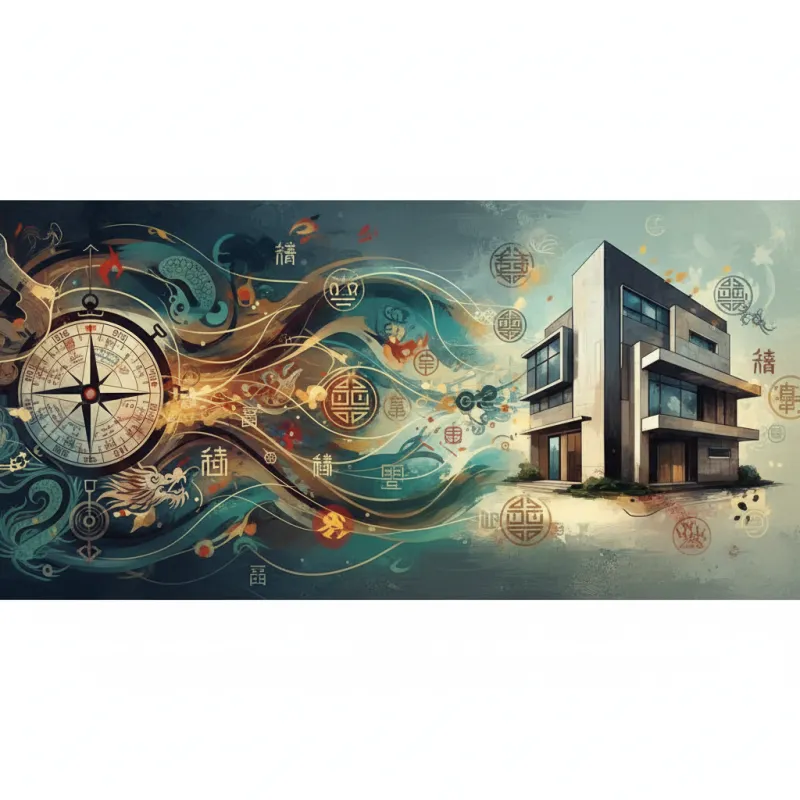
You've arranged your home according to every feng shui article you could find online. There's a fountain bubbling in your "wealth corner," mirrors strategically placed to "multiply abundance," and you've banned all cacti from your bedroom. Yet somehow, your life hasn't transformed into the harmonious paradise those blog posts promised. Here's the uncomfortable truth: the feng shui you've been practicing probably has as much to do with authentic Chinese geomancy as a Panda Express orange chicken has to do with Sichuan cuisine.
The Great Simplification: How Feng Shui Lost Its Teeth
When feng shui (風水, fēng shuǐ) arrived in the West during the 1980s and 90s, it underwent a transformation that would make its Song Dynasty practitioners weep. What was once a complex system requiring years of study, mathematical calculations, and deep knowledge of Chinese cosmology got repackaged as interior decorating advice you could absorb during a coffee break.
Traditional feng shui practitioners spent decades mastering the luopan (羅盤, luó pán) — the feng shui compass with up to 40 concentric rings of information. They studied the Yijing (易經, Yì Jīng, the Book of Changes), memorized the interactions of the five elements (五行, wǔ xíng), and learned to calculate the influence of time on space through systems like Flying Stars (飛星, fēi xīng). The Western version? Put your bed in the "command position" and call it a day.
This isn't just oversimplification — it's a fundamental misunderstanding of what feng shui actually is. The term literally means "wind and water," referring to the flow of qi (氣, qì) through landscapes and structures. It's a system for analyzing how the physical environment affects the energy available to inhabitants, rooted in the same philosophical framework that gave us Chinese medicine and the five elements.
Mistake 1: Ignoring the Compass Directions
Walk into any Western home decorated with "feng shui principles" and ask the owner which direction their front door faces. Chances are, they have no idea. This is like trying to navigate using a map with no north arrow.
Authentic feng shui is directionally specific. The Ba Zhai (八宅, bā zhái) or Eight Mansions system, for instance, divides buildings into eight sectors based on the sitting and facing directions, with each sector having different qualities depending on the building's orientation and the birth data of its occupants. Your "wealth corner" isn't automatically the far left corner from your entrance — it depends on the actual compass direction of your home and which school of feng shui you're following.
The popular "Black Hat Sect" feng shui that dominates Western books and websites was created in the 1980s by Thomas Lin Yun, who deliberately removed the compass directions to make the system more accessible to Western audiences. While this made feng shui easier to market, it also stripped away one of its fundamental diagnostic tools. It's like practicing medicine without taking the patient's temperature or blood pressure — you might occasionally stumble onto something helpful, but you're essentially guessing.
Mistake 2: The Bagua Map Oversimplification
If you've encountered Western feng shui, you've probably seen the bagua (八卦, bā guà) map — an octagonal or square grid that you overlay on your floor plan, with each section corresponding to a life area like wealth, relationships, or career. Place the map over your home, the instructions say, and enhance the appropriate corners with symbolic objects.
This is a bastardization of the actual bagua, which is a fundamental concept from the Yijing representing eight trigrams that symbolize natural phenomena and their transformations. In classical feng shui, the bagua isn't a decorating template you slap onto any floor plan. It's a sophisticated system for understanding how different energies manifest in different directions, and it must be oriented to actual compass directions, not to wherever your front door happens to be.
The eight trigrams — Qian (乾, qián), Kun (坤, kūn), Zhen (震, zhèn), Xun (巽, xùn), Kan (坎, kǎn), Li (離, lí), Gen (艮, gèn), and Dui (兌, duì) — each have specific elemental associations, family member correspondences, and directional placements that don't change based on your floor plan. Qian always represents the northwest, heaven, and the father figure. You can't just decide it's wherever your front door faces.
Mistake 3: Treating Feng Shui as Static
You bought the crystal, placed the fountain, arranged the furniture. Done, right? Wrong.
Classical feng shui recognizes that time is as important as space. The Flying Stars system (玄空飛星, xuán kōng fēi xīng) calculates how the energy of different sectors changes annually, monthly, and even daily based on the cycles of time. What was auspicious last year might be problematic this year. A bedroom that supported health in 2020 might need adjustments in 2025.
This temporal dimension is completely absent from most Western feng shui advice, which treats your home as if it exists in a timeless vacuum. Traditional practitioners would calculate the "period" of your building (based on when it was built or last renovated), determine the annual and monthly star combinations for each sector, and adjust recommendations accordingly. This is why authentic feng shui consultations aren't one-time affairs — the energy map of your space is constantly shifting.
Mistake 4: Ignoring the External Environment
Western feng shui obsesses over what's inside your home while largely ignoring what's outside it. You'll find endless advice about where to place your sofa but almost nothing about how the mountain behind your house or the road in front of it affects your home's energy.
In classical feng shui, the external environment is paramount. The Form School (巒頭, luán tóu) of feng shui, one of the oldest approaches, focuses almost entirely on landscape features — mountains, water bodies, the shapes of surrounding buildings, the flow of roads. A feng shui master would spend far more time analyzing the landforms around your property than worrying about whether your toilet lid is up or down.
The ideal feng shui site has a mountain or high ground behind it (the Black Tortoise, 玄武, xuán wǔ), lower ground in front (the Red Phoenix, 朱雀, zhū què), and protective hills to the left and right (the Azure Dragon, 青龍, qīng lóng, and White Tiger, 白虎, bái hǔ). Water should be visible in front, flowing gently rather than rushing. These landscape considerations matter far more than your interior decorating choices, yet they're rarely mentioned in Western feng shui books because they're not actionable for most readers — you can't exactly move a mountain.
Mistake 5: The Superstition Trap
Western feng shui has accumulated a collection of superstitions that would make a traditional practitioner's head spin. Don't sleep with your feet toward the door (you'll be carried out like a corpse). Don't have a mirror facing your bed (it steals your soul). Don't keep cacti (they're too aggressive). Don't have three of anything (it sounds like "separate" in Chinese).
While traditional feng shui does have some taboos, they're based on principles of energy flow and symbolic resonance within Chinese culture, not arbitrary rules. The problem with importing these taboos into Western contexts is that the cultural symbolism often doesn't translate. The number four is considered unlucky in Chinese because it sounds like "death" (死, sǐ) — but this phonetic association doesn't exist in English. Similarly, many "rules" about mirrors, plants, and objects are based on Chinese cultural associations that may not apply in Western contexts.
Authentic feng shui is about understanding principles — how qi flows, how elements interact, how forms affect energy — and applying them intelligently to your specific situation. It's not about following a checklist of dos and don'ts that someone compiled from half-understood Chinese folk beliefs.
What Authentic Feng Shui Actually Looks Like
Real feng shui consultation begins with measurement and calculation. The practitioner uses a luopan to determine the precise facing direction of your building (usually to within a few degrees). They note the construction or renovation date to determine the building's "period" in the 180-year cycle of the Xuan Kong (玄空, xuán kōng) system. They analyze the external environment, noting the locations of mountains, water, roads, and neighboring structures.
Then comes the calculation phase. Using the facing direction and period, they plot the Flying Stars chart for your building, determining which types of energy occupy each sector. They consider the annual and monthly stars, the interaction of the five elements, and how these energies affect different occupants based on their birth data (which connects feng shui to bazi or Four Pillars astrology).
Only after all this analysis do they make recommendations — and these are specific to your building, your situation, and the current time period. They might recommend using certain rooms for specific purposes, placing water features in particular locations (based on actual compass directions, not arbitrary corners), or making structural changes if feasible. They'll also tell you when conditions will change and what adjustments to make.
This is a far cry from "put a money frog in your wealth corner and watch the cash roll in."
Moving Forward: Learning Real Feng Shui
If you're serious about feng shui, start by unlearning most of what Western sources have taught you. Get a real compass and determine the actual directions in your home. Study the fundamentals — the five elements and their interactions, the eight trigrams, the concept of yin and yang. Read translations of classical texts like the Qing Dynasty "Ru Di Yan" (入地眼, rù dì yǎn, "Earth Eye") or the "Shui Long Jing" (水龍經, shuǐ lóng jīng, "Water Dragon Classic").
Better yet, find a teacher trained in classical feng shui — someone who uses a luopan, calculates Flying Stars, and can explain the theoretical basis for their recommendations. Yes, this requires more effort than reading a blog post and rearranging your furniture. But feng shui is a sophisticated system that developed over thousands of years. It deserves more respect than we've given it in the West.
Your home's energy is too important to trust to oversimplified, decontextualized advice from sources that treat ancient Chinese geomancy as if it were an IKEA instruction manual. The real thing is more complex, more interesting, and ultimately more effective than the watered-down version we've been sold.
Related Reading
- What Is Feng Shui? A Complete Beginner's Guide
- The Complete Guide to Feng Shui: Ancient Wisdom for Modern Living
- Yin and Yang Balance in Home Design
- Chi Energy Flow: How to Keep It Moving
- Feng Shui Basics: What It Actually Is (No Mystical Nonsense)
- Swimming Pools and Feng Shui: Wealth Feature or Energy Drain?
- The Bagua Map Explained: Your Feng Shui Floor Plan Guide
- Exploring Feng Shui, I Ching, and Chinese Metaphysics in Modern Homes
Explore Chinese Culture
- Explore Daoist philosophy and practice
- Explore traditional Chinese customs
- Explore ancient Chinese cosmology