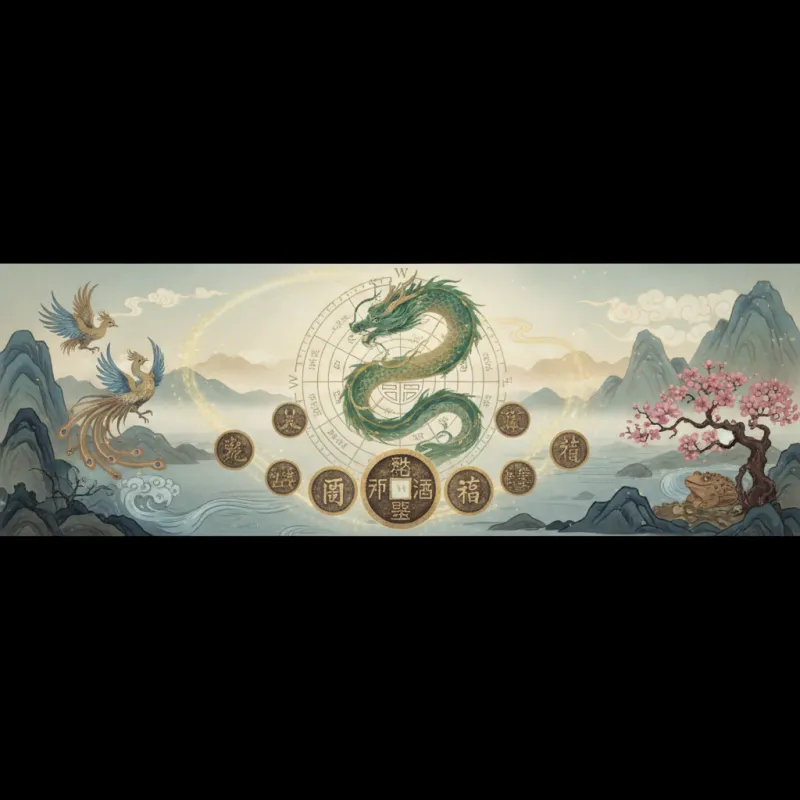
The Complete Guide to Feng Shui: Ancient Wisdom for Modern Living
You've probably seen the miniature bamboo plants in office cubicles, the strategically placed mirrors in restaurant entryways, or heard someone mention their "money corner." But feng shui (风水, fēng shuǐ) — literally "wind-water" — is far more than decorative trinkets and superstitious furniture arrangement. It's a 3,000-year-old Chinese philosophical system that examines how humans interact with their environment, rooted in the same principles that inform traditional Chinese medicine, martial arts, and classical Chinese painting. Whether you're a skeptic curious about the cultural phenomenon or someone ready to transform your living space, this guide will take you beyond the stereotypes into the practical heart of feng shui.
What Feng Shui Really Is (And What It Isn't)
The Western world's introduction to feng shui in the 1980s and 90s created a peculiar hybrid — part ancient wisdom, part New Age mysticism, part interior design trend. Walk into any home goods store and you'll find "feng shui fountains" and "feng shui crystals" marketed with the same enthusiasm as aromatherapy candles. This commercialization has obscured what feng shui practitioners in China have studied for millennia.
At its core, feng shui is an environmental science concerned with the flow of qi (气, qì) — the vital life force that animates all things. Originating during the Han Dynasty (206 BCE – 220 CE), feng shui was initially used to site tombs and palaces, ensuring that the deceased or the emperor would benefit from auspicious environmental conditions. The classic text Zang Shu (葬书, Zàng Shū, "Book of Burial"), attributed to Guo Pu (276-324 CE), established many foundational principles: "Qi rides the wind and scatters, but is retained when encountering water."
This isn't mysticism — it's observation. Ancient Chinese noticed that homes built in certain locations with specific orientations experienced better health outcomes, more prosperity, and greater harmony. They observed that buildings positioned to capture gentle breezes while avoiding harsh winds were more comfortable. They noted that structures near flowing water but protected from flooding thrived. Over centuries, these observations crystallized into a systematic approach to environmental design.
Modern feng shui has diverged into multiple schools with sometimes contradictory advice, leading to understandable confusion. Some practitioners emphasize compass directions and mathematical calculations; others focus on landform analysis and intuitive assessment. Some incorporate Buddhist or Taoist religious elements; others maintain a secular approach. This guide will help you navigate these variations and extract practical principles you can apply regardless of which school resonates with you.
The Philosophical Foundation: Understanding Qi, Yin-Yang, and the Five Elements
Qi: The Animating Force
Before you can practice feng shui, you must understand qi. In Chinese philosophy, qi is the fundamental substance of the universe — simultaneously matter and energy, tangible and intangible. In the human body, qi flows through meridians (the basis of acupuncture). In the environment, qi flows through landscapes, buildings, and rooms.
Feng shui practitioners distinguish between different types of qi. Sheng qi (生气, shēng qì, "generating breath") is vibrant, life-supporting energy that meanders gently through a space, bringing vitality and opportunity. Sha qi (煞气, shà qì, "killing breath") is harsh, destructive energy that moves too quickly or stagnates, causing problems. Si qi (死气, sǐ qì, "dead breath") is stagnant energy that accumulates in cluttered, dark, or unused spaces.
The goal of feng shui is to cultivate sheng qi while dispersing or redirecting sha qi and si qi. Think of qi like water in a stream — it should flow smoothly, neither rushing violently nor pooling into stagnant ponds. A long, straight hallway creates sha qi because energy rushes through too quickly, like water through a pipe. A cluttered storage room accumulates si qi because energy cannot circulate, like a stagnant pond breeding mosquitoes.
Yin and Yang: The Dynamic Balance
Yin (阴, yīn) and yang (阳, yáng) represent the fundamental duality that structures all existence. Yang is active, bright, warm, and expansive; yin is passive, dark, cool, and contractive. Neither is superior — they're complementary forces that must balance for harmony to exist.
In feng shui applications, different spaces require different yin-yang balances. Bedrooms should be more yin — quiet, dark, restful — to support sleep and recovery. Living rooms and offices should be more yang — bright, active, stimulating — to support social interaction and productivity. A bedroom that's too yang (bright lights, stimulating colors, electronic devices) will disrupt sleep. An office that's too yin (dim lighting, heavy curtains, dark colors) will sap energy and motivation.
The ancient text Huangdi Neijing (黄帝内经, Huángdì Nèijīng, "Yellow Emperor's Classic of Medicine"), compiled around 100 BCE, states: "Yin and yang are the way of heaven and earth, the fundamental principle of the myriad things, the father and mother of change and transformation." This principle extends from cosmology to interior design — your home should reflect the dynamic balance of yin and yang appropriate to each space's function.
The Five Elements: Wood, Fire, Earth, Metal, Water
The Wu Xing (五行, wǔ xíng, "Five Phases" or "Five Elements") system describes how different types of qi interact and transform. Unlike Western classical elements, the Chinese five elements represent processes and qualities rather than static substances:
Wood (木, mù) represents growth, expansion, and vitality. It's associated with spring, the color green, vertical shapes, and the east direction. Wood energy supports creativity, new beginnings, and personal development.
Fire (火, huǒ) represents transformation, passion, and illumination. It's associated with summer, the color red, triangular shapes, and the south direction. Fire energy supports recognition, fame, and dynamic activity.
Earth (土, tǔ) represents stability, nourishment, and grounding. It's associated with late summer, yellow and brown colors, square shapes, and the center. Earth energy supports relationships, health, and stability.
Metal (金, jīn) represents precision, clarity, and completion. It's associated with autumn, white and metallic colors, circular shapes, and the west direction. Metal energy supports organization, efficiency, and mental clarity.
Water (水, shuǐ) represents flow, wisdom, and potential. It's associated with winter, black and dark blue colors, wavy shapes, and the north direction. Water energy supports career, life path, and deep knowledge.
These elements interact through two primary cycles. The Generating Cycle (相生, xiāng shēng) describes how elements support each other: Wood feeds Fire, Fire creates Earth (ash), Earth bears Metal, Metal collects Water (condensation), Water nourishes Wood. The Controlling Cycle (相克, xiāng kè) describes how elements regulate each other: Wood parts Earth, Earth dams Water, Water extinguishes Fire, Fire melts Metal, Metal cuts Wood.
Understanding these cycles allows you to balance spaces. If a room feels too fiery (overstimulating, aggressive), you can introduce water elements (a fountain, dark colors) to control the fire, or earth elements (ceramics, square shapes) to absorb some of the fire energy. If a space feels stagnant (too much earth), you can add wood elements (plants, vertical lines) to break up the heaviness.
The Bagua Map: Your Feng Shui Blueprint
The bagua (八卦, bā guà, "eight trigrams") is feng shui's most recognizable tool — an octagonal map that divides space into eight life areas, each associated with specific elements, colors, and aspects of life. The bagua originates from the I Ching (易经, Yì Jīng, "Book of Changes"), China's oldest classical text, dating to approximately 1000 BCE.
The eight areas of the bagua are:
Kan (坎, kǎn) — Career and Life Path (North, Water element): This area relates to your professional journey and life purpose. It's associated with black, dark blue, and wavy shapes.
Gen (艮, gèn) — Knowledge and Cultivation (Northeast, Earth element): This area supports learning, meditation, and self-improvement. It's associated with dark blue and green colors.
Zhen (震, zhèn) — Family and New Beginnings (East, Wood element): This area relates to family relationships and health. It's associated with green and wooden materials.
Xun (巽, xùn) — Wealth and Abundance (Southeast, Wood element): This area influences prosperity and abundance. It's associated with purple, green, and gold colors.
Li (离, lí) — Fame and Reputation (South, Fire element): This area relates to how others perceive you and your achievements. It's associated with red and triangular shapes.
Kun (坤, kūn) — Love and Relationships (Southwest, Earth element): This area influences romantic partnerships and marriage. It's associated with pink, red, and earth tones.
Dui (兑, duì) — Children and Creativity (West, Metal element): This area relates to creative projects and children. It's associated with white and metallic colors.
Qian (乾, qián) — Helpful People and Travel (Northwest, Metal element): This area influences mentors, benefactors, and travel opportunities. It's associated with gray, white, and metallic colors.
The center, called Tai Qi (太极, tài jí), represents health and overall balance.
There are two primary methods for applying the bagua. The Classical Method uses a compass to determine the actual cardinal directions of your space, then overlays the bagua accordingly (north is always the career area). The Western Method, popularized by Professor Lin Yun's Black Sect Tantric Buddhism school, aligns the bagua with your entrance — the wall containing your main door always represents the career, knowledge, and helpful people areas, regardless of compass direction.
Both methods have merit. The Classical Method connects to the original Chinese practice and incorporates the earth's magnetic field. The Western Method is more accessible for beginners and acknowledges that how you enter and move through a space affects your experience of it. Many contemporary practitioners use both, applying the Classical Method for overall property assessment and the Western Method for individual rooms.
To use the bagua, sketch your floor plan and divide it into nine equal sections (a tic-tac-toe grid). Identify which areas correspond to which life aspects. Then assess each area: Is it cluttered? Well-lit? Does it contain appropriate elements? A cluttered wealth corner might correlate with financial struggles. A dark, neglected relationship corner might reflect partnership difficulties. A vibrant, well-maintained career area might support professional success.
Form School vs. Compass School: Two Approaches to Feng Shui
Feng shui's long history has produced different schools of practice, but two major branches dominate: Form School (峦头派, luán tóu pài) and Compass School (理气派, lǐ qì pài).
Form School: Reading the Landscape
Form School, the older tradition, emerged in the mountainous regions of southern China. It emphasizes the physical forms of the landscape — mountains, rivers, valleys, and how buildings relate to these features. Form School practitioners are trained to "read" the land like a text, identifying auspicious and inauspicious formations.
The ideal Form School site features the Four Celestial Animals configuration: the Azure Dragon (青龙, qīng lóng) on the left (east), the White Tiger (白虎, bái hǔ) on the right (west), the Black Tortoise (玄武, xuán wǔ) behind (north), and the Red Phoenix (朱雀, zhū què) in front (south). In landscape terms, this means gentle hills on the left, slightly lower hills on the right, a protective mountain behind, and an open area with a water feature in front.
For urban applications, Form School examines building shapes, street patterns, and how structures relate to each other. A building at a T-junction, where a road points directly at it, receives harsh sha qi. A building on a curved street that "embraces" it receives beneficial qi. Sharp corners of neighboring buildings pointing at your property create "poison arrows" of sha qi.
Form School is intuitive and accessible. You don't need complex calculations — just observation skills and an understanding of how energy flows through physical space. Master Yang Yun-Sang (杨筠松, Yáng Yún-Sōng, 834-900 CE), considered the father of Form School, wrote in his classic text Han Long Jing (撼龙经, Hàn Lóng Jīng, "Shaking the Dragon Classic"): "First observe the dragon's form, then examine the water's flow."
Compass School: Mathematical Precision
Compass School developed in the flatter regions of northern China, where landscape features were less dramatic. It relies on the luopan (罗盘, luó pán), a complex Chinese compass with multiple rings of information, to determine precise orientations and calculate auspicious directions based on time and space.
The most sophisticated Compass School system is Flying Stars (飞星, fēi xīng), which calculates how different types of qi move through a building based on its construction date and orientation. Each building has a unique "natal chart" that shows which areas receive beneficial or harmful qi during different time periods. A Flying Stars analysis might reveal that your bedroom occupies a sector with illness stars during the current 20-year period, explaining persistent health issues.
Another Compass School method is Eight Mansions (八宅, bā zhái), which determines auspicious directions based on your birth year. Each person belongs to either the East or West Life Group, with four favorable and four unfavorable directions. Ideally, you should sleep with your head pointing toward one of your favorable directions and position your desk to face a favorable direction.
Compass School requires more technical knowledge and precise measurements. A few degrees difference in orientation can significantly change the analysis. However, it offers specific, personalized recommendations rather than general principles.
Most professional feng shui consultants today integrate both schools. They use Form School to assess the overall site and major features, then apply Compass School methods for fine-tuning and personalized recommendations. For beginners, starting with Form School principles provides a solid foundation before exploring more complex Compass School calculations.
Room-by-Room Feng Shui Guide
The Entrance: First Impressions Matter
Your entrance is called the mouth of qi (气口, qì kǒu) — where energy enters your home. A welcoming, unobstructed entrance invites beneficial qi; a cluttered, dark entrance restricts it.
Keep your entrance well-lit, clean, and free of obstacles. The door should open fully without hitting furniture or walls. If your entrance is cramped, use mirrors to create a sense of spaciousness (but never place a mirror directly opposite the door, which pushes qi back out). Place a beautiful object or artwork that makes you smile when you enter — this sets a positive tone for the entire home.
If your door opens to a wall, hang artwork that creates depth, like a landscape painting. If it opens to stairs, place a plant or decorative object between the door and stairs to slow descending qi. If it faces a bathroom, keep the bathroom door closed and place a crystal or faceted glass sphere in the entrance to disperse qi before it rushes into the bathroom.
The Living Room: Gathering Qi
The living room should be the most yang space in your home — bright, active, and welcoming. Position seating in a command position: facing the entrance with a solid wall behind, allowing you to see who enters while feeling supported.
Arrange furniture to encourage conversation and connection. Avoid placing all seating against walls, which creates distance. Instead, create an intimate grouping with a coffee table as the center. The ideal shape for a living room is square or rectangular; irregular shapes can be balanced with furniture placement and lighting.
Living rooms benefit from wood and fire elements. Plants bring vitality and improve air quality. A fireplace (or candles if you lack one) adds warmth and gathering energy. Avoid excessive water elements in living rooms, which can dampen the active yang energy needed for social interaction.
The Kitchen: Nourishing Health and Wealth
In feng shui, the kitchen represents both health (food preparation) and wealth (the stove symbolizes the family's ability to generate resources). The stove is particularly important — it should be clean, in good working order, and positioned so the cook can see the entrance without turning their back to the door.
The classic feng shui conflict in kitchens is the fire-water clash: the stove (fire) opposing the sink or refrigerator (water). If possible, separate these elements with a wooden cutting board or place a small plant between them. Wood mediates between water and fire in the generating cycle.
Keep your kitchen clutter-free and well-organized. Broken appliances, expired food, and dirty dishes all create stagnant qi. A clean, functional kitchen supports both physical health and financial prosperity.
The Bedroom: Sanctuary for Rest
Bedrooms should be yin — quiet, dark, and restful. The bed position is crucial. Place your bed in the command position: diagonal from the door with a solid wall behind the headboard, but not directly in line with the door. This position allows you to see the entrance while feeling protected.
Avoid placing your bed under a window, which lacks support, or under exposed beams, which create oppressive downward pressure. If you must sleep under a beam, hang two bamboo flutes at 45-degree angles on the beam to "lift" the energy.
Remove electronics from the bedroom or keep them at least six feet from the bed. Televisions, computers, and phones emit electromagnetic fields and create yang energy that disrupts sleep. Cover or remove mirrors that reflect the bed — traditional feng shui holds that mirrors in bedrooms can disturb rest and create relationship problems by symbolically introducing "third parties."
Use pairs of objects in the bedroom to support partnership: two nightstands, two lamps, pairs of decorative items. Avoid single or odd-numbered items, which emphasize solitude. Choose calming colors — soft blues, greens, and earth tones — rather than stimulating reds or bright whites.
The Home Office: Productive Energy
Position your desk in the command position, facing the door with a solid wall behind you. This creates a sense of control and authority. Avoid sitting with your back to the door, which creates subconscious anxiety, or facing a wall, which limits vision and opportunity.
Home offices need yang energy for productivity. Ensure good lighting, preferably natural light. Add plants for vitality and air quality. Use the wood element (wooden desk, green colors) to support growth and creativity, and metal element (filing cabinets, white colors) for organization and clarity.
Keep your desk organized and clutter-free. Clutter represents unfinished business and creates mental distraction. Use the bagua on your desk surface: the far left corner is your wealth area (good for a small plant or prosperity symbol), the far right is relationships (good for a photo of loved ones), and the center back is fame and recognition (good for diplomas or awards).
The Bathroom: Managing Water Energy
Bathrooms present feng shui challenges because they're associated with draining energy and resources. The key is containment — preventing qi from flowing down drains and toilets.
Keep bathroom doors closed and toilet lids down when not in use. Place a small mirror on the outside of the bathroom door to symbolically deflect qi away from the bathroom. Use plants to absorb excess water energy and add vitality.
Ensure good ventilation to prevent stagnant, damp qi. Keep bathrooms clean and well-maintained — leaky faucets symbolize wealth draining away. Use earth elements (stones, earth-tone colors) to absorb water energy and create stability.
Essential Feng Shui Principles for Beginners
If you're new to feng shui, these foundational principles will create the most significant impact:
Clear clutter ruthlessly. Clutter is the number one feng shui problem in modern homes. It creates stagnant qi, represents unfinished business, and drains energy. The Chinese saying goes: "Messy home, messy mind" (家乱心乱, jiā luàn xīn luàn). Start your feng shui practice with a thorough decluttering. Keep only items you use, love, or find beautiful. Everything else is blocking your qi.
Fix what's broken. Broken items represent broken aspects of your life. A broken clock suggests time standing still. A stuck door indicates blocked opportunities. Burned-out light bulbs create dark, yin energy. Make a list of everything in your home that needs repair and systematically fix each item. This simple practice often creates immediate positive shifts.
Let in light and air. Qi flows on light and air. Open curtains during the day. Open windows regularly to refresh the air. Add full-spectrum lighting to dark corners. Plants improve air quality while adding vitality. These simple actions dramatically improve qi flow.
Use the command position. Position your bed, desk, and main seating in command positions — facing the entrance with solid support behind. This fundamental principle creates a sense of security and control that affects everything from sleep quality to work productivity.
Balance yin and yang. Assess each room's function and adjust the yin-yang balance accordingly. Add yang elements (light, color, activity) to spaces that feel too heavy or depressing. Add yin elements (soft textures, calm colors, quiet) to spaces that feel too chaotic or stimulating.
Incorporate the five elements. Ensure each room contains all five elements in appropriate proportions. This creates balance and completeness. You don't need literal representations — a wooden table, a candle, a ceramic bowl, a metal frame, and a glass of water cover all five elements.
Honor your entrance. Your entrance sets the tone for your entire home. Make it beautiful, welcoming, and unobstructed. This single area affects every aspect of your life because it's where all qi enters.
Create clear pathways. Qi should flow smoothly through your home like a gentle stream. Remove obstacles from hallways and doorways. Arrange furniture to create clear, curved pathways rather than straight lines or blocked routes.
Common Feng Shui Mistakes to Avoid
Even well-intentioned feng shui practitioners make mistakes. Here are the most common pitfalls:
Over-relying on "cures" without addressing root problems. Placing a crystal in your wealth corner won't create prosperity if your finances are disorganized and you're drowning in debt. Feng shui enhances and supports your efforts; it doesn't replace them. Address practical issues first, then use feng shui to optimize your environment.
Ignoring personal taste and comfort. Some people create feng shui homes that feel like museum displays rather than lived-in spaces. If you hate red but place red objects in your fame area because a book said to, you're creating disharmony. Feng shui should enhance your life, not make you uncomfortable in your own home. Adapt principles to your preferences.
Applying bagua rigidly without considering actual use. If your wealth corner is in a bathroom, don't panic. Focus on keeping that bathroom clean, beautiful, and well-maintained. Use the bagua as a guide, not a rigid prescription. The actual function and condition of a space matters more than its theoretical bagua position.
Mixing too many schools and creating confusion. One book says face your bed north; another says face your favorable direction based on your birth year; a third says face the door. Contradictory advice creates paralysis. Choose one approach and apply it consistently rather than trying to follow every recommendation you encounter.
Neglecting maintenance. Feng shui isn't a one-time fix. Qi flows and changes. Seasons shift. Your life evolves. Regular maintenance — cleaning, decluttering, refreshing — keeps qi flowing smoothly. A feng shui consultation from five years ago may no longer serve your current situation.
Focusing on symbolism over substance. Three-legged money frogs and lucky bamboo have their place, but they're not magic. A cluttered home with broken appliances and poor lighting won't be fixed by placing a wealth vase in the corner. Address fundamental issues — light, air, cleanliness, organization — before adding symbolic enhancements.
Forgetting that feng shui is one factor among many. Your environment influences your life, but it doesn't determine it. Hard work, relationships, health habits, and countless other factors matter. Feng shui creates supportive conditions; you still must take action. As the Chinese proverb states: "First comes destiny, second comes luck, third comes feng shui, fourth comes accumulating merit, fifth comes study" (一命二运三风水四积阴德五读书, yī mìng èr yùn sān fēng shuǐ sì jī yīn dé wǔ dú shū).
Feng Shui for Specific Life Goals
Attracting Wealth and Prosperity
The wealth corner (财位, cái wèi) is the southeast area of your home or the far left corner from your entrance. To enhance wealth qi:
Activate this area with wood and water elements. Place a healthy plant (jade plants and money trees are traditional choices) or a small fountain. Purple, green, and gold colors support wealth energy. Keep this area clean, well-lit, and clutter-free.
Ensure your stove is clean and all burners work — the stove represents your ability to generate resources. Face your stove toward the center of your home rather than toward a wall, symbolizing cooking for the family rather than isolation.
Fix all leaks immediately. Dripping faucets and running toilets symbolize wealth draining away. Keep bathroom doors closed and toilet lids down to prevent qi (and symbolically, money) from flowing down drains.
Display symbols of abundance that resonate with you. This might be a bowl of oranges (gold color, round shape suggesting coins), a prosperity vase, or images of abundance. But remember: these are enhancements, not substitutes for sound financial practices.
Supporting Health and Vitality
The center of your home, the Tai Qi area, governs overall health. Keep this area open, clean, and well-lit. Avoid placing heavy furniture or storage in the center — qi should flow freely through this space.
Bedrooms directly affect health through sleep quality. Ensure your bedroom is yin, dark, and quiet. Remove electronics. Use natural materials for bedding. Position your bed in the command position with solid support behind the headboard.
The east area of your home relates to family health. Enhance this area with wood elements — plants, wooden furniture, green colors. Family photos displayed here strengthen family bonds and collective health.
Bring nature indoors. Plants improve air quality, add vitality, and connect you to natural cycles. Choose plants appropriate for each room's light conditions. Avoid plants with sharp, pointed leaves in bedrooms (too yang); prefer rounded, soft leaves.
Ensure good air quality and natural light throughout your home. Open windows regularly. Use full-spectrum bulbs in areas lacking natural light. Poor air and insufficient light create stagnant, unhealthy qi.
Enhancing Relationships and Love
The relationship corner (姻缘位, yīn yuán wèi) is the southwest area of your home or the far right corner from your entrance. To enhance relationship qi:
Use pairs of objects — two candles, two crystals, pairs of decorative items. Pairs symbolize partnership and balance. Avoid single items or groups of three, which suggest solitude or third-party interference.
Display images of happy couples or pairs of animals (mandarin ducks are traditional symbols of marital happiness). Ensure these images reflect the kind of relationship you want to attract or maintain.
Use earth and fire elements in this area. Pink, red, and earth tones support relationship energy. Avoid excessive water or metal elements, which can cool romantic passion.
In your bedroom, ensure equal space on both sides of the bed with matching nightstands and lamps. This creates balance and welcomes partnership. Remove items from previous relationships that carry old emotional energy.
If you're single and want to attract a partner, make space for them. Clear out half your closet. Use two pillows. Set the table for two occasionally. These actions signal readiness for partnership.
For existing relationships, remove any images or objects that represent solitude or separation. Avoid displaying single figures in artwork. Keep the relationship corner clean and beautiful, treating it with the same care you'd give the relationship itself.
Scientific Perspectives on Feng Shui
The scientific community's relationship with feng shui is complex. While many specific feng shui claims lack empirical support, several underlying principles align with established scientific knowledge.
Environmental psychology confirms that physical environments affect mood, behavior, and performance. Studies show that natural light improves mood and productivity, that clutter increases stress and decreases focus, and that views of nature support healing and well-being. These findings validate core feng shui principles about light, organization, and connection to nature.
Biophilic design, a contemporary architectural movement, echoes feng shui's emphasis on incorporating natural elements. Research by Dr. Roger Ulrich demonstrated that hospital patients with views of trees recovered faster than those facing brick walls. Studies on indoor plants show they reduce stress, improve air quality, and enhance cognitive function — all outcomes feng shui attributes to incorporating wood elements.
Color psychology research supports feng shui's use of color to influence mood and behavior. Red increases arousal and energy (explaining its use in dining rooms and living areas), while blue promotes calm and focus (supporting its use in bedrooms and meditation spaces). These effects occur across cultures, suggesting biological rather than purely cultural responses.
Proxemics, the study of personal space, validates feng shui's command position principle. Research shows that people feel more secure and confident when they can see entrances and have solid support behind them. Sitting with one's back to a door creates measurable stress responses.
Chronobiology and circadian rhythm research support feng shui's emphasis on natural light and alignment with natural cycles. Exposure to natural light regulates sleep-wake cycles, hormone production, and mood. Feng shui's recommendation to maximize natural light and minimize artificial light in bedrooms aligns with this research.
However, many specific feng shui claims remain unverified. The existence of qi as a measurable energy hasn't been demonstrated scientifically. Compass School calculations based on birth dates and building orientations lack empirical support. The bagua's division of space into life areas is a conceptual framework rather than a physical reality.
The most scientifically defensible approach treats feng shui as a sophisticated system of environmental design principles developed through centuries of observation. Whether qi exists as a literal energy or serves as a useful metaphor for environmental quality, applying feng shui principles often creates more comfortable, functional, and aesthetically pleasing spaces. The mechanism may be debatable, but the outcomes — reduced stress, improved mood, better sleep, enhanced productivity — are measurable and valuable.
Dr. Stephen Kellert, a Yale professor who studied biophilic design, noted: "Traditional cultures developed sophisticated understandings of how to create healthy, supportive environments. Modern science is now confirming many of these intuitive insights." Feng shui may be one such traditional system, encoding environmental wisdom in a cultural framework that predates modern scientific methods.
DIY Feng Shui vs. Hiring a Consultant
Most people can successfully apply basic feng shui principles without professional help. If you're addressing general issues — improving qi flow, decluttering, enhancing specific rooms — DIY feng shui is entirely appropriate. Start with the foundational principles outlined in this guide: clear clutter, fix broken items, improve lighting, position furniture in command positions, and balance the five elements.
Books, websites, and courses provide ample information for self-study. Begin with Form School principles, which rely on observation and common sense rather than complex calculations. Apply changes gradually, observing how each adjustment affects your experience of the space. Trust your intuition — if a change feels wrong, it probably is, regardless of what a book recommends.
However, professional consultants offer value in several situations:
Complex Compass School analysis. If you want a Flying Stars chart or Eight Mansions analysis, you'll need someone trained in these technical methods. These calculations require precise measurements, specialized knowledge, and experience interpreting results.
Major life transitions or persistent problems. If you're experiencing serious health issues, relationship difficulties, or career stagnation despite your best efforts, a consultant might identify environmental factors you've overlooked. Sometimes an outside perspective reveals patterns invisible to those living in the space.
New construction or major renovations. Consulting a feng shui expert during the design phase allows you to incorporate principles from the beginning rather than trying to correct problems later. Choosing an auspicious building orientation, positioning rooms optimally, and selecting appropriate materials is easier during construction than after completion.
Business applications. Commercial feng shui for offices, retail spaces, or restaurants involves different considerations than residential feng shui. A consultant experienced in commercial applications can help optimize customer flow, employee productivity, and business success.
When choosing a consultant, ask about their training, experience, and approach. Reputable practitioners will:
- Explain their methodology clearly
- Provide specific, actionable recommendations
- Respect your budget and preferences
- Avoid fear-based tactics or claims of dire consequences
- Acknowledge that feng shui is one factor among many affecting your life
- Offer follow-up support as you implement changes
Be wary of consultants who:
- Make grandiose promises of instant wealth or perfect relationships
- Insist you must purchase expensive "cures" or products
- Use fear to pressure you into immediate action
- Claim their school is the only "authentic" feng shui
- Refuse to explain their reasoning or methodology
Fees vary widely. Basic consultations might cost $200-500, while comprehensive analyses of large properties can run several thousand dollars. Some consultants charge hourly rates; others offer package pricing. Ensure you understand what's included before committing.
Whether you choose DIY or professional consultation, remember that feng shui is a tool, not a magic solution. It creates supportive environmental conditions, but you must still take action toward your goals. The most powerful feng shui practice combines environmental optimization with personal effort, creating alignment between your space, your intentions, and your actions.
Feng shui offers a time-tested framework for creating harmonious, supportive environments. Whether you approach it as ancient wisdom, environmental psychology, or aesthetic design philosophy, its core principles — maximize light and air, maintain cleanliness and order, position yourself advantageously, balance opposing forces, and connect with nature — create spaces that support human flourishing.
Start small. Choose one room or one principle and apply it consistently. Observe the results. Adjust as needed. Over time, you'll develop an intuitive sense of how energy flows through space and how to optimize it for your needs. Your home should support your life, not complicate it. Let that principle guide your feng shui practice, and you'll create a space that truly feels like a sanctuary.