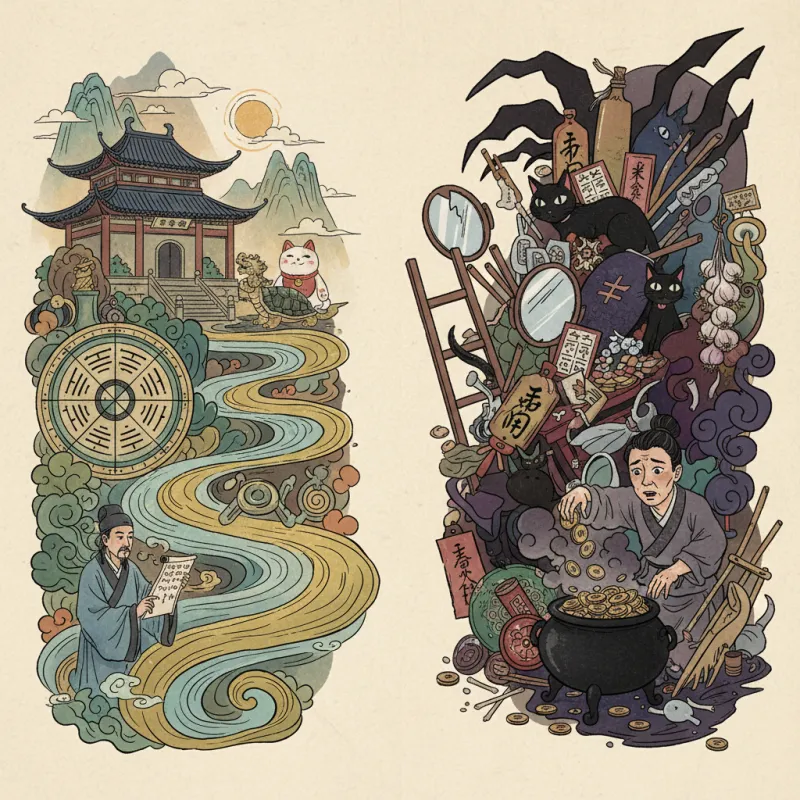
You're standing in a furniture store, about to buy a bed, when your aunt grabs your arm. "Not that one — the headboard has a mirror. You'll lose all your energy while you sleep." The salesperson rolls their eyes. You're caught between family tradition and modern skepticism, wondering: is this ancient wisdom or just superstition with a Chinese accent?
This tension sits at the heart of feng shui (风水 fēngshuǐ). It's not a simple binary where feng shui is either "real" or "fake." The actual situation is messier and more interesting: feng shui is a pre-scientific system that contains genuine observations about human psychology and spatial design, mixed with metaphysical claims that can't be empirically verified, all wrapped in a cultural framework that evolved over two millennia.
The problem isn't feng shui itself — it's that we're trying to evaluate a Tang Dynasty (618-907 CE) system using 21st-century epistemology. That's like asking whether Aristotelian physics is "true." It's the wrong question. The right question is: what does feng shui get right, what does it get wrong, and where exactly is the line?
The Superstition Label: Who Gets to Decide?
When Western skeptics call feng shui superstition, they usually mean: "belief not based on scientific evidence." Fair enough. But by that standard, most of human culture is superstitious. Wearing black to funerals doesn't have empirical backing. Neither does facing the flag during the national anthem. These are cultural practices that create meaning and structure.
The difference is that feng shui makes falsifiable claims. It doesn't just say "north-facing doors feel different" (subjective, cultural). It says "north-facing doors in certain years bring financial loss" (objective, testable). When feng shui crosses from aesthetic preference into causal prediction, it enters scientific territory — and that's where it runs into trouble.
Classical feng shui texts like the Zangshu (葬书 Zàngshū, "Book of Burial") by Guo Pu (郭璞, 276-324 CE) describe qi (气 qì) as a tangible substance that flows through landscapes and accumulates in certain formations. This isn't metaphor — it's a physical claim about reality. And by modern physics, it's wrong. There's no measurable energy field that concentrates at the junction of mountain ridges or disperses when wind crosses water.
But here's where it gets interesting: even though the mechanism is wrong, some of the observations are right.
What Feng Shui Gets Right (And Why)
Take the classic feng shui principle: don't sleep with your bed directly aligned with the door. Superstition? Maybe. But also: sleeping in direct line-of-sight to an entrance creates subconscious vigilance. You're evolutionarily wired to monitor entry points for threats. This isn't about qi flow — it's about the autonomic nervous system and sleep quality.
Or consider the preference for "mountain behind, water in front" (背山面水 bèishān miànshuǐ) in site selection. Ancient feng shui masters said this position gathers beneficial qi. Modern environmental psychology says it provides prospect (open view for monitoring threats) and refuge (protected back for safety). Different explanation, same outcome.
The Five Elements theory in feng shui recommends balancing wood, fire, earth, metal, and water in your space. The metaphysics is questionable, but the design principle is sound: varied textures, colors, and materials create more psychologically engaging environments than monotonous ones. You don't need to believe in elemental qi to appreciate that a room with only metal and glass feels cold, while adding wood and plants makes it more comfortable.
This is where feng shui practitioners and skeptics both miss the point. Practitioners insist the traditional explanations are literally true. Skeptics dismiss the entire system because the explanations are wrong. But you can have correct observations with incorrect theories. Medieval doctors noticed that moldy bread helped wounds heal (correct observation) and attributed it to balancing bodily humors (incorrect theory). The observation was valuable even when the theory was nonsense.
Where Feng Shui Becomes Superstition
The line gets crossed when feng shui makes specific, unfalsifiable predictions based on arbitrary correlations. This happens most often in Flying Star feng shui (飞星风水 fēixīng fēngshuǐ), which assigns numbers to compass directions and time periods, then predicts outcomes based on their combinations.
A Flying Star practitioner might say: "In 2024, the number 5 star is in the east sector, bringing misfortune. Place six metal coins there to suppress it." This is pure superstition because:
- The number assignments are arbitrary (why does 5 mean misfortune?)
- The remedy is arbitrary (why specifically six coins, not five or seven?)
- The mechanism is unexplained (how do coins suppress a number?)
- The prediction is unfalsifiable (any bad event can be attributed to the star, any good event to the remedy)
This is different from saying "cluttered spaces increase stress" (testable) or "natural light improves mood" (measurable). Flying Star feng shui has the structure of superstition: it creates anxiety about invisible forces, then sells remedies that can't be proven to work or fail.
The same applies to many commercial feng shui products. A three-legged toad (三脚蟾蜍 sānjiǎo chánchú) statue doesn't attract wealth. A bagua mirror (八卦镜 bāguà jìng) doesn't deflect negative energy. These are cultural symbols that became commodified superstitions. If you like how they look, fine. If you think they have magical properties, you've crossed the line.
The Bazi Problem: When Correlation Isn't Causation
Feng shui often intersects with bazi (八字 bāzì), the Chinese system of analyzing destiny based on birth date and time. A feng shui consultant might say: "Your bazi shows weak water element, so your home needs a water feature in the north."
This combines two unfalsifiable systems into a double superstition. Even if we grant that birth time correlates with personality (dubious), and that personality correlates with environmental preferences (plausible), the specific prescriptions are arbitrary. Why north? Why water feature specifically, not blue paint or a humidifier?
The I Ching faces similar issues. As a philosophical text about change and adaptation, it's profound. As a divination system that claims to predict specific outcomes based on coin tosses or yarrow stalks, it's superstition. The wisdom is in the interpretive framework, not in the method of selection.
The Pragmatic Middle Ground
So where does this leave us? Here's a framework:
Probably useful: Feng shui principles that align with environmental psychology, ergonomics, and design theory. Natural light, uncluttered spaces, comfortable furniture arrangements, connection to nature, clear sightlines, defined functional zones. You don't need to believe in qi to benefit from these.
Culturally meaningful but not causal: Symbolic elements like colors, numbers, and directional associations. If red makes you feel energized because of cultural conditioning, that's real — but it's psychology, not metaphysics. The effect is in your mind, not in the color itself.
Probably superstition: Specific predictions based on compass directions, time periods, or birth data. Remedies involving arbitrary objects or numbers. Claims about invisible forces that can't be measured or tested. Expensive consultations that promise concrete outcomes (wealth, health, relationships) based on furniture placement.
The honest answer is that feng shui is both wisdom and superstition, and you need discernment to separate them. A good test: if someone can explain why a feng shui principle works using psychology, biology, or physics, it's probably useful. If the only explanation is "that's what the ancient masters said" or "it balances the qi," be skeptical.
Why the Distinction Matters
This isn't just academic. People spend thousands on feng shui consultations and remedies. Some delay important decisions waiting for "auspicious dates." Others arrange their homes in uncomfortable ways because a practitioner said it would bring prosperity.
The tragedy is that feng shui's genuine insights — about how space affects mood, how natural elements improve wellbeing, how clutter creates stress — get lost in the superstitious overlay. When you reject feng shui entirely because of the metaphysical claims, you miss the practical wisdom. When you accept it entirely without critical thinking, you waste money on ineffective remedies and give external forces credit for outcomes you created yourself.
The middle path is harder because it requires judgment. You can't just follow rules or reject everything. You have to ask: does this make sense? Is there a plausible mechanism? Can I test whether it works? Am I doing this because it genuinely improves my space, or because I'm anxious about invisible forces?
Your aunt's warning about the mirrored headboard? There's actually something to it — not because mirrors drain qi, but because seeing your reflection while trying to sleep can be subtly disturbing. The observation is valid even if the explanation is wrong. That's feng shui in a nutshell: useful insights wrapped in outdated cosmology.
The line between feng shui and superstition isn't fixed — it's wherever you stop asking "why does this work?" and start accepting "because tradition says so." Keep asking why, and you'll find the wisdom. Stop asking, and you're just rearranging furniture based on ancient superstition.
Related Reading
- The History of Feng Shui: From Ancient China to Your Living Room
- What Is Feng Shui? A Complete Beginner's Guide
- Feng Shui Basics: What It Actually Is (No Mystical Nonsense)
- The Bagua Map: Your Home's Energy Blueprint
- Chi Energy Flow: How to Keep It Moving
- Exploring Feng Shui, I Ching, and Chinese Metaphysics in Bazi Practice
- Unlocking the Ancient Arts: Feng Shui, I Ching, and the Mysteries of Chinese Metaphysics
- Harmonizing Your Kitchen: The Role of Feng Shui and I Ching in Culinary Spaces
Explore Chinese Culture
- Explore Daoist philosophy and practice
- Explore traditional Chinese customs
- Explore ancient Chinese cosmology