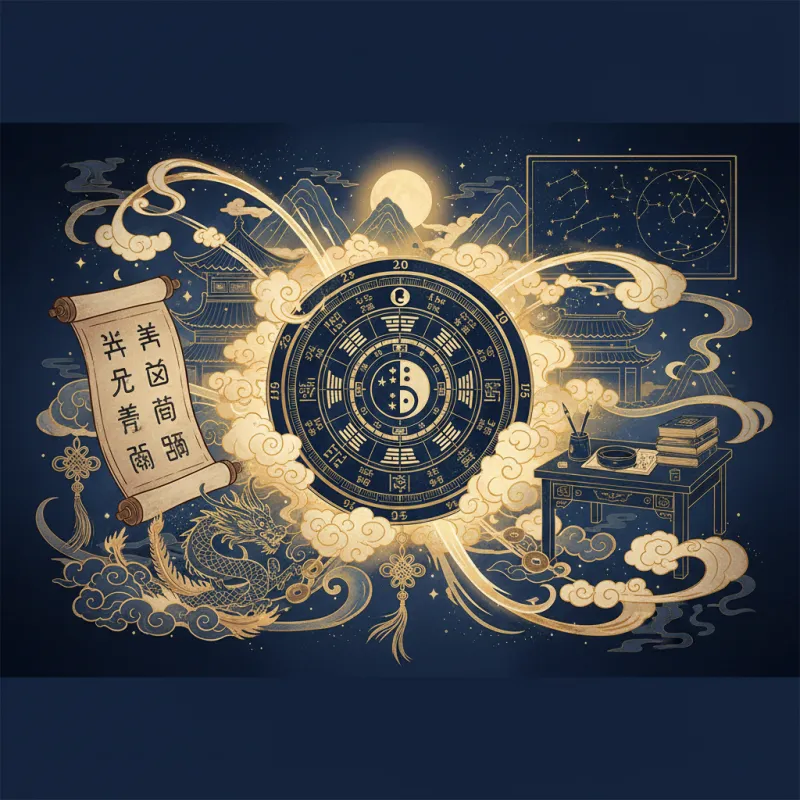
Picture this: A Ming Dynasty scholar sits in his study, compass in hand, calculating the precise angle at which his desk should face. Outside, a master architect adjusts the placement of a garden rock by mere inches, consulting texts that predate the Roman Empire. These aren't superstitious rituals—they're applications of sophisticated systems that have shaped Chinese civilization for millennia, systems we collectively call Chinese metaphysics (中国玄学, Zhōngguó xuánxué). And contrary to what Instagram influencers might have you believe, these practices are far more complex—and far more interesting—than arranging crystals on your nightstand.
The Philosophical Foundation: More Than Mysticism
Chinese metaphysics isn't a single practice but an interconnected web of disciplines, all rooted in a worldview that sees the universe as a dynamic system of patterns and correspondences. At its heart lies the concept of qi (氣, qì)—often translated as "energy" or "life force," though neither term quite captures its meaning. The ancient text Huainanzi (淮南子), compiled around 139 BCE, describes qi as the fundamental substance from which all things emerge and to which they return. It's simultaneously material and immaterial, the breath in your lungs and the vitality in your spirit.
This isn't abstract philosophy divorced from daily life. The Han Dynasty scholar Dong Zhongshu (董仲舒, 179-104 BCE) built an entire cosmological system connecting human affairs to celestial patterns, arguing that the emperor's moral conduct could literally affect weather patterns and harvests. Whether you believe that or not, it demonstrates how seriously these frameworks were taken—they weren't parlor tricks but tools for understanding causality in a pre-scientific world.
The Five Elements theory (五行, wǔxíng)—Wood, Fire, Earth, Metal, and Water—provides the grammar for this cosmic language. But here's what most introductory books get wrong: these aren't static substances but phases of transformation. Wood doesn't just represent trees; it embodies the expansive, upward energy of spring growth. Metal isn't merely iron and gold; it's the contracting, consolidating force of autumn harvest. Understanding this dynamic quality is crucial to grasping how Chinese metaphysical systems actually function in practice.
Feng Shui: Architecture as Applied Philosophy
Feng Shui (風水, fēng shuǐ) literally means "wind-water," but that translation barely scratches the surface. The Zangshu (葬書, "Book of Burial"), attributed to Guo Pu (郭璞, 276-324 CE), contains one of the earliest systematic explanations: "Qi rides the wind and scatters, but is retained when encountering water." This isn't poetic metaphor—it's a technical principle about how environmental features affect the flow of qi through a landscape.
Classical Feng Shui divides into two major schools, and their differences matter. The Form School (巒頭派, luántóu pài) emphasizes the physical landscape—mountain ranges, water courses, the shape of hills. A Form School master in Tang Dynasty China would spend years studying how dragon veins (龍脈, lóngmài)—ridgelines that channel qi—flow through terrain. The Compass School (理氣派, lǐqì pài), which gained prominence during the Song Dynasty (960-1279 CE), adds temporal dimensions using the luopan (羅盤), a complex compass with up to 40 concentric rings encoding astronomical, calendrical, and directional data.
The Forbidden City in Beijing exemplifies Feng Shui principles at imperial scale. Its north-south axis aligns with cosmic order, its back protected by Jingshan (景山, "Prospect Hill"), an artificial mountain built specifically for this purpose. The placement of gates, the number of roof ornaments, even the color of roof tiles—all follow Feng Shui calculations. This wasn't decoration; it was statecraft. The emperor's legitimacy depended partly on demonstrating mastery over these cosmic patterns.
Modern Feng Shui often reduces these principles to interior decorating tips, which is like using a scientific calculator as a paperweight. Yes, you can apply Feng Shui to apartment layouts, but the system was designed to work at scales from grave sites to capital cities, integrating astronomy, geography, and temporal cycles into a unified framework.
I Ching: The Mathematics of Change
The Yijing (易經, Yìjīng), usually romanized as I Ching, might be the most misunderstood text in Chinese philosophy. Westerners often encounter it as a fortune-telling manual, but its original purpose was far more sophisticated. Compiled during the Western Zhou Dynasty (1046-771 BCE) with commentaries added during the Warring States period (475-221 BCE), it's fundamentally a system for modeling change itself.
The text consists of 64 hexagrams, each composed of six lines that are either broken (yin) or unbroken (yang). But here's what makes it brilliant: these aren't random symbols. They're generated through a systematic process that creates a binary notation system—essentially, ancient Chinese computer code. Each hexagram represents a specific configuration of yin and yang forces, and the text provides interpretations of what that configuration means in various contexts.
King Wen (周文王, Zhōu Wén Wáng), imprisoned by the Shang Dynasty around 1100 BCE, supposedly arranged the hexagrams into their current sequence while awaiting execution. Whether that story is historical or legendary, it captures something true: the I Ching emerged from people trying to find patterns in chaos, to make decisions when outcomes were uncertain. The hexagram "Difficulty at the Beginning" (屯, Zhūn) doesn't predict your future—it describes a pattern where initial obstacles require patience and gradual progress, a situation that recurs throughout human experience.
The philosopher Leibniz, encountering the I Ching in the early 18th century, recognized its binary structure as similar to his own work on binary mathematics. The psychologist Carl Jung saw it as a tool for accessing the unconscious. Both were partly right and partly projecting their own frameworks onto it. The I Ching works best when understood on its own terms: as a sophisticated pattern language for navigating uncertainty, developed by a culture that saw change as the fundamental reality rather than an aberration.
The Interconnected Web: How These Systems Work Together
Here's where it gets really interesting: these aren't separate practices but different applications of the same underlying principles. A skilled practitioner of Chinese metaphysics moves fluidly between them, using whichever tool fits the question at hand.
Consider a traditional Chinese doctor diagnosing an illness. They might use Five Elements theory to understand organ relationships, apply I Ching principles to predict disease progression, and recommend Feng Shui adjustments to the patient's living space—all in the same consultation. The 16th-century physician Li Shizhen (李時珍), author of the Bencao Gangmu (本草綱目, "Compendium of Materia Medica"), explicitly integrated these frameworks into his medical practice.
Or take the practice of selecting auspicious dates (擇日, zérì). This combines astronomical observation, I Ching hexagrams, and the Chinese calendar's complex system of stems and branches (天干地支, tiāngān dìzhī). When a Qing Dynasty merchant chose a date to open a new shop, he wasn't being superstitious—he was using the best predictive tools his culture had developed, tools that encoded centuries of observed correlations between timing and outcomes.
The bazi system, or Four Pillars of Destiny, exemplifies this integration. It uses your birth time to generate four pairs of stems and branches, then interprets them through Five Elements relationships, I Ching principles, and sometimes Feng Shui considerations for life planning. It's astrology, yes, but astrology as a complex computational system rather than newspaper horoscopes.
The Modern Relevance Question
So what do we do with all this in the 21st century? The easy answer is to dismiss it as pre-scientific superstition, but that's intellectually lazy. These systems represent sophisticated attempts to find patterns in complex phenomena—human behavior, environmental influences, temporal cycles—using the tools available to pre-modern civilizations.
Some aspects have been validated by modern research. Studies on environmental psychology confirm that spatial arrangements affect mood and productivity, even if the mechanisms aren't "qi flow." Chronobiology demonstrates that timing matters for everything from surgery outcomes to learning retention, echoing the Chinese emphasis on temporal factors. The I Ching's binary structure genuinely anticipates concepts in information theory and systems thinking.
Other aspects remain unverified or unfalsifiable by scientific methods. Does the direction your house faces affect your fortune? Does your birth time determine personality traits? These claims require either accepting the metaphysical framework or remaining agnostic. What we can say is that millions of people across centuries found these systems useful for decision-making and meaning-making, which is itself significant.
The real value might lie not in whether these systems are "true" in a scientific sense, but in what they offer as alternative ways of thinking. Western thought tends toward linear causality and reductionism—break things into parts, find the cause, fix the problem. Chinese metaphysics offers circular causality and holism—everything affects everything else, patterns recur at different scales, timing matters as much as action.
Practicing Discernment in a Commercialized Field
Here's my honest take: the commercialization of Chinese metaphysics has created a minefield of misinformation. For every serious practitioner who's spent decades studying classical texts, there are dozens of weekend-certified "masters" selling expensive consultations based on superficial understanding.
Red flags to watch for: anyone promising specific material outcomes ("this will make you rich"), practitioners who can't cite classical sources, those who mix Chinese metaphysics with completely unrelated New Age practices, and anyone who claims their particular lineage has "secret" knowledge unavailable in traditional texts. The classics—Yijing, Zangshu, Huangdi Neijing (黃帝內經)—have been publicly available for centuries.
If you're genuinely interested in these systems, start with reputable translations of source texts. Richard Wilhelm's I Ching translation, despite its age, remains valuable. For Feng Shui, seek out practitioners trained in classical methods who can explain the astronomical and geographical reasoning behind their recommendations. For Five Elements theory, look at how it's applied in traditional Chinese medicine, where it's part of a larger diagnostic framework rather than a standalone system.
The Enduring Legacy
Walking through any Chinese city today, you'll still see these ancient systems in action. Construction projects consult Feng Shui masters. Businesses choose opening dates through traditional calendars. People make major life decisions after I Ching consultations. This isn't mere tradition or superstition—it's a living practice that continues to provide frameworks for navigating uncertainty and complexity.
Whether these systems work through actual metaphysical forces or through psychological and cultural mechanisms is almost beside the point. They've shaped one of the world's oldest continuous civilizations, influenced everything from architecture to medicine to military strategy, and continue to offer alternative ways of thinking about our relationship to space, time, and each other. In an age of algorithmic prediction and data-driven decision-making, there's something refreshing about systems that acknowledge mystery, embrace paradox, and insist that some patterns can only be understood through centuries of accumulated wisdom rather than controlled experiments.
The scholar in his Ming Dynasty study, calculating compass angles, wasn't so different from us—just someone trying to make sense of a complex world using the best tools available. The tools have changed, but the questions remain remarkably similar.
Related Reading
- Unlocking the Secrets of Feng Shui and I Ching: A Journey Through Chinese Metaphysics
- Exploring Feng Shui, I Ching, and Chinese Metaphysics: Symbols of Ancient Divination and Geomancy
- Feng Shui for Gardens and Outdoor Spaces
Explore Chinese Culture
- Explore Daoist philosophy and practice
- Explore traditional Chinese customs
- Explore ancient Chinese cosmology