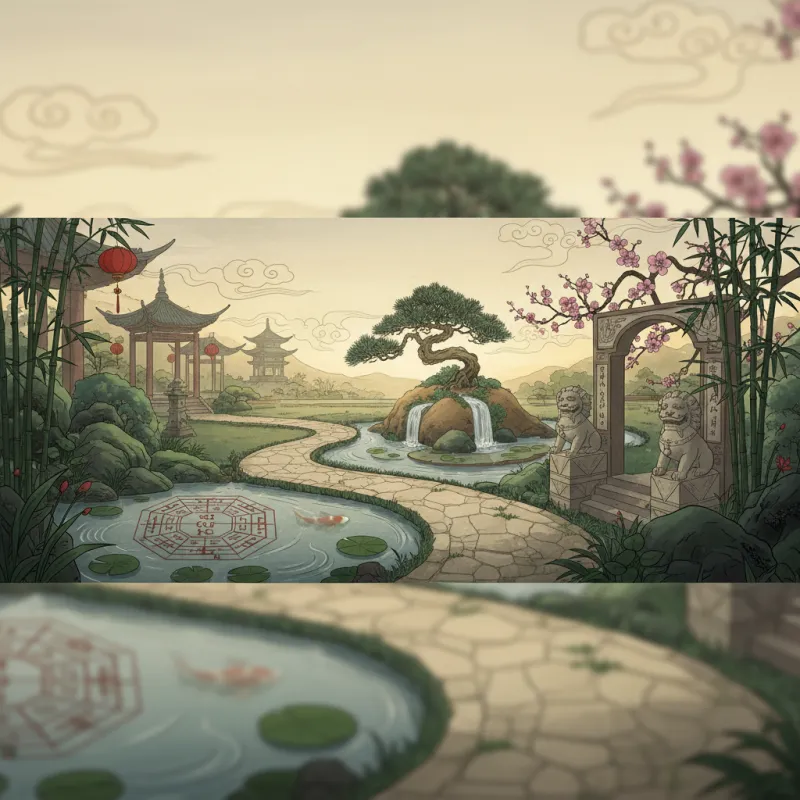
In classical feng shui texts like the Yangzhai Sanyao (阳宅三要 Yángzhái Sānyào, "Three Essentials of Yang Dwellings") from the Qing Dynasty, outdoor spaces receive equal — sometimes greater — attention than interior rooms. The reasoning is straightforward: qi flows from the broader environment into your specific space. If the external qi is corrupted, blocked, or aggressive, no amount of interior adjustment will compensate.
The Five Elements in Living Form
Western gardening focuses on aesthetics and maintenance schedules. Chinese garden design thinks in terms of wuxing (五行 wǔxíng), the five elements, manifested through actual living materials. This isn't symbolic — it's about creating a physical environment where wood, fire, earth, metal, and water exist in productive relationship.
Wood element appears obviously in trees and plants, but the type matters enormously. Bamboo (竹 zhú) represents flexibility and resilience — it bends in storms rather than breaking. The famous gardens of Suzhou feature bamboo groves specifically positioned in the east and southeast sectors, supporting the wood element's natural direction. Pine trees symbolize longevity and steadfastness, appropriate for the north where they support water element energy.
Fire element in gardens comes primarily from sunlight exposure and flowering plants with red, orange, or purple blooms. The south-facing areas of traditional Chinese gardens always featured the most vibrant flowering plants — peonies (牡丹 mǔdān), azaleas, and hibiscus. But fire also appears in pointed, upward-reaching forms: tall grasses, spiky plants, triangular rock formations.
Earth element manifests through flat surfaces, stones, and low-growing plants. In the famous gardens of the Summer Palace in Beijing, earth element dominates the central areas with broad pathways, flat stones, and carefully positioned boulders. Clay pots, ceramic ornaments, and yellow-flowering plants all reinforce earth energy.
Metal element appears in white and metallic-colored flowers, round-leaved plants, and actual metal garden ornaments. Traditional gardens used bronze incense burners, iron lanterns, and white chrysanthemums (菊花 júhuā) to activate metal energy in the west and northwest sectors.
Water element is the most critical and most frequently mishandled. A water feature isn't automatically beneficial — stagnant water breeds sha qi (煞气 shàqì, harmful energy). Classical texts specify that water should be visible from the main entrance, flow toward the house rather than away from it, and maintain clarity and movement. The ponds in the Garden of the Master of Nets in Suzhou demonstrate this perfectly: water flows in gentle curves, never in straight aggressive lines, and the depth varies to create visual interest and proper qi circulation.
The Bagua Applied to Outdoor Space
Most people think bagua mapping only applies to interior rooms. Wrong. The Bazi Zhaijing (八宅镜 Bāzhái Zhàijìng, "Eight Mansions Mirror") from the Tang Dynasty explicitly describes how to overlay the bagua onto your entire property, not just your house.
Stand at your front door facing outward. The area directly in front represents your career and life path (kan 坎 kǎn, water element). This space should be open, unobstructed, and ideally feature a gentle water element or flowing pathway. Blocking this area with dense shrubs or aggressive plants creates career stagnation.
The far left corner (from your front door perspective) governs wealth and prosperity (xun 巽 xùn, wood element). This is where traditional Chinese homes placed their most valuable plants — fruit trees, bamboo groves, or flowering plants that attracted beneficial qi. I've seen modern practitioners place compost bins or trash areas here, then wonder why their finances struggle.
The far right corner relates to relationships and helpful people (qian 乾 qián, metal element). Metal element plants — white flowers, round-leaved varieties — work well here. Avoid thorny plants or aggressive growth patterns that symbolically "attack" relationship energy.
The back center area connects to fame and reputation (li 离 lí, fire element). This sector benefits from bright flowering plants, good sunlight exposure, and upward-reaching forms. Shade-heavy, downward-growing plants here suppress your public visibility and recognition.
Water Features: The Most Powerful and Most Dangerous Element
In feng shui practice, water represents wealth, opportunity, and the flow of beneficial circumstances. But water features cause more problems than any other garden element because people install them without understanding the classical principles.
The Xuankong Feixing (玄空飞星 Xuánkōng Fēixīng, Flying Star) system, developed during the Song Dynasty, provides specific guidance about water placement based on your home's facing direction and the current time period. Water in the wrong location doesn't just fail to help — it actively harms. I've consulted on properties where a misplaced fountain correlated with financial loss, health problems, and relationship breakdowns.
General principles that apply regardless of specific calculations: water should flow toward your house, not away from it. Water flowing away symbolizes wealth and opportunity leaving. The famous feng shui master Yang Yunsong (杨筠松 Yáng Yúnsōng, 834-900 CE) wrote extensively about water dragon formations — the patterns water makes as it flows through landscape. Gentle curves bring beneficial qi; straight aggressive flows create sha qi.
Water should be proportional to your property size. A massive pond on a small lot overwhelms the space with too much yin energy. A tiny fountain on a large property provides insufficient activation. The water should be visible from inside your home, particularly from areas where you spend significant time, but shouldn't directly face your front door in an aggressive manner.
Stagnant water is worse than no water. Algae-covered ponds, mosquito-breeding fountains, and murky water features generate harmful qi that affects health and finances. If you can't maintain clean, moving water, don't install a water feature. Traditional gardens employed servants specifically to maintain water clarity — it was considered that important.
The Poison Arrow Problem in Gardens
Sha qi in outdoor spaces comes primarily from sharp angles, aggressive lines, and hostile forms pointing toward your home. Western landscape design often creates these problems unintentionally.
Straight pathways pointing directly at your front door act like arrows shooting harmful energy toward your entrance. Classical Chinese gardens never feature straight paths — they curve, meander, and create visual interest while allowing qi to flow gently. The famous Moon Gate (月门 yuèmén) circular openings in traditional gardens serve partly to soften and redirect qi flow.
Sharp corners from buildings, walls, or large rocks pointing toward your home create cutting qi. If you can't remove the source, traditional solutions include placing a bagua mirror (八卦镜 bāguà jìng) to reflect the harmful energy, or positioning plants to soften and absorb the sharp qi before it reaches your living space. Rounded, soft-leaved plants work better than spiky varieties for this purpose.
Dead or dying plants generate decaying qi that affects the corresponding life area. A dead tree in your wealth corner isn't just ugly — it symbolically represents dying financial energy. Remove dead plants immediately and replace them with healthy, thriving varieties.
Overhead beams, power lines, or tree branches pointing down at your home create oppressive qi. This is called "pressing down" energy and affects the occupants' ability to rise, succeed, and feel optimistic. Trim aggressive branches and, if possible, work with utility companies to redirect overhead lines.
Yin-Yang Balance: The Forgotten Principle
Most modern feng shui advice focuses on activating yang energy — bright colors, moving water, vibrant plants. But gardens require yin-yang balance just like interior spaces. Too much yang creates restless, aggressive energy; too much yin brings stagnation and depression.
Yang elements in gardens include: bright sunlight, vibrant colors, moving water, tall upward-reaching plants, open spaces, and active areas like patios or play spaces. Yin elements include: shade, dark colors, still water, low-growing plants, enclosed spaces, and quiet contemplation areas.
The classical Chinese gardens I mentioned earlier — Suzhou's gardens, Beijing's Summer Palace, the gardens of wealthy merchants in Anhui Province — all demonstrate sophisticated yin-yang balance. They feature bright open courtyards (yang) adjacent to shaded covered walkways (yin). Vibrant flowering areas (yang) transition into quiet bamboo groves (yin). Active social spaces (yang) connect to private meditation pavilions (yin).
Your garden should include both. If every area is bright, open, and active, the space becomes exhausting rather than restorative. If every area is shaded, enclosed, and still, the space becomes depressing rather than peaceful. Create zones with different energy qualities and allow natural transitions between them.
Seasonal Considerations and the Chinese Calendar
Western gardening thinks in terms of spring, summer, fall, and winter. Chinese garden design incorporates the lunar calendar, the 24 solar terms (二十四节气 èrshísì jiéqì), and the changing elemental influences throughout the year.
The Tong Shu (通书 Tōngshū, Chinese almanac) provides guidance about auspicious dates for planting, pruning, and major garden changes. While you don't need to follow this strictly, understanding the principle matters: different times of year favor different activities and different elemental energies.
Spring (wood element season) favors planting and new growth. This is when wood element areas of your garden — east and southeast — should receive attention and activation. Summer (fire element season) is ideal for flowering plants and bright colors, particularly in the south sector. Late summer (earth element season) supports grounding activities like stone placement and pathway creation. Fall (metal element season) is the time for pruning, harvesting, and metal element enhancements in the west and northwest. Winter (water element season) is for planning, rest, and water feature maintenance.
Traditional gardens featured plants that provided interest in all seasons — the "four gentlemen" (四君子 sì jūnzǐ) of plum blossom (winter), orchid (spring), bamboo (summer), and chrysanthemum (autumn) ensured year-round beauty and balanced qi.
Practical Implementation: Start Small, Think Systematically
You don't need to redesign your entire outdoor space immediately. Start with the area most visible from your main living spaces or the bagua sector most relevant to your current life challenges.
If career feels stuck, focus on the area directly in front of your entrance. Clear obstacles, create an open welcoming path, and consider a small water feature if appropriate for your property's facing direction. If relationships need support, work on the far right corner with metal element plants and rounded, harmonious forms.
Remove dead plants immediately — this is non-negotiable. Clear clutter, broken pots, and abandoned garden projects. These create stagnant qi that affects everything else you do. Traditional feng shui masters would refuse to work on a property until basic clearing was complete.
Observe how qi flows through your space. Walk your property at different times of day and notice where energy feels stuck, where it flows too quickly, and where it feels balanced. Trust your intuition here — if an area feels uncomfortable or unwelcoming, that's real information about the qi quality.
Consider consulting resources on feng shui for home offices to understand how your outdoor space affects your indoor work environment, or explore bagua mapping techniques for more detailed sector analysis.
Your garden isn't separate from your feng shui practice — it's the foundation. Get the external environment right, and your interior adjustments become significantly more effective. Ignore it, and you're trying to fill a bucket with holes in the bottom.
Related Reading
- Home Office Feng Shui: Work Better from Home
- Bedroom Feng Shui: Creating Your Personal Sanctuary
- Feng Shui Front Door and Entryway Essentials
- Feng Shui for Your Home and Office: Practical Tips That Actually Work
- The Dragon Year Baby Boom: Why Chinese Parents Plan Pregnancies Around the Zodiac
- Harmonizing Your Kitchen: The Role of Feng Shui and I Ching in Culinary Spaces
- Chinese Breathing Techniques for Energy and Calm
Explore Chinese Culture
- Explore Daoist philosophy and practice
- Explore traditional Chinese customs
- Explore ancient Chinese cosmology