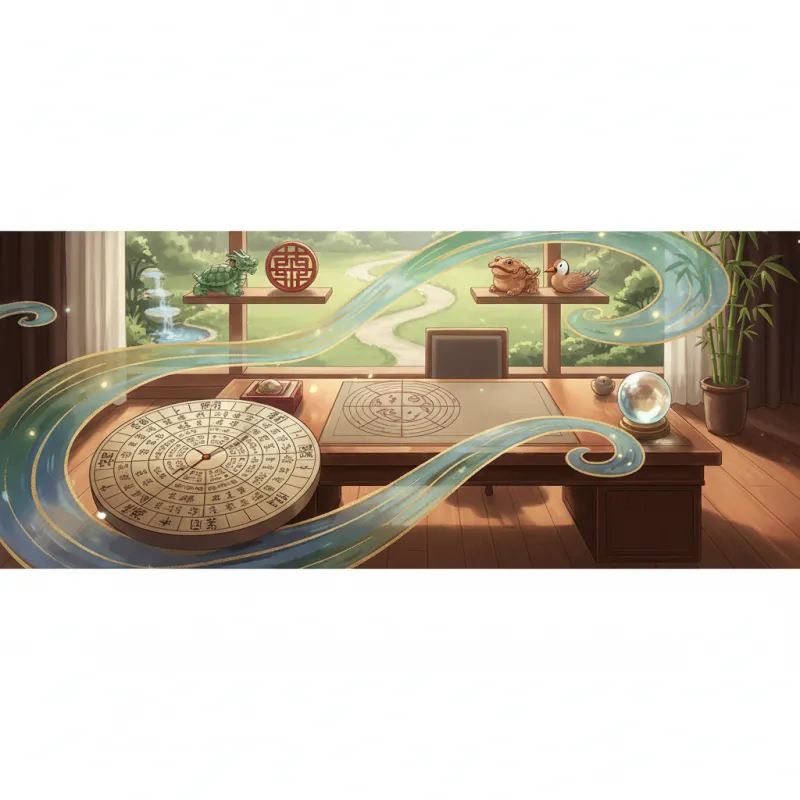
Your laptop sits on the kitchen table, surrounded by breakfast crumbs and yesterday's coffee mug. You've been "working from home" for months now, but your back aches, your focus scatters, and somehow you're both working all the time and getting nothing done. The problem isn't your willpower or your work ethic. It's that you've turned your sanctuary into a battlefield, mixing energies that ancient Chinese practitioners spent centuries learning to separate.
In feng shui (风水 fēngshuǐ), the art of arranging space to harmonize with natural forces, your home office isn't just about having a desk and a chair. It's about creating a container for productive qi (气 qì) that doesn't leak into your bedroom, your dining room, or your peace of mind. The masters who advised emperors during the Tang Dynasty understood something we're only now rediscovering: where you work shapes how you work, and mixing rest spaces with work spaces creates a kind of energetic static that exhausts you without producing results.
The Command Position: Where Power Sits
Walk into any executive's office and notice where the desk sits. It's rarely against a wall, never facing away from the door. This isn't ego — it's the command position (靠山 kào shān, literally "mountain at your back"), and it's been the foundation of feng shui office arrangement since the Song Dynasty.
The principle is simple: sit with your back to a solid wall, facing the door at an angle, with as much of the room visible as possible. This position activates what feng shui calls the "turtle-snake" formation — solid support behind you (the turtle's shell), clear vision ahead (the snake's awareness). When you can see who's entering your space without turning around, your nervous system relaxes. You stop unconsciously guarding your back and can focus forward.
In practical terms, this means your desk should never face a wall directly. That's called "hitting the wall qi" and it's exactly what it sounds like — your energy has nowhere to go. It also means avoiding sitting with your back to the door, which creates what the classical texts call "backstabbing position." Even if you live alone, this arrangement keeps your sympathetic nervous system on low-level alert, draining focus you could use for actual work.
If your space is too small for ideal positioning, use a mirror. Place it where you can see the door's reflection while working. It's not as powerful as direct sight lines, but it gives your subconscious the information it needs to relax.
Separating Work Qi from Living Qi
The biggest mistake remote workers make is thinking they can work anywhere. Your bed, your couch, your dining table — these spaces have established energetic patterns, and work qi doesn't belong in any of them. When you answer emails from bed, you're teaching your body that bed is a place of alertness and stress. When you take Zoom calls from the couch, you're corrupting your rest space with performance anxiety.
The ideal solution is a separate room with a door you can close. This creates what feng shui calls a "qi container" — a space where work energy can build, concentrate, and then be sealed off when you're done. The door is crucial. It's not just a physical barrier; it's a psychological and energetic one. When you close that door at the end of the workday, you're performing a ritual that tells your entire system: work is over.
But most people don't have a spare room. So you create separation through other means. A folding screen (屏风 píngfēng) is the classical solution — Chinese scholars used them for centuries to divide single rooms into distinct zones. Place one between your work area and your living space. When work is done, fold it to hide your desk from view. Out of sight isn't just out of mind; it's out of your energetic field.
If screens feel too formal, use a bookshelf, a curtain, or even a large plant. The point is to create a visual and energetic boundary that says "work stays here." Some practitioners recommend different lighting for work zones — cooler, brighter light for productivity, warmer light for living spaces. This leverages the five elements theory, where metal element (associated with white, bright light) supports focus, while fire element (warm, golden light) supports rest and connection.
The Five Elements in Your Office Layout
Feng shui's five elements (五行 wǔxíng) — wood, fire, earth, metal, water — aren't just philosophical concepts. They're practical tools for balancing the energy in your workspace. Each element corresponds to colors, shapes, materials, and directions, and your office should contain all five in appropriate proportions.
Wood element (东 dōng, east direction) represents growth, creativity, and new beginnings. Bring it in through plants, wooden furniture, or the color green. A living plant on your desk isn't decoration — it's a qi generator, constantly producing fresh oxygen and vital energy. The classical texts recommend bamboo (竹 zhú) for scholars' studios because it grows quickly and bends without breaking, qualities every knowledge worker needs.
Fire element (南 nán, south direction) represents recognition, passion, and transformation. Too much fire in an office creates burnout; too little creates apathy. Balance it through small amounts of red, triangular shapes, or actual light sources. A desk lamp with warm light serves double duty — illumination and fire element activation.
Earth element (中 zhōng, center) represents stability, nourishment, and grounding. This is your foundation, literally and figuratively. Ceramic objects, square shapes, yellow and brown tones — these anchor your space and prevent the scattered feeling that comes from too much mental activity. A clay pot for your pens, a stone paperweight, a square rug under your desk chair.
Metal element (西 xī, west direction) represents precision, efficiency, and completion. This is your computer, your filing system, your organizational tools. Metal cuts through confusion and brings clarity, but too much creates rigidity. Balance metal's sharp energy with curves and organic materials.
Water element (北 běi, north direction) represents wisdom, flow, and career advancement. In feng shui, water is directly connected to career luck, which is why so many practitioners recommend water features for offices. A small fountain, an aquarium, or even a picture of flowing water in the north sector of your office activates career qi. But be careful — stagnant water (like a neglected plant saucer) creates stagnant career energy.
The Bagua Map: Activating Career and Wealth Sectors
The bagua (八卦 bāguà) is feng shui's energy map, dividing any space into nine sectors that correspond to different life areas. For a home office, two sectors matter most: career (north) and wealth (southeast).
Stand at your office door facing in. The far left corner is your wealth sector (财位 cái wèi). This is where you want to place symbols of abundance — a healthy plant, a small fountain, or objects in purple and gold. The classical texts recommend jade plants or money trees, but any thriving plant works. The key is vitality. A dying plant in your wealth corner is worse than nothing.
The center of the wall opposite your door is your career sector. This is where you want to place your most important credentials, awards, or symbols of professional achievement. Not for ego, but as energetic anchors that remind the space — and you — of your professional identity and trajectory. If you're building a business, this is where you put your vision board or business plan.
Some practitioners get dogmatic about bagua placement, but the Ming Dynasty master Jiang Pingjie wrote that intention matters more than precision. If your space is oddly shaped or your door placement is awkward, work with what you have. Place your wealth symbols where they feel right, where you'll see them and be reminded of abundance.
What Doesn't Belong in Your Office
Feng shui is as much about what you remove as what you add. Certain objects carry energies that undermine productivity and focus, and they need to go.
Clutter is the obvious one. Every unfinished project, every pile of papers, every random object without a home — these are qi blockages. They don't just look messy; they create energetic drag that slows everything down. The classical texts call this "sha qi" (煞气 shà qì), or attacking energy. It's not dramatic or violent; it's the slow drain of working in chaos.
Mirrors facing your desk create what's called "qi confusion." You're essentially doubling your workload energetically, and your reflection can be distracting on a subconscious level. Mirrors belong behind you or to the side, never directly in your line of sight while working.
Sharp corners pointing at your desk are "poison arrows" (暗箭 àn jiàn) in feng shui terminology. The corner of a bookshelf, the edge of a filing cabinet, the point of a wall — these create aggressive qi that can manifest as stress, conflict, or obstacles in your work. Soften them with plants, drape fabric over them, or reposition furniture so they don't aim at your workspace.
Electronics you're not using should be unplugged or at least turned off. Standby mode still generates electromagnetic fields that interfere with your body's natural rhythms. This isn't superstition — it's measurable. Your router, your printer, your phone charger — if you're not actively using it, turn it off.
Personal photos are tricky. Family pictures can be grounding, but they can also pull your attention away from work. The classical approach is to keep them in your rest areas, not your work areas. Your office should remind you of your professional identity and goals, not your domestic responsibilities. Save the family photos for your living room.
Timing Your Office Setup: Choosing Auspicious Dates
The I Ching (易经 Yìjīng) and Chinese almanac tradition teach that timing matters as much as placement. Setting up a new office or rearranging an existing one should happen on an auspicious date, particularly one that supports career and wealth energies.
The Chinese almanac (通书 tōngshū) lists favorable and unfavorable dates for different activities. Look for dates marked as good for "opening business" (开市 kāi shì) or "moving" (移徙 yí xǐ). Avoid dates marked as inauspicious for these activities, and especially avoid the "breaking day" (破日 pò rì) of each month.
If you're not familiar with reading the almanac, a simpler approach is to choose a day when you feel energized and optimistic. Your personal qi state matters. Setting up your office when you're exhausted or frustrated imprints that energy into the space. Wait for a day when you feel clear, motivated, and positive about your work.
The hour matters too. In Chinese timekeeping, each two-hour period corresponds to a different animal and element. The dragon hour (7-9 AM) and the horse hour (11 AM-1 PM) are traditionally favorable for career-related activities. These are yang hours, when productive energy is naturally high.
Maintaining Your Office's Energy
Creating good feng shui isn't a one-time setup. Energy in a space needs maintenance, just like the physical space does. The classical texts recommend regular clearing practices to prevent stagnant qi from accumulating.
Open your windows daily, even in winter. Fresh air is fresh qi. Stale air is stale energy, and you can't think clearly in it. Five minutes of cross-ventilation resets your office's energetic field.
Clear your desk at the end of each workday. This isn't just tidying — it's a ritual that signals completion and prevents yesterday's unfinished business from contaminating tomorrow's fresh start. The Qing Dynasty scholar Yuan Mei wrote that a clear desk is a clear mind, and he was right.
Refresh your plants, clean your windows, dust your surfaces. Physical cleaning is energetic cleaning. When you wipe down your desk, you're not just removing dirt; you're clearing accumulated stress and stagnation.
Every few months, consider a deeper clearing. Burn sage or palo santo, ring a bell in each corner, or simply open all the windows and doors and let wind blow through. These practices sound mystical, but they're practical — they reset the space and your relationship to it.
Your home office isn't just where you work. It's a tool that either supports your productivity and wellbeing or undermines them. Feng shui gives you a framework for making that space work with you instead of against you. The principles are ancient, but the need is modern: we're all trying to create boundaries in spaces that weren't designed for them, to separate work from life when they're happening in the same four walls.
The good news is that small changes create measurable results. Move your desk into command position and notice how your focus sharpens. Add a plant and watch how the space feels more alive. Close a door or draw a screen and feel how completely your nervous system shifts from work mode to rest mode. These aren't placebo effects — they're the result of aligning your environment with principles that Chinese practitioners have been refining for over two thousand years.
Start with one change. Just one. See what shifts. Then make another. Your home office doesn't have to be perfect to be effective. It just has to be intentional.
Related Reading
- Feng Shui Front Door and Entryway Essentials
- Feng Shui for Your Home and Office: Practical Tips That Actually Work
- Bedroom Feng Shui: Creating Your Personal Sanctuary
- Feng Shui for Gardens and Outdoor Spaces
- How to Prepare Your Home for the New Feng Shui Year
- Harmonizing Life Through Feng Shui, I Ching, and Geomancy: A Cultural Exploration
- Mirrors in the Bedroom: Feng Shui Rules and Reasons
Explore Chinese Culture
- Explore Daoist philosophy and practice
- Explore traditional Chinese customs
- Explore ancient Chinese cosmology