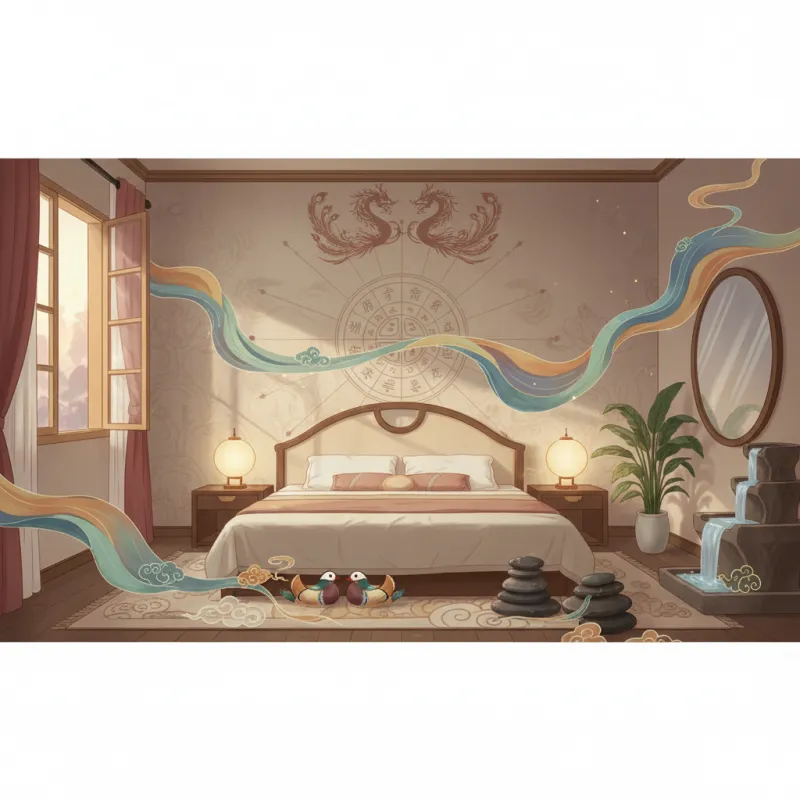
You spend roughly a third of your life in your bedroom. That's 122 days per year, 3,660 days per decade. If the energy in that room is off — if the qi (气 qì) is stagnant, if the elements are imbalanced, if the space feels more like a storage unit than a sanctuary — you're not just losing sleep. You're draining your life force eight hours at a time.
Most feng shui (风水 fēngshuǐ) advice treats the bedroom like a puzzle with one piece: bed placement. Put the bed in the command position, they say, and you're done. But walk into any master's bedroom in classical Chinese architecture — the private quarters of a Ming Dynasty scholar's residence, for instance — and you'll see something more sophisticated. These rooms were designed as complete energy systems, where every element from the door threshold to the window coverings worked together to create what the texts call "nurturing yin" (养阴 yǎng yīn).
Your bedroom isn't just where you sleep. It's where your body performs its deepest repair work, where your consciousness dissolves and reconstitutes itself, where you're at your most vulnerable for hours on end. The total energetic environment determines whether you wake up restored or depleted.
The Yin Imperative: Why Bedrooms Must Be Different
The bedroom operates on different energetic principles than the rest of your home. While living spaces thrive on yang energy (阳气 yáng qì) — movement, light, social interaction — the bedroom requires dominant yin (阴 yīn). This isn't about making the room dark and depressing. It's about creating an environment that supports the yin activities of rest, intimacy, and cellular regeneration.
The Huangdi Neijing (黄帝内经 Huángdì Nèijīng), the foundational text of Chinese medicine written around 300 BCE, describes sleep as the time when yang qi retreats inward and yin qi rises to the surface. Your bedroom should facilitate this natural transition, not fight against it. When the room is too yang — too bright, too stimulating, too cluttered with active energy — your body struggles to make the shift into deep rest.
Practical yin qualities include: soft textures over hard surfaces, muted colors over bright ones, minimal electronics, lower lighting options, and a general sense of enclosure and protection. The room should feel like a cave in the best sense — sheltered, quiet, removed from the world's demands.
But yin doesn't mean lifeless. A bedroom that's too yin becomes stagnant, depressive, a place where energy pools and grows heavy. You need just enough yang to keep the qi moving — a window that opens, some natural light during the day, perhaps one piece of art that brings joy. The classical ratio mentioned in feng shui texts is roughly 70% yin to 30% yang for sleeping spaces.
The Command Position and Its Exceptions
The command position is feng shui's most famous bedroom rule: place your bed where you can see the door without being directly in line with it. This position, called the "emperor's view" in some texts, puts you in a psychologically secure position. You're not startled by people entering, you're not subconsciously on guard, and you can relax completely.
The principle comes from military strategy. In the Art of War, Sun Tzu writes about positioning yourself where you can see threats approaching while remaining protected. The bedroom application is gentler but follows the same logic. When you can't see the door from bed, your nervous system maintains a low-level alert state even during sleep. You might not consciously notice, but your body does.
But here's what the simplified advice misses: the command position isn't always the best position. In some rooms, placing the bed in the command position puts it under a window, or directly across from a bathroom door, or against a wall that backs onto a kitchen. These are all worse than a bed that's not quite in command position but avoids other problems.
The hierarchy of bedroom placement concerns goes like this: First, avoid having your head directly under a window or skylight — this creates unstable qi above you during sleep. Second, avoid positioning the bed directly in line with the door (the "coffin position" in Chinese tradition). Third, avoid placing the bed against a wall that backs onto a bathroom, especially if plumbing runs through that wall. Fourth, avoid positioning where the foot of the bed points directly out the door. Only after addressing these issues should you optimize for the command position.
In a small room where you can't achieve everything, prioritize solid wall support behind your head and avoiding the coffin position. You can work with a bed that doesn't quite see the door. You can't work with a bed that has no backing or sits in the direct energy stream between door and window.
The Five Elements in Bedroom Design
The five elements theory (五行 wǔxíng) — wood, fire, earth, metal, and water — provides a framework for creating energetic balance in your bedroom. But most people apply it superficially, adding a plant for wood or a candle for fire without understanding the deeper dynamics.
Each element has a quality of qi. Wood energy rises and expands — it's growth, vitality, new beginnings. Fire energy radiates and transforms — it's passion, clarity, peak experiences. Earth energy stabilizes and nourishes — it's grounding, support, the center that holds. Metal energy contracts and refines — it's precision, completion, letting go. Water energy descends and flows — it's wisdom, depth, the unconscious.
For sleep, you want a bedroom that emphasizes earth and metal, with supporting touches of water. Earth provides the stable, nourishing foundation. Metal brings the quality of completion and release that allows you to let go of the day. Water connects you to the deep unconscious realms of sleep and dreams.
Wood and fire should be minimal in the bedroom. Too much wood energy makes the room feel restless and growing — fine for an office, problematic for sleep. Too much fire energy creates intensity and stimulation when you need calm and dissolution. This is why feng shui practitioners traditionally advised against red bedrooms (too much fire) or bedrooms with many plants (too much wood).
In practice, this means: Earth tones for walls and bedding — ochres, taupes, soft browns, muted terracottas. Metal through the bed frame itself, through round shapes, through white or gray accents. Water through the color black in small doses, through flowing fabrics, through imagery of calm water if you use art. Minimize bright greens (wood) and reds, oranges, or bright purples (fire).
Your personal bazi (八字 bāzì) — your four pillars of destiny based on birth time — might modify this. If your chart is extremely cold and wet (lots of water and metal), you might need more fire and wood in your bedroom to balance your personal energy. But for most people, the earth-metal-water combination creates the most supportive sleep environment.
The Electronics Problem Nobody Wants to Hear
Remove the TV from your bedroom. Remove the laptop. Put your phone in another room, or at minimum across the room in airplane mode. This is the feng shui advice that gets the most resistance, and it's non-negotiable if you want optimal bedroom energy.
The issue isn't primarily electromagnetic fields, though those matter too. The issue is that electronics are yang energy generators. They emit light, they connect you to the stimulating outside world, they activate your mind when your mind needs to power down. A TV in the bedroom means you're literally watching yang energy (moving images, sound, drama, news, conflict) in a space that should be cultivating yin.
The Daoist sleep practices described in texts like the Yangsheng Yaoji (养生要集 Yǎngshēng Yàojí) from the Tang Dynasty emphasize creating a clear boundary between waking consciousness and sleep consciousness. You prepare for sleep through a gradual dimming of light, a quieting of sound, a withdrawal from external stimulation. Scrolling through your phone in bed or watching TV until you pass out short-circuits this natural transition.
I know the counterarguments. The TV helps me fall asleep. I need my phone for the alarm. I like to read on my tablet in bed. Here's the thing: these are all symptoms of a nervous system that's so overstimulated it can't wind down naturally. The TV doesn't help you fall asleep — it exhausts you into unconsciousness, which isn't the same as healthy sleep. Use an actual alarm clock. Read physical books with a bedside lamp.
If you absolutely must have a phone in the bedroom, keep it at least eight feet from your head, in airplane mode, with the screen facing down. Better yet, put it in the hallway and use an alarm clock. Your bedroom should be a technology-free zone, a place where the electromagnetic soup of modern life doesn't penetrate.
Mirrors, Closets, and the Things We Don't See
The classical feng shui prohibition against mirrors facing the bed has a solid energetic basis. Mirrors are yang — they reflect, activate, and multiply energy. During sleep, when you're in a yin state, a mirror facing you creates a subtle energetic disturbance. Some traditions say it "scatters the soul" during sleep. More practically, it prevents the complete energetic settling that deep rest requires.
If you wake up tired despite sleeping enough hours, check for mirrors facing your bed. This includes mirrored closet doors, which are common in modern bedrooms and terrible for sleep quality. Cover them with curtains, replace them with solid doors, or at minimum angle them so they don't directly reflect the bed.
Closets present a different problem. In feng shui analysis, closets are considered "dead spaces" — areas where energy stagnates because there's no light, no air circulation, and often no organization. A bedroom with a large closet, especially one that's cluttered and chaotic, has a pocket of stagnant qi that affects the whole room's energy.
The solution isn't to eliminate closets — that's impractical. The solution is to treat your closet as part of your bedroom's energy system. Keep it organized. Don't stuff it so full that the door barely closes. Clear it out seasonally. If possible, install a small light that you turn on periodically to activate the space. Some practitioners recommend placing a small mirror on the inside of the closet door (not facing the bed) to energetically "expand" the space and prevent stagnation.
Under-bed storage creates similar issues. The space under your bed should be empty, allowing qi to circulate freely around your sleeping body. When you store things under the bed, especially old items or clutter, you're literally sleeping on top of stagnant energy. If you must use under-bed storage in a small space, keep it minimal, organized, and limited to soft items like extra bedding — never old papers, broken items, or things you're "meaning to deal with."
The Sensory Environment: Beyond the Visual
Feng shui is often treated as a purely visual practice — arrange furniture this way, use these colors, hang this mirror. But the bedroom's sensory environment includes sound, smell, air quality, and temperature. These invisible factors often matter more than the visible ones.
Air quality in the bedroom is critical. You're breathing the same air for eight hours straight, and if that air is stale, dusty, or contaminated with off-gassing from synthetic materials, your body can't fully restore itself. Open windows when possible. Use natural fiber bedding and curtains. Avoid synthetic air fresheners, which are just chemical soups masking as scent. If you live in a polluted area, a quality air purifier is worth the investment — just make sure it's quiet enough not to disturb sleep.
Sound environment matters enormously. The ideal bedroom is quiet, but not dead silent — some gentle ambient sound (distant rain, soft wind, quiet white noise) can actually improve sleep by masking sudden noises that might wake you. What you want to avoid is irregular, unpredictable sounds: traffic noise, neighbors' voices, appliances cycling on and off. Heavy curtains, weatherstripping, and solid doors all help create acoustic boundaries.
Temperature regulation is often overlooked in feng shui discussions, but it's fundamental. The body needs to cool down slightly to enter deep sleep. A bedroom that's too warm prevents this natural temperature drop. Most sleep research suggests 60-67°F (15-19°C) as optimal. In feng shui terms, this relates to the metal element — the contracting, cooling quality that allows release and rest.
Scent can support bedroom energy when used carefully. Lavender, chamomile, and sandalwood are traditionally associated with sleep and yin energy. But avoid strong scents, synthetic fragrances, or anything that feels stimulating. The bedroom should smell clean and neutral, with perhaps a subtle natural scent if you choose. Some practitioners recommend changing bedding scents with the seasons — lighter florals in spring, deeper woods in winter — to keep the room's energy aligned with natural cycles.
Boundaries, Thresholds, and Energetic Separation
The bedroom door is a threshold between the active yang world of your home and the restful yin sanctuary of your sleep space. This boundary needs to be clear and respected. A bedroom that's also a home office, or a TV room, or a storage area, or a place where you eat meals, has confused energy. The space doesn't know what it's for, and neither does your nervous system.
In traditional Chinese homes, the bedroom was strictly private. Only family members entered. There was a clear energetic and physical separation between public and private spaces. Modern open-plan living makes this harder, but the principle still applies: your bedroom should be used only for sleep and intimacy. Not work, not entertainment, not storage, not exercise.
If you live in a studio or small space where your bedroom is also your living area, create a clear boundary. A folding screen, a curtain, even a bookshelf can mark the division between zones. When you're in the sleep zone, you're in the sleep zone — no laptop, no work papers, no eating meals. This trains your nervous system to associate the space with rest.
The threshold itself — the doorway — can be energetically marked. Some traditions place a small threshold stone or change the flooring material at the bedroom entrance. You might use a small rug just inside the door, or paint the door frame a different color. The point is to create a felt sense of crossing from one energetic zone to another.
Keep the bedroom door closed when you're not in the room. This isn't just about privacy — it's about maintaining the room's distinct energy. An open bedroom door allows the room's qi to mix with the rest of the house's energy, diluting its yin quality. At night, a closed door also provides psychological security and better acoustic separation.
The Bed Itself: Foundation of Rest
After all the talk about room layout and energy flow, we come back to the bed itself — the piece of furniture where you'll spend a third of your life. The bed's quality, materials, and condition directly affect your sleep and health.
Feng shui traditionally recommends a solid headboard attached to a solid bed frame. The headboard provides symbolic and energetic support — you're backed by something stable. The frame lifts the mattress off the floor, allowing qi to circulate underneath. Platform beds without space underneath can work if they're solid and well-made, but avoid beds that are just a mattress on the floor. This creates stagnant energy and, practically speaking, poor air circulation and potential moisture problems.
The mattress itself should be as natural as possible. Memory foam and synthetic materials off-gas chemicals and don't breathe well. Natural latex, organic cotton, and wool are better choices. Yes, they're more expensive. But given how much time you spend on your mattress, it's worth the investment. A mattress that's old, sagging, or uncomfortable is terrible feng shui regardless of where you position it.
Bedding should be natural fibers — cotton, linen, silk, wool. These materials breathe, regulate temperature, and have better energetic qualities than synthetics. Color matters: earth tones, soft blues, gentle greens, whites, and grays all support sleep. Avoid bright reds, oranges, or busy patterns that stimulate rather than soothe.
The bed should be proportional to the room. A king bed in a small room dominates the space and leaves no room for qi to flow. A twin bed in a large room looks lost and doesn't provide the sense of enclosure and security that supports rest. The bed should be the room's focal point without overwhelming it.
Seasonal Adjustments and Living Practice
Feng shui isn't a set-it-and-forget-it system. The energy of your bedroom should shift with the seasons, just as natural energy shifts throughout the year. This doesn't mean redecorating every three months, but it does mean making small adjustments that keep the room's energy aligned with natural cycles.
In spring and summer, when yang energy is naturally stronger, you can lighten the bedroom slightly. Lighter bedding, more natural light during the day, perhaps a window open more often. In fall and winter, when yin energy dominates, the bedroom should become more enclosed and cozy. Heavier bedding, warmer colors in accent pieces, less exposure to cold drafts.
The Chinese solar calendar divides the year into 24 periods of about 15 days each, each with its own energetic quality. You don't need to follow this precisely, but the principle is sound: your environment should reflect and support the natural energy of the time. A bedroom that stays exactly the same year-round is out of sync with natural rhythms.
Pay attention to how you feel. If you're waking up tired, having trouble falling asleep, or experiencing restless dreams, something in the bedroom's energy is off. Don't just accept poor sleep as normal. Systematically check the factors we've discussed: bed position, element balance, electronics, mirrors, air quality, sound environment. Often, one or two adjustments can dramatically improve sleep quality.
Feng shui is ultimately about creating environments that support your life force. Your bedroom, where you spend your most vulnerable hours, deserves careful attention. Not as a one-time project, but as an ongoing practice of creating and maintaining your personal sanctuary. When you get it right, you don't just sleep better — you wake up with more energy, more clarity, and more capacity to engage with your life. That's worth far more than any decorating trend or quick fix.
For more on applying feng shui principles to your work environment, see Home Office Feng Shui. And if you're interested in how the five elements influence different areas of your life, explore Five Elements Theory.
Related Reading
- Feng Shui Front Door and Entryway Essentials
- Feng Shui for Gardens and Outdoor Spaces
- Home Office Feng Shui: Work Better from Home
- Phone Number Feng Shui: Why Chinese People Pay Thousands for the Right Digits
- Mirrors in the Bedroom: Feng Shui Rules and Reasons
- Exploring Feng Shui, I Ching, and Chinese Metaphysics in Bazi Practice
Explore Chinese Culture
- Explore Daoist philosophy and practice
- Explore traditional Chinese customs
- Explore ancient Chinese cosmology