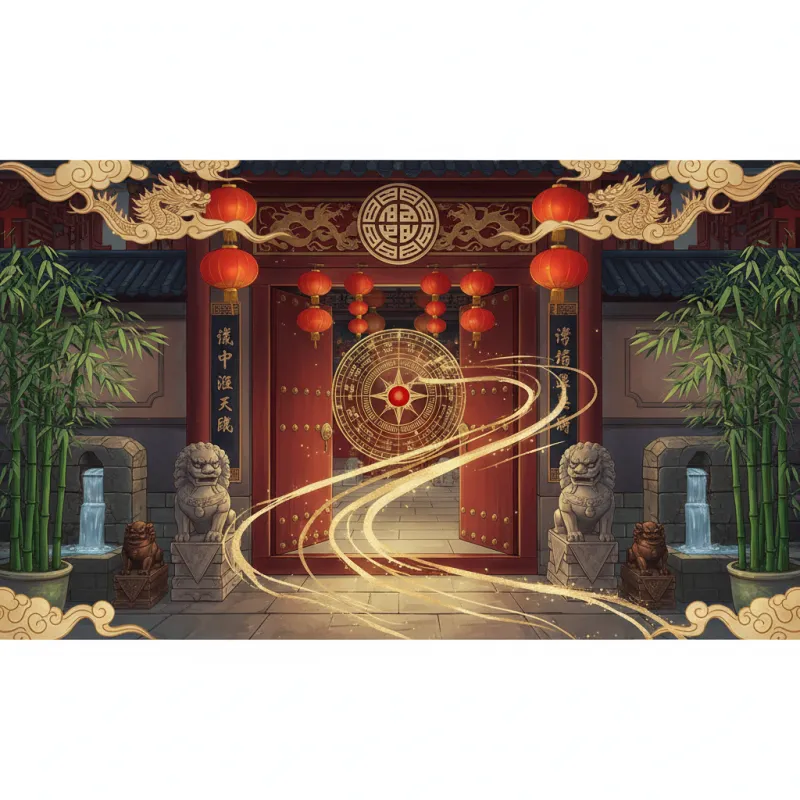
Your front door opens and closes dozens of times each day, but have you ever stopped to consider what it's actually doing? Not just physically — though that matters — but energetically. In classical feng shui texts, the front door isn't called an entrance. It's called the 气口 (qìkǒu), literally "qi mouth," and that metaphor tells you everything. Just as your mouth determines whether you consume nourishment or poison, your front door determines the quality of energy that feeds every room in your home.
I've walked through hundreds of front doors over the years, and I can tell you this: the most expensive door I ever saw was also one of the worst. Solid mahogany, custom hardware, probably cost more than my first car. But it stuck when you pushed it, scraped the threshold, and opened into a dark hallway crammed with shoes and unopened mail. Meanwhile, a modest apartment door in an older building — nothing special, just well-maintained and opening into a small but immaculate entryway — felt like taking a deep breath after being underwater. The difference wasn't the door itself. It was everything the door represented about how energy moves through space.
The Path Before the Door
Qi doesn't teleport to your threshold. It travels. And what it encounters on that journey shapes its quality before it ever reaches your door.
In the 《阳宅三要》 (Yángzhái Sān Yào, "Three Essentials of Yang Dwellings"), written during the Ming Dynasty, Master Zhao Jiufeng identifies the approach path as one of the critical factors in residential feng shui. He wasn't talking about aesthetics. He was talking about flow patterns — how energy gathers, accelerates, or disperses based on the physical environment.
A straight path pointing directly at your door is called a 冲煞 (chōngshà), or "rushing sha." Qi moves too fast, like water through a fire hose instead of a gentle stream. You feel it when you walk up: there's a sense of being pushed or hurried. Classical texts recommend curving the path, adding plantings to slow the flow, or placing a screen or decorative element to redirect the energy before it hits the door.
Conversely, a path that's overgrown, cluttered, or poorly lit creates stagnant qi. Energy can't find its way to your door, or arrives depleted and murky. I've seen homes where the front path was so neglected that visitors instinctively used the side or back entrance instead. The residents wondered why opportunities seemed to pass them by. The answer was right there in the approach — if energy can't find your door easily, neither can good fortune.
The ideal approach is gently curved or angled, well-lit, clearly maintained, and proportional to the door itself. Not a grand boulevard leading to a modest door, not a narrow crack leading to a mansion entrance. Balance and ease of movement.
The Door Itself: Function Over Fashion
Here's what matters about your actual door, in order of importance:
It must open fully. Not 80% of the way because there's a shoe rack behind it. Not with a scraping sound because the hinges need oil. Fully, smoothly, easily. The 《八宅明镜》 (Bā Zhái Míng Jìng, "Eight Mansions Bright Mirror") states that a door that doesn't open completely restricts the flow of opportunities into the home. This isn't metaphorical. When your door physically can't open all the way, you're literally limiting what can enter your space.
It must be in good repair. Peeling paint, broken hardware, cracked glass, warped wood — these aren't just maintenance issues. They're signals that the most important threshold in your home is being neglected. If you wouldn't trust a doctor whose office door was falling apart, why would qi trust your home's entrance?
It must be proportional to the home. A massive door on a small house creates imbalance — too much yang energy entering a space that can't process it. A tiny door on a large house restricts flow. The classical ratio is roughly 1:5 to 1:7 — the door height should be about one-fifth to one-seventh of the building's height. Modern homes don't always follow this, but the principle remains: the entrance should feel appropriate to the scale of the dwelling.
Direction matters, but not the way most people think. Yes, classical feng shui assigns favorable and unfavorable directions based on your 命卦 (mìngguà, life trigram). But I've seen people obsess over compass directions while ignoring the fact that their "auspicious" door opens into a wall of clutter. Get the basics right first. A well-maintained door in a "less favorable" direction will outperform a neglected door in a "perfect" direction every time.
The Threshold Moment
The threshold itself — that strip of material where outside becomes inside — deserves attention. In traditional Chinese architecture, thresholds were often raised, requiring you to step up and over. This wasn't just to keep out dirt and water. It was a deliberate pause, a moment of transition between the external world and the domestic sanctuary.
Modern homes rarely have raised thresholds, but you can create that sense of transition in other ways. A doormat that you actually use (not a decorative one that's too pretty to step on) serves this function. So does the simple act of removing shoes. The point is marking the boundary: here ends the outside world, here begins the protected space of home.
I'm particularly fond of the practice, common in older Chinese homes, of placing a small threshold stone or metal strip at the door. Not high enough to trip over, just enough to notice. That moment of noticing — of consciously crossing from one space to another — is itself a feng shui practice. It's mindfulness built into architecture.
The Entryway: First Impressions Are Everything
What qi encounters immediately after entering your door matters as much as the door itself. The 《地理人子须知》 (Dìlǐ Rénzǐ Xū Zhī, "What Earth's Children Must Know"), written by Xu Shanji in the Ming Dynasty, devotes an entire section to the 明堂 (míngtáng, "bright hall") — the space immediately inside the entrance.
This space should be:
Open enough to allow qi to gather and settle. Not a narrow hallway that funnels energy too quickly into the home. Not a cramped space where you're immediately confronted with walls or obstacles. Qi needs a moment to transition from the movement of the outside world to the more settled energy of the interior.
Bright. Natural light is ideal, but good artificial lighting works too. Dark entryways create stagnant qi. I've seen people install beautiful doors and then leave the entryway dim because they "don't spend much time there." You don't spend much time in your mouth either, but you still brush your teeth.
Clean and uncluttered. This is where most modern homes fail. The entryway becomes a dumping ground for shoes, coats, bags, mail, packages, and whatever else didn't make it further into the house. Every item sitting in your entryway is an obstacle to incoming qi. It's like trying to breathe through a congested nose.
Welcoming. This is subjective, but you know it when you feel it. A plant, a piece of art, a mirror (placed correctly — not directly facing the door, which bounces qi back out), a small table with fresh flowers. Something that says "this is a home, not just a building."
The classical texts recommend that the entryway be proportional to the home — not too large (which disperses qi before it can circulate) and not too small (which restricts flow). For most modern homes, this means the entryway should be roughly 6-10% of your total living space. But again, quality matters more than size. A small, well-maintained entryway beats a large, cluttered one.
Common Mistakes and How to Fix Them
The mirror facing the door. This is probably the most common feng shui mistake I see. People put a mirror directly across from the front door thinking it will "expand the space" or "bring in more light." What it actually does is bounce incoming qi right back out the door. If you want a mirror in the entryway — and mirrors can be useful for checking your appearance before leaving — place it on a side wall, not directly opposite the door.
The staircase facing the door. In homes where the staircase is directly aligned with the front door, qi rushes up the stairs instead of circulating through the main floor. Classical texts call this 泄气 (xièqì), "leaking qi." The traditional solution is to place a screen, room divider, or substantial piece of furniture between the door and the stairs to redirect the flow. Even a large plant can work if the space is tight.
The bathroom visible from the door. If the first thing you see when entering is a bathroom, qi is being drawn toward water and drainage rather than circulating through living spaces. Keep the bathroom door closed, or use a curtain or screen to block the direct sightline.
Clutter as "lived-in charm." There's a difference between a home that looks lived-in and a home where the entryway is a storage zone. If you can't walk through your front door without navigating around objects, you have a problem. Qi follows the same paths you do — if you're squeezing past obstacles, so is the energy trying to nourish your home.
Neglecting the exterior. The outside of your front door matters as much as the inside. Peeling paint, dead plants, broken light fixtures, accumulated leaves or debris — these create 煞气 (shàqì), or "killing qi," before energy even reaches your threshold. I've seen people spend thousands on interior feng shui consultations while ignoring the fact that their front door exterior looked abandoned.
Seasonal Adjustments and Maintenance
Feng shui isn't static. The quality of qi changes with seasons, weather, and time. Your front door and entryway should adapt accordingly.
In winter, when 阴气 (yīnqì, yin energy) is naturally stronger, your entryway needs more light and warmth. This doesn't mean cranking up the heat — it means ensuring good lighting, perhaps adding warmer colors in your decor, keeping the space especially clean and clear.
In summer, when 阳气 (yángqì, yang energy) dominates, you might want to introduce cooler colors, ensure good air circulation, and be especially vigilant about clutter (which generates heat and stagnation).
The equinoxes — spring and autumn — are traditional times for deep cleaning and reassessing your entryway. Not because of superstition, but because these are natural transition points in the year's energy cycle. What worked in winter might not work in summer. What you needed in summer might not serve you in winter.
Regular maintenance isn't just practical — it's a feng shui practice. Oiling hinges, touching up paint, replacing worn doormats, cleaning light fixtures, trimming plants — these small acts of attention keep qi flowing smoothly. Neglect accumulates, and accumulated neglect creates stagnant energy that affects everything downstream.
The Bigger Picture
Your front door and entryway don't exist in isolation. They're part of a larger system that includes your home office setup and your bedroom arrangement. But they're the beginning of that system, and beginnings matter.
I think about the 《易经》 (Yìjīng, I Ching) hexagram 屯 (Zhūn, "Difficulty at the Beginning"). The image is of a sprout pushing through hard earth — the beginning is difficult, but it determines everything that follows. Your front door is that beginning. Get it right, and everything else becomes easier. Neglect it, and you're fighting an uphill battle with every other feng shui adjustment you make.
The good news is that improving your front door and entryway is usually straightforward. You don't need to renovate or spend thousands of dollars. You need to pay attention, maintain what's there, and remove obstacles to flow. Sometimes the most powerful feng shui adjustments are the simplest ones: oil the hinges, clear the clutter, replace the burnt-out bulb, sweep the threshold.
Your front door opens and closes dozens of times each day. Each time it opens, it's an opportunity for fresh qi to enter. Each time it closes, it's a boundary protecting your home's energy. Treat it accordingly.
Related Reading
- Feng Shui for Your Home and Office: Practical Tips That Actually Work
- Bedroom Feng Shui: Creating Your Personal Sanctuary
- Home Office Feng Shui: Work Better from Home
- Feng Shui for Gardens and Outdoor Spaces
- Unlocking the Wisdom of Feng Shui and I Ching: A Journey Through Chinese Metaphysics
- The Five Elements Are Not Elements (And Why That Matters)
- Harmonizing Your Kitchen: The Role of Feng Shui and I Ching in Culinary Spaces
Explore Chinese Culture
- Explore Daoist philosophy and practice
- Explore traditional Chinese customs
- Explore ancient Chinese cosmology