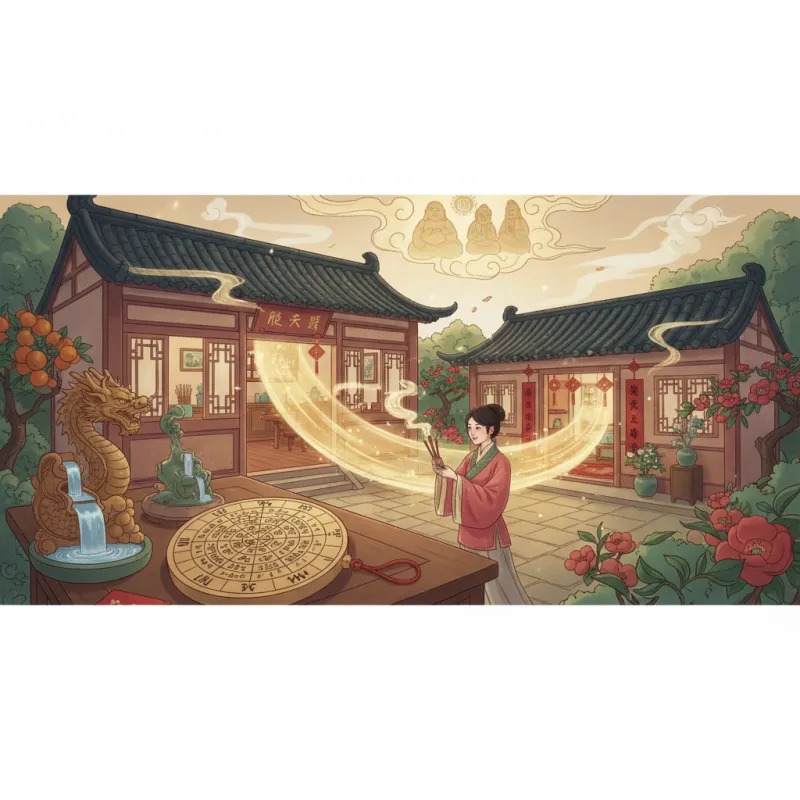
Every year around February 4th, something shifts. Not metaphorically — the Chinese solar calendar literally marks a new beginning called Lì Chūn (立春), the "Start of Spring." This is when the annual Flying Star chart rotates, and the energy map of your home changes completely. Miss this transition, and you're essentially living with last year's energy blueprint while everyone else has moved on.
Most Western articles about "Chinese New Year feng shui" get the date wrong. They focus on the Lunar New Year — the big celebration with red envelopes and fireworks. But in classical feng shui, the energy transition happens on Li Chun, which can fall anywhere between February 3rd and 5th. The two dates are not the same thing, and confusing them means you might be "preparing" your home on the wrong day entirely.
I've watched clients spend hundreds on consultations, only to implement changes two weeks late because they waited until Lunar New Year. The Flying Stars had already shifted. The afflicted sectors had already activated. And they wondered why their "cures" weren't working.
Understanding the Li Chun Transition
Li Chun marks the first of the 24 solar terms (二十四节气, èrshísì jiéqì) in the Chinese calendar. Unlike the Lunar New Year, which follows the moon's cycles and changes dates annually, Li Chun is solar-based and falls consistently around February 4th each year — sometimes February 3rd or 5th depending on the astronomical calculations.
This is the moment when the Tai Sui (太岁, Tàisuì) — the Grand Duke Jupiter — shifts position. The annual Flying Stars rotate. The Three Killings (三煞, Sānshà) relocate to a new direction. If you've studied Flying Star feng shui, you know these aren't abstract concepts. They're directional energy patterns that classical practitioners have tracked for centuries, and they reset on Li Chun, not during the Lunar festivities.
The Qing Dynasty feng shui master Shen Zhu Reng wrote in his Yang Zhai San Yao (阳宅三要) that "the year begins at Li Chun, not at the first moon." He wasn't being poetic. He meant that any annual feng shui adjustments must align with the solar calendar, because that's when the cosmic qi (气, qì) pattern actually changes.
Deep Cleaning Before the Energy Shift
The traditional practice of sweeping out the old year isn't just about tidiness — it's about clearing stagnant qi before new energy patterns establish themselves. But timing matters more than most people realize.
In classical practice, you should complete your deep cleaning before Li Chun arrives. Once the new Flying Stars settle into position, you want a clean slate for them to work with. Cleaning after the transition is like rearranging furniture after guests have already sat down — you're disrupting patterns that have already begun forming.
Start at least three days before Li Chun. Focus on areas that accumulate hidden dirt: behind appliances, under beds, inside closets, the tops of cabinets. These are places where qi stagnates throughout the year. In feng shui theory, stagnant qi (滞气, zhìqì) can trap old energy patterns, preventing new beneficial qi from circulating properly.
Pay special attention to the sectors that will host afflicted stars in the coming year. If you know the Five Yellow (五黄, Wǔhuáng) is moving to your bedroom, that room needs to be immaculate before Li Chun. The Five Yellow amplifies whatever it finds — including accumulated dust, clutter, and stagnant energy.
Don't forget windows. In feng shui, windows are the "eyes" of the home, and dirty windows literally obscure your ability to perceive opportunities. The Ming Dynasty text Ru Shou Jing (入首经) specifically mentions that "clouded glass clouds judgment." Clean windows allow clear qi to enter and circulate.
Identifying and Addressing Afflicted Sectors
Every year, certain compass directions become energetically challenging. The three main afflictions — Tai Sui, Three Killings, and Five Yellow — relocate annually, and you need to know where they're going before Li Chun arrives.
The Tai Sui position follows the 12 Earthly Branches in sequence. In 2025 (Year of the Snake), Tai Sui occupies the Southeast 3 sector (142.5° to 157.5°). You should never "confront" Tai Sui — meaning no renovations, no loud noises, no digging in that direction. The classical texts say "do not disturb the earth where Tai Sui resides" (太岁头上不可动土, Tàisuì tóu shàng bùkě dòngtǔ). This isn't superstition; it's about not activating negative qi in an already sensitive sector.
The Three Killings (Sānshà) is even more specific. It occupies a 90-degree arc and changes based on the year's Earthly Branch. For Snake years, the Three Killings sits in the West (247.5° to 337.5°). Unlike Tai Sui, you can face the Three Killings — you just can't have it at your back. This affects desk placement, bed orientation, and seating arrangements.
The Five Yellow is the most notorious annual affliction. It's a Flying Star, not a directional energy, so it moves through the nine sectors of the Luo Shu grid. In 2025, the Five Yellow occupies the Center palace. This is actually less problematic than when it lands in a specific direction, because the center is harder to "activate" through movement. But you still want to avoid major renovations or excessive activity in the central area of your home.
Before Li Chun, walk through your home with a compass and identify these sectors. Mark them mentally or on a floor plan. Then make a simple rule: no renovations, no loud construction, no digging in these areas for the entire year. If you're planning home improvements, schedule them for sectors that host auspicious stars instead.
Strategic Placement of Annual Cures
The word "cure" makes feng shui sound like folk medicine, but what we're really talking about is strategic placement of elements to balance or suppress certain energies. And like everything else, these need to be in place before Li Chun.
For the Tai Sui sector, the traditional remedy is a Pi Yao (貔貅, Píxiū) — a mythical creature that faces Tai Sui to "appease" it. But here's what most articles won't tell you: the Pi Yao needs to be placed in the sector opposite Tai Sui, facing toward it. In 2025, that means placing it in the Northwest 3 sector, facing Southeast. The logic is that you're showing respect to Tai Sui without directly confronting it.
For the Three Killings, you want metal energy to suppress the sha qi (煞气, shàqì). A brass Wu Lou (葫芦, húlu) or metal wind chime works, but it must be placed in the afflicted sector itself — the West in 2025. The metal element "exhausts" the wood energy of the Three Killings, reducing its negative impact.
The Five Yellow requires metal as well, but specifically still metal, not moving metal like wind chimes. A brass bell that you never ring, a metal plate, or six Chinese coins tied with red string. The number six is important — it represents the Qian trigram (乾, Qián), which is pure metal energy. Place this in the Center palace before Li Chun, and leave it undisturbed for the year.
But here's the critical part: these cures only work if the sectors are clean and the items are placed with intention. Tossing a Pi Yao in the general direction of Northwest while eating breakfast doesn't count. Take five minutes. Use a compass. Place it precisely. The difference between 305° and 325° might seem trivial, but in feng shui, you're either in the correct sector or you're not.
Activating Auspicious Sectors
While everyone obsesses over afflictions, the real opportunity lies in activating beneficial sectors. Every year, certain directions host auspicious Flying Stars that can enhance wealth, relationships, health, or academic success. These need activation after Li Chun, once the new stars have settled.
In 2025, the #8 Wealth Star sits in the Southwest. This is the most auspicious star in Period 9 (which began in 2024), and having it in the Southwest — an earth element sector — creates a harmonious relationship. To activate it, you need movement and yang energy. A water feature is ideal, but it must be clean, moving water. A fountain, an aquarium with an aerator, even a small desktop water feature. The movement "stirs" the qi and activates the wealth potential.
The #9 Multiplying Star occupies the East in 2025. This star amplifies whatever it touches, so you want to ensure it's touching something good. If your home office or study is in the East, this is an excellent year for career advancement or academic achievement. Activate it with fire energy — red decor, bright lighting, or even a small candle you light regularly. The fire element feeds the #9 star's inherent fire nature, strengthening its positive effects.
The #1 Victory Star lands in the North. This star governs competition, recognition, and career success. It's a water star in a water sector, which creates strong resonance. Activate it with metal energy — a metal wind chime, a brass bell, or metal decor. Metal generates water in the productive cycle, enhancing the #1 star's natural strength.
Timing matters here too. Don't activate these sectors until after Li Chun. If you place a water fountain in the Southwest on February 1st, you're activating last year's energy pattern, not this year's. Wait until February 4th or later. Give the new Flying Stars time to settle into their positions.
Adjusting Bed and Desk Orientations
Your bed and desk orientations affect you daily, so they deserve special attention during the annual transition. The goal is to face auspicious directions while avoiding afflicted ones, but this gets complicated when personal directions (based on your Kua number) conflict with annual directions.
First, check if your bed or desk currently faces Tai Sui or has the Three Killings at its back. In 2025, you don't want to face Southeast (Tai Sui) or have West at your back (Three Killings). If either applies, you need to reorient before Li Chun.
But here's where it gets nuanced: your personal Kua directions (based on your birth year and gender) don't change annually. If Southeast is your Sheng Qi (生气, Shēngqì) direction — your best direction for vitality and success — you're now in a bind. Do you face your best personal direction and confront Tai Sui, or do you avoid Tai Sui and face a less favorable direction?
Classical practitioners prioritize annual afflictions over personal directions. The reasoning is that annual energies are temporary but intense, while personal directions are constant but gentler. It's better to face your second-best direction for one year than to activate Tai Sui and deal with obstacles all year long.
For desks, facing an auspicious Flying Star sector can override personal direction concerns. If you're a West Group person but the #8 Wealth Star is in the Southwest, facing Southwest for your desk might be worth it, especially if you're working on financial projects or business development.
Beds are trickier because you can't easily change which direction your head points without moving the entire bed. If your current orientation conflicts with annual energies, consider whether the conflict is severe enough to warrant rearranging your bedroom. Facing Tai Sui from bed is problematic. Having the Three Killings at your back while sleeping is worse. But having the Five Yellow in your bedroom without facing it directly might be manageable with proper cures.
Make these adjustments before Li Chun if possible. If you're moving furniture on February 5th, you're already living with the new energy pattern, and the adjustment becomes reactive rather than proactive.
Refreshing Symbolic Enhancements
Beyond the technical aspects of Flying Stars and directional energies, feng shui includes symbolic enhancements — objects that represent desired outcomes. These should be refreshed annually, ideally just before Li Chun.
If you have a wealth bowl (聚宝盆, jùbǎopén), empty it, clean it thoroughly, and refill it with fresh items: new coins, crystals, or symbolic representations of abundance. The act of refreshing it signals a new beginning and prevents the energy from becoming stale.
Replace any dried or dead plants. In feng shui, dead organic matter represents decay and stagnant qi. If you have lucky bamboo that's turned yellow, throw it out before Li Chun. Start the new year with vibrant, living plants that represent growth and vitality.
Check your red envelopes or prosperity symbols. If they're faded, torn, or dusty, replace them. The color red (红, hóng) represents fire energy and yang qi, but only when it's vibrant. Faded red is worse than no red at all — it suggests diminished vitality.
If you use the traditional Chinese calendar or almanac (通书, Tōngshū), replace it with the new year's edition. These almanacs list auspicious and inauspicious dates for various activities, and they're calculated specifically for each year. Using last year's almanac after Li Chun is like using an expired map — the information is no longer accurate.
Some practitioners replace door gods (门神, ménshén) or spring couplets (春联, chūnlián) annually. Even if you're not traditionally Chinese, the principle applies: symbolic protections and blessings should be refreshed to align with the new year's energy. You don't need to follow every tradition, but choose the ones that resonate with you and commit to refreshing them properly.
The Day-Of Ritual
On Li Chun itself — the actual day, not the Lunar New Year — there's a specific ritual that classical practitioners follow. It's simple but intentional, and it marks the energetic transition in a conscious way.
At the exact time of Li Chun (which varies by year and location — check an astronomical calendar), open all windows and doors for at least 15 minutes. This allows old qi to exit and new qi to enter. The Qing Dynasty text Ba Zhai Ming Jing (八宅明镜) describes this as "welcoming the new qi" (迎新气, yíng xīn qì).
Some practitioners burn incense or sage during this time, walking through each room to clear stagnant energy. The smoke is symbolic — it represents the transformation of solid matter into ethereal energy, a metaphor for releasing old patterns.
After closing the windows, spend a few minutes in the center of your home (if accessible) or in your most-used room. Stand quietly and set intentions for the year. This isn't New Age manifestation — it's a practical way to align your consciousness with the new energy pattern. In feng shui theory, human intention (意, yì) interacts with environmental qi. You're not just a passive recipient of energy; you're an active participant in how it manifests.
Some people prepare a special meal on Li Chun, including foods that represent the five elements: something green (wood), something red (fire), something yellow (earth), something white (metal), something black (water). This is more folk tradition than classical feng shui, but it's a tangible way to acknowledge the transition and engage all five elements in balance.
The key is consciousness. Whether you follow every ritual or create your own, the point is to mark Li Chun as a distinct moment of transition. Most people sleepwalk through it, unaware that the energy map of their home just rotated. By acknowledging it consciously, you're already ahead of 95% of people who claim to practice feng shui.
Beyond the Annual Transition
Preparing your home for the new feng shui year isn't a one-day event — it's a process that begins weeks before Li Chun and continues into the first month of the new year. But once you've done it properly, you've set the foundation for the entire year ahead.
The annual transition is also an opportunity to reassess your overall feng shui setup. Are there permanent features of your home that consistently create problems? Is your front door aligned with your back door, creating a "through-flow" of qi? Are there sharp corners pointing at your bed or desk? The annual preparation is a good time to address these issues, because you're already in the mindset of optimization.
Consider keeping a feng shui journal. Note which sectors you activated, which cures you placed, and what changes you made. Then, throughout the year, track what happens. Did the wealth sector activation correlate with financial improvements? Did avoiding Tai Sui prevent obstacles? This kind of empirical observation is how feng shui evolved over centuries — practitioners tested theories, noted results, and refined their methods.
Remember that feng shui is one factor among many. It can optimize your environment and remove obstacles, but it doesn't override personal effort, skill, or timing. The annual forecast gives you a map, but you still have to walk the path.
The difference between someone who "does feng shui" and someone who practices it seriously is attention to detail and timing. Preparing your home for the new feng shui year isn't about buying cures or rearranging furniture randomly. It's about understanding the energetic transition, respecting the timing, and making precise adjustments that align your environment with the new annual pattern. Do it right, and you're not just preparing your home — you're preparing yourself for whatever the year brings.
Related Reading
- Feng Shui Monthly Tips: Adjusting Your Space Through the Year
- Annual Feng Shui Cures and Enhancers: What to Place Where
- Feng Shui 2026 Forecast: Year of the Fire Horse
- Feng Shui Annual Forecast: How the Year's Energy Affects Your Home
- The Bagua Map Explained: Your Feng Shui Floor Plan Guide
- Unlocking the Secrets of Feng Shui: Water Features in Chinese Metaphysics
- ** Exploring the Harmonious Relationship Between Feng Shui and Plants in Chinese Metaphysics
Explore Chinese Culture
- Explore Daoist philosophy and practice
- Explore traditional Chinese customs
- Explore ancient Chinese cosmology