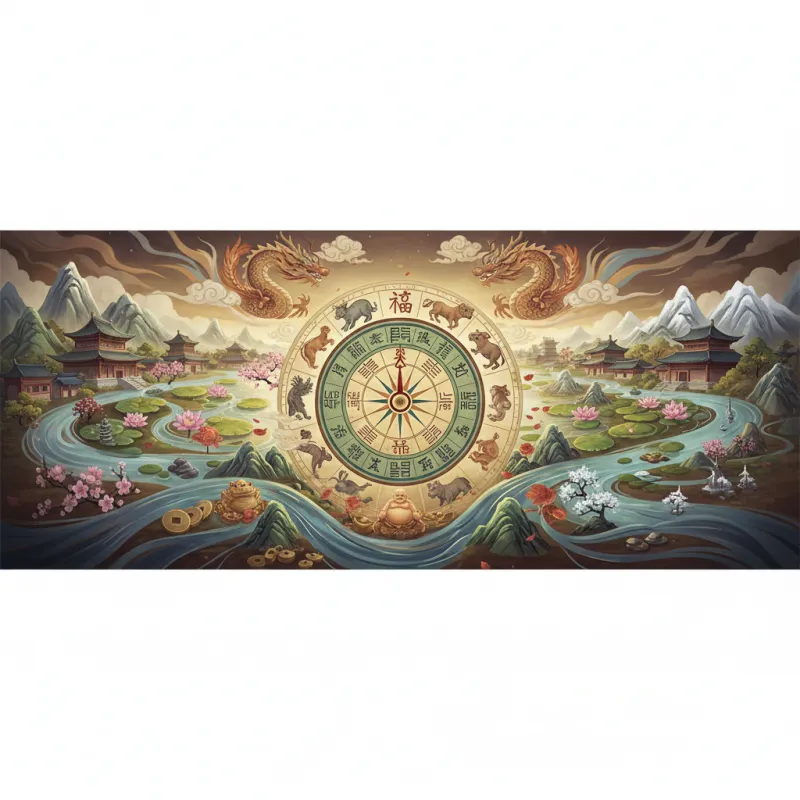
Your living room felt alive in spring. By midsummer, it was fine. Now, three months later, you walk in and something's... off. The furniture hasn't moved. The paint's the same. But the space feels heavy, stuck, like air that forgot how to circulate. You're not imagining it. In classical feng shui practice, this is exactly what happens when monthly qi (气 qì) patterns shift and your environment stays frozen in place.
The Flying Stars Don't Wait for You to Notice
Traditional feng shui operates on a system most Westerners never encounter: the nine flying stars (九宫飞星 jiǔgōng fēixīng), which rotate through your home's nine sectors every lunar month. These aren't decorative symbols. They're energetic patterns mapped from actual astronomical observations during the Han Dynasty, refined over centuries by practitioners who tracked how different star combinations affected health, wealth, and relationships in specific locations.
Each month, these stars "fly" to new positions. Star 5 (五黄 wǔhuáng), associated with obstacles and illness, might land in your bedroom in March but shift to your kitchen by April. Star 8 (八白 bā bái), the current period's prosperity star, moves too. A corner that supported your work in January might actively drain your energy by June. Classical texts like the Shen Shi Xuan Kong Xue (沈氏玄空学) from the Qing Dynasty document exactly how these patterns unfold — and how to adjust for them.
Most people set up feng shui cures once, following generic advice from books written for mass audiences. Then they wonder why the results fade. The answer: they're using static solutions for dynamic problems. Monthly adjustments aren't about obsessive tweaking. They're about staying synchronized with patterns that exist whether you acknowledge them or not.
What Actually Changes Month to Month
The lunar calendar divides the year into twelve months, but these aren't arbitrary divisions. Each month aligns with specific earthly branches (地支 dìzhī) and heavenly stems (天干 tiāngān) that create distinct energetic signatures. The first lunar month (正月 zhēngyuè), usually falling in February, carries Tiger energy — active, bold, sometimes aggressive. The fifth month (午月 wǔyuè) in June peaks with Fire element intensity. The eleventh month (子月 zǐyuè) in December brings maximum Water and Yin qualities.
These aren't metaphors. In bazi analysis, practitioners calculate how monthly pillars interact with your birth chart to predict favorable and challenging periods. The same principle applies to spaces. A home's natal chart (based on construction date and facing direction) interacts differently with each month's incoming energy. What worked in Wood-dominant spring months might clash with Metal-heavy autumn qi.
The five elements cycle through dominance patterns throughout the year. Spring months (Tiger, Rabbit, Dragon) emphasize Wood. Summer months (Snake, Horse, Goat) peak in Fire. Late summer (Dragon and Goat months) transition through Earth. Autumn (Monkey, Rooster, Dog) brings Metal forward. Winter (Pig, Rat, Ox) maximizes Water. Your space needs different elemental support depending on which phase you're in.
Practical Monthly Adjustments That Actually Matter
Start with the afflicted sectors. Every month, certain areas of your home become energetically problematic based on flying star positions. The 5 Yellow star brings obstacles. The 2 Black star (二黑 èrhēi) affects health, particularly for women and elderly people. The 3 Jade star (三碧 sānbì) triggers arguments and legal troubles. Classical practice uses metal element cures — wind chimes, metal bowls, coins — to exhaust these Earth-element stars in their monthly locations.
But here's what the simplified guides miss: the cures need to match the specific star's nature. For the 5 Yellow, you need heavy, still metal — think brass bowls or metal weights, not tinkling chimes. For the 2 Black, moving metal works better — a metal wind chime or clock. For the 3 Jade (which is Wood element, not Earth), you need Fire element to control it: red objects, lights, or candles in that sector.
The auspicious stars need activation, not just acknowledgment. When Star 8 flies into your home office, that's the month to push major projects, sign contracts, or launch initiatives. Add earth element (crystals, ceramics, yellow tones) to strengthen it. When Star 1 (一白 yībái), the water star associated with wisdom and relationships, enters your bedroom, enhance it with actual water features or dark blue/black accents. When Star 6 (六白 liùbái), the heaven star of authority and mentorship, lands in your study, add metal element and keep the area especially clean and organized.
Seasonal element adjustments matter more than most people realize. In spring months, reduce Metal element in your main living areas — it cuts Wood energy when Wood should be ascending. Add green plants, wooden furniture, vertical lines. In summer, minimize Water element in active spaces (it clashes with Fire's peak), but keep it strong in bedrooms for balance. In autumn, reduce Fire element — those red accent walls that energized you in June might feel aggressive by October. In winter, minimize Earth element in social areas, as it dams Water's natural flow.
The Lunar Calendar Rhythm Your Space Needs
Each lunar month begins with the new moon, not the first of the month on Western calendars. This matters because qi shifts follow lunar cycles, not arbitrary date divisions. The new moon marks the beginning of waxing energy — the two weeks when qi builds and expands. This is when you should activate auspicious sectors, start new projects in favorable areas, and add yang elements (light, sound, movement) to spaces you want to energize.
The full moon marks the peak and the beginning of waning energy. The two weeks after full moon are for consolidating, completing, and adding yin elements (stillness, darkness, quiet) to spaces that need calming. If you're trying to activate wealth qi during the waning moon phase, you're working against the current. It's like planting seeds in autumn — technically possible, but you're making it harder than it needs to be.
The four seasonal nodes (立春 lìchūn, 立夏 lìxià, 立秋 lìqiū, 立冬 lìdōng) mark major energetic shifts when flying stars change their annual positions. These typically fall in early February, May, August, and November. The two weeks around these dates are transition periods when qi is unstable. Classical texts advise against major renovations, moving furniture, or implementing new feng shui adjustments during these windows. Wait until the new season settles, usually about a week after the node date.
What You Don't Need to Change
Not everything requires monthly attention. Your home's basic structure — the location of doors, windows, bed placement, stove position — should follow classical principles that remain constant. The eight mansions (八宅 bāzhái) method and flying star calculations for your home's natal chart don't change month to month. These form your foundation.
Personal element needs based on your bazi chart stay consistent too. If you're a weak Water day master who needs Metal and Water support, that doesn't flip in summer just because Fire element is seasonally dominant. Your personal element balance takes priority over seasonal adjustments in your private spaces like bedrooms.
The monthly adjustments work best as accent changes, not complete overhauls. You're adding a metal bowl here, moving a plant there, changing throw pillow colors, adjusting lighting. Think of it like seasoning food — you're enhancing the base recipe, not replacing it every month. A practitioner once told me she keeps a box of seasonal items (colored cloths, small element objects, portable water features) that she rotates through key sectors. Takes her maybe twenty minutes per month.
When Monthly Adjustments Actually Make a Difference
You'll notice the impact most in spaces you use daily for important activities. Your home office, if you work from home. Your bedroom, where you spend a third of your life. Your kitchen, if you cook regularly. The entryway, which filters all incoming qi. These high-traffic, high-impact areas benefit most from monthly fine-tuning.
Pay special attention during months when your personal bazi chart clashes with the monthly energy. If you're a Rooster year person, the Rabbit month (usually March) brings direct opposition. If you're a Horse day master, the Rat month (usually December) creates conflict. During these months, strengthen your personal element in your bedroom and workspace. Add extra cures in sectors where afflicted stars land. Be more conservative with major decisions.
The months when annual and monthly flying stars combine badly need extra attention. When the annual 5 Yellow occupies the same sector as the monthly 2 Black, that location becomes seriously problematic. When the annual 3 Jade meets the monthly 3 Jade, argument energy doubles. Classical practitioners track these combinations and advise clients to avoid those sectors entirely during problem months — don't renovate there, don't spend extended time there, keep the area quiet and still.
The Rhythm Becomes Intuitive
After tracking monthly adjustments for a full year, you start to feel the patterns. You notice that your energy dips in certain months, peaks in others. You recognize when a space needs more yang activation versus yin settling. You develop instincts about when to push forward and when to consolidate.
This isn't mystical sensitivity. It's pattern recognition. The same way you eventually learn that you're more productive in morning versus afternoon, or that certain foods affect your energy differently in summer versus winter. You're just extending that awareness to your environment.
The goal isn't to become dependent on monthly adjustments, constantly worried that your space is "wrong." The goal is to develop a relationship with your environment that's responsive rather than static. Your home becomes a tool you tune, not a stage set you arrange once and forget. The ancient practitioners who developed these systems lived in their spaces for decades, watching how seasonal and monthly shifts affected daily life. They weren't following rules. They were following patterns they'd observed directly. You're doing the same thing, just with a few thousand years of documented observations to guide you.
Related Reading
- Feng Shui 2026 Forecast: Year of the Fire Horse
- How to Prepare Your Home for the New Feng Shui Year
- Feng Shui Annual Forecast: How the Year's Energy Affects Your Home
- Annual Feng Shui Cures and Enhancers: What to Place Where
- Discover the Secrets of Feng Shui: Transforming Your Garden with I Ching and Chinese Metaphysics
- Unlocking Office Harmony: The Role of Feng Shui and I Ching in Modern Workspaces
- Swimming Pools and Feng Shui: Wealth Feature or Energy Drain?
Explore Chinese Culture
- Explore Daoist philosophy and practice
- Explore traditional Chinese customs
- Explore ancient Chinese cosmology