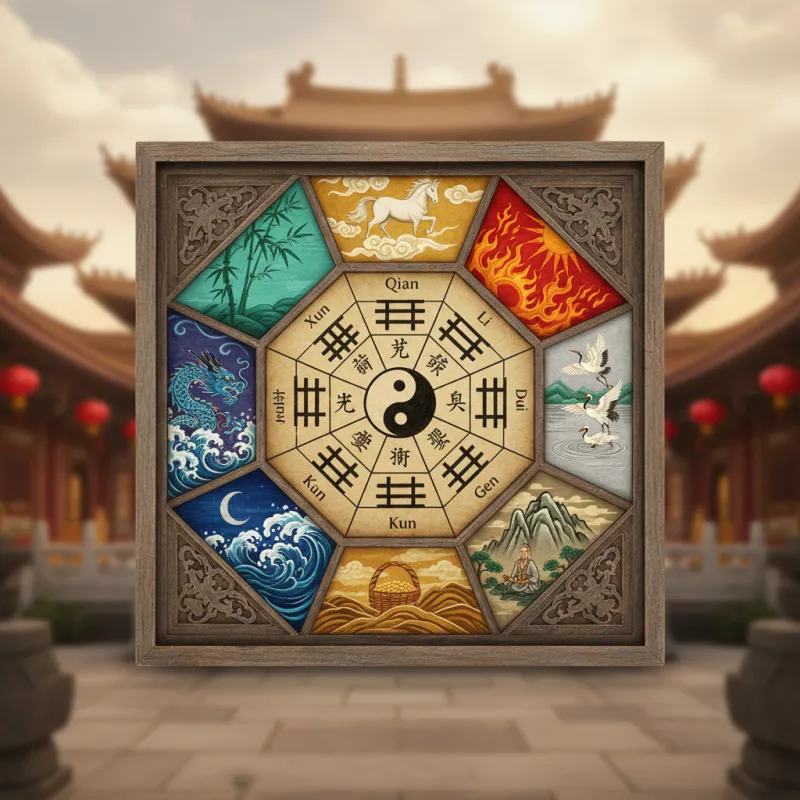
You walk into your home after a long day, and something feels... off. Not wrong exactly, but the energy seems stuck in the corners, pooling in odd places like water that forgot how to flow. Your career feels stagnant, your relationships need a spark, and your health could use attention. What if I told you that ancient Chinese masters developed a precise map—not of streets or territories, but of invisible energy currents—that could diagnose exactly where your life force is leaking away?
The Bagua Map (八卦图, bāguà tú) isn't some New Age invention dreamed up in a California wellness center. It's a sophisticated energy diagnostic tool rooted in the I Ching (易经, Yìjīng), the 3,000-year-old "Book of Changes" that influenced everyone from Confucius to Carl Jung. Think of it as an X-ray machine for your home's Qi (气, qì)—revealing which life areas are thriving and which are gasping for breath.
The Eight Trigrams: Building Blocks of Reality
Before we map your home, we need to understand what we're mapping with. The Bagua consists of eight trigrams (卦, guà), each a unique combination of three lines that are either broken (yin) or solid (yang). These aren't arbitrary symbols—they're the fundamental building blocks of change itself, according to the I Ching.
Each trigram carries a name, a natural element, a family member, a body part, and a life aspiration. Take Qian (乾, qián), the trigram of three unbroken lines. It represents heaven, the father, the head, and career success—pure yang energy pushing upward and outward. Its opposite, Kun (坤, kūn), shows three broken lines: earth, the mother, the abdomen, and relationships—receptive yin energy that nurtures and supports.
The other six trigrams occupy the spectrum between these poles. Zhen (震, zhèn) is thunder and new beginnings. Xun (巽, xùn) is wind and wealth. Kan (坎, kǎn) is water and career. Li (离, lí) is fire and fame. Gen (艮, gèn) is mountain and knowledge. Dui (兑, duì) is lake and children. Each trigram emerged from centuries of observation—ancient sages watching how natural forces interacted and recognizing those same patterns in human affairs.
Two Schools, Two Maps: The Great Bagua Divide
Here's where things get interesting, and where many Feng shui books conveniently gloss over a crucial detail: there are two completely different ways to apply the Bagua Map to your home. The Classical (or Compass) School and the Western (or BTB) School disagree fundamentally on how to orient the map, and this isn't a minor technical quibble—it's the difference between using a compass that points north versus one that points wherever you happen to be standing.
The Classical School, dominant in Asia and rooted in texts like the Tang Dynasty's "Yellow Emperor's Classic," insists you must use an actual compass (罗盘, luópán). You align the Bagua according to the magnetic directions of your home. North always corresponds to the Kan trigram (career), south to Li (fame), east to Zhen (family), and so on. This method connects your home to the actual electromagnetic field of the Earth and the movement of celestial bodies—the same principles used in Chinese astrology and Bazi.
The Western BTB (Black Sect Tantric Buddhism) School, popularized in America during the 1980s by Grand Master Lin Yun, takes a radically different approach. Forget the compass. Instead, align the Bagua based on your front door, which always falls in the Knowledge, Career, or Helpful People areas. The rest of the map unfolds from there, regardless of actual compass directions. Critics call this "Feng shui lite"—a simplified system divorced from classical cosmology. Supporters argue it's more intuitive and accessible, focusing on intention rather than magnetic fields.
Which is correct? I'll be blunt: if you want authentic Feng shui as practiced for millennia, use a compass. The BTB method has its merits for quick assessments and psychological reframing, but it's essentially a different system that borrowed the Bagua's vocabulary. That said, many people report results with BTB methods, which tells us something important about the power of intention and attention—even if it's not traditional Feng shui.
Mapping Your Space: The Practical Process
Let's get practical. You've chosen your school (I recommend Classical for serious practice), and now you're standing in your home with a compass app on your phone. Here's how to overlay the Bagua Map onto your actual living space.
First, find the center point of your home. For regular shapes, this is straightforward geometry. For L-shaped or irregular homes, you'll need to determine if the missing section is significant enough to count as a "missing area"—a topic that deserves its own discussion about Feng shui cures and remedies. Stand at this center point and take your compass reading.
Now divide your floor plan into nine equal sections, like a tic-tac-toe grid. The center square is the Tai Qi (太极, tàijí), the heart of your home where all energies converge. The eight surrounding squares correspond to the eight trigrams and their associated life areas:
North (Kan): Career and life path. This area governs your professional journey and sense of purpose. Water element. Colors: black, dark blue. If your home office or front door sits here, excellent—you're literally entering through your career sector.
Northeast (Gen): Knowledge and self-cultivation. This is your wisdom corner, ideal for libraries, meditation spaces, or study areas. Earth element. Colors: blue, green, black.
East (Zhen): Family and health. The sector of ancestors, elders, and physical vitality. Wood element. Colors: green, brown. Many practitioners place family photos here.
Southeast (Xun): Wealth and prosperity. Not just money, but abundance in all forms. Wood element. Colors: purple, green, gold. The infamous "wealth corner" that gets so much attention in popular Feng shui.
South (Li): Fame and reputation. How the world sees you, your social standing, and recognition. Fire element. Colors: red, orange, purple. This is where you want your awards, diplomas, and press clippings.
Southwest (Kun): Love and relationships. Partnership, marriage, and romantic connections. Earth element. Colors: pink, red, white. Pairs of objects work well here—two candles, two pillows, two anything.
West (Dui): Children and creativity. Offspring, creative projects, and what you birth into the world. Metal element. Colors: white, gold, silver.
Northwest (Qian): Helpful people and travel. Mentors, benefactors, networking, and journeys. Metal element. Colors: gray, white, silver. Some practitioners keep a small globe or travel photos here.
Reading the Energy: What Your Bagua Reveals
Once you've mapped your home, the real work begins: interpretation. A Bagua Map isn't just a static overlay—it's a diagnostic tool that reveals patterns in your life by examining what's happening in each sector.
Is your wealth corner (Southeast) occupied by a bathroom? Water draining away suggests money flowing out faster than it comes in. Many Feng shui consultants have seen this exact configuration in homes where clients struggle with savings, regardless of income level. The classical remedy involves keeping the toilet lid down and the bathroom door closed—simple actions that symbolically "plug the drain."
Does your relationship corner (Southwest) house your home gym with aggressive, solitary energy? You might find partnerships feel like work, or that you're attracting competitive rather than complementary partners. Moving exercise equipment to the East (health) sector and creating a softer, paired energy in the Southwest often correlates with shifts in relationship dynamics.
Here's something most Feng shui books won't tell you: missing areas matter more than most practitioners admit. If your floor plan creates a missing section in the Northwest (helpful people), you might notice a pattern of having to do everything yourself, struggling to find mentors, or feeling unsupported by others. The classical texts from the Song Dynasty are quite clear that missing sectors create deficiencies in corresponding life areas.
But—and this is crucial—correlation isn't causation. The Bagua Map works through a combination of actual environmental factors (light, air flow, spatial psychology) and the focused attention you bring to different life areas. When you identify your career corner and intentionally enhance it, you're not just moving furniture—you're programming your subconscious to prioritize career development every time you see that space.
Beyond the Basics: Advanced Bagua Applications
Once you've mastered the basic nine-sector grid, traditional Feng shui offers deeper layers of analysis. The Flying Stars system (飞星, fēixīng) overlays time-based energy patterns onto the Bagua, calculating how Qi shifts annually, monthly, and even daily. A sector that's auspicious this year might be challenging next year, requiring different enhancements or cures.
You can also apply the Bagua fractally—to individual rooms, desks, or even your bed. Your bedroom has its own Bagua Map, with its own relationship corner and wealth sector. Some practitioners take this to extremes, mapping their desk drawers and refrigerator shelves, though at some point you're probably overthinking it.
The relationship between the Bagua and the Five Elements (五行, wǔxíng) adds another dimension. Each sector has an associated element, and you can strengthen or weaken areas using the productive and destructive cycles of elements. Want to boost your fame (South, Fire element)? Add Wood element objects, since Wood feeds Fire. Need to calm an overactive career sector (North, Water)? Introduce Earth elements, which absorb Water. This is where understanding the Five Elements becomes essential for sophisticated Feng shui practice.
The Skeptic's Question: Does It Actually Work?
Let's address the elephant in the room: is the Bagua Map real, or is it an elaborate system of confirmation bias and placebo effects?
The honest answer is: probably both, and that doesn't make it less valuable. Modern environmental psychology confirms that our surroundings profoundly affect our mood, behavior, and even decision-making. The Bagua Map provides a framework for intentionally designing spaces that support specific goals—and intention is powerful.
When you designate a wealth corner and place symbols of abundance there, you're creating a daily visual reminder of financial goals. When you enhance your relationship sector with paired objects and soft colors, you're priming yourself to think about partnership. The Bagua works as a form of environmental programming, whether or not you believe in Qi as a literal force.
That said, I've consulted with enough people who made simple Bagua-based changes and experienced uncanny shifts—job offers arriving days after enhancing the career sector, relationships improving after addressing the Southwest corner—to remain agnostic about the mechanism. Maybe it's Qi. Maybe it's psychology. Maybe it's both. The results speak for themselves.
The Bagua Map gives you a systematic way to audit your living space and identify areas of neglect or imbalance. Even if you strip away all the mystical language, you're left with a practical tool for creating environments that support your goals. And if there's something more to it—some actual energetic reality that ancient Chinese masters perceived—well, you're tapping into that too.
Your home is speaking to you right now, through the arrangement of furniture, the flow of light, the placement of objects. The Bagua Map is simply the translation guide, helping you understand what it's saying and how to respond. Whether you're a true believer or a curious skeptic, mapping your space according to the eight trigrams will change how you see your home—and possibly how you live your life.
Related Reading
- Your Feng Shui Is Probably Wrong: Common Mistakes Westerners Make
- Feng Shui vs. Superstition: Where's the Line?
- What Is Feng Shui? A Complete Beginner's Guide
- The History of Feng Shui: From Ancient China to Your Living Room
- Feng Shui Colors: What Every Color Means and Where to Use It
- Kitchen Feng Shui: Cooking Up Prosperity
- Exploring Feng Shui, I Ching, and Chinese Metaphysics: Symbols of Ancient Divination and Geomancy
- Gold and Red: The Power Combination in Feng Shui
Explore Chinese Culture
- Explore Daoist philosophy and practice
- Explore traditional Chinese customs
- Explore ancient Chinese cosmology