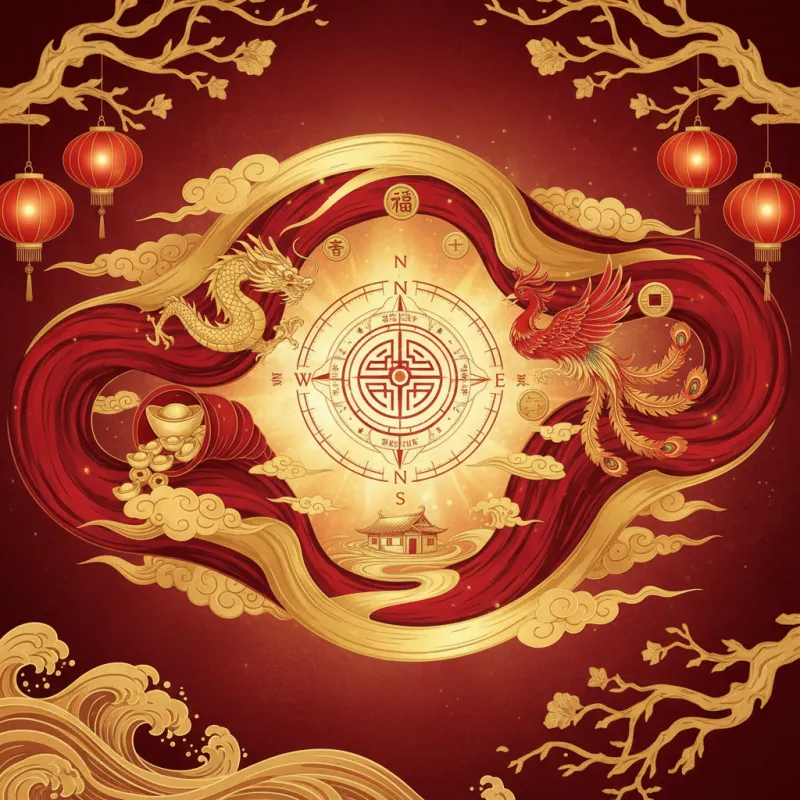
Picture the moment a bride steps into her wedding chamber, wrapped in crimson silk embroidered with golden phoenixes. The room glows — red lanterns overhead, gold tassels swaying, the air itself seeming to pulse with heat and light. Your grandmother would tell you this combination brings good fortune. But she might not tell you why it works, or that the same principles governing that bridal chamber also explain why the Emperor's throne sat on a red dais under a golden canopy, why temple gods wear red robes with gold trim, and why your local Chinese restaurant probably has both colors splashed across its entrance.
Red and gold aren't just aesthetically pleasing together. In feng shui's Five Elements framework, they represent a carefully calibrated energetic relationship that generates wealth, commands respect, and anchors auspicious energy. Red embodies fire (火, huǒ) — active, expansive, celebratory. Gold represents both earth and metal depending on context — earth when we're talking about yellow-gold tones (土, tǔ), metal when we mean metallic gold (金, jīn). The magic happens in how these elements interact.
The Fire-Earth-Metal Cycle: Why This Combination Actually Works
Most feng shui explanations stop at "red is lucky, gold is wealthy." That's like saying a car works because it has wheels. Let's look at the actual mechanics.
In the productive cycle (生, shēng) of the Five Elements, fire creates earth — think of volcanic ash enriching soil, or fire reducing matter to mineral ash. Earth, in turn, creates metal — minerals and ores form within the earth's crust. So when you place red (fire) and gold (earth/metal) together, you're not just combining two lucky colors. You're creating a generative sequence where one element literally produces the next.
This matters because feng shui isn't about static symbolism. It's about energy flow. Fire's nature is to rise, expand, and radiate. Earth's nature is to stabilize, accumulate, and ground. Metal's nature is to concentrate, refine, and conduct. When you combine red and gold, you get fire's activating energy → earth's stabilizing accumulation → metal's concentrated wealth. The sequence moves from activation to manifestation to preservation.
Compare this to red and blue (fire and water), which create conflict in the destructive cycle — water extinguishes fire. Or gold and green (metal and wood), where metal cuts wood. Red and gold don't fight. They collaborate.
Historical Precedent: Imperial Authority and Divine Power
The Forbidden City (紫禁城, Zǐjìnchéng), built during the Ming Dynasty starting in 1406, is essentially a massive feng shui statement in red and gold. The walls are red — not just any red, but a specific iron oxide pigment that took years to perfect. The roof tiles are glazed in imperial yellow-gold, a color so restricted that commoners could be executed for using it. This wasn't decorative excess. It was elemental engineering.
The emperor represented the ultimate yang authority — fire energy, the sun, heaven's mandate. But fire alone is unstable, consuming, dangerous. By surrounding himself with earth tones (the golden roofs, yellow glazed tiles) and metal (bronze vessels, gold ornaments), the emperor's fire energy was channeled into productive, stable authority rather than destructive chaos. The palace itself became a physical manifestation of the productive element cycle, with the emperor as the fire source generating earth's stability and metal's wealth for the empire.
Look at any Qing Dynasty imperial portrait — the emperor wears a yellow (earth) robe embroidered with red (fire) dragons and gold (metal) thread. Even his clothing followed the elemental sequence. The Qianlong Emperor (乾隆, reigned 1735-1796) was particularly obsessive about this, commissioning detailed studies of color symbolism and insisting on specific red-gold ratios in palace decorations based on his birth chart's elemental needs.
Red-Gold in Different Contexts: Not One-Size-Fits-All
Here's where most feng shui advice goes wrong: treating red and gold as universally beneficial. They're not. The combination works powerfully in specific contexts but can be overwhelming or inappropriate in others.
Wealth and business spaces: This is red-gold's strongest application. The fire-earth-metal sequence directly corresponds to the wealth generation process — initial investment (fire's activation) → business growth (earth's accumulation) → profit realization (metal's concentration). This is why nearly every traditional Chinese bank, gold shop, or trading house features red and gold prominently. The Hong Kong Stock Exchange building? Red structural elements, gold accents. Not coincidence.
Celebration and ceremony: Weddings, New Year, temple festivals — occasions where you want maximum yang energy and auspicious symbolism. The red-gold combination amplifies celebratory energy and signals important transitions. In traditional weddings, the bride's red and gold outfit isn't just pretty; it's meant to activate fire energy (passion, new beginnings) while grounding it in earth stability (lasting marriage) and attracting metal wealth (prosperity).
Authority and leadership spaces: Executive offices, government buildings, positions of power. The combination conveys both dynamic authority (red/fire) and stable legitimacy (gold/earth-metal). But note the ratio matters — too much red creates aggression, too much gold creates rigidity.
Where red-gold doesn't work: Bedrooms (too activating for rest), meditation spaces (too stimulating for calm), healthcare environments (fire energy can aggravate illness), and spaces for people with strong fire in their bazi (八字, bāzì) charts who need cooling, not heating. If your birth chart already has excessive fire, adding red-gold is like throwing gasoline on a bonfire.
The Ratio Question: How Much Red, How Much Gold?
Traditional feng shui texts like the Yangzhai Sanyao (阳宅三要, "Three Essentials of Yang Dwellings") from the Qing Dynasty suggest that elemental balance depends on the space's purpose and the occupant's birth elements. For red and gold, the classical ratio is roughly 60% red to 40% gold for activating wealth energy, or 40% red to 60% gold for stabilizing existing wealth.
In practice, this might mean red walls with gold accents for a new business trying to generate momentum, or gold/cream walls with red decorative elements for an established business focused on preservation. The Qing merchant families of Shanxi Province, who dominated Chinese banking for centuries, typically used gold as the dominant color in their counting houses with strategic red accents — they were managing wealth, not generating it from scratch.
Modern applications get this wrong constantly. Walk into any Chinese restaurant in the West and you'll see red and gold splashed everywhere in equal measure with no thought to ratio or purpose. It's feng shui as decoration rather than feng shui as energy management. The result is often visually overwhelming and energetically confused — neither activating nor stabilizing, just loud.
Metallic Gold vs. Yellow-Gold: An Important Distinction
When feng shui practitioners talk about "gold," they're often conflating two different elemental energies. Metallic gold — actual gold leaf, gold paint with metallic sheen, brass, bronze — represents metal element (金, jīn). Yellow-gold or golden yellow — the color without metallic quality — represents earth element (土, tǔ).
This distinction matters because the elemental dynamics differ. Red with metallic gold creates a fire-earth-metal sequence: fire → earth → metal. Red with yellow-gold creates a fire-earth relationship: fire → earth, stopping there. The first generates and concentrates wealth. The second generates and stabilizes, but doesn't concentrate.
For wealth activation, you want metallic gold — actual shine and reflectivity. This is why traditional Chinese gold shops display actual gold jewelry in red-lined cases, not just yellow paint. The metal element's concentrating quality is essential. For general stability and nourishment, yellow-gold works fine. This is why many homes use red and yellow-gold rather than red and metallic gold — they're seeking stability, not aggressive wealth generation.
The Xuankong Feixing (玄空飞星, "Mysterious Void Flying Stars") school of feng shui, which dominated during the late Qing and Republican periods, specifically distinguished between these gold types in its color recommendations. Master Shen Zhu Reng (沈竹礽, 1849-1906), one of the school's key systematizers, wrote that metallic gold should be used in wealth sectors (typically southeast or northwest depending on the period), while yellow-gold should be used in health and relationship sectors.
Practical Application: Getting Red-Gold Right in Modern Spaces
If you're going to use red and gold together, here's how to do it with actual feng shui logic rather than just slapping up decorations:
Identify your purpose first. Wealth generation? Use 60% red, 40% metallic gold, concentrated in your wealth sector (usually southeast or the far left corner from your entrance). Stability and preservation? Use 40% red, 60% yellow-gold, distributed more evenly. Authority and leadership? Use red as the base with gold accents at eye level and above.
Consider your personal elements. Check your bazi chart or at least your birth year element. If you're already fire-heavy (born in fire years like 1986, 1987, 1996, 1997), reduce the red proportion or skip this combination entirely. If you're water-heavy (1972, 1973, 1982, 1983), red-gold can provide beneficial warming, but balance it with some blue or black elements to avoid completely overwhelming your water nature.
Use texture and material, not just color. Red silk has different energy than red paint. Gold leaf has different energy than gold plastic. Traditional applications used natural materials — silk, lacquer, actual gold — because the material itself carries elemental properties beyond just color. Modern substitutes work, but they're weaker. A red silk cushion with gold embroidery carries more feng shui impact than a red plastic chair with gold spray paint.
Respect the space's existing energy. A north-facing room (water energy) might struggle with heavy red-gold (fire-earth-metal). A south-facing room (fire energy) might become overwhelming with too much red. Adjust your ratios based on the space's inherent elemental tendency. This is where feng shui becomes art rather than formula — you're balancing multiple energetic factors, not just applying a rule.
Seasonal adjustments matter. Red-gold is naturally more appropriate in autumn and winter (metal and water seasons) when you need warming, activating energy. In summer (fire season), it can be excessive. Some traditional households would actually swap out red-gold decorations for cooler colors in summer months, then bring them back in autumn. Modern climate control makes this less critical, but the principle remains — don't fight the seasonal energy.
The Cultural Weight: Why This Combination Persists
Beyond the elemental mechanics, red and gold carry centuries of cultural association that amplifies their feng shui effect. When Chinese people see red and gold together, they're not just seeing colors — they're seeing weddings, New Year celebrations, temple festivals, imperial grandeur, ancestral blessings. This collective cultural imprinting creates what you might call "psychological feng shui" that reinforces the elemental feng shui.
The Dream of the Red Chamber (红楼梦, Hónglóumèng), written by Cao Xueqin in the mid-18th century, describes the Jia family mansion's decorations in obsessive detail. Red and gold appear constantly in scenes of wealth, celebration, and power — but notably absent in scenes of decline and tragedy. Cao Xueqin, whose own family fell from imperial favor, understood that these colors weren't just decoration but markers of energetic and social status.
This cultural dimension means red-gold works differently for Chinese versus non-Chinese users. For someone raised in Chinese culture, the combination triggers deep associations with prosperity and celebration. For someone without that background, the effect is purely elemental — still valid, but lacking the cultural amplification. This doesn't mean non-Chinese people can't use red-gold effectively, but they should understand they're working with one layer of meaning rather than multiple layers.
When to Avoid Red-Gold Entirely
Let's be clear about when this combination is wrong. If you're trying to create calm, contemplative energy — meditation rooms, bedrooms, therapy spaces — red-gold is counterproductive. The fire-earth-metal sequence is inherently activating and materializing. It pushes energy outward and downward into manifestation. That's the opposite of what you want for rest, reflection, or spiritual practice.
Similarly, if your space already has strong fire energy — south-facing, lots of sunlight, angular architecture, red brick exterior — adding more red-gold is overkill. You'll create an imbalanced environment that feels aggressive or draining. In these cases, you'd want to introduce cooling elements like blue and white or green and brown to balance the existing fire.
Health considerations matter too. Traditional Chinese medicine associates excessive fire with inflammation, anxiety, high blood pressure, and insomnia. If you or your household members struggle with these issues, red-gold environments can exacerbate them. The activating quality that makes red-gold powerful for wealth can be harmful for health when fire is already excessive in the body.
The Modern Evolution: Red-Gold in Contemporary Design
Contemporary feng shui practitioners are adapting red-gold applications for modern aesthetics and lifestyles. Instead of the bold, saturated reds and bright golds of traditional design, many now recommend burgundy or wine reds with rose gold or champagne gold — softer versions that maintain the elemental relationship while fitting modern minimalist sensibilities.
This works because the elemental quality isn't about saturation or brightness — it's about the fundamental color frequency and material properties. A muted burgundy is still fire element. Rose gold is still metal element. The productive cycle still functions. What changes is the intensity and cultural signaling. Softer versions feel contemporary rather than traditional, making them more acceptable in modern professional or residential spaces where bold red-gold might feel out of place.
Some practitioners are also exploring red-gold in unexpected materials — red concrete with gold metal inlays, red glass with gold lighting, red textiles with gold hardware. These applications maintain the elemental relationship while creating fresh aesthetic expressions. The key is understanding the principle (fire-earth-metal productive cycle) rather than just copying traditional forms.
The combination's power hasn't diminished in the modern era — it's just being expressed in new ways. Whether it's a tech startup using burgundy and rose gold in their branding, a luxury hotel using red lacquer and gold leaf in their lobby, or a family using red cushions and gold picture frames in their living room, the fundamental feng shui dynamic remains the same: fire activates, earth stabilizes, metal concentrates. Red and gold together create a complete cycle of energetic generation, accumulation, and manifestation.
That's why this combination has persisted for millennia and will continue to persist. It's not just tradition or superstition. It's applied elemental physics, cultural psychology, and aesthetic power combined into two colors that, when used correctly, create one of the most potent energetic environments in feng shui practice.
Related Reading
- Feng Shui Color Symbolism: The Hidden Meanings Behind Every Hue
- Black in Feng Shui: Power, Depth, and When to Use It
- Feng Shui Color Guide by Room
- Color Theory in Feng Shui: Why Red Means Luck and White Means Death
- Harnessing the Power of Flying Stars in Feng Shui and I Ching
- The Five Phases: Understanding Wu Xing as Movement, Not Material
- ** Exploring the Harmonious Relationship Between Feng Shui and Plants in Chinese Metaphysics
Explore Chinese Culture
- Explore Daoist philosophy and practice
- Explore traditional Chinese customs
- Explore ancient Chinese cosmology