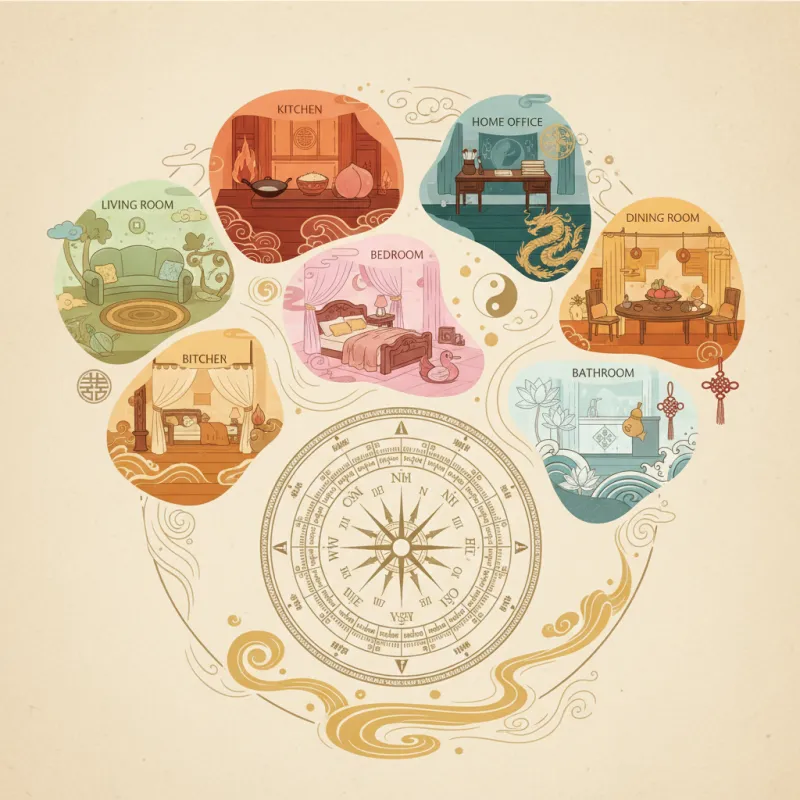
You walk into a room and something feels off. The furniture is fine, the layout makes sense, but you can't shake the feeling that you're swimming upstream just by being there. Nine times out of ten, the culprit is color — not because you chose "ugly" colors, but because you chose colors that fight against the room's purpose, its direction, or your own elemental nature.
Feng shui color theory isn't interior decorating with mystical window dressing. It's a diagnostic system rooted in the Five Elements (五行, wǔ xíng) — Wood, Fire, Earth, Metal, and Water — and their relationships to compass directions, room functions, and human activity. The Huangdi Neijing (黄帝内经, Yellow Emperor's Classic of Internal Medicine), written during the Warring States period, established the color-element correspondences that feng shui practitioners still use today: green for Wood, red for Fire, yellow for Earth, white for Metal, black for Water. But knowing the correspondences is just the beginning. The real skill is knowing when to apply them, when to soften them, and when to ignore them entirely.
Living Room: The Heart of Social Energy
The living room is yang space — active, social, conversational. It needs colors that encourage interaction without overstimulation. This is where most people go wrong: they either make it too yin (soft grays, muted blues) and the room feels lifeless, or too yang (bright reds, intense oranges) and conversations become arguments.
Earth tones are your foundation here. Warm beiges, terracotta, soft yellows — these belong to the Earth element and create what the classics call "gathering qi" (聚气, jù qì). Earth is the center in the Five Elements cycle, the stabilizing force that allows other elements to interact without conflict. A living room in Earth tones naturally becomes a place where people want to linger.
But Earth alone makes a room static. You need accent colors based on the room's compass direction. A south-facing living room can handle Fire element reds and purples because south is Fire's home direction — the energy reinforces rather than conflicts. A north-facing living room needs Water element blues and blacks, but sparingly. Too much Water in a social space and the energy becomes introspective, even melancholic. Use navy or charcoal as accents, not as the dominant color.
The occupants' personal elements matter more in living rooms than anywhere else because multiple people use the space. If you're a strong Fire person (born in summer, lots of Fire in your bazi chart) and your partner is a strong Water person, you need Earth colors to mediate. Earth receives Water and produces Fire in the productive cycle — it's the diplomatic element. This is why so many traditional Chinese homes used yellow and ochre in common areas. It wasn't just imperial fashion; it was practical element balancing.
Bedroom: Yin Sanctuary and the Direction Problem
Bedrooms are yin spaces — restful, private, restorative. The color mistake here is using colors that are too yang (bright whites, vivid reds) or colors that activate rather than calm. But the bigger mistake is ignoring the bedroom's compass direction entirely.
A bedroom in the east or southeast (Wood directions) should use soft greens and blues. Wood element colors in Wood directions create what's called "element harmony" (元素和谐, yuánsù héxié) — the room's inherent energy and its color energy align. But notice I said soft greens and blues. Bright emerald or electric blue are too yang for a bedroom regardless of direction. You want colors that suggest Wood's growth energy without its aggressive spring vitality. Think sage, seafoam, dusty teal.
South-facing bedrooms are tricky. South is Fire direction, but Fire colors (red, purple, bright orange) are terrible for sleep. Fire is the most yang of the five elements — it rises, it activates, it prevents the downward, inward movement that sleep requires. The solution isn't to avoid Fire entirely but to use its yin expression: deep burgundy, mauve, soft coral. These contain Fire's warmth without its stimulation. Or you can use Earth colors, since Fire produces Earth in the productive cycle. A south bedroom in warm taupe or soft terracotta feels naturally comfortable.
West and northwest bedrooms (Metal directions) should use whites, grays, and metallics, but again, the yin versions. Bright white is too yang — it reflects light, activates the mind, prevents melatonin production. Use cream, ivory, warm gray. Metal element colors in Metal directions create clarity and precision, which sounds wrong for a bedroom until you realize that good sleep requires mental clarity. A cluttered mind doesn't rest. Metal's energy, properly applied, cuts through mental noise.
North bedrooms (Water direction) can use blues and blacks, but this is where personal elements become critical. If you're a weak Water person (little Water in your bazi, born in summer), Water colors in a Water direction might make you feel depleted. You'd be better with Earth colors to contain the Water, or Metal colors to produce more Water gently. The Zangfu theory from traditional Chinese medicine applies here: too much of your weak element doesn't strengthen you; it exhausts you further.
For more on how personal elements interact with directional energy, see Understanding Your Personal Element Profile.
Kitchen: Fire and Water in Eternal Conflict
The kitchen is feng shui's nightmare room because it contains both Fire (stove) and Water (sink) in close proximity. These elements are in the destructive cycle — Water extinguishes Fire. No amount of color will fix a stove directly opposite a sink, but color can soften the conflict.
Earth element colors are essential in kitchens because Earth sits between Fire and Water in the productive cycle. Fire produces Earth (ash becomes soil), and Earth produces Water (water flows from mountains). Use yellows, warm browns, terracotta tiles, beige cabinets. Earth mediates the elemental war happening in every kitchen.
White kitchens are popular in the West, and from a feng shui perspective, they're not wrong — white is Metal, and Metal produces Water while being produced by Earth. A white kitchen with warm wood (Earth) accents and stainless steel (Metal) appliances creates a productive cycle: Earth → Metal → Water. The Fire element (stove) is contained rather than conflicted.
But avoid blue kitchens. Blue is Water, and too much Water in a kitchen suppresses Fire energy entirely. Fire in feng shui isn't just the literal stove; it's transformation energy, the ability to turn raw ingredients into nourishment. A blue kitchen feels cold even when it's physically warm. I've seen people complain that they never want to cook in their newly renovated blue kitchens, and it's not a coincidence.
Red kitchens are equally problematic but for the opposite reason. Too much Fire creates what the classics call "excessive yang" (阳盛, yáng shèng) — the energy becomes aggressive, chaotic. People in all-red kitchens report feeling rushed, making mistakes, burning food. If you want red in the kitchen, use it as an accent on the south wall or in decorative elements, not as the dominant color.
Home Office: Direction Determines Function
Home offices need colors that support focused mental work, but the type of work matters. A home office where you do creative work needs different colors than one where you do analytical work.
For creative work (writing, design, art), use Wood element colors — greens and teals. Wood is the element of growth, expansion, new ideas. A green home office in the east or southeast (Wood directions) creates powerful element harmony. The room's directional energy and its color energy both support creative generation. But if your office is in the west or northwest (Metal directions), green becomes problematic. Metal cuts Wood in the destructive cycle — you'll feel like your ideas are being pruned before they fully form. In Metal direction offices, use white or gray with green accents, not green as the dominant color.
For analytical work (accounting, programming, research), use Metal element colors — whites, grays, metallics. Metal's energy is precise, discriminating, focused. A white or gray office in the west or northwest creates the mental clarity that detailed work requires. But too much Metal becomes rigid. Add Earth element accents (warm wood desk, beige rug) to soften Metal's cutting energy.
If your office is in the north (Water direction), you have options. Water is the element of wisdom, depth, and flow — good for both creative and analytical work. Use blues and blacks, but balance them with Wood (green) if you do creative work, or Metal (white) if you do analytical work. A north office in navy blue with white trim and green plants creates a productive cycle: Metal → Water → Wood.
South-facing offices (Fire direction) are energizing but can become overstimulating. Fire is quick, bright, scattered — good for brainstorming, bad for sustained focus. Use Fire colors (reds, purples) sparingly, and ground the space with Earth tones. A south office in warm beige with burgundy accents gives you Fire's activation without its chaos.
The occupant's personal element matters enormously in home offices because you spend hours there daily. If you're a strong Fire person, a Fire-colored office in a Fire direction might make you manic. You'd be better with Earth colors to ground your Fire, or even Water colors to control it (though this risks feeling suppressed). This is where consulting your bazi chart becomes practical rather than esoteric. For guidance on determining your dominant element, see Calculating Your Bazi Element Balance.
Bathroom: Water's Domain and the Drainage Problem
Bathrooms are Water element rooms by function — they're where water enters and leaves the home. The feng shui concern isn't the Water itself but the drainage. Water flowing out represents wealth and energy leaving, which is why classical feng shui texts recommend keeping bathroom doors closed and toilet lids down.
Color can't fix bad bathroom placement (directly opposite the front door, above the kitchen, in the wealth corner), but it can minimize Water's draining effect. Use Earth element colors — beiges, tans, warm browns. Earth contains Water in the controlling cycle, preventing it from flowing away unchecked. A bathroom in Earth tones feels grounded rather than depleting.
White bathrooms are common and feng shui-acceptable because white is Metal, and Metal produces Water in the productive cycle. But all-white bathrooms can feel cold and clinical. Add warm wood (Earth) elements — bamboo accessories, wooden bath mat, warm beige towels. This creates Earth → Metal → Water, a productive cycle that feels balanced.
Avoid blue bathrooms. Blue is Water, and Water in a Water room amplifies the draining effect. I've worked with clients who felt exhausted after showers in blue bathrooms, and switching to Earth tones made a noticeable difference. The same applies to black — it's Water element and too yin for a room that's already yin by function.
Green bathrooms (Wood element) are interesting because Water produces Wood in the productive cycle. A green bathroom uses the Water energy rather than letting it drain away. But green bathrooms work best when the bathroom is in the east or southeast (Wood directions). A green bathroom in the west (Metal direction) creates conflict — Metal cuts Wood, and the room feels uncomfortable even if you can't articulate why.
Dining Room: Earth's Gathering Function
Dining rooms are Earth element spaces by function — they're where families gather, where nourishment happens, where the day's scattered energy comes together. Earth colors are natural here: warm yellows, oranges, terracotta, rich browns.
But the dining room's compass direction modifies the color choice. A dining room in the southwest or northeast (Earth directions) can use pure Earth tones — the room's function and direction align perfectly. A dining room in the south (Fire direction) should use Earth tones with Fire accents because Fire produces Earth. Think warm yellow walls with burgundy curtains or orange placemats.
A dining room in the north (Water direction) needs careful handling. Water and Earth are in the controlling cycle — Earth dams Water. Too much Earth in a north dining room feels heavy, stagnant. Use lighter Earth tones (cream, light tan) with blue accents to acknowledge the room's Water direction. Or use Metal colors (white, gray) to create a productive cycle: Metal → Water, with Earth as accents rather than the dominant color.
Red dining rooms are traditional in Chinese culture because red is Fire, and Fire produces Earth (the dining room's functional element). Red also stimulates appetite and conversation. But Western-style bright red is too yang. Use deeper reds — burgundy, wine, brick red. These contain Fire's warmth and social energy without its aggressive yang quality.
Green dining rooms work if the room is in the east or southeast (Wood directions) because Wood produces Fire, and Fire produces Earth — a double productive cycle. But green dining rooms in other directions feel off. Wood's energy is upward and outward, which conflicts with the dining room's gathering, centering function.
Children's Rooms: Growth Energy and Age Considerations
Children's rooms need colors that support growth, learning, and healthy sleep — a tricky balance. The child's age matters as much as the room's direction.
For young children (under 7), use soft, yin colors regardless of direction. Their yang energy is already high; the room needs to calm rather than stimulate. Soft blues, gentle greens, warm peaches, light yellows. These are yin expressions of their respective elements — they contain the element's quality without its intensity.
For older children and teenagers (7-18), consider the room's direction and the child's personal element. An east-facing room (Wood direction) in soft greens supports growth and learning. A south-facing room (Fire direction) in warm Earth tones (peach, coral, soft yellow) grounds Fire's intensity while maintaining its energizing quality. A west-facing room (Metal direction) in soft grays or creams supports focus and discipline.
Avoid bright primary colors in children's rooms. Red, bright blue, vivid yellow — these are too yang. They overstimulate, prevent rest, and create what traditional texts call "scattered qi" (散气, sàn qì). The child's energy disperses rather than consolidates. I've seen dramatic behavioral improvements when parents switch from bright primary colors to softer, more yin versions of the same hues.
The child's personal element, determined by their bazi chart, should influence color choice as they get older. A Fire-dominant teenager in a Fire-colored room might become aggressive or anxious. They'd benefit from Earth colors to ground their Fire, or even Water colors to control it (though this requires careful application — too much Water and they feel suppressed). For more on how elemental imbalances manifest in behavior and health, see Five Elements and Personal Wellness.
The Practical Application: Testing and Adjustment
Feng shui color theory gives you a framework, not a formula. The room's direction, its function, and the occupants' personal elements all matter, but so does personal preference and cultural context. A color that's theoretically perfect but that you hate will never feel right.
Start with the room's function and direction. These are fixed factors. Then consider personal elements — yours if it's a private space, the primary users' if it's a shared space. Choose colors that create productive cycles or element harmony rather than destructive cycles or element conflict.
But then live with it. Feng shui isn't static. A color that feels perfect in summer might feel wrong in winter. A color that worked when you were 30 might not work at 40. Your personal element balance shifts with age, health, and life circumstances. The room's energy shifts with seasons and with who uses it.
The classical texts emphasize observation over rigid application. The Zhuangzi (庄子) says "the perfect man uses his mind like a mirror — it grasps nothing, it refuses nothing, it receives but does not keep." Apply feng shui color principles, then observe. Does the room feel comfortable? Do you want to spend time there? Do you sleep well, work productively, socialize easily? If yes, the colors are working regardless of whether they follow every rule. If no, adjust.
This is why feng shui masters traditionally visited homes multiple times, observing how occupants interacted with the space across different times of day and different seasons. Color in feng shui isn't about perfection; it's about creating environments where human activity flows naturally, where you're not fighting the space just by being in it. Get that right, and the specific shade of green becomes less important than the fact that the room finally feels like home.
Related Reading
- Feng Shui Color Symbolism: The Hidden Meanings Behind Every Hue
- Black in Feng Shui: Power, Depth, and When to Use It
- Color Theory in Feng Shui: Why Red Means Luck and White Means Death
- Gold and Red: The Power Combination in Feng Shui
- Designing Feng Shui Meditation Spaces
- Smart Home and Feng Shui: Can Technology and Tradition Coexist?
- Face Reading: The Ancient Chinese Art of Judging Character by Appearance
Explore Chinese Culture
- Explore Daoist philosophy and practice
- Explore traditional Chinese customs
- Explore ancient Chinese cosmology