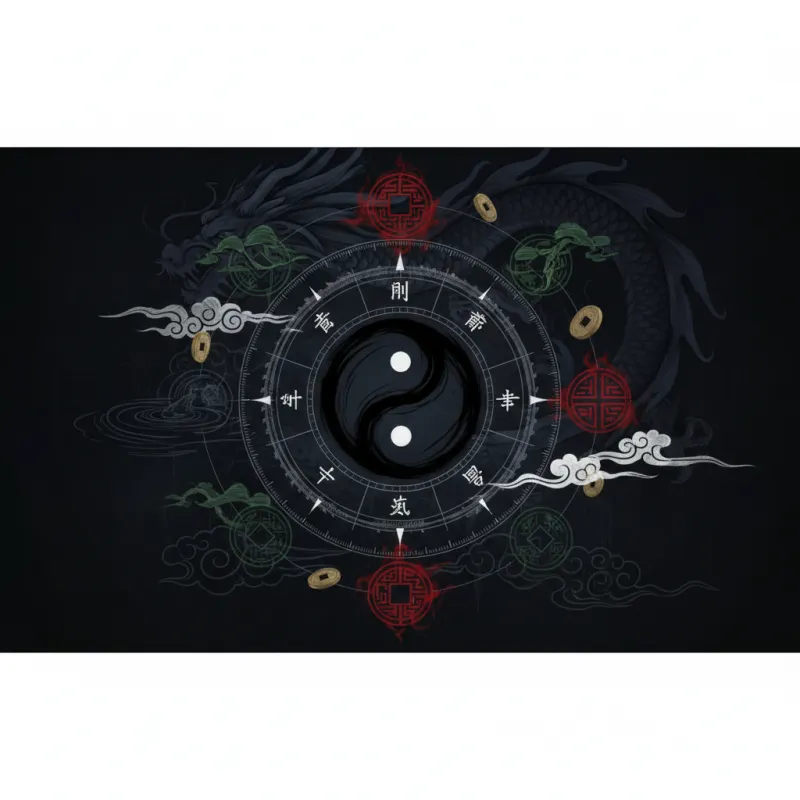
Ask a feng shui consultant about painting your bedroom black and watch them recoil. "Too yin!" they'll say. "It drains energy, invites depression, brings bad luck." Then ask them about the black granite water feature in every high-end hotel lobby in Hong Kong, or why the wealthiest families in Singapore favor black lacquer furniture, or why the Forbidden City's northern gates — the most auspicious direction — are trimmed in deep black.
Suddenly the story gets more complicated.
Black in feng shui isn't unlucky. It's misunderstood. As the color of the water element (水 Shuǐ), black represents the deepest, most concentrated form of energy in the Five Elements system. It's the color of midnight, of deep ocean trenches, of ink used to write the I Ching. It holds power, mystery, and potential — but like actual water, it can either nourish or drown depending on how you use it.
The Water Element: Black's True Nature
In classical Five Elements theory (五行 Wǔ Xíng), black belongs entirely to water. Not dark blue, not charcoal gray — pure black. This association runs deeper than simple color matching. Water in Chinese cosmology represents:
The direction North (北 Běi) — considered the most yin direction, associated with winter, rest, and accumulation of resources. The North Star, unchanging and reliable, governs this sector.
Career and life path (事業 Shìyè) — the bagua area linked to water governs your professional journey, not just your job but your calling, your legacy, the flow of your working life.
Wisdom through depth — water seeks the lowest places, accumulates knowledge, reflects truth. The Daodejing (道德經) says "上善若水" (shàng shàn ruò shuǐ) — "the highest good is like water," precisely because it's humble, adaptable, and essential.
Wealth accumulation — not the active generation of wealth (that's wood), but the gathering and storing of it. Think reservoirs, not rivers. Black represents money already earned, savings, inheritance, the deep pockets that sustain you through lean times.
This is why you'll see black granite, black marble, and black lacquer in the wealth corners of traditional Chinese businesses. It's not decorative — it's functional feng shui, creating a symbolic reservoir for prosperity.
When Black Works: Strategic Placement
Black thrives in specific contexts. Use it wrong and yes, it becomes oppressive. Use it right and it anchors your entire space.
North-facing rooms and sectors — This is black's home territory. A north-facing home office with black accents supports career advancement. Black picture frames on the north wall of your living room strengthen the career area without overwhelming the space.
Water features and wealth areas — Black stone in fountains, black tiles around pools, black frames around aquariums. You're doubling down on the water element, creating a concentrated point of wealth energy. The famous Bellagio fountains in Las Vegas? Black granite base. Not coincidence.
Grounding excessive fire energy — In the Five Elements cycle, water controls fire (水克火 shuǐ kè huǒ). If a room feels too yang — too much red, too much activity, too much heat — strategic black cools it down. A black coffee table in an all-red dining room. Black curtains in a south-facing bedroom that gets blasted with afternoon sun.
Professional and formal spaces — Black conveys authority, seriousness, depth. Law offices, executive suites, libraries, meditation rooms. Places where you want gravitas, not playfulness. The black robes of judges and scholars throughout Chinese history weren't arbitrary — they signaled water element wisdom and authority.
As accent, not foundation — Here's the key: black works best in small, intentional doses. Black throw pillows on a cream sofa. A black vase on a wooden shelf. Black hardware on white cabinets. You're adding depth and contrast, not creating a cave.
When Black Fails: The Danger Zones
Black becomes problematic when it overwhelms or appears in the wrong elemental context.
Bedrooms, especially for sleep — Too much black in a bedroom suppresses yang energy when you need it most — in the morning, when you're trying to wake up. A black bedroom might help insomniacs initially, but long-term it can lead to oversleeping, depression, lack of motivation. If you love black bedding, balance it with white sheets or light-colored walls.
Small, windowless spaces — Black needs space to breathe. In a tiny, dark bathroom or closet, black tiles or paint make the space feel like a tomb. The water element becomes stagnant instead of flowing. You want water to move, not pool in dark corners.
South-facing rooms — The south belongs to fire element (火 Huǒ). Black here creates direct elemental conflict. Water extinguishes fire, suppressing the natural yang energy of southern exposure. If you must use black in a south room, add wood element colors (green, brown) as a bridge — wood feeds fire and is fed by water, creating a productive cycle instead of a destructive one.
Children's rooms — Kids need yang energy for growth, play, learning. Black is too yin, too still, too adult. Even teenagers benefit from lighter colors. Save the black walls for their college dorm room when they're trying to look sophisticated.
Kitchens — The kitchen is a fire element space (cooking, transformation, yang activity). Excessive black here dampens the fire energy you need for nourishment and family vitality. Black granite countertops? Fine, they're grounded by the earth element of stone. All-black cabinets and appliances? You're creating a cold, unwelcoming space where no one wants to cook.
Black in Bazi and Personal Elements
Your relationship with black isn't universal — it depends on your personal element structure from your bazi chart (八字 Bāzì), the Four Pillars of Destiny.
If water is your favorable element, black becomes your power color. Wear it, surround yourself with it, use it liberally. You're strengthening your core energy. People with strong fire in their chart often need water to balance — black clothing, black accessories, even black cars can help moderate excessive yang energy.
If water is your unfavorable element, black can drain you. Too much water in your chart already? Adding black is like adding weight to someone who's drowning. You'll feel heavy, stuck, unmotivated. Stick to your favorable element colors instead — maybe earth tones if you need grounding, or metal colors (white, silver, gold) if you need clarity.
If you're earth element dominant, black (water) can be problematic because water controls earth in the destructive cycle (水克土 shuǐ kè tǔ). You might feel undermined or eroded by too much black in your environment. Use it sparingly, if at all.
This is why generic feng shui advice fails. "Black is bad" or "black is good" misses the entire point. The question is: bad or good for whom, in what context, for what purpose?
Pairing Black: The Art of Balance
Black rarely works alone. It needs companions, contrasts, context. The traditional Chinese aesthetic understood this perfectly.
Black and white — The yin-yang symbol (太極圖 Tàijí Tú) shows this pairing at its most fundamental. Black and white together create dynamic balance, each defining the other. In interior design, this combination is crisp, clear, sophisticated. Think black lacquer furniture against white walls, black calligraphy on white paper, black and white photography.
Black and gold — Water and metal. Metal generates water in the productive cycle (金生水 jīn shēng shuǐ), so gold or brass accents with black create a flowing, supportive relationship. This is why you see black lacquer with gold leaf in traditional Chinese furniture — it's not just beautiful, it's elementally harmonious. The gold feeds the black, strengthening the water element.
Black and green — Water and wood. Water nourishes wood (水生木 shuǐ shēng mù), making this pairing naturally productive. Black pots with green plants, black frames around botanical prints, black furniture in a room with lots of greenery. The black supports growth and vitality rather than suppressing it.
Black and earth tones — This is trickier because earth and water conflict in the destructive cycle. But in practice, black with warm browns, tans, and beiges can work if the earth tones dominate. Think black accents in a predominantly brown room. The earth contains the water, preventing it from overwhelming the space.
Avoid pairing black heavily with red or orange (fire colors) unless you're deliberately trying to create tension or drama. The elemental conflict is too direct for most living spaces.
The Cultural Context: Why Black Got a Bad Reputation
Black's negative reputation in popular feng shui comes from a real place — Chinese funeral customs. Black (and white) are traditional mourning colors, worn at funerals, associated with death and grief. For generations, this created a cultural aversion to black in celebratory or daily contexts.
But this is cultural association, not feng shui principle. The Five Elements system predates these funeral customs by centuries. In the I Ching (易經 Yìjīng), written around 1000 BCE, black represents the ultimate yin — not death, but potential, the void from which all things emerge, the dark soil where seeds germinate.
The Daoist tradition embraced black as the color of the Dao itself — mysterious, profound, beyond comprehension. "玄之又玄" (xuán zhī yòu xuán) — "mystery upon mystery" — uses the character 玄, which means deep black or dark.
Modern feng shui practitioners, especially those catering to Western clients, often oversimplify to avoid confusion. "Black is bad" is easier to remember than "black represents water element energy which can be favorable or unfavorable depending on your personal bazi chart, the room's direction, and the specific application." But easy isn't accurate.
Practical Applications: Black in Real Spaces
Let's get specific. Here's how to actually use black effectively:
Home office — Black desk accessories, black filing cabinets, black picture frames on the north wall. Supports career energy without overwhelming the space. Pair with wood furniture and green plants to keep energy flowing.
Bathroom — Black towels, black bath mat, small black decorative items. Bathrooms are already water element spaces, so black reinforces rather than conflicts. But keep walls light to prevent the space from feeling like a cave.
Living room — Black as accent color only. Black throw pillows, black lamp bases, black picture frames, maybe one black accent chair. Creates depth and sophistication without suppressing the social yang energy you want in communal spaces.
Entryway — A black console table or black door mat can work well, especially if your front door faces north. It grounds the energy as people enter, creates a sense of arrival and importance. But balance with good lighting and lighter wall colors.
Meditation or reading nook — This is where black can shine. A black meditation cushion, black curtains to block light, black bookshelves. You want depth, quiet, inward focus — all water element qualities. Just ensure the space gets natural light when you're not using it for meditation.
Avoid — Black ceilings (too oppressive, creates downward pressure), all-black rooms (stagnant energy, depression risk), black in children's spaces (suppresses growth energy), black dominating fire element rooms like kitchens or south-facing living areas.
The Verdict: Black as Tool, Not Taboo
Black in feng shui is like water in nature — essential, powerful, and potentially dangerous if mishandled. A river nourishes civilization. A flood destroys it. The water hasn't changed; the context has.
Stop thinking of black as "bad luck" and start thinking of it as concentrated water element energy. Ask yourself: Does this space need more water energy? Does my personal bazi chart favor water? Am I using black to create depth and contrast, or am I drowning the space in yin?
The most sophisticated feng shui applications use black sparingly and strategically — a black granite water feature in the north corner, black lacquer furniture with gold accents, black accessories that ground and anchor without overwhelming. They understand that black isn't the problem. Ignorance is.
Use black with intention, respect its power, and balance it with other elements. Do that, and black becomes one of your most valuable feng shui tools — the color that adds depth, authority, and the mysterious power of water to your space.
For more on elemental color theory, see Understanding the Five Elements in Color Selection and Water Element Colors Beyond Black and Blue.
Related Reading
- Feng Shui Color Guide by Room
- Feng Shui Color Symbolism: The Hidden Meanings Behind Every Hue
- Gold and Red: The Power Combination in Feng Shui
- Color Theory in Feng Shui: Why Red Means Luck and White Means Death
- ** Exploring the Harmonious Relationship Between Feng Shui and Plants in Chinese Metaphysics
- The Bagua Map Explained: Your Feng Shui Floor Plan Guide
- Feng Shui for Shops and Restaurants: Attract More Customers
Explore Chinese Culture
- Explore Daoist philosophy and practice
- Explore traditional Chinese customs
- Explore ancient Chinese cosmology