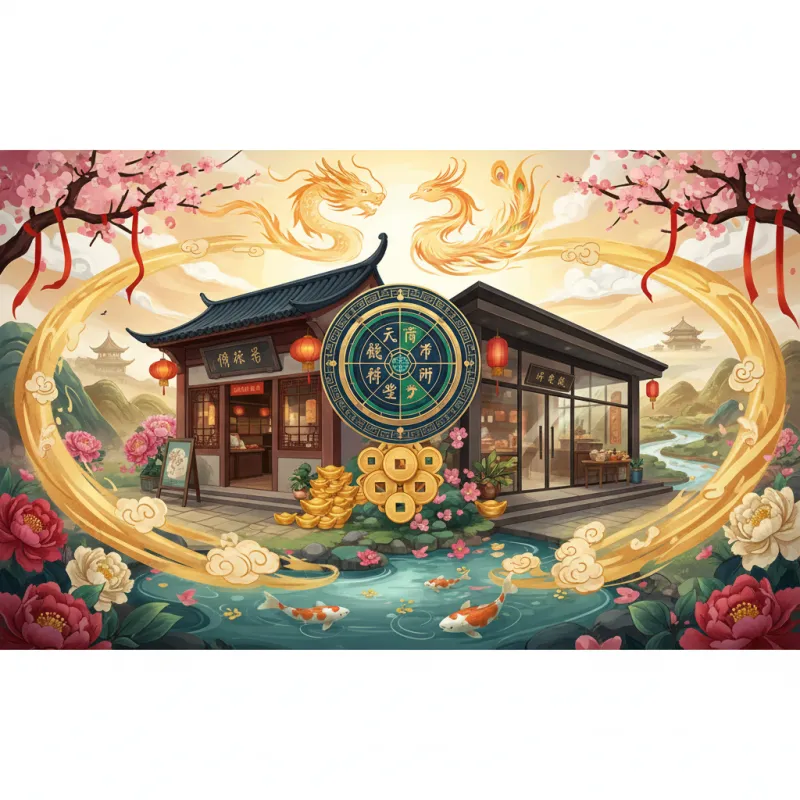
Walk past the storefronts in Singapore's Chinatown at dusk, and you'll see the same scene repeated: aquarium lights glowing blue-green near entrances, the soft burble of water pumps, fish darting between ceramic pagodas. Then look up at the buildings themselves—notice how certain shops thrive for decades while others cycle through owners every eighteen months, despite being on the same street, paying similar rent, selling comparable goods. The difference isn't location, product, or even service. It's how the space itself is arranged to work with qi (气 qì), the vital energy that feng shui (风水 fēngshuǐ) practitioners have been manipulating in commercial spaces since the Tang Dynasty.
The fish tank isn't decoration. It's technology—ancient technology for activating water energy at the entrance, which in five element theory represents the flow of wealth and opportunity. But it's just one piece of a comprehensive system that successful Chinese businesses have refined over centuries. Understanding these principles doesn't require mysticism or belief. It requires recognizing that spatial arrangement affects human behavior in measurable ways, and that feng shui is fundamentally a language for describing and optimizing those effects.
The Entrance: Where Qi Becomes Customers
The front door of your shop or restaurant is called the "mouth of qi" (气口 qìkǒu) in feng shui texts, and the metaphor is precise. Everything that enters your business—customers, money, opportunities—comes through this opening. The Ming Dynasty feng shui master Jiang Pingjie wrote that "the door determines prosperity or decline by ninety percent," which sounds like hyperbole until you spend time observing how people actually interact with commercial entrances.
The ideal entrance is visible, accessible, and inviting—obvious principles, but feng shui adds specificity. The door should open inward to "gather" qi rather than push it away. It should be proportional to the building; an oversized entrance on a small shop creates imbalance, while a tiny door on a large space restricts flow. The path to the door should be clear and slightly curved rather than straight, because qi moves in meandering patterns like water, and a straight shot creates sha qi (煞气 shā qì)—harsh, cutting energy that makes people unconsciously uncomfortable.
This is where the fish tank comes in. Placing an aquarium near the entrance, specifically to the left as you enter (the "dragon side" in feng shui orientation), activates water energy at the threshold. Water represents wealth in five element theory, but more practically, a well-maintained aquarium creates movement, sound, and visual interest that draws attention and slows people down as they enter. The fish themselves—typically goldfish or koi—add the element of life, which feng shui texts describe as "activating" the water's potential. A stagnant pond doesn't attract qi; moving, living water does.
The number of fish matters. Eight is standard—eight red or gold fish representing prosperity, often with one black fish to "absorb" negative energy. This isn't numerology for its own sake; it's a mnemonic device that ensures the tank looks abundant without being overcrowded. Nine fish total is also common, as nine (九 jiǔ) sounds like "long-lasting" (久 jiǔ) in Chinese, creating a linguistic resonance that reinforces the intention.
The Cash Register: Positioning Your Wealth Accumulator
In feng shui for commercial spaces, the cash register or point of sale is treated as the "wealth position" (财位 cái wèi), and its placement follows specific rules that have nothing to do with customer convenience and everything to do with energy accumulation. The traditional position is diagonal from the entrance, as far back as possible while still maintaining visibility. This creates what feng shui practitioners call the "commanding position"—you can see who enters while being protected from direct energy flow.
Never place the register directly facing the front door. This creates a straight line of qi flow that rushes in and immediately out, taking money with it. The Chinese term for this is "piercing heart sha" (穿心煞 chuān xīn shā), and while the name is dramatic, the principle is sound: you want energy to circulate through the space, not shoot through it. If your layout forces a direct alignment, place a screen, plant, or display between the door and register to redirect the flow.
The register should have a solid wall behind it, never a window or open space. This provides symbolic and psychological support—the "mountain" backing in feng shui terms. Employees working at a register with their backs to a window or hallway report feeling anxious and exposed, which affects their interactions with customers. The wall should ideally be painted in earth tones (yellow, beige, brown) or metal tones (white, gold, silver), as earth generates metal in the five element cycle, and metal represents money and accumulation.
Above or behind the register, many Chinese businesses place specific symbols: a three-legged toad (金蟾 jīn chán) holding a coin, a laughing Buddha, or a Chinese coin sword. These aren't superstitions—they're focal points that reinforce the intention of the space. The three-legged toad, according to legend, appears near homes that are about to receive wealth, so placing one at your wealth position is a form of sympathetic magic. More practically, it's a conversation starter that signals to Chinese customers that you understand and respect these traditions, building cultural trust.
Color and Element Balance: Beyond Red and Gold
Yes, Chinese restaurants and shops use red and gold extensively, but understanding why requires knowing five element theory (五行 wǔ xíng). Red represents fire, which in the element cycle generates earth, which generates metal (wealth). Gold represents metal directly. Together, they create a generative cycle that symbolically produces prosperity. But using only red and gold creates imbalance—too much fire energy can make a space feel aggressive or chaotic.
The most sophisticated feng shui applications balance all five elements: wood (green, brown, plants, vertical lines), fire (red, purple, triangular shapes), earth (yellow, beige, square shapes), metal (white, gold, circular shapes), and water (black, blue, flowing forms). A restaurant might use red tablecloths (fire) with wooden chairs (wood), white plates (metal), and blue accent walls (water), creating a complete cycle that feels harmonious even to people who've never heard of feng shui.
For restaurants specifically, fire element should be strong but controlled, as it represents both cooking and transformation. The kitchen should be in the back of the space, never visible from the entrance—this is practical hygiene but also feng shui principle. Exposing the kitchen creates "fire at the gate," which feng shui texts warn against. If your layout requires an open kitchen, use metal elements (stainless steel, white tiles) to control the fire energy through the element cycle, where metal is generated by earth and generates water, which controls fire.
Shops selling different products should emphasize different elements. A bookstore or plant shop should emphasize wood (growth, expansion). A jewelry store or bank should emphasize metal (precision, value). A spa or tea house should emphasize water (flow, relaxation). This isn't arbitrary—it's matching the element that represents your product's essential quality and amplifying it through color, material, and form.
Seating Arrangements: The Psychology of Comfort
In restaurants, table placement follows the same commanding position principle as the cash register. The most desirable seats—the ones that fill first—have a wall behind them and a view of the entrance. This is universal human psychology that feng shui codified centuries ago. People feel vulnerable with their backs to doors or windows, and they'll unconsciously avoid those seats or feel uncomfortable in them, eating faster and leaving sooner.
Booth seating along walls is feng shui-optimal for this reason. Tables in the center of the room should be round or oval rather than square, as curved edges create gentler qi flow and encourage conversation. Square tables with sharp corners pointing at diners create small instances of sha qi—not enough to be consciously noticed, but enough to create subtle discomfort over the course of a meal.
The worst position in any restaurant is a table directly in line with the front door, especially if it's also in line with the bathroom or kitchen door. This creates "rushing qi" that makes diners feel exposed and hurried. If your layout includes such a table, expect it to turn over quickly—which might seem good for business but actually reduces per-table revenue as people order less and skip dessert. Better to place a host stand, plant, or decorative screen in that position and move the table slightly off-axis.
For shops, the same principles apply to browsing patterns. You want customers to meander through the space, not rush straight through. This is why successful shops rarely have a straight path from entrance to exit. They use displays, shelving, and strategic placement of high-interest items to create a flowing, curved path that exposes customers to more products. This isn't manipulation—it's working with how people naturally move through space when they feel comfortable and unhurried.
Mirrors: Doubling Prosperity or Reflecting It Away
Mirrors are powerful feng shui tools that can double your business or destroy it, depending on placement. The principle is simple: mirrors reflect and amplify whatever they face. Place a mirror reflecting your dining room or shop floor, and you symbolically double your customers and activity. Place a mirror reflecting your front door, and you push qi (and customers) back out before they fully enter.
The most common mirror placement in Chinese restaurants is on the wall opposite the dining area, creating the illusion of a larger, busier space. This isn't just visual trickery—it creates psychological social proof. People are drawn to busy restaurants because crowds signal quality and safety. A mirror that makes your half-full restaurant look completely packed triggers this instinct.
Never place mirrors reflecting the cash register or safe. This symbolically reflects money out of the business. Never place mirrors in the kitchen reflecting the stove, as this amplifies fire energy to dangerous levels—both symbolically and practically, as it can make the kitchen feel more chaotic and hot. Never place mirrors directly facing each other, creating an infinite reflection; feng shui texts warn this creates "unstable qi" that manifests as business volatility.
Mirrors should be large enough to reflect a person's full head without cutting it off, as a cut reflection is considered inauspicious. They should be kept spotlessly clean—a dirty or cracked mirror is worse than no mirror at all, as it suggests neglect and decline. Some feng shui practitioners recommend placing a small red dot or symbol in the corner of business mirrors to "activate" their wealth-attracting properties, though this is more folk practice than classical feng shui.
Lighting and Air: The Invisible Foundations
Qi follows light and air. This is perhaps the most practical feng shui principle, and the one most often neglected. A dark, stuffy shop or restaurant repels customers regardless of how perfectly you've positioned your cash register or fish tank. Bright, well-ventilated spaces attract people naturally because humans are drawn to light and fresh air—we're phototropic and aerotropic by nature.
Natural light is ideal, but most commercial spaces rely on artificial lighting. The feng shui approach is to layer lighting at multiple levels: bright general lighting for visibility and energy, accent lighting to highlight products or architectural features, and softer ambient lighting to create warmth. Avoid harsh fluorescent lighting that casts a greenish tint—it makes food look unappetizing and people look ill. LED lighting with warm color temperature (2700-3000K) mimics natural light and creates a welcoming atmosphere.
Dark corners are "dead qi" zones where energy stagnates. Every corner of your space should receive some light, even if it's just a small accent lamp. This is especially important for corners diagonal from the entrance, which feng shui identifies as wealth corners. A dark, cluttered wealth corner symbolically suggests blocked prosperity. Place a light, plant, or attractive display there to activate the space.
Air quality matters more than most business owners realize. Stale air makes people tired and irritable; fresh air energizes them. If you can't open windows, invest in proper ventilation and air purification. Plants help—they're living qi generators that improve air quality while adding wood element. The best feng shui plants for businesses are jade plants (money trees), bamboo, and peace lilies. Avoid cacti and plants with sharp, spiky leaves, as these create small instances of sha qi.
Maintenance: The Feng Shui of Functioning Systems
Here's what feng shui texts don't emphasize enough but every successful business owner knows: broken things create broken energy. A burned-out light bulb, a wobbly table, a door that sticks, a bathroom with a dripping faucet—each of these small dysfunctions creates a subtle message of decline and neglect that customers absorb unconsciously.
The fish tank that's supposed to attract wealth? If the water is cloudy and the fish are dying, it becomes a symbol of stagnation and death. Better to have no fish tank than a poorly maintained one. The lucky bamboo on the counter? If it's turning yellow and dropping leaves, it signals decay. The mirror that doubles your prosperity? If it's smudged and spotted, it suggests you don't care about details.
This is where feng shui intersects with basic business operations. The most perfectly positioned cash register won't help if your bathroom is dirty, your menu is sticky, or your staff is visibly unhappy. Feng shui isn't magic that overrides fundamentals—it's a system for optimizing spaces that already function well. Think of it as the difference between a good restaurant and a great one, not between a failing restaurant and a successful one.
Chinese business owners who take feng shui seriously typically perform regular "space clearing" rituals—deep cleaning, decluttering, and energetic refreshing of the space. This might involve burning incense, ringing bells in corners, or simply opening all windows and doors to let fresh air circulate. The specific ritual matters less than the intention: regularly resetting the space's energy by removing accumulated stagnation.
Putting It Together: A System, Not Superstition
The businesses that thrive using feng shui principles don't treat them as superstition or magic. They treat them as a comprehensive system for spatial optimization that addresses human psychology, cultural symbolism, and practical functionality simultaneously. The fish tank attracts attention and creates ambiance. The cash register position provides security and control. The color scheme creates emotional resonance. The lighting and air quality affect mood and energy. The maintenance signals care and professionalism.
You don't need to believe in qi to benefit from these principles. You just need to recognize that space affects behavior, and that feng shui is a sophisticated language for describing and optimizing those effects. The reason you see the same patterns repeated in successful Chinese businesses worldwide isn't blind tradition—it's accumulated wisdom about what works, refined over centuries of observation and practice.
Start with the basics: clean, well-lit space with good air flow. Clear entrance with something attractive (plant, art, water feature) to the left as you enter. Cash register in commanding position with solid wall behind it. Comfortable seating with wall support. Mirrors reflecting activity, not doors. Colors and elements balanced for your specific business type. Everything maintained and functioning properly.
Then observe. Notice which tables fill first, which areas of your shop get the most traffic, where people naturally pause or hurry through. Feng shui isn't about imposing a rigid system—it's about reading the qi flow in your specific space and making adjustments to optimize it. The principles provide a framework, but every space is unique and requires individual attention.
The most successful applications of feng shui in business are invisible. Customers don't walk in thinking "excellent commanding position on that cash register" or "nice activation of the wealth corner." They just feel comfortable, welcome, and inclined to stay longer and return often. That's the real goal—not to impress people with your feng shui knowledge, but to create a space where energy flows smoothly and business thrives naturally.
For deeper understanding of how these principles connect to broader Chinese metaphysical systems, explore Bazi and Business Timing for choosing auspicious opening dates, or Five Elements in Business Strategy for matching your business model to elemental strengths. The spatial feng shui of your shop or restaurant works best when aligned with temporal and strategic feng shui—a complete system for business success that Chinese entrepreneurs have been refining for over a thousand years.
Related Reading
- Why Chinese Restaurants Have Aquariums
- Feng Shui for Your Office Desk
- Finding and Activating Your Wealth Corner
- Feng Shui for Your Office: Boost Productivity and Career
- Discover the Secrets of Feng Shui: Transforming Your Garden with I Ching and Chinese Metaphysics
- Unlocking the Secrets of Feng Shui and I Ching: A Journey Through Chinese Metaphysics
- Chinese Face Reading: What Your Face Reveals
Explore Chinese Culture
- Explore Daoist philosophy and practice
- Explore traditional Chinese customs
- Explore ancient Chinese cosmology