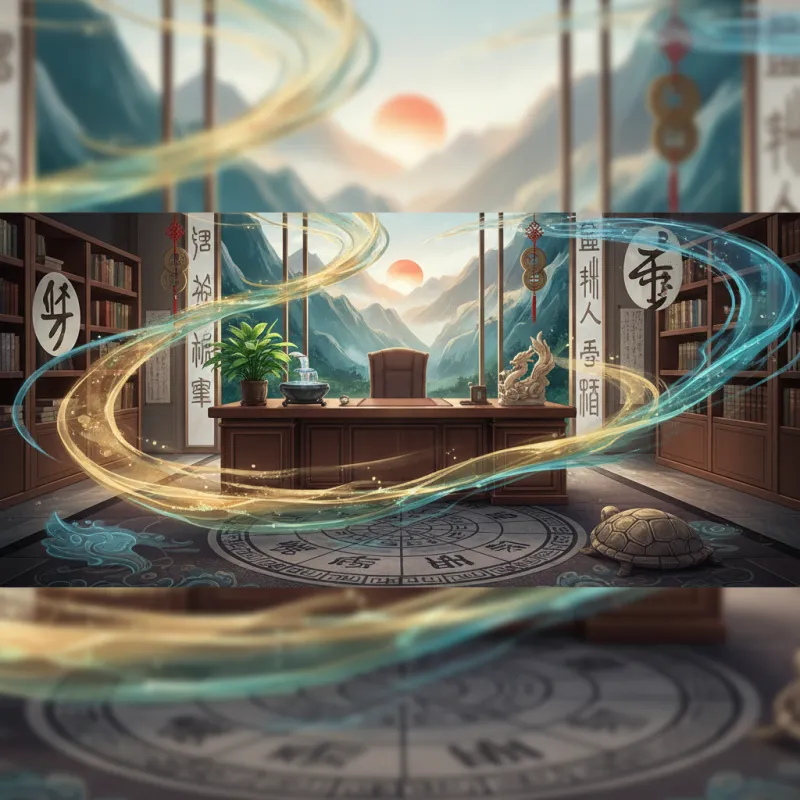
Stare at your computer screen for eight hours with your back to the door, and you'll spend half that time unconsciously tensing your shoulders. Your nervous system knows what feng shui practitioners have codified for centuries: when you can't see who's approaching, your body stays in low-grade alert mode. That tension isn't just physical discomfort — it's leaked energy that should be going toward your actual work.
The office environment operates on the same principles as any other space in feng shui (风水 fēngshuǐ) — the flow and quality of qi (气 qì) directly impacts outcomes. But unlike your bedroom where the goal is rest, or your kitchen where it's nourishment, the office demands a specific type of energy: focused, forward-moving, and opportunistic. Get the spatial arrangement wrong and you're not just uncomfortable. You're actively working against yourself.
The Commanding Position: Why Executives Always Face the Door
Walk into any CEO's office and notice where the desk sits. It's never randomly placed. The chair faces the door with a solid wall behind it, positioned diagonally across from the entrance rather than directly in line with it. This is the commanding position (主位 zhǔwèi), and it's not about ego or power displays — though those certainly follow from it.
The commanding position puts you in visual control of your space. You see opportunities (and threats) as they approach. You're backed by stability rather than empty space. The diagonal placement means energy entering through the door doesn't rush straight at you, which would be overwhelming, but flows around the room in a way you can observe and interact with.
In classical feng shui texts like the Yangzhai Sanyao (阳宅三要 Yángzhái Sānyào, "Three Essentials of Yang Dwellings"), this principle appears repeatedly: the master of the house, the head of the business, the person making decisions must have their back protected and their view unobstructed. It's the spatial equivalent of the strategic advantage in weiqi (围棋) — control the corners, influence the center.
If you're in a cubicle or shared office where you can't control your desk position, use a small mirror angled so you can see the entrance behind you. It's not as powerful as actually facing the door, but it addresses the nervous system issue of being approached from behind. Your body can relax when your eyes have the information they need.
The Five Elements in Your Workspace
Every office contains all five elements (五行 wǔxíng) whether you've consciously arranged them or not. The question is whether they're balanced or whether one element dominates to the point of creating stagnation or chaos.
Wood (木 mù) appears in plants, paper, wooden furniture, and vertical lines. It represents growth, expansion, and upward movement — exactly what you want for career advancement. But too much wood without metal to prune it becomes wild and unfocused. That's the office with papers everywhere, plants taking over the desk, and projects that start but never finish.
Fire (火 huǒ) is lighting, electronics, red colors, and triangular shapes. It's passion, visibility, and transformation. A well-lit office with good task lighting supports fire energy. But fluorescent overhead lights that cast no shadows create harsh, unmodulated fire that leads to burnout rather than inspiration. If you're feeling frantic or scattered, you likely have too much fire and not enough water to balance it.
Earth (地 tǔ) grounds and stabilizes through ceramics, stones, square shapes, and earth tones. It's the element of reliability and completion. A completely earth-dominant office — beige walls, beige furniture, beige carpet — creates the energy of a waiting room. Nothing moves. Nothing changes. You need earth for stability, but not so much that it smothers the wood energy of growth.
Metal (金 jīn) appears in actual metal objects, white and metallic colors, and circular shapes. It's precision, clarity, and completion. Metal cuts through confusion and brings projects to conclusion. Filing cabinets, metal desk accessories, and white boards all contribute metal energy. But an all-metal, all-white office becomes sterile and harsh — the energy is too sharp, too cutting, without wood's flexibility or water's flow.
Water (水 shuǐ) shows up in actual water features, glass, mirrors, black and dark blue colors, and flowing, irregular shapes. It's wisdom, communication, and the flow of resources (including money). A small fountain near the entrance of your office space supports the flow of opportunities coming in. But water in the wrong location — like directly behind your desk — undermines your stability. You want water in front of you or to the side, not at your back.
Look at your current office and identify which element dominates. Then add small amounts of the element that controls it to create balance. Too much wood? Add metal through a metal desk organizer or white accessories. Too much fire? Add water through a small fountain or blue artwork. The goal isn't perfect elemental balance — it's dynamic balance that supports the specific work you're doing.
The Bagua Map: Where to Put What
The bagua (八卦 bāguà) divides any space into nine zones, each corresponding to a different life area. Stand at your office entrance facing in and imagine the space divided into a three-by-three grid. The far left corner is wealth and prosperity (财位 cáiwèi). The far right is relationships and helpful people. The center back is fame and reputation. And so on.
This isn't superstition — it's a spatial memory system that helps you consciously arrange your environment to support specific goals. Want to focus on career advancement? Pay attention to the center back area of your office, which corresponds to recognition and reputation. Keep it clean, well-lit, and display any awards, certifications, or evidence of your expertise there.
The wealth corner (far left from the entrance) is where many feng shui practitioners recommend placing a small water feature or healthy plant. The logic is sound: water represents the flow of resources, and wood represents growth. Together in the wealth area, they symbolically support financial expansion. But here's what matters more than the symbolism: keeping that corner clean, uncluttered, and intentionally arranged means you're paying attention to the financial aspect of your work. The consciousness matters as much as the cure.
The helpful people area (far right from entrance) is ideal for your phone, contact management system, or a small metal object. This is where you want to support networking and collaboration energy. If you're in a field where relationships drive success, this area deserves particular attention.
Avoid putting trash cans, broken items, or clutter in any bagua area you want to activate. It's not that a trash can in your wealth corner will make you poor — it's that you're training your subconscious to associate that life area with waste and disposal. Your environment is constantly sending you messages. Make sure they're the messages you want to receive.
What's Behind You Matters More Than What's in Front
In feng shui, the area behind you represents your support, your backing, your foundation. A solid wall behind your desk is ideal. It's the mountain at your back in classical landscape theory — stable, protective, unchanging. When you have solid backing, you can focus forward without unconsciously worrying about what's behind you.
A window directly behind your desk is problematic. Your support is literally transparent and unstable. Energy flows out the window rather than supporting you. If you're stuck with a window behind you, keep the blinds partially closed during work hours, or place a substantial piece of furniture between your chair and the window. A credenza or bookshelf creates the solid backing you need.
The worst scenario is having your back to the door with nothing behind you — no wall, no furniture, just open space. This is the "betrayal position" in classical texts, and while that's dramatic language, the principle is sound. You're vulnerable from behind and you can't see what's approaching. Your nervous system knows this even if your conscious mind doesn't, and it keeps you in a state of low-level vigilance that drains energy from your actual work.
If you absolutely cannot change your desk position, at least angle your monitor so you can see the door's reflection, or position a small mirror to give you a view of the entrance. The goal is eliminating the startle response when someone approaches from behind.
Clutter Isn't Just Messy — It's Stagnant Qi
The relationship between clutter and stagnant qi (气 qì) isn't metaphorical. Clutter represents unmade decisions, incomplete projects, and deferred action. Every pile of papers on your desk is a pile of things you haven't processed. Every drawer stuffed with random objects is a drawer full of "I'll deal with this later." That energy of postponement permeates your space.
In the Huangdi Neijing (黄帝内经 Huángdì Nèijīng, "The Yellow Emperor's Classic of Internal Medicine"), stagnation is the root of disease. When qi doesn't flow, problems develop. The same principle applies to your workspace. When your office is cluttered, energy can't move freely. Opportunities can't find you because there's no space for them to land.
The solution isn't minimalism for its own sake. It's intentional curation. Everything in your office should either be actively useful or meaningfully inspiring. That award from five years ago that you're keeping out of obligation but don't actually value? It's taking up space that could hold something that genuinely motivates you. Those reference books you haven't opened in two years? They're creating visual noise that distracts from the resources you actually use.
Clear your desk completely once a week. Put everything back only if it serves your current projects. File or discard the rest. This isn't just tidying — it's creating space for new opportunities to enter. In feng shui for business, the flow of qi directly correlates with the flow of opportunities, resources, and success. Stagnant space means stagnant career.
Light, Air, and the Quality of Qi
The quality of qi in your office depends heavily on two factors that modern workplaces often get wrong: lighting and air quality. Harsh fluorescent overhead lighting creates what classical texts call "cutting qi" (煞气 shàqì) — sharp, aggressive energy that leads to headaches, eye strain, and irritability. It's fire element without modulation, all intensity and no warmth.
Ideal office lighting combines natural light from windows with task lighting at your desk. The natural light connects you to the daily cycle of yang energy rising and falling, which helps regulate your own energy levels. The task lighting gives you control over your immediate workspace without relying on harsh overhead fixtures. If you're stuck with fluorescent lights, add a desk lamp with a warm bulb and turn off the overhead light when possible.
Air quality is equally critical. Stale air is stagnant qi made literal. If your office has no windows or poor ventilation, you're working in an environment where energy can't refresh itself. Add a small fan to keep air moving. Open windows when possible. Bring in plants that actively clean the air — snake plants, pothos, or peace lilies. The goal is creating an environment where you can take a deep breath and feel energized rather than depleted.
The Chinese concept of sheng qi (生气 shēngqì, "living qi") versus si qi (死气 sǐqì, "dead qi") captures this perfectly. Living qi is fresh, moving, and vitalizing. Dead qi is stale, stuck, and draining. Your office should support living qi through good light, fresh air, and regular energy renewal. If you feel tired after an hour at your desk despite being well-rested, the quality of qi in your space is the first thing to examine.
The Career Area and Your Professional Identity
The center back section of your office corresponds to career and reputation in the bagua system. This is where you want to consciously display evidence of your professional identity and achievements. Not in a boastful way, but in a way that reminds you — and anyone who enters your space — of your expertise and trajectory.
Diplomas, certifications, awards, and published work belong here. So do images or objects that represent your professional aspirations. If you're working toward a specific goal, a visual representation of that goal in your career area keeps it in your conscious awareness. The principle is similar to vision boards, but more spatially integrated and less Pinterest-aesthetic.
What doesn't belong in your career area: personal photos (those go in the relationship area), plants (better in the wealth corner), or clutter. This area should be clean, well-lit, and intentionally curated. It's the spatial equivalent of your professional reputation — what do you want it to communicate?
In traditional feng shui, the career area also relates to the water element and the direction north. If your office happens to face north, you're already aligned with career energy. If not, you can still activate this area through intentional arrangement and by adding water element features like a small fountain, images of water, or the color black in moderation.
Small Changes, Significant Shifts
You don't need to renovate your office or buy new furniture to improve its feng shui. The most impactful changes are often the smallest: angling your desk so you face the door, clearing clutter from your wealth corner, adding a plant to bring in wood energy, improving your task lighting, or placing a small mirror to eliminate the blind spot behind you.
Start with the commanding position. If you can't move your desk, use a mirror. Then address clutter — clear your desk and keep only what serves your current work. Add one element that's missing from your space based on the five element analysis. These three changes alone will shift the energy of your office noticeably within a week.
The goal of feng shui in business isn't to follow rules rigidly. It's to create an environment that supports your work rather than undermining it. Your office should make you feel focused, energized, and capable. If it doesn't, the spatial arrangement is working against you. And unlike many factors in your career, your immediate environment is something you can actually control.
Related Reading
- Finding and Activating Your Wealth Corner
- Why Chinese Restaurants Have Aquariums
- Feng Shui for Your Office Desk
- The Dragon Year Baby Boom: Why Chinese Parents Plan Pregnancies Around the Zodiac
- Exploring the Interconnections of Feng Shui, I Ching, and Chinese Metaphysics
- Discovering the Colors of Feng Shui and I Ching: Their Power and Symbolism
Explore Chinese Culture
- Explore Daoist philosophy and practice
- Explore traditional Chinese customs
- Explore ancient Chinese cosmology