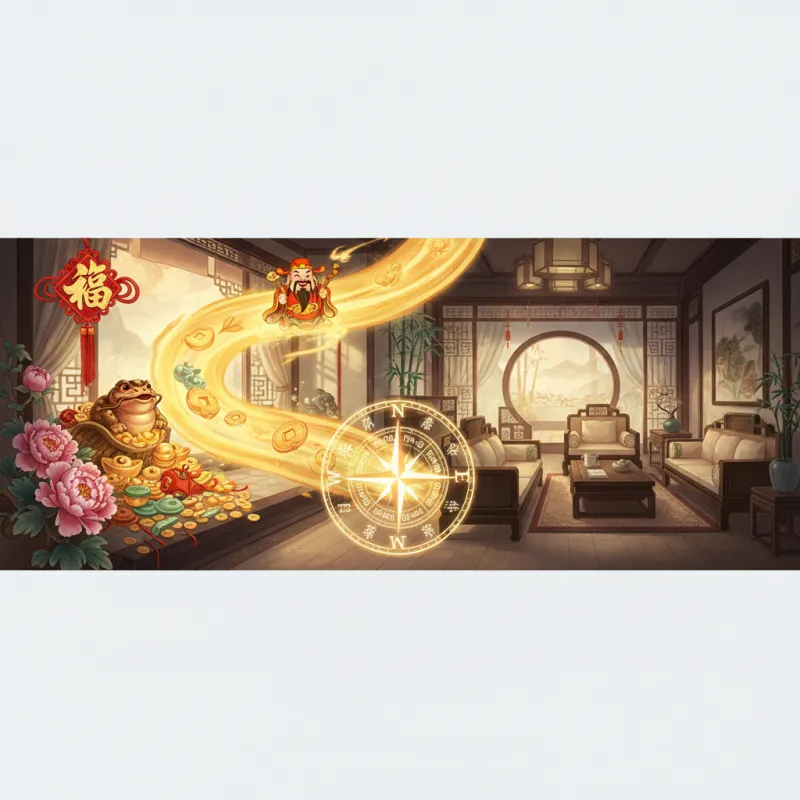
Imagine walking into your home and discovering a $10,000 check wedged behind a dusty bookshelf in the far left corner of your living room. You'd probably wonder how you missed it for so long. In feng shui (风水 fēngshuǐ), that's essentially what most people are doing — except the "check" isn't paper, it's energetic potential, and it's been sitting there the entire time you've lived there.
The wealth corner isn't mystical nonsense. It's a spatial organizing principle that's been refined over two millennia, tested in imperial palaces and merchant homes alike. The Tang Dynasty (618-907 CE) saw feng shui masters employed by the wealthiest families specifically to optimize these zones. They weren't decorating. They were engineering environments for prosperity. And while we can debate the mechanism — qi flow, psychological priming, spatial awareness — the practice remains remarkably consistent: identify the zone, activate it, maintain it.
Here's what actually works, stripped of the Instagram-friendly crystal clutter.
The Bagua Method vs. The Flying Stars Method
Most English-language feng shui content presents the bagua (八卦 bāguà) overlay method as if it's the only approach. Stand at your front door, divide your space into nine sectors, find the far left corner — that's your wealth area. Simple. Accessible. And about 40% of the story.
The bagua method comes from the Black Sect Tantric Buddhist school, popularized in the West during the 1980s by Grand Master Lin Yun. It's legitimate, it works for many practitioners, and it requires zero calculations. You can implement it in five minutes with a floor plan and a pencil.
But classical feng shui — the kind practiced in Hong Kong financial districts and Singapore corporate headquarters — uses Flying Stars (飞星 fēixīng), a time-based system that changes with construction dates and compass directions. In Flying Stars, your wealth sector isn't fixed. It shifts based on when your building was completed and which direction it faces. The wealth star (typically the 8 star in the current Period 9, which began in 2024) lands in a different sector for every building.
I'm not here to declare one method superior. I've seen both produce results. The bagua method is democratic and immediate. Flying Stars is precise but requires either a consultant or serious study. For most people starting out, the bagua approach offers the fastest path to tangible changes. You can always layer in Flying Stars complexity later.
For this article, we'll focus on the bagua method, but know that classical practitioners would approach this differently — and that's fine. Feng shui has always had regional variations and competing schools. The Jiangxi school and the Fujian school argued for centuries. You're allowed to pick an approach and test it.
Finding Your Wealth Corner (Bagua Method)
Stand at your front door, facing into your home. Not the door you actually use most — the formal front door, the one the architect designated as the main entrance. In feng shui terms, this is the "mouth of qi" (气口 qìkǒu), where energy enters your space.
Now imagine dividing your home into a three-by-three grid, like a tic-tac-toe board. The far left corner from where you're standing — the back left sector — is your wealth corner. In bagua terminology, this is the Xun (巽 xùn) position, associated with wind, wood element, and abundance.
If your home has an irregular shape, you might be missing this corner entirely. L-shaped homes, homes with attached garages that create indentations, homes with significant architectural projections — these create "missing sectors" that classical practitioners consider problematic. If your wealth corner is literally outside your building envelope, you have options: use the wealth corner of your bedroom instead, or the wealth corner of your office, or address the missing sector with exterior landscaping and lighting. Feng shui is fractal; the same principles apply at multiple scales.
Some practitioners argue you should use the wealth corner of individual rooms rather than the whole house. I've found both approaches effective. The whole-house wealth corner tends to affect overall financial trajectory — career moves, investment returns, unexpected windfalls. Room-specific wealth corners (especially in bedrooms and home offices) seem to influence daily money flow and immediate opportunities. If you're going to pick one, start with the whole-house corner. It's the primary zone.
What's Probably There Right Now
Go look at your wealth corner. Actually stand up and go look. I'll wait.
If you're like most people, you found one of these scenarios: storage (boxes, old electronics, seasonal items you forgot about), a bathroom (which classical practitioners consider a drain on wealth energy), a closet (stagnant, dark, unused space), a neglected corner with dust and items you haven't touched in months, or absolutely nothing — just empty, unactivated space.
The worst wealth corner I ever saw was in a friend's apartment: a corner behind the couch where they'd been throwing junk mail for six months. Unopened bills, expired coupons, credit card offers. The symbolism was almost too perfect — literally treating financial correspondence as garbage in the exact zone associated with money energy.
The second-worst was a bathroom with a constantly dripping faucet. In feng shui, water represents wealth, and dripping water represents wealth leaking away. The homeowner had been meaning to fix it for two years. Two years of symbolic financial drainage in the wealth sector. When they finally called a plumber, they got a job offer the same week. Coincidence? Maybe. But that's how feng shui works — it operates in the space between symbol and reality, where changing one seems to shift the other.
Activating Your Wealth Corner: What Actually Matters
Forget the three-legged toad statues. Forget the "wealth ship" figurines. Forget the red envelopes stuffed with coins. These items aren't wrong, but they're not the foundation. They're decoration on top of structure, and most people skip straight to decoration without building the structure first.
The structure is this: clean, well-lit, intentionally arranged space with living energy and symbolic wealth representations that mean something to you personally.
Start with a deep clean. Remove everything from the corner. Dust, vacuum, wipe down surfaces. Wash the windows if there are any. Fix anything broken — loose floorboards, chipped paint, burned-out light bulbs. This isn't symbolic. This is literal. You're establishing that this space matters enough to maintain properly.
Next, lighting. Wealth corners are often in the back of homes, away from windows, naturally dim. Add a lamp. Not a bare bulb, not a flickering fluorescent — a proper lamp with warm light that you actually turn on regularly. In five element theory, light represents fire, which generates earth, which produces metal (associated with gold and money). But more practically, light activates space. It makes you notice the corner. It prevents stagnation.
Now add something living. A healthy plant is traditional — bamboo (竹 zhú) for growth, jade plant (玉树 yùshù) for wealth, money tree (发财树 fācáishù) for obvious reasons. But "living" can also mean fresh flowers you replace weekly, or a small fountain with moving water (though be cautious with water features in bedrooms; they can disrupt sleep). The key is that it requires maintenance. You're establishing a relationship with this space. You're visiting it regularly, noticing it, caring for it.
Then add your wealth symbols. This is where it gets personal. Traditional feng shui suggests items like a wealth bowl (filled with coins, crystals, and symbolic items), images of abundance (fruit, harvest scenes, flowing water), or representations of what wealth means to you specifically. I know someone who keeps a framed photo of the house they're saving to buy. Another person keeps a small sculpture they purchased on a trip funded by their first major career success. These aren't generic symbols; they're personal anchors.
The wood element is associated with the wealth corner in bagua theory, so wooden items, green colors, and vertical shapes are considered supportive. But don't let this override your instincts. If a particular object makes you feel abundant when you look at it, that's more valuable than following element theory perfectly.
What to Avoid
Clutter is the obvious one, but let's be specific about what counts as clutter in this context. It's not about minimalism. It's about stagnation. Items you use regularly and return to their place aren't clutter. Items you've forgotten about, items you're storing "just in case," items you're keeping out of guilt — that's clutter. That's stuck energy.
Trash cans in the wealth corner are considered problematic, especially if they're overflowing. You're symbolically treating wealth as garbage. If your floor plan puts a trash can in this corner, use one with a lid, empty it frequently, and keep it impeccably clean.
Bathrooms in the wealth corner are a common concern. Water going down drains represents wealth flowing away. The traditional remedy is to keep the toilet lid down, keep the bathroom door closed, and place a mirror on the outside of the bathroom door to symbolically "reflect" the bathroom out of the space. Does this work? I've seen people swear by it. I've also seen people ignore it with no apparent consequences. If you have a bathroom in your wealth corner and your finances are fine, don't create anxiety where none exists. If your finances are struggling, try the remedies. They cost nothing.
Broken items are universally considered problematic. A broken clock in your wealth corner suggests "broken" or "stopped" financial flow. A dead plant suggests dying prosperity. A burned-out light bulb suggests dimmed opportunities. Fix or remove these immediately.
Heavy, downward-pointing objects are thought to suppress energy. A large, dark, heavy cabinet pressing down on your wealth corner might be creating a sense of weight and burden around money. This doesn't mean you need to remove all furniture, but consider whether the energy of the space feels light and open or heavy and oppressive.
Maintenance Is the Practice
Here's what separates people who get results from feng shui adjustments from people who don't: consistency. You can set up the perfect wealth corner — plant, light, meaningful symbols, immaculate cleanliness — and if you ignore it for six months, you've just created another stagnant zone.
The practice is visiting the corner regularly. Water the plant. Dust the surfaces. Notice what's there. Spend thirty seconds standing in that space, acknowledging it, appreciating it. This sounds absurdly simple, but it's the mechanism that makes feng shui work on a practical level. You're training your attention. You're creating a ritual around financial awareness.
I recommend a weekly check-in. Every Sunday evening, or Monday morning, or whatever rhythm works for you — visit your wealth corner. Make sure it's clean, the plant is healthy, the light works, nothing's broken. This five-minute habit does more than any expensive feng shui cure you could buy.
Some practitioners suggest placing a small bowl of water in the wealth corner and changing it weekly. The water represents fresh, flowing wealth energy, and the weekly change ensures you're engaging with the space regularly. Others suggest keeping a small journal near the wealth corner where you note financial wins, no matter how small — a refund you received, a bill that was lower than expected, a friend who paid back a loan. This trains your brain to notice abundance rather than scarcity.
The specific method matters less than the consistency. You're establishing a relationship with a physical space in your home, and through that relationship, you're establishing a different relationship with money itself. That's the real mechanism.
Does This Actually Work?
I can't prove feng shui works in a double-blind study. Neither can anyone else. What I can tell you is that people who clean, organize, and intentionally arrange their living spaces tend to report better outcomes than people who don't. People who regularly engage with symbols of their goals tend to achieve those goals more often than people who don't. People who create rituals around what matters to them tend to feel more in control of their lives.
Is that feng shui, or is that just good spatial psychology? Does it matter?
The wealth corner practice works because it makes you think about money regularly in a non-anxious way. It works because it gives you a physical location to anchor financial intentions. It works because maintaining it requires the same skills that maintaining finances requires — attention, consistency, care, regular small actions rather than occasional big ones.
Try it for three months. Set up your wealth corner properly — clean, lit, living element, meaningful symbols. Visit it weekly. Maintain it. Notice what happens. Not just with money, but with your relationship to money. Do you feel differently about finances? Do you notice opportunities you would have missed? Do you take actions you would have avoided?
Feng shui isn't magic. It's environmental psychology wrapped in Chinese cosmology, and it's been refined over centuries by people who took spatial arrangement very seriously. The wealth corner is one small piece of a much larger system, but it's a piece you can implement today, in your actual home, with no special tools or training.
Your wealth corner exists whether you acknowledge it or not. The question is whether you're going to treat it like the valuable space it represents, or keep using it as a junk drawer.
For more on applying feng shui principles to business environments, see Feng Shui for Shops and Restaurants. If you're interested in how personal energy cycles affect financial timing, explore Bazi and Career Timing.
Related Reading
- Feng Shui for Your Office Desk
- Feng Shui for Your Office: Boost Productivity and Career
- Why Chinese Restaurants Have Aquariums
- Chinese Zodiac: The Twelve Animals Are Not What You Think
- Unlocking the Secrets of Feng Shui and I Ching: A Journey Through Chinese Metaphysics
- Exploring Feng Shui, I Ching, and Chinese Metaphysics in Bazi Practice
Explore Chinese Culture
- Explore Daoist philosophy and practice
- Explore traditional Chinese customs
- Explore ancient Chinese cosmology