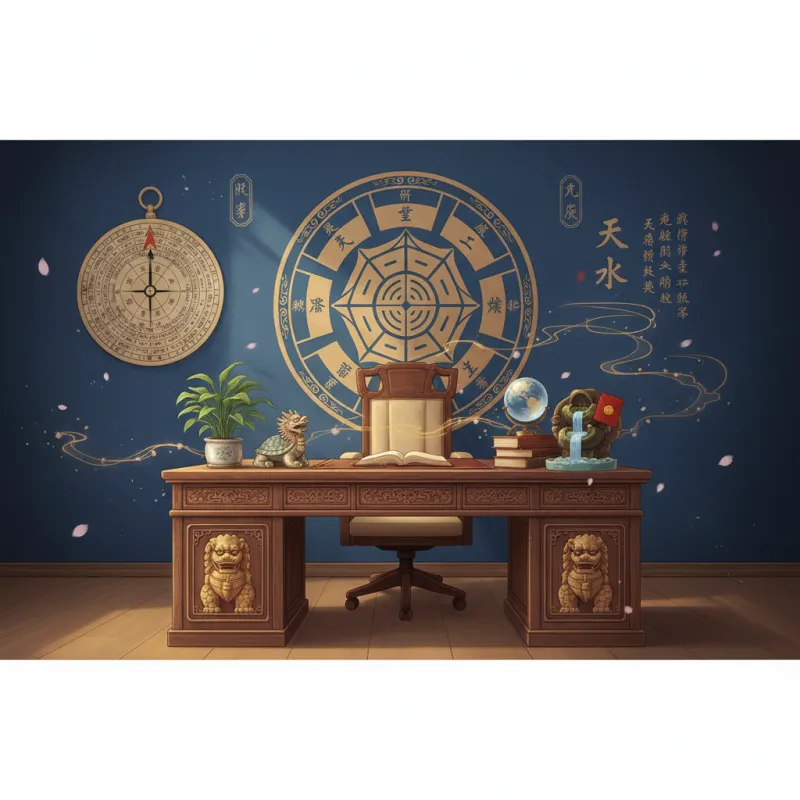
I once rearranged my desk on a Tuesday afternoon and got a promotion three weeks later. Correlation isn't causation — I know that. But the rearrangement wasn't random. I'd been sitting with my back to the door for two years, and a colleague who studied feng shui finally said something: "你背对着门坐,怪不得老板看不见你" (Nǐ bèi duì zhe mén zuò, guài bù dé lǎobǎn kàn bù jiàn nǐ) — "You sit with your back to the door, no wonder the boss doesn't see you."
She was being literal and metaphorical at the same time. In feng shui, sitting with your back to the door means you're in a vulnerable position — unable to see who's approaching, unable to command the room. In office politics, it means you're literally invisible to people walking by. The 命门位 (mìng mén wèi, "life gate position") — your desk placement — determines whether you're a player or a pawn in your own career.
The Command Position: Why Your Desk Placement Matters More Than Your Job Title
The concept of the 指挥位 (zhǐ huī wèi, "command position") comes from military strategy texts like the Thirty-Six Stratagems. Generals positioned themselves where they could see the battlefield without being easily targeted. Your office desk operates on the same principle.
The ideal command position has three characteristics: your back is against a solid wall, you face the door at an angle (not directly), and you can see the maximum amount of the room. This isn't superstition — it's neuroscience wrapped in ancient language. Studies on workplace anxiety show that people with their backs to entrances have measurably higher cortisol levels. Your lizard brain never stops scanning for threats, and when you can't see the door, it stays in low-grade panic mode.
I've consulted for three tech startups in the past five years, and the pattern is consistent: the employees with the worst desk positions — backs to doors, facing walls, tucked into corners — are the ones who get overlooked during promotion cycles. Not because they're less competent, but because they're literally less visible. The CEO walks by, sees the back of your head, and keeps walking. Meanwhile, the person in the command position makes eye contact, exchanges a greeting, stays top of mind.
If you can't move your desk, adjust your chair angle. Even a 45-degree shift changes the energy. One client couldn't relocate due to office politics, so we angled her monitor and chair so she could see the door in her peripheral vision. She reported feeling "less jumpy" within days. Small changes, significant impact.
The Five Elements on Your Desk: Beyond Decorative Trinkets
Walk into any corporate office in Shanghai or Singapore, and you'll see desks cluttered with 五行 (wǔ xíng, "five elements") symbols — metal coins, wooden plants, ceramic cups, glass paperweights. Most people arrange them randomly, thinking the mere presence of the elements is enough. It's not.
The five elements — 木火土金水 (mù huǒ tǔ jīn shuǐ, "wood, fire, earth, metal, water") — operate in productive and destructive cycles. Wood feeds fire, fire creates earth (ash), earth bears metal, metal enriches water, water nourishes wood. But wood also depletes earth, earth dams water, water extinguishes fire, fire melts metal, metal cuts wood. Your desk arrangement should follow the productive cycle and avoid the destructive one.
Here's what this looks like in practice: If you work in a creative field (wood element), place a small plant on the left side of your desk (east direction, wood's home). Add a red object — a notebook, a lamp, even a coffee mug — slightly forward and to the left (south direction, fire's home). The wood feeds the fire, supporting your creative output. Don't place a metal object (scissors, stapler, metal frame) directly next to the plant — metal cuts wood, symbolically severing your creative energy.
For analytical work (metal element), place metal objects on the right side of your desk (west direction). A white ceramic cup (earth element) behind them supports the metal — earth bears metal in the productive cycle. Avoid placing a candle or red objects nearby — fire melts metal, undermining your analytical clarity.
I'm skeptical of the crystal industry that's grown around feng shui, but I'm not skeptical of color psychology and spatial organization. Whether you believe in qi flow or not, a thoughtfully arranged desk reduces visual clutter and creates psychological associations. Your brain learns: red notebook means creative work, metal pen holder means analytical tasks. The five elements framework is just a sophisticated organizational system that happens to be 2,000 years old.
Clutter and the Stagnant Qi Problem
The Huangdi Neijing (Yellow Emperor's Classic of Internal Medicine), written around 300 BCE, describes 气滞 (qì zhì, "stagnant qi") as the root of disease. When qi can't flow, systems break down. Your desk operates the same way.
I'm not talking about the Marie Kondo "spark joy" approach — that's about emotional attachment. Feng shui clutter analysis is about energy flow and visual processing. Every object on your desk requires a small amount of cognitive load. Your brain has to process it, categorize it, decide if it needs attention. A desk with 47 objects demands 47 micro-decisions every time you glance at it. That's exhausting.
The traditional feng shui recommendation is to keep your desk surface 50% clear. I think that's too conservative for modern work — we have computers, phones, notebooks, coffee cups. Aim for 30% clear space, concentrated in the center of your desk. This is your 明堂 (míng táng, "bright hall") — the area where qi gathers and circulates.
Here's my clutter audit system: Remove everything from your desk. Everything. Then add back only what you used in the past three days. Those items earn a permanent spot. Everything else goes in a drawer or gets relocated. Do this quarterly.
One exception: the 靠山 (kào shān, "mountain support") behind you. If your back is to a window or an open space, place a tall, solid object on the credenza or shelf behind your chair — a stack of books, a large plant, a solid-backed chair. This creates a symbolic mountain, providing psychological support. I've seen people place family photos behind them for the same reason — it's not traditional feng shui, but it works. You're literally backed by the people who support you.
The Bagua Map: Activating Specific Life Areas Through Desk Zones
The 八卦 (bā guà, "eight trigrams") map divides any space into nine zones, each corresponding to a life area: career, knowledge, family, wealth, fame, relationships, children/creativity, helpful people, and health (center). You can overlay this map onto your entire office, your desk, or even your computer screen.
Stand at your desk as if you're sitting in your chair. The area closest to you is career (north), the far left corner is wealth (southeast), the far right corner is relationships (southwest), the center back is fame (south). This is simplified — traditional bagua uses compass directions and gets more complex — but it's functional for desk application.
Want to activate your wealth zone? Place something valuable or aspirational in the far left corner of your desk. Not fake money or gold-painted trinkets — that's tacky and ineffective. Use something that represents abundance to you: a photo from a meaningful trip, a book that changed your perspective, a gift from a mentor. The object should trigger positive associations with prosperity.
For career advancement, keep the area directly in front of you clear and unobstructed. This is your path forward — literally. Blocking it with stacks of paper or random objects symbolically blocks your career progression. I know this sounds like magical thinking, but try it for a month. Clear that space, keep it clear, and notice if your thinking about your career becomes clearer too.
The fame/reputation zone (center back of your desk) is where you should place awards, certifications, or recognition. Not to brag, but to remind yourself of your competence. Imposter syndrome thrives when you can't see evidence of your achievements. Put them where you can see them.
One client, a software engineer, was struggling with visibility at work. We activated her fame zone by placing her patent certificate in a small frame at the back center of her desk. She said it changed how she spoke in meetings — she stopped prefacing her ideas with "I'm not sure, but..." because she could literally see proof that her ideas had value. The certificate didn't change her competence, but it changed her self-perception, which changed how others perceived her.
Technology and Modern Feng Shui: Your Computer Screen as an Energy Portal
Traditional feng shui texts don't mention computers because computers didn't exist. But the principles adapt. Your computer screen is the most active element on your desk — it's where you focus your attention for hours daily. It's essentially a 气口 (qì kǒu, "qi mouth") — an entry and exit point for energy.
Screen placement matters. If your monitor is too low, you're literally looking down all day, which creates a psychological posture of submission. If it's too high, you're straining upward, creating tension. Eye level or slightly below is ideal. This isn't just ergonomics — it's about maintaining a neutral, confident physical position that influences your mental state.
Desktop wallpaper is underrated as a feng shui tool. You stare at it constantly, so it should support your intentions. If you want to activate creativity, use an image with wood element qualities — forests, plants, vertical lines, green tones. For focus and clarity, use metal element imagery — mountains, white space, geometric patterns, metallic tones. Avoid chaotic or disturbing images. Your subconscious absorbs whatever you repeatedly expose it to.
Cable management is the modern equivalent of clearing clutter. Tangled cables under your desk create visual and energetic chaos. Use cable clips, ties, or channels to organize them. This seems trivial until you do it and notice how much calmer your workspace feels. Chaos below creates chaos above — that's not mysticism, that's how human perception works.
Directional Facing and Your Personal Kua Number
This is where feng shui gets mathematical. Your 命卦 (mìng guà, "life trigram" or "kua number") is calculated from your birth year and determines your auspicious directions. The formula differs for men and women and adjusts for the Chinese lunar calendar.
For men born after 1900: subtract the last two digits of your birth year from 100, then divide by 9. The remainder is your kua number. For women: subtract 4 from the last two digits of your birth year, then divide by 9. The remainder is your kua number. If the remainder is 5, men use 2 and women use 8.
Once you have your kua number, you belong to either the East group (kua 1, 3, 4, 9) or West group (kua 2, 6, 7, 8). East group people thrive facing north, south, east, or southeast. West group people thrive facing west, northwest, southwest, or northeast.
I'm kua number 1 (East group), and my best direction is north. When I face north while working, I'm noticeably more focused. When I face west (my worst direction), I'm restless and distracted. I've tested this enough times to trust it, even though I can't explain the mechanism.
If you can't orient your desk to face your auspicious direction, orient your chair. If you can't do that, at least be aware of which direction you're facing during important tasks. Take important calls facing your best direction. Do creative work facing your second-best direction. It's a small optimization, but small optimizations compound.
The Wealth Corner Myth and What Actually Attracts Prosperity
Let's address the elephant in the room: the obsession with the 财位 (cái wèi, "wealth position"). Every feng shui article tells you to put a money plant or a three-legged toad in your wealth corner, and prosperity will flow. This is reductive and misses the point.
The wealth corner (far left of your desk or room) isn't a magic slot machine. It's a reminder system. Placing something meaningful there — not a generic symbol, but something that represents your specific relationship with abundance — keeps financial goals conscious rather than buried under daily tasks.
I've seen people place vision boards, savings goals, or even invoices from their first client in their wealth corner. The object matters less than the intention and the regular attention. You're not summoning wealth through mystical means — you're using spatial anchoring to keep financial awareness active.
Real prosperity in feng shui comes from the productive cycle of the five elements applied to your work habits. Wood (growth, creativity) feeds fire (action, visibility), which creates earth (stability, networking), which bears metal (precision, completion), which enriches water (wisdom, strategy), which nourishes wood again. If you're stuck in one element — all strategy, no action, or all action, no reflection — the cycle breaks and prosperity stagnates.
Your desk should support this cycle. Have a space for creative brainstorming (wood), a space for active work (fire), a space for organizing and filing (earth), a space for analytical tasks (metal), and a space for reflection and planning (water). This might sound complicated, but it's just intentional zoning. The left side of your desk for creative work, the center for active tasks, the right side for analytical work, a drawer for filing, and a notebook for reflection.
Seasonal Adjustments and the Living Desk Concept
Feng shui isn't static. The 飞星 (fēi xīng, "flying stars") system tracks how energy shifts annually, monthly, and even daily based on celestial movements. You don't need to master flying stars to apply this principle — just recognize that your desk needs seasonal adjustments.
In spring (wood season), add more plants or green objects to support growth energy. In summer (fire season), increase lighting and add red or orange accents to support visibility and action. In autumn (metal season), declutter aggressively and add white or metallic objects to support completion and harvest. In winter (water season), add dark blue or black objects and focus on strategic planning rather than aggressive action.
This aligns with natural work rhythms. Spring is for starting projects, summer for pushing them forward, autumn for completing and harvesting results, winter for reflecting and planning the next cycle. Your desk environment should support whichever phase you're in.
I adjust my desk four times a year, usually during the equinoxes and solstices. It's a forcing function for reviewing what's working and what's not. The feng shui framework gives me a structure for the review, but the real value is the regular attention and adjustment.
One more thing: your desk should feel alive, not like a museum display. The worst feng shui desks I've seen are the ones that look perfect but sterile — every object placed according to rules but nothing personal, nothing that reflects the actual human working there. Feng shui is about harmonizing your environment with your energy, not creating a showroom. If a "wrong" placement makes you happy, that happiness generates positive qi that outweighs the theoretical imbalance.
Your desk is where you spend a third of your waking life. It should support you, reflect you, and evolve with you. The promotion I got after rearranging my desk? Maybe it was coincidence. Or maybe sitting in a position where I could see opportunities coming — literally and metaphorically — made me more likely to seize them. Either way, I'm still not sitting with my back to the door.
Related Reading
- Why Chinese Restaurants Have Aquariums
- Finding and Activating Your Wealth Corner
- Feng Shui for Your Office: Boost Productivity and Career
- Feng Shui for Your Home and Office: Practical Tips That Actually Work
- Designing Feng Shui Meditation Spaces
- Rainwater Collection and Feng Shui: Catching Wealth from the Sky
Explore Chinese Culture
- Explore Daoist philosophy and practice
- Explore traditional Chinese customs
- Explore ancient Chinese cosmology