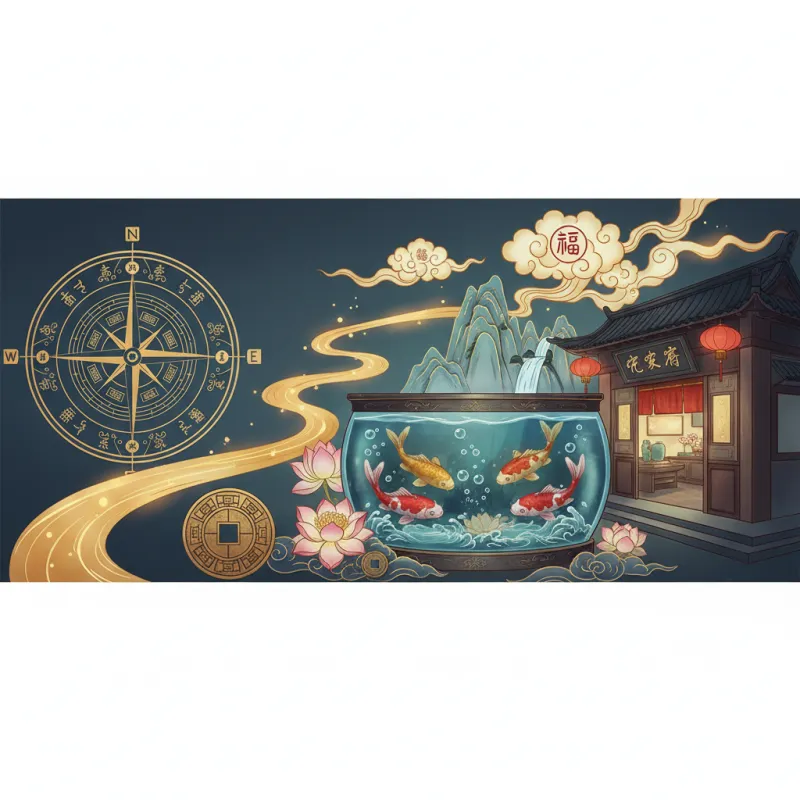
You walk into a Chinese restaurant and there it is — a massive aquarium near the entrance, bubbling away with fat goldfish circling lazily through artificial coral. You probably think it's just décor, like the red lanterns or the jade Buddha on the counter. But ask the owner why it's there, and if they're honest, they'll tell you: that tank is making them money. Not metaphorically. Not symbolically. In their mind, those fish are actively pulling wealth through the front door.
This isn't superstition dressed up as interior design. It's feng shui (风水 Fēng Shuǐ) — literally "wind-water" — applied with surgical precision to the most vulnerable part of any business: cash flow. And once you understand the logic behind it, you'll never look at a restaurant aquarium the same way again.
Water as Wealth: The Fundamental Equation
In feng shui theory, water (水 Shuǐ) equals money. Not in a poetic sense. In a direct, almost mechanical sense. The classical texts — particularly the Qing Nang Jing (青囊经 Qīng Náng Jīng, "Classic of the Azure Bag") from the Tang Dynasty — establish water as the primary carrier of qi (气 Qì), the vital energy that animates all things. Where water flows, qi flows. Where qi flows, prosperity follows.
But here's the critical detail most people miss: still water doesn't count. A stagnant pond is useless, even harmful. The water must move. It must circulate. That's why restaurant aquariums always have pumps, filters, aerators — the water is in constant motion, creating what feng shui practitioners call "living water" (活水 Huó Shuǐ). This moving water generates active qi, which in turn attracts wealth qi (财气 Cái Qì) into the space.
The placement near the entrance isn't random either. In feng shui, the entrance is the "mouth of qi" (气口 Qì Kǒu) — the primary point where energy enters a building. Position your water feature here, and you're essentially installing a wealth magnet at the exact spot where customers (and their money) flow in. The logic is elegant: water attracts qi, qi attracts people, people bring money, money flows like water. It's a closed loop.
The Fish Themselves: Why Goldfish and Koi
The water does the heavy lifting, but the fish aren't just passengers. They're active participants in the wealth-generation system. In Chinese, the word for fish (鱼 Yú) is a homophone for "surplus" or "abundance" (余 Yú). This isn't a coincidence that feng shui practitioners ignore — it's a linguistic resonance they actively exploit. Every time someone sees the fish, the subconscious connection fires: fish = surplus = prosperity.
But not just any fish will do. Walk into ten Chinese restaurants, and nine will have goldfish (金鱼 Jīn Yú — literally "gold fish") or koi (锦鲤 Jǐn Lǐ). The goldfish connection is obvious — gold equals wealth in every culture. But koi carry additional symbolic weight. In Chinese mythology, koi that swim upstream and leap over the Dragon Gate (龙门 Lóng Mén) transform into dragons. It's a metaphor for perseverance and transformation, yes, but also for upward mobility and success against odds. For a restaurant owner, especially an immigrant entrepreneur, that symbolism hits different.
The number of fish matters too. The most common configuration is nine fish: eight red or gold ones and one black. The eight represent wealth and prosperity (eight being the luckiest number in Chinese culture, sounding like "prosper" 发 Fā). The single black fish is the protector — it absorbs negative energy and bad luck. If that black fish dies, the owner doesn't mourn. They replace it immediately and consider it a bullet dodged. The black fish took the hit meant for the business.
Some restaurants go with six fish (smooth, progressive energy) or multiples of nine. You'll rarely see four (sounds like "death" 死 Sǐ) or five (associated with the five elements but considered unstable in this context). The numerology isn't decorative. It's strategic.
Placement and Direction: The Technical Details
Here's where feng shui stops being folk wisdom and starts looking like engineering. The aquarium's exact position within the entrance area depends on the building's facing direction and the owner's bazi (八字 Bā Zì) — their birth chart based on the year, month, day, and hour of birth. A proper feng shui consultant will calculate the building's sitting and facing directions using a luopan (罗盘 Luó Pán), the feng shui compass, then determine which sector corresponds to the wealth position.
In classical feng shui, this is often the southeast sector, governed by the wood element (木 Mù) in the five elements system. Wood and water have a productive relationship — water nourishes wood — so placing water in the wood sector creates a harmonious cycle. But this isn't universal. Some schools place the aquarium in the north (water's home direction) or in the "wealth star" position according to Flying Star feng shui (飞星风水 Fēi Xīng Fēng Shuǐ), which changes based on the building's construction period.
What's consistent across schools: the aquarium should never be directly opposite the front door. That creates a "water rushing out" formation, where wealth qi flows straight through the building and exits without circulating. It should also never be in the kitchen (water and fire clash) or in the center of the restaurant (the earth element position, where water creates a destructive cycle).
The size matters too. Too small, and the wealth effect is negligible. Too large, and you risk "drowning" the space in excessive water energy, which can lead to financial instability — money flowing in but also flowing out uncontrollably. The rule of thumb: the aquarium should be proportional to the entrance area, substantial enough to be noticed immediately but not so large it dominates the space.
The Maintenance Ritual: Keeping the Wealth Flowing
Here's something most diners never consider: the aquarium's effectiveness depends entirely on its maintenance. Dirty water, dead fish, broken pumps — these don't just look bad. In feng shui terms, they're actively harmful. Stagnant or polluted water generates "sha qi" (煞气 Shà Qì), negative energy that repels customers and money.
This is why you'll often see restaurant staff cleaning the tank during off-hours, sometimes daily. It's not just hygiene. It's wealth maintenance. The water must be clear, the fish must be healthy and active, the pump must be running. Some owners add specific plants like lucky bamboo (富贵竹 Fù Guì Zhú) or arrange rocks in auspicious formations. The aquarium becomes a living feng shui adjustment that requires constant attention.
When a fish dies, it's replaced immediately — often the same day. Leaving dead fish in the tank is considered catastrophic from a feng shui perspective. It signals decay, stagnation, the death of prosperity. The black fish dying is acceptable (it did its job), but if multiple fish die or the goldfish start dying, that's a warning sign. Something is wrong with the business's energy, and the aquarium is reflecting it back.
Some restaurant owners perform small rituals when setting up a new aquarium or adding new fish. They might choose an auspicious date from the Chinese almanac (通胜 Tōng Shèng), add coins to the bottom of the tank, or have a feng shui master bless the water. These aren't required, but they're common enough that suppliers in Chinese communities know to expect them.
Beyond Restaurants: The Broader Pattern
Chinese restaurants are the most visible example, but the aquarium-as-wealth-tool pattern extends across Chinese-owned businesses. Real estate offices, jewelry stores, banks, hotels — anywhere money changes hands, you'll find aquariums positioned with feng shui intent. The restaurant industry just makes it most obvious because the aquariums are larger and more prominently placed.
There's a practical reason restaurants lean into this harder than other businesses: the restaurant industry has brutal margins and high failure rates. When you're operating on thin profits and facing intense competition, you use every advantage available. If feng shui gives you even a psychological edge — making you more confident, making customers feel more comfortable, creating a sense of abundance — that's worth the investment in a good aquarium system.
And there's evidence, anecdotal but consistent, that it works. Not because water literally attracts money through mystical forces, but because the aquarium creates a specific atmosphere. Moving water is calming. Fish are mesmerizing. The combination makes people linger longer, feel more relaxed, spend more freely. The feng shui explanation and the psychological explanation might be describing the same phenomenon from different angles.
The Modern Evolution: LED Lights and Digital Fish
Walk into a newer Chinese restaurant, especially in major cities, and you might see aquariums with LED lighting systems that cycle through colors, or elaborate multi-tank setups with waterfalls and rock formations. Some high-end places have moved to wall-mounted tanks or floor-to-ceiling installations. The feng shui principles remain the same, but the execution has gotten more sophisticated.
There's also a growing trend of "digital aquariums" — large screens displaying realistic fish animations. From a strict feng shui perspective, these are controversial. Some practitioners argue that digital water doesn't generate real qi because there's no actual water element present. Others say the visual effect is sufficient to activate the wealth symbolism, especially if the screen is positioned correctly and the imagery is high-quality.
My take: the digital versions miss the point. Part of the aquarium's power comes from the actual presence of water — the sound, the humidity, the living creatures. A screen can't replicate that. It's like the difference between a photograph of food and actual food. The image might look appealing, but it doesn't nourish you.
That said, I've seen restaurants use digital displays as supplements to physical aquariums, creating a layered water presence throughout the space. That's more interesting. It suggests the owners understand the principle deeply enough to adapt it creatively rather than just following a template.
The Skeptic's Question: Does It Actually Work?
Let's address this directly. Does putting an aquarium in your restaurant entrance actually increase revenue? The honest answer: it depends on what you mean by "work."
If you're asking whether water generates mystical wealth energy that materializes as increased customer traffic — that's not falsifiable. You either accept the feng shui worldview or you don't. But if you're asking whether the aquarium creates conditions that support business success, the answer is more clearly yes.
The aquarium signals investment and care. It shows the owner takes the business seriously enough to maintain something living and beautiful. It creates a focal point that makes the entrance memorable. It generates a calming atmosphere that makes customers more comfortable spending time (and money) in the space. These are real, measurable effects.
There's also the placebo effect on the owner themselves. If you believe your aquarium is attracting wealth, you're more likely to feel confident, make bold decisions, and project success. That confidence is contagious. Customers pick up on it. Staff pick up on it. The belief becomes self-fulfilling.
The most successful Chinese restaurant owners I've talked to don't separate the feng shui explanation from the practical one. They'll tell you the aquarium attracts wealth qi, and in the next breath explain how it improves customer experience and brand perception. Both things are true simultaneously. The feng shui framework gives them a systematic way to think about spatial design and energy flow, which happens to align with good business instincts.
What You Can Learn From This
Even if you're not opening a Chinese restaurant, there's something useful here. The aquarium practice demonstrates a principle that applies across business feng shui: your physical space isn't neutral. It's either supporting your goals or working against them. Small adjustments to placement, flow, and symbolism can have outsized effects.
You don't need to believe in qi to recognize that entrance design matters, that water features affect mood, that symbolism influences perception. The Chinese restaurant aquarium is just one highly refined example of using space intentionally to create specific outcomes.
Next time you walk into a Chinese restaurant and see that big tank near the door, don't dismiss it as cultural decoration. Look closer. Notice where it's positioned. Count the fish. Watch how the water moves. You're looking at a wealth technology that's been refined over centuries, adapted to modern contexts, and proven effective enough that thousands of business owners continue investing in it.
That aquarium isn't there by accident. It's there because someone calculated that those fish, that water, that specific placement would help their business thrive. And chances are, they're right.
Related Reading
- Feng Shui for Shops and Restaurants: Attract More Customers
- Finding and Activating Your Wealth Corner
- Feng Shui for Your Office: Boost Productivity and Career
- Feng Shui for Your Office Desk
- Feng Shui for Business: Attract Customers and Wealth
- The Chinese Zodiac: What Your Animal Sign Actually Means
- The Bagua Map Explained: Your Feng Shui Floor Plan Guide
Explore Chinese Culture
- Explore Daoist philosophy and practice
- Explore traditional Chinese customs
- Explore ancient Chinese cosmology