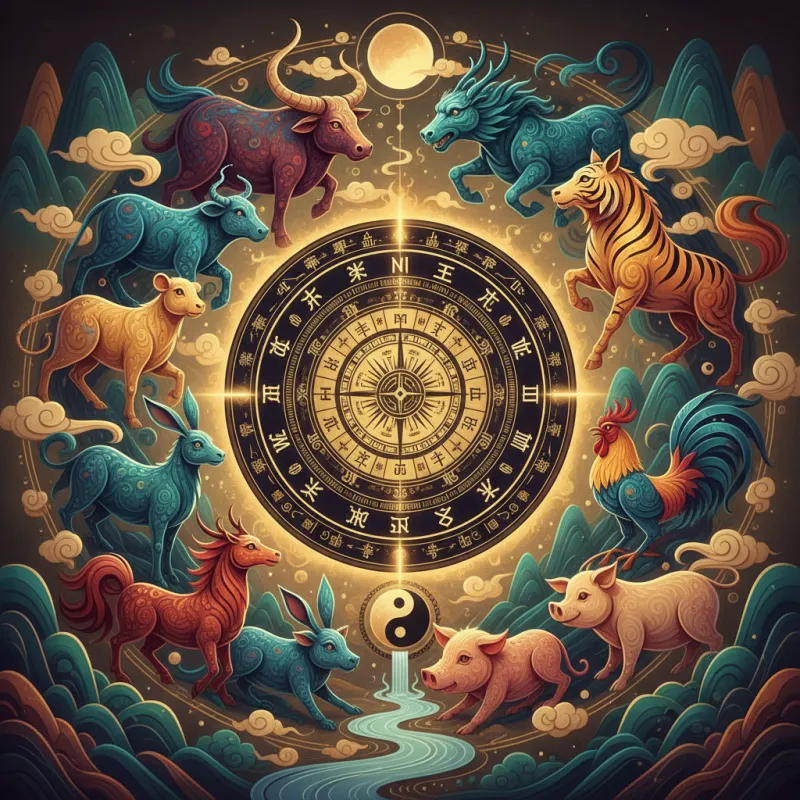
Most people think they know their Chinese zodiac sign. They'll tell you they're a Dragon because they were born in 1988, and therefore they're naturally charismatic and destined for success. But here's the uncomfortable truth: the twelve animals were never meant to tell you who you are. They're a calendar system that got hijacked by fortune-tellers and turned into something it was never designed to be.
What the Zodiac Actually Is
The Chinese zodiac (生肖, shēngxiào — literally "birth resemblance") is fundamentally a time-keeping device. Each of the twelve animals marks a position in a repeating cycle used to count years, months, days, and even hours. The Rat doesn't represent a personality type any more than "Tuesday" does. It's a label, a marker in time, nothing more.
This system emerged during the Han Dynasty (206 BCE – 220 CE), when scholars needed a way to make the complex sexagenary cycle (干支, gānzhī) more accessible to common people. The sixty-year cycle combining ten Heavenly Stems and twelve Earthly Branches was mathematically elegant but difficult to remember. Attaching animal names to the twelve Earthly Branches made the system stick in popular memory. It was a mnemonic device, not a mystical revelation about human nature.
The twelve animals — Rat, Ox, Tiger, Rabbit, Dragon, Snake, Horse, Goat, Monkey, Rooster, Dog, and Pig — cycle through in fixed order. If you were born in a Rat year, that simply means your birth year corresponds to the first position in the twelve-year cycle. The animal tells you where you fall in the calendar, not whether you're clever or ambitious or destined to marry a Dragon.
The Personality Trap
Walk into any Chinatown gift shop and you'll find zodiac placemats explaining that Tigers are brave, Rabbits are gentle, and Dragons are natural leaders. These descriptions feel ancient and authoritative, but they're mostly modern inventions — or at best, folk elaborations that have little to do with the system's original function.
The classical texts on Chinese astrology — works like the Yuanhai Ziping (淵海子平) from the Song Dynasty or the Sanming Tonghui (三命通會) from the Ming Dynasty — barely mention personality traits associated with the twelve animals. When they do discuss the animals, it's in the context of compatibility calculations, directional associations, or elemental relationships within bazi analysis. The animals function as technical components in a larger computational system, not as personality archetypes.
The personality associations we see today gained traction in the 20th century, particularly as Chinese culture was packaged for Western consumption. Publishers needed content that would sell, and "What Your Chinese Zodiac Says About You" made for better copy than "The Twelve Earthly Branches and Their Calendrical Functions." The simplification was understandable but deeply misleading.
How the System Really Works
In authentic Chinese metaphysics, your birth year animal is just one piece of a much larger puzzle. A proper astrological analysis examines your Four Pillars (四柱, sìzhù) — the year, month, day, and hour of your birth, each represented by a pair of characters from the sexagenary cycle. That gives you eight characters total (八字, bāzì), which is why the system is called "Eight Characters" or bazi.
Each of these eight characters has an associated animal from the zodiac. You're not just a "Rat person" — you might have a Rat year, a Tiger month, a Horse day, and a Rooster hour. The interactions between these four animals, combined with the five elements assigned to each position, create a complex energetic map that practitioners use for timing decisions and understanding life patterns.
Even then, the animals themselves are secondary. What matters more are the Heavenly Stems (the ten elements in their yin and yang forms) and how they interact with each other. The animals provide additional information about hidden elements and seasonal timing, but they're supporting actors, not the main show.
The Folk Tradition vs. The Technical System
This doesn't mean the folk tradition is worthless. Popular culture has its own validity, and if millions of people find meaning in identifying as a Dragon or a Rabbit, that cultural practice has value. The problem arises when folk tradition gets mistaken for the technical system, when people think they understand Chinese astrology because they know their birth year animal.
It's similar to how Western astrology has both a popular and a technical tradition. Most people know their sun sign and read horoscopes in magazines, but serious astrologers work with birth charts showing planetary positions, houses, and aspects. The sun sign is real — it's where the sun was in the zodiac at your birth — but it's a tiny fraction of the full picture. Chinese zodiac animals work the same way.
The folk tradition also includes genuinely old beliefs that aren't part of the formal astrological system. For instance, the idea that certain animal years are unlucky for births (particularly for girls born in Horse years) is a superstition with deep cultural roots, but you won't find it in classical texts. It's folklore, not metaphysics, though the line between them has always been blurry in practice.
Why the Confusion Persists
The Western appetite for personality systems is insatiable. We have Myers-Briggs, Enneagram, astrology, numerology, and countless other frameworks promising to explain who we are. When the Chinese zodiac arrived in Western consciousness, it got slotted into this existing category. It became another personality quiz, another way to sort people into types.
This misunderstanding is reinforced every Lunar New Year when media outlets publish articles about what the Year of the Rabbit or Year of the Dragon means for your personality and fortune. These pieces rarely mention that the year animal is just one of four in your chart, or that the animal itself is less important than the element and stem associated with it.
Chinese restaurants and cultural centers often perpetuate the simplified version because it's accessible and fun. There's nothing wrong with this as entertainment, but it shouldn't be confused with the actual practice of Chinese astrology, which requires years of study to understand properly.
What You Should Actually Know
If you want to engage with the Chinese zodiac in a meaningful way, start by understanding what it is: a calendrical system with layers of meaning that go far beyond personality traits. Your birth year animal is a starting point, not a destination.
To get a real reading, you need your complete birth data — year, month, day, and hour — and ideally, you need someone trained in bazi analysis who can interpret how the elements and animals in your chart interact. This is closer to getting a full natal chart reading in Western astrology than reading your horoscope in the newspaper.
You should also recognize that Chinese metaphysics is a living tradition with multiple schools of thought. A practitioner trained in classical texts will give you different information than someone working in the folk tradition, and both will differ from modern psychological interpretations. None of these approaches is necessarily "wrong," but they're not interchangeable.
The Deeper Pattern
The real insight of the Chinese zodiac isn't about personality — it's about cycles and timing. The twelve animals mark the rhythm of time, the way seasons and years flow in predictable patterns. Understanding your position in these cycles can help you make better decisions about when to act and when to wait, when to push forward and when to consolidate.
This is why Chinese astrology is traditionally used for selecting auspicious dates rather than describing personality. The system assumes that time itself has qualities, that certain moments are more favorable for certain actions. The animals help identify these moments within the larger framework of stems, branches, and elements.
When you stop trying to find yourself in your zodiac animal and start seeing it as a marker in time's great wheel, the system begins to make sense. You're not a Dragon or a Rat — you were born in a Dragon year or a Rat year, which means something specific about the energetic quality of that time and how it relates to other times in your life.
The twelve animals aren't personality types. They're not destiny. They're a calendar that's been in continuous use for over two thousand years, elegant in its simplicity and profound in its applications. That's more than enough without turning them into something they were never meant to be.
Related Reading
- The Twelve Chinese Zodiac Animals: Complete Guide
- The Dragon Year Baby Boom: Why Chinese Parents Plan Pregnancies Around the Zodiac
- The Chinese Zodiac: What Your Animal Sign Actually Means
- The Chinese Zodiac: Complete Guide to All 12 Animal Signs
- Chinese Zodiac Compatibility: Who Gets Along and Who Doesn't
- Chinese Breathing Techniques for Energy and Calm
- What Is the I Ching? A Complete Guide to the Book of Changes
- Unlocking Office Harmony: The Role of Feng Shui and I Ching in Modern Workspaces
Explore Chinese Culture
- Explore Daoist philosophy and practice
- Explore traditional Chinese customs
- Explore ancient Chinese cosmology