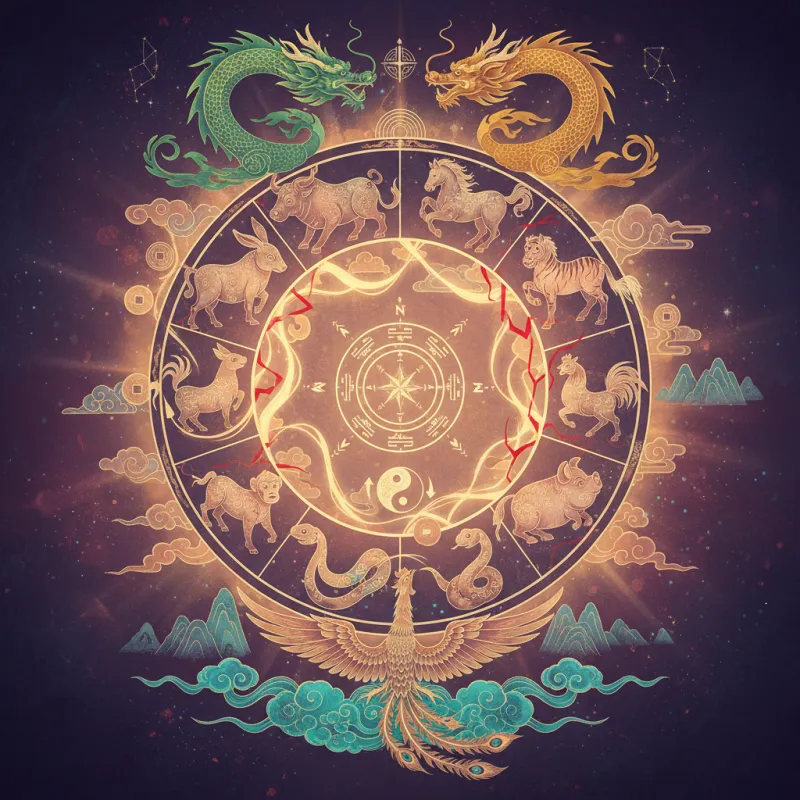
Your grandmother wasn't being superstitious when she asked about your partner's birth year — she was reading a compatibility map that's been refined over two thousand years. The Chinese zodiac compatibility system isn't fortune-telling; it's pattern recognition based on the cyclical interactions of twelve animals and five elements, a framework so mathematically elegant that even skeptics find themselves checking the charts.
The Architecture of Compatibility
The twelve animals of the Chinese zodiac — Rat, Ox, Tiger, Rabbit, Dragon, Snake, Horse, Goat, Monkey, Rooster, Dog, and Pig — aren't randomly assigned personality traits. Each occupies a specific position in a cycle that mirrors the wǔxíng (五行 wǔxíng), the five elements that govern transformation in Chinese metaphysics. When two animals meet, their elemental natures either generate, control, or remain neutral to each other.
The compatibility system operates on three levels. First, the liùhé (六合 liùhé), or six harmonies, pairs animals that are six years apart in the cycle. These are considered the most natural matches: Rat and Ox, Tiger and Pig, Rabbit and Dog, Dragon and Rooster, Snake and Monkey, Horse and Goat. Second, the sānhé (三合 sānhé), or three harmonies, creates triangular alliances of animals four years apart. Third, the liùchōng (六冲 liùchōng), or six clashes, identifies animals directly opposite each other in the twelve-year cycle — these are the relationships that require the most work.
The Six Harmony Pairs: Natural Allies
The liùhé relationships represent complementary opposites. The Rat's cleverness balances the Ox's steadiness. The Tiger's boldness softens with the Pig's generosity. The Rabbit's diplomacy grounds the Dog's loyalty. The Dragon's ambition finds structure in the Rooster's precision. The Snake's wisdom pairs with the Monkey's adaptability. The Horse's independence harmonizes with the Goat's creativity.
I've watched these pairings play out in real relationships. A Rat-born friend married an Ox, and their dynamic is exactly what the texts predict: she generates ideas at lightning speed, he evaluates and implements them methodically. They rarely argue because they occupy different operational zones. The Ox doesn't feel threatened by the Rat's mental gymnastics, and the Rat doesn't feel constrained by the Ox's deliberate pace.
The Dragon-Rooster pairing is particularly interesting because it contradicts Western assumptions about compatibility. Dragons are expansive, theatrical, sometimes grandiose. Roosters are detail-oriented, critical, perfectionistic. You'd think they'd drive each other crazy. Instead, the Rooster provides the quality control the Dragon needs, and the Dragon gives the Rooster a vision worth perfecting. This is the pairing you see in successful business partnerships — one person dreams big, the other makes sure the dream actually works.
The Triangle Alliances: Three-Way Harmony
The sānhé groups create four triangular alliances, each sharing an elemental affinity. The Rat, Dragon, and Monkey form the water-aligned achievers' triangle — ambitious, strategic, and results-oriented. The Ox, Snake, and Rooster create the metal-aligned thinkers' triangle — analytical, persistent, and methodical. The Tiger, Horse, and Dog form the fire-aligned activists' triangle — passionate, loyal, and action-driven. The Rabbit, Goat, and Pig create the wood-aligned creatives' triangle — artistic, empathetic, and harmony-seeking.
These triangular relationships work because the three animals share a fundamental approach to life. Put a Rat, Dragon, and Monkey in a room, and they'll immediately start strategizing about how to optimize whatever situation they're in. They speak the same language of efficiency and achievement. Similarly, a Tiger, Horse, and Dog will bond over shared causes and principles — these are the animals that lead social movements and fight for justice.
The creative triangle of Rabbit, Goat, and Pig is often underestimated in modern interpretations that prize ambition over artistry. But this alliance has produced some of China's greatest poets, painters, and musicians. These three animals prioritize beauty, emotional authenticity, and interpersonal harmony. They're not competing for dominance; they're collaborating to create something meaningful. In the Tang Dynasty, you'd find this energy in the literary salons where poets gathered to compose verses and critique each other's work.
The Six Clashes: Opposite Energies
The liùchōng pairs sit directly across from each other in the zodiac wheel: Rat and Horse, Ox and Goat, Tiger and Monkey, Rabbit and Rooster, Dragon and Dog, Snake and Pig. These aren't necessarily bad relationships, but they require conscious effort because the two animals operate from fundamentally different worldviews.
The Rat-Horse clash is about freedom versus security. Rats are hoarders and planners; Horses are wanderers and risk-takers. A Rat wants to build a nest egg; a Horse wants to see what's over the next hill. This pairing can work if both parties respect the other's core need — the Rat must allow the Horse some freedom, and the Horse must provide the Rat with some stability. Without that mutual respect, the Rat feels abandoned and the Horse feels trapped.
The Dragon-Dog clash is particularly intense because both animals have strong principles, but their principles point in opposite directions. Dragons believe in their own exceptionalism and expect others to recognize it. Dogs believe in equality and loyalty to the group. A Dragon walks into a room expecting to be the center of attention; a Dog walks in looking for who needs help. These two can drive each other crazy — the Dragon thinks the Dog is self-righteous, and the Dog thinks the Dragon is narcissistic. But when they align on a shared mission, they're unstoppable. The Dragon provides the vision and charisma, the Dog provides the moral compass and follow-through.
The Tiger-Monkey clash is the trickster versus the warrior. Tigers are direct, honorable, and sometimes rigid in their sense of right and wrong. Monkeys are clever, flexible, and willing to bend rules if it serves their purposes. Tigers find Monkeys untrustworthy; Monkeys find Tigers predictable and easy to manipulate. This pairing shows up in Chinese literature as the eternal conflict between the righteous hero and the cunning strategist. Think of the relationship between the straightforward generals and the scheming advisors in Romance of the Three Kingdoms — that's Tiger-Monkey energy.
Beyond the Animals: The Five Elements Layer
The zodiac compatibility system becomes more nuanced when you factor in the wǔxíng cycle that overlays the twelve animals. Each animal is associated with one of the five elements — metal, water, wood, fire, or earth — and these elements interact according to generating and controlling cycles. Wood feeds fire, fire creates earth, earth bears metal, metal collects water, water nourishes wood. But wood also controls earth, earth controls water, water controls fire, fire controls metal, and metal controls wood.
This means a Rat born in 1984 (wood Rat) has different compatibility patterns than a Rat born in 1996 (fire Rat). The wood Rat pairs well with fire signs because wood feeds fire, but might struggle with earth signs because wood controls earth. This is why serious bazi analysis looks at the full Four Pillars — year, month, day, and hour — rather than just the year animal. The year animal gives you the broad strokes, but the elements provide the detail work.
I've seen this play out in a Snake-Pig relationship that shouldn't have worked according to the basic zodiac clash, but did work because of elemental harmony. The Snake was a metal Snake, the Pig was a water Pig, and metal generates water in the wǔxíng cycle. The Snake's sharp analytical nature (metal) actually supported the Pig's emotional depth (water) rather than conflicting with it. They've been together for fifteen years.
The Practical Application: What This Actually Means
Here's what the compatibility charts don't tell you: no pairing is doomed, and no pairing is guaranteed. The zodiac system describes tendencies, not destinies. A Rat and Horse can build a successful relationship if they understand their fundamental differences and create space for both security and freedom. A Dragon and Rooster might be naturally compatible, but they'll still fail if they don't communicate or share values.
The real value of zodiac compatibility isn't in deciding whether to date someone. It's in understanding the natural friction points in your relationship and developing strategies to address them. If you're a Tiger married to a Monkey, you know you'll need to work on trust — the Tiger needs to accept that the Monkey's flexibility isn't dishonesty, and the Monkey needs to understand that the Tiger's directness isn't rigidity. That awareness alone can prevent years of misunderstanding.
Traditional Chinese families used these charts as one data point among many. They also considered family background, education, financial stability, and personal character. The zodiac compatibility was a framework for understanding potential challenges, not a veto power over love. Modern practitioners of Chinese astrology take the same approach — use the system as a tool for insight, not as a rigid rule book.
The Compatibility Chart in Modern Context
The zodiac compatibility system has survived for millennia because it maps onto observable patterns in human relationships. The achievers' triangle of Rat, Dragon, and Monkey really does tend to bond over shared ambition. The activists' triangle of Tiger, Horse, and Dog really does tend to unite around causes and principles. The clashing pairs really do experience predictable friction points.
But the system was developed in a culture where marriages were arranged, gender roles were fixed, and individual choice was limited. Modern relationships operate under different rules. We choose our partners based on attraction, shared interests, and emotional connection. We expect equality and mutual growth. We change careers, cities, and sometimes core values throughout our lives. The zodiac compatibility framework needs to be adapted to these realities.
The most useful way to apply zodiac compatibility today is as a personality framework similar to Myers-Briggs or the Enneagram. It gives you a vocabulary for discussing differences and a map for understanding why certain conflicts keep recurring. When a Horse complains that their Rat partner is too cautious, and the Rat complains that the Horse is too impulsive, they're not just having a personality clash — they're experiencing the fundamental tension between security and freedom that defines the Rat-Horse dynamic. Naming that tension doesn't resolve it, but it does make it less personal and more manageable.
The compatibility system also reminds us that differences can be complementary rather than problematic. Western culture often assumes that similarity breeds compatibility — we look for partners who share our interests, values, and lifestyle preferences. The Chinese zodiac suggests the opposite: sometimes the best partnerships are between people who balance each other's extremes. The Ox grounds the Rat's scattered energy. The Rooster refines the Dragon's grandiose visions. The Pig softens the Tiger's aggressive righteousness. These aren't compromises; they're synergies.
Reading Your Own Chart
If you want to explore zodiac compatibility seriously, start with your birth year animal but don't stop there. Learn about the five elements that govern your year, month, day, and hour of birth. Understand which element dominates your chart and which elements you're missing. A person with too much fire needs water to balance them; a person with too much metal needs wood to soften them. Compatibility isn't just about matching animals — it's about creating elemental balance.
Pay attention to the sānhé triangles. If you're a Rat, you'll naturally click with Dragons and Monkeys even if you've just met them. There's an immediate sense of understanding, a shared wavelength. These are your natural allies in work and friendship, not just romance. Similarly, notice your liùhé partner — the animal six years away from yours. These relationships often feel effortless because you complement each other's strengths and weaknesses without competing.
And don't write off the clashing pairs. Some of the most dynamic, growth-oriented relationships happen between opposite animals. The friction forces both people to expand beyond their comfort zones. A Rat learns spontaneity from a Horse. A Dragon learns humility from a Dog. A Tiger learns flexibility from a Monkey. These relationships require more work, but they also offer more transformation.
The Chinese zodiac compatibility system isn't about finding your perfect match — it's about understanding the dance between different energies and learning the steps that make the dance work. Your grandmother knew this. That's why she asked about birth years.
Related Reading
- The Twelve Chinese Zodiac Animals: Complete Guide
- The Chinese Zodiac: What Your Animal Sign Actually Means
- Chinese Zodiac: The Twelve Animals Are Not What You Think
- The Chinese Zodiac: Complete Guide to All 12 Animal Signs
- The Dragon Year Baby Boom: Why Chinese Parents Plan Pregnancies Around the Zodiac
- Unlocking Office Harmony: The Role of Feng Shui and I Ching in Modern Workspaces
- The Wood Element: Growth, Creativity, and Spring
- Smart Home and Feng Shui: Can Technology and Tradition Coexist?
Explore Chinese Culture
- Explore Daoist philosophy and practice
- Explore traditional Chinese customs
- Explore ancient Chinese cosmology