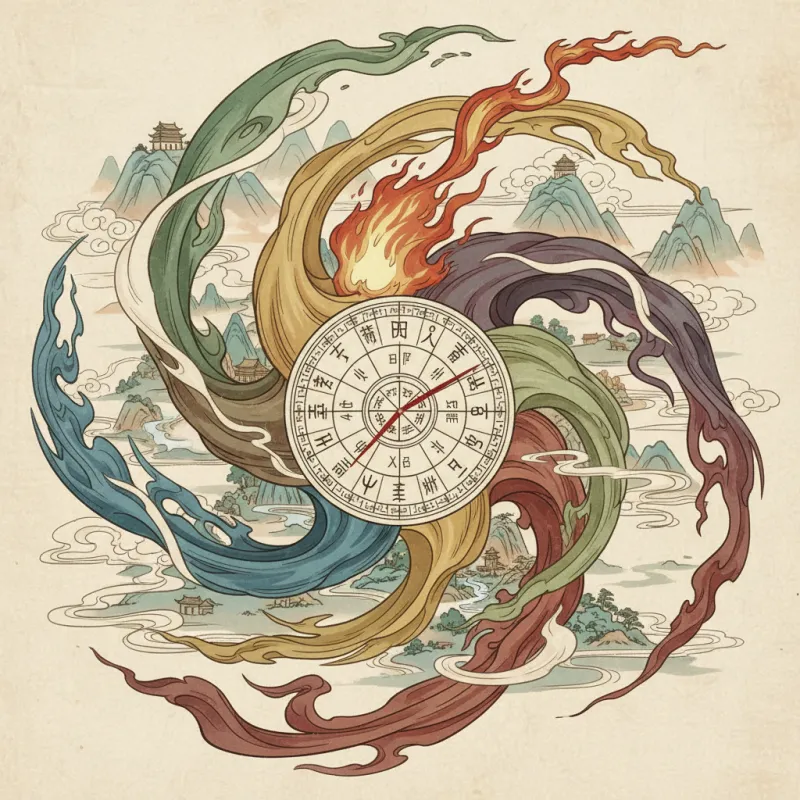
Most people trying to balance their home's energy are unknowingly fighting against a mistranslation that's over a century old. They're adding wooden furniture when they need growth, placing metal objects when they need contraction, and wondering why their feng shui adjustments feel lifeless. The problem? We've been taught to think of 五行 (wǔxíng) as five things when they're actually five verbs.
The Mistranslation That Changed Everything
When James Legge translated the Chinese classics in the 1860s, he rendered 五行 (wǔxíng) as "five elements." It seemed reasonable enough — after all, European philosophy had its four elements of earth, air, fire, and water. But Legge missed something crucial: the character 行 (xíng) doesn't mean "element" or "substance." It means "to walk," "to move," "to act," or "to circulate." The Shuowen Jiezi (說文解字), China's oldest dictionary from 100 CE, defines 行 as "the movement of a person" — literally showing two feet in motion.
This wasn't just a translation hiccup. It fundamentally altered how Westerners — and eventually modern Chinese people influenced by Western education — understood the entire system. An element is static, fixed, something you can hold or point to. A phase is dynamic, transitional, something you experience and move through. When you grasp this distinction, suddenly the generating and controlling cycles stop being arbitrary rules and become obvious descriptions of how change actually works.
What the Classical Texts Actually Say
The earliest systematic discussion of wǔxíng appears in the Shàngshū (尚書), the Book of Documents, compiled around the 4th century BCE. The Hóngfàn (洪範) chapter doesn't describe five substances sitting in jars. It describes five dynamic processes: Water soaks downward, Fire flames upward, Wood can be bent and straightened, Metal can be molded and hardened, Earth permits sowing and reaping. Every single description is a verb phrase, an action, a transformation.
The Huáinánzǐ (淮南子), written in 139 BCE, makes this even clearer. It explicitly states that the five xíng are "five movements of qi" (五氣之行). Not five types of matter, but five patterns of how vital energy moves through the world. The text describes Wood as "the beginning of life" (生之始), Fire as "the flourishing of yang" (陽之盛), Metal as "the gathering inward" (收斂), and Water as "the storage of essence" (精之藏). These are phases in a cycle, not ingredients in a recipe.
Even the arrangement of the five xíng in classical texts reveals their processual nature. They're almost never listed as isolated items. They're described in sequences: Wood generates Fire, Fire generates Earth, Earth generates Metal, Metal generates Water, Water generates Wood. This is the language of transformation, not taxonomy.
The Five Phases as Seasonal Movements
The most intuitive way to understand wǔxíng as phases rather than elements is through the seasons — which is exactly how the classical texts introduce them. Wood corresponds to spring, but not because trees are made of wood. It corresponds to spring because Wood describes the quality of energy in spring: rising, expanding, bursting forth, initiating growth. It's the phase when yang energy begins its ascent.
Fire corresponds to summer not because it's hot (though it is), but because Fire describes the peak of expansion, the maximum expression of yang, the moment when growth reaches its fullest flowering before beginning to turn. This is why Fire is associated with the heart in Chinese medicine — not because the heart is literally on fire, but because the heart governs the peak expression of life force.
Metal corresponds to autumn, the phase of gathering inward, condensing, harvesting, and letting go of what's no longer needed. The energy that expanded outward in spring and summer now contracts and consolidates. Metal's association with the lungs makes perfect sense when you understand this: breathing in is a gathering, a taking in of essence from the external world.
Water corresponds to winter, the phase of maximum storage, rest, and potential. Energy has descended to its lowest, most concentrated point. Everything appears still, but beneath the surface, the seeds of next spring's Wood phase are already forming. The kidneys store jing (精), the essential substance that will fuel the next cycle of growth.
And Earth? Earth is the center, the pivot point between phases, the brief pause that allows one transformation to complete before the next begins. In the seasonal cycle, Earth corresponds to the transition periods between seasons — what Chinese calendars call dòyuè (斗月), the "turning months." This is why trying to map Earth to a single season never quite works. Earth isn't a season; it's the ground that makes seasonal change possible.
Why This Matters for Your Practice
Understanding wǔxíng as phases rather than elements completely transforms how you work with feng shui principles in your environment. When someone says "I need more Wood energy in my office," the question isn't "how much wooden furniture should I buy?" The question is "what phase of energy does this space need?"
If your office feels stagnant, stuck, unable to initiate new projects, then yes — you need Wood phase energy. But you don't create that by adding wooden objects. You create it by introducing the qualities of Wood: upward movement (tall plants, vertical lines), new growth (living things, not dead wood), morning light (Wood is associated with the east and dawn), and the color of new leaves (fresh greens, not brown wood tones).
I once consulted for a startup that had filled their office with reclaimed wood furniture, wood paneling, and wooden decorative objects because a feng shui book told them Wood element supports growth. The space felt heavy, dark, and oppressive — the opposite of growth energy. We removed most of the wooden objects and instead added floor-to-ceiling windows, living bamboo plants, and a policy of opening all blinds at sunrise. Within weeks, the team reported feeling more creative and energized. Same "element," completely different phase.
The same principle applies to all five phases. Metal phase energy isn't about buying metal objects — it's about creating the quality of gathering, refining, and letting go. Water phase energy isn't about fountains (though moving water can help) — it's about creating depth, stillness, and potential. Fire phase energy isn't about candles — it's about peak expression, visibility, and connection.
The Generating Cycle as Process, Not Causation
When classical texts say "Wood generates Fire" (木生火, mù shēng huǒ), Western readers often imagine a mechanical cause-and-effect: wood fuel creates fire. But the Chinese verb 生 (shēng) means "to give birth to," "to grow," or "to bring forth." It's organic, not mechanical. Wood doesn't cause Fire the way striking a match causes flame. Wood phase naturally matures into Fire phase the way spring naturally becomes summer.
Think of a plant growing. The Wood phase is the shoot pushing up through soil, the stem lengthening, the leaves unfurling. This growth doesn't suddenly stop and transform into something called "Fire." Rather, the growth process reaches its peak expression — the flower blooms, the fruit ripens, the plant achieves its maximum yang expression. This peak is Fire phase. It's the same continuous process, moving through different phases of intensity and quality.
Fire generates Earth (火生土, huǒ shēng tǔ) because peak expression naturally leads to consolidation. The flower becomes fruit, the fruit falls and nourishes the soil, the intense activity of summer gives way to the harvest of late summer. Energy that was dispersed and expansive begins to gather and stabilize. This is Earth phase — not dirt, but the process of centering and transforming.
Earth generates Metal (土生金, tǔ shēng jīn) because consolidation naturally leads to refinement. The harvest is gathered, the essential is separated from the inessential, what's valuable is preserved and what's not needed is released. This is Metal phase — the quality of autumn, of distillation, of taking in what nourishes and letting go of what doesn't.
Metal generates Water (金生水, jīn shēng shuǐ) because refinement naturally leads to essence. What's been gathered and distilled now descends to its most concentrated form, stored in the depths, held in potential. This is Water phase — not the substance H₂O, but the quality of maximum yin, of rest, of the seed waiting in winter soil.
And Water generates Wood (水生木, shuǐ shēng mù) because stored potential naturally erupts into new growth. The seed sprouts, the energy that was held in reserve now pushes upward and outward, and the cycle begins again. This isn't water "causing" wood to grow — it's the natural progression of energy from maximum storage to renewed expression.
The Controlling Cycle as Regulation, Not Conflict
The controlling cycle (相克, xiāng kè) is even more misunderstood when you think in terms of elements rather than phases. "Wood controls Earth" sounds like an antagonistic relationship — wood breaking up earth, roots destroying soil. But kè (克) doesn't mean "destroy" or "attack." It means "to regulate," "to restrain," or "to keep in check." It's the relationship between phases that prevents any one phase from becoming excessive.
Wood controls Earth because growth regulates consolidation. If Earth phase energy becomes too dominant — too much centering, too much stability, too much holding — Wood phase energy breaks up that stagnation and initiates new movement. This isn't destruction; it's necessary regulation. A garden that's all soil with no plants isn't balanced — it needs the breaking-up action of roots, the upward thrust of growth.
Earth controls Water because centering regulates depth. If Water phase energy becomes excessive — too much withdrawal, too much storage, too much inward focus — Earth phase energy provides boundaries and direction. Water without banks becomes a flood; Water with banks becomes a river. The controlling relationship creates useful form.
Fire controls Metal because peak expression regulates contraction. If Metal phase energy becomes too dominant — too much letting go, too much refinement, too much gathering inward — Fire phase energy brings things back into visibility and connection. You can't only harvest and store; at some point, you need to express and share what you've gathered.
Metal controls Wood because refinement regulates growth. If Wood phase energy becomes excessive — too much expansion, too much initiation, too much outward movement — Metal phase energy cuts back, prunes, and focuses the growth. A plant that's all growth and no pruning becomes weak and scattered. The cutting back strengthens what remains.
Water controls Fire because depth regulates peak expression. If Fire phase energy becomes excessive — too much intensity, too much visibility, too much outward expression — Water phase energy provides the cooling, the rest, the return to essence. You can't stay at peak intensity forever; you need the downward movement of Water to restore your reserves.
Living With Phases Instead of Elements
Once you start seeing wǔxíng as phases of energy rather than types of matter, your entire relationship with your environment shifts. You stop asking "what element is this object?" and start asking "what phase of energy does this space embody?" You stop trying to balance your home like a chemistry equation and start orchestrating it like a symphony, where different movements flow into each other.
A bedroom needs Water phase energy — depth, stillness, storage, rest. Not necessarily a water fountain (which might actually be too active), but the qualities of Water: low lighting, deep colors, minimal visual stimulation, a sense of being held and contained. The best bedrooms I've seen have almost no decorative objects at all — just essential furniture, soft textures, and a quality of quietness that lets you descend into rest.
A kitchen needs Fire phase energy — transformation, connection, the peak expression of nourishment. Not necessarily red walls (though they might work), but the qualities of Fire: good lighting, a sense of gathering and sharing, visibility of the cooking process, warmth. The worst kitchens are hidden away, dark, and isolated. The best ones are the heart of the home, where people naturally congregate.
A home office needs Wood phase energy — initiation, growth, upward movement, new beginnings. Not necessarily wooden furniture, but the qualities of Wood: natural light (especially morning light), living plants, vertical elements, a sense of possibility and expansion. Add some Metal phase energy too — refinement, focus, the ability to cut away distractions — and you have a space that supports both creative generation and productive execution.
Your living room might need Earth phase energy — centering, gathering, the pivot point where different activities and people come together. Not necessarily earth tones (though they might help), but the qualities of Earth: comfortable seating arranged for conversation, a sense of stability and welcome, a space that feels like the center of your home rather than a showroom.
The phases you need will shift with the seasons, with your life circumstances, with your current challenges and goals. This is why understanding the five elements as dynamic phases rather than static substances is so powerful — it gives you a framework for working with change rather than trying to create a fixed, "perfect" arrangement that never needs adjustment.
The Deeper Pattern
Here's what the classical texts understood that modern interpretations often miss: wǔxíng isn't really about five separate things at all. It's about one continuous process of transformation that moves through five recognizable phases. Energy doesn't jump from Wood to Fire to Earth like hopping between islands. It flows continuously, and we mark five points in that flow where the quality of energy is distinct enough to name and work with.
This is why the Daoist texts often speak of wǔxíng and yīn-yáng (陰陽) together. Yīn-yáng describes the fundamental polarity of change — the oscillation between expansion and contraction, rising and falling, outward and inward. Wǔxíng describes the five phases of that oscillation: the beginning of expansion (Wood), the peak of expansion (Fire), the pivot point (Earth), the beginning of contraction (Metal), and the peak of contraction (Water).
When you understand this, you stop trying to "balance" the five elements like ingredients in a recipe — two parts Wood, one part Fire, a pinch of Metal. Instead, you start asking: what phase of transformation is this space, this situation, this moment calling for? What quality of energy wants to emerge here? And how can I support that emergence?
That's the shift from thinking about elements to thinking about phases. And that's when feng shui stops being about furniture arrangement and starts being about participating in the natural flow of change that moves through all things.
Related Reading
- The Fire Element: Passion, Fame, and Summer
- The Five Elements Are Not Elements (And Why That Matters)
- The Five Elements in Interior Design
- The Wood Element: Growth, Creativity, and Spring
- Harmonizing Your Kitchen: The Role of Feng Shui and I Ching in Culinary Spaces
- Unlocking the Wisdom of Feng Shui and I Ching: A Journey Through Chinese Metaphysics
- Bedroom Feng Shui for Better Sleep
Explore Chinese Culture
- Explore Daoist philosophy and practice
- Explore traditional Chinese customs
- Explore ancient Chinese cosmology