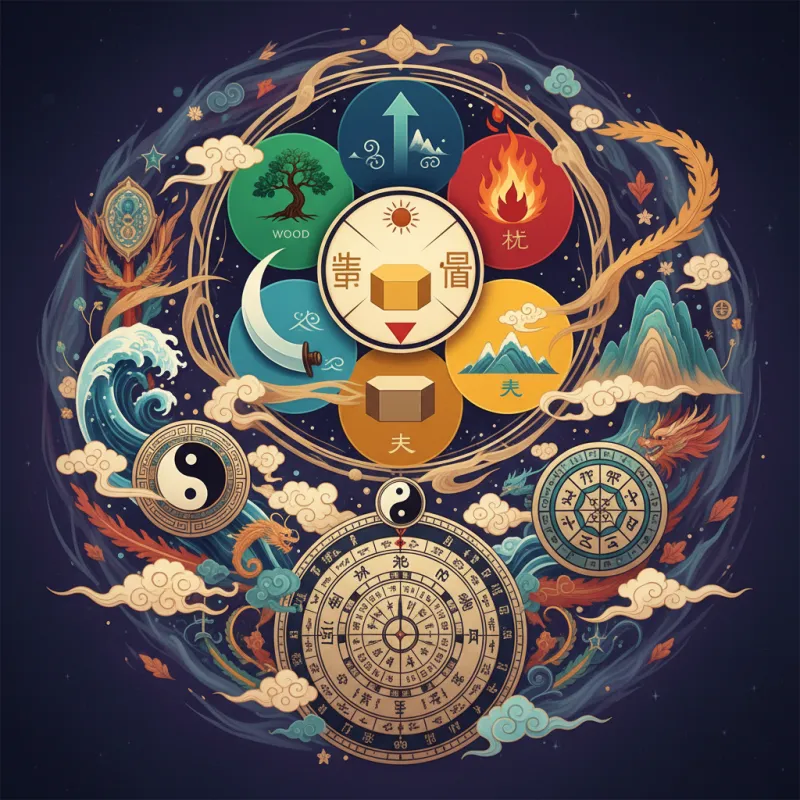
You're holding a piece of wood in one hand and a metal blade in the other. Which one wins? The answer seems obvious — metal cuts wood — but this simple observation contains the seed of an entire philosophical system that has shaped Chinese thought for over two millennia. The five elements theory (五行 wǔxíng) doesn't just explain why metal defeats wood; it explains why your liver acts up in spring, why certain business partnerships fail spectacularly, and why that corner of your house always feels stagnant.
Not Elements, But Phases of Transformation
Here's where most English translations get it wrong: wǔxíng doesn't mean "five elements." It means "five movements" or "five phases." This isn't pedantic nitpicking — it's the difference between understanding the system and completely missing the point. Wood (木 mù), Fire (火 huǒ), Earth (土 tǔ), Metal (金 jīn), and Water (水 shuǐ) aren't substances you can bottle and label. They're verbs disguised as nouns, processes frozen into convenient categories.
Wood represents expansion, the explosive growth of spring bamboo shoots pushing through frozen ground. Fire is transformation at its peak, the moment of maximum yang before the inevitable turn. Earth is stabilization, the harvest gathered and stored. Metal is contraction, the pruning and refining that comes with autumn. Water is descent, the return to potential, the seed waiting in winter darkness. Everything cycles through these phases, from the seasons to your emotional states to the rise and fall of dynasties.
The Warring States period (475-221 BCE) saw philosophers desperately trying to make sense of chaos. Zou Yan (鄒衍), the cosmologist who systematized five elements theory, wasn't just playing intellectual games. He was watching kingdoms rise and fall, trying to find patterns in the bloodshed. His insight was that change follows predictable patterns — not because the universe is mechanical, but because transformation itself has a grammar.
The Two Cycles That Govern Everything
The five elements interact through two fundamental cycles, and understanding these is like getting the cheat codes to reality. The generating cycle (相生 xiāngshēng) describes how each element creates the next: Wood feeds Fire, Fire creates Earth (ash), Earth bears Metal, Metal enriches Water (minerals), Water nourishes Wood. This is the cycle of support, of natural progression, of things flowing as they should.
Then there's the controlling cycle (相克 xiāngkè), which sounds ominous but is actually essential for balance. Wood parts Earth (roots breaking soil), Earth dams Water, Water extinguishes Fire, Fire melts Metal, Metal cuts Wood. Without this cycle of control, the generating cycle would spiral into excess. Imagine fire with nothing to check it, or water with no boundaries. The controlling cycle isn't about destruction — it's about necessary limitation.
But here's what the basic diagrams don't show you: there's also an insulting cycle (相侮 xiāngwǔ) that occurs when elements become too strong or too weak. When Metal is excessive, instead of being controlled by Fire, it "insults" Fire by overwhelming it. When Water is deficient, instead of controlling Fire, it gets "insulted" by Fire evaporating it. This is where things get interesting in practical application, because it explains why sometimes the normal relationships break down.
Traditional Chinese Medicine builds its entire diagnostic framework on these cycles. Your liver is Wood, your heart is Fire, your spleen is Earth, your lungs are Metal, your kidneys are Water. When you're angry all the time (excess Wood), it's not just affecting your liver — it's insulting your Earth (spleen/stomach), causing digestive issues. The relationship between elements isn't just theoretical; it's playing out in your body right now.
Mapping the Elements to Everything
Once you see the five elements framework, you can't unsee it. The ancient Chinese mapped everything onto this system with an obsessiveness that would make a modern taxonomist jealous. Seasons, directions, colors, flavors, organs, emotions, planets, musical notes, numbers — everything got sorted into five categories.
Spring is Wood, summer is Fire, late summer is Earth (yes, they added a fifth season), autumn is Metal, winter is Water. East is Wood, south is Fire, center is Earth, west is Metal, north is Water. Green is Wood, red is Fire, yellow is Earth, white is Metal, black is Water. Sour is Wood, bitter is Fire, sweet is Earth, pungent is Metal, salty is Water.
This might seem arbitrary until you start noticing the patterns. Wood's color is green (vegetation), its season is spring (growth), its direction is east (sunrise, beginning), its flavor is sour (like unripe fruit, still growing). Fire's color is red (flames), its season is summer (heat), its direction is south (maximum yang), its flavor is bitter (like burnt things). The correspondences aren't random — they're based on careful observation of how things actually behave in nature.
The Huangdi Neijing (黃帝內經), the foundational text of Chinese medicine written around 300 BCE, takes these correspondences and runs with them. It maps emotions to elements: anger to Wood, joy to Fire, worry to Earth, grief to Metal, fear to Water. It maps body tissues: tendons to Wood, blood vessels to Fire, flesh to Earth, skin to Metal, bones to Water. It even maps sounds: shouting to Wood, laughing to Fire, singing to Earth, weeping to Metal, groaning to Water.
The Element You Are (And Why It Matters)
In bazi (八字) fortune-telling, your birth chart is analyzed through the lens of five elements. You're not just one element — you're a complex mixture, with different elements dominating different aspects of your chart. But most people have one or two elements that are particularly strong or weak, and this shapes everything from your personality to your career prospects to your health vulnerabilities.
Someone with strong Wood is growth-oriented, ambitious, sometimes inflexible. They're the entrepreneur who can't stop starting new projects, the person who gets restless if they're not moving forward. Their challenge is learning when to stop expanding. Someone with weak Wood lacks direction, struggles with decision-making, can't seem to get projects off the ground. They need to cultivate their Wood element — through color (green), direction (east), activities (planning, starting things), even diet (sour foods, leafy vegetables).
Strong Fire people are charismatic, passionate, sometimes manic. They're the life of the party, the inspiring leader, the person who burns bright and sometimes burns out. Weak Fire people lack enthusiasm, struggle with depression, can't seem to generate excitement about anything. Strong Earth people are stable, nurturing, sometimes stuck. They're the reliable friend, the person everyone depends on, the one who has trouble saying no. Weak Earth people feel ungrounded, can't seem to establish routines, struggle with self-care.
The five elements in personality analysis goes deeper than Western astrology because it's not just about describing traits — it's about understanding the dynamic relationships between different aspects of yourself. If you're strong Wood and weak Metal, you're all growth with no pruning, all expansion with no refinement. You need to cultivate Metal to balance yourself out.
When Elements Clash in Real Life
The five elements theory isn't just for fortune tellers and feng shui consultants. It shows up in Chinese strategic thinking, business partnerships, even marriage compatibility. The Romance of the Three Kingdoms (三國演義), that epic novel of strategy and betrayal, is essentially a five elements drama playing out across decades of warfare.
Liu Bei (劉備) is Wood — benevolent, growth-oriented, building alliances. Cao Cao (曹操) is Metal — sharp, cutting, ruthless in his efficiency. Sun Quan (孫權) is Water — adaptive, flowing around obstacles, waiting for the right moment. The novel's entire structure follows five elements logic: Metal (Cao Cao) tries to cut Wood (Liu Bei), but Wood is supported by Water (Sun Quan's alliance). When the alliance breaks, Metal can finally overcome Wood.
In business, partnerships between people of compatible elements tend to last longer. Wood and Fire work well together — Wood feeds Fire's enthusiasm, Fire transforms Wood's ideas into reality. Earth and Metal are natural partners — Earth provides resources, Metal refines them into value. But Wood and Metal together? That's a recipe for conflict unless both parties are aware of the dynamic and work to balance it.
Feng shui takes these principles and applies them to physical space. A room with too much Fire element (red colors, triangular shapes, bright lights) will feel agitated and exhausting. Add some Water element (black or blue colors, wavy patterns, actual water features) to control the Fire, and suddenly the space feels balanced. A career area (north, Water element) that's dominated by Earth element (yellow colors, square shapes, ceramic objects) will feel blocked — Earth dams Water. Remove some Earth or add Metal (which drains Earth and generates Water) and opportunities start flowing again.
The Modern Relevance of Ancient Patterns
You might think a 2,000-year-old philosophical system has nothing to say about modern life, but the five elements framework is arguably more relevant now than ever. We live in a world of excess Fire — constant stimulation, endless growth, burnout as a lifestyle. We've forgotten the wisdom of the controlling cycle, the necessity of Metal's pruning and Water's rest.
Silicon Valley is pure Fire element run amok: move fast and break things, disrupt everything, growth at all costs. No wonder everyone's anxious and exhausted. The five elements framework would prescribe more Metal (structure, boundaries, saying no) and more Water (rest, reflection, strategic patience). But that doesn't fit the narrative of exponential growth, so we just keep adding more Fire until something breaks.
Traditional Chinese culture understood something we've forgotten: balance isn't a static state you achieve once and maintain forever. It's a dynamic process of constant adjustment, of recognizing which element is excessive and which is deficient, of knowing when to generate and when to control. The five elements aren't a rigid system of classification — they're a flexible framework for understanding change.
The genius of wǔxíng is that it's simultaneously simple and infinitely complex. A child can understand that water puts out fire. A master can spend a lifetime exploring the subtle interactions between elements in medicine, strategy, art, and daily life. The framework scales from the cosmic (the movement of planets) to the intimate (the taste of your dinner), and it works at every level because it's describing something fundamental about how change happens.
Living With the Elements
So what do you do with this knowledge? Start by observing which elements are strong or weak in your own life. Are you all Wood (constant planning and starting) with no Fire (execution and completion)? All Earth (stability and routine) with no Metal (refinement and letting go)? The imbalances are usually obvious once you start looking.
Then make small adjustments. If you're deficient in Water, add more black or blue to your environment, spend time near actual water, practice activities that embody Water's qualities (meditation, strategic thinking, rest). If you're excessive in Fire, introduce more Water to control it — not to extinguish your passion, but to give it boundaries and direction.
The five elements theory isn't asking you to believe in anything supernatural. It's offering a vocabulary for describing patterns you already recognize intuitively. You know that some people are "fiery" and others are "grounded." You know that spring feels different from autumn, that some colors energize you while others calm you down. The five elements just give you a systematic way to work with these observations.
The framework has survived for two millennia not because it's scientifically accurate in the modern sense, but because it's phenomenologically accurate — it describes lived experience in a way that's useful for making decisions and understanding change. And in a world that's increasingly complex and chaotic, having a framework for understanding how things interact, conflict, support, and transform might be exactly what we need.
Related Reading
- The Wood Element: Growth, Creativity, and Spring
- Five Element Compatibility: The Productive and Destructive Cycles
- The Five Elements in Interior Design
- The Fire Element: Passion, Fame, and Summer
- The Water Element: Wisdom, Career, and Winter
- Bedroom Feng Shui: Creating Your Personal Sanctuary
- Reflecting Harmony: The Role of Mirrors in Feng Shui and I Ching Divination
- Unlocking Office Harmony: The Role of Feng Shui and I Ching in Modern Workspaces
Explore Chinese Culture
- Explore Daoist philosophy and practice
- Explore traditional Chinese customs
- Explore ancient Chinese cosmology