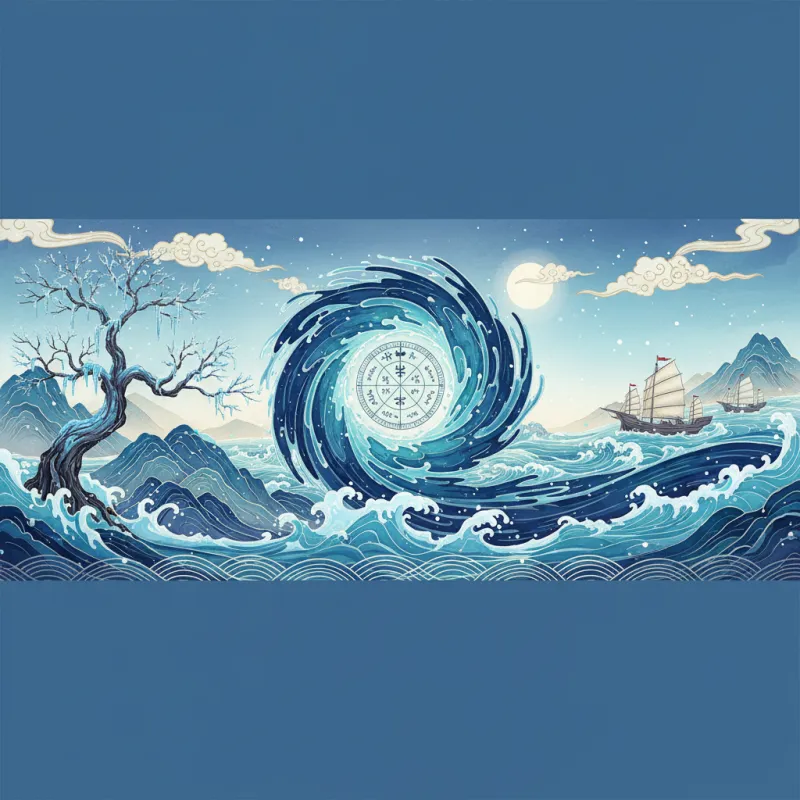
Picture a frozen lake in the depths of winter—its surface still as glass, yet beneath, currents continue their ancient dance. This is 水 (shuǐ), the Water element, and it holds secrets that Chinese sages have contemplated for millennia. Unlike the other elements that announce themselves boldly, Water whispers. It teaches through yielding, conquers through flowing downward, and achieves mastery by never forcing its way.
The Paradox of Water's Power
The Daodejing (道德經) states in Chapter 78: "Nothing in the world is softer than water, yet nothing is better at overcoming the hard and strong." Laozi wasn't being poetic—he was describing a fundamental principle that governs everything from military strategy to career advancement. Water doesn't fight obstacles; it finds the path of least resistance, yet given enough time, it carves through mountains.
In the 五行 (wǔxíng, Five Elements) system, Water represents the ultimate yin phase—the deepest darkness before dawn, the stillness before movement begins. It corresponds to the north direction, the color black or deep blue, and the winter season when nature withdraws into contemplation. But here's what most people miss: Water isn't passive. It's gathering strength, consolidating wisdom, preparing for the explosive growth of spring's Wood element.
The ancient Chinese observed that water always seeks the lowest place, yet from the lowest valleys, rivers gain the power to shape continents. This isn't weakness—it's strategic positioning. In understanding the Five Elements cycle, Water nourishes Wood (career growth and expansion) while controlling Fire (fame and recognition). This relationship reveals why true wisdom often comes from those who've descended into difficulty rather than those who've only known success.
Water and the Architecture of Wisdom
The I Ching's 坎卦 (Kǎn guà, the Abysmal/Water trigram) appears as two solid yang lines surrounding a broken yin line—danger on the outside, softness within. This isn't coincidental symbolism. The hexagram teaches that genuine wisdom requires experiencing danger while maintaining inner flexibility. The 29th hexagram, 坎為水 (Kǎn Wéi Shuǐ, the Abysmal Water), doubled, warns against the "pit" but also promises that "water flows on and on, and merely fills up all the places through which it flows."
During the Song Dynasty (960-1279 CE), Neo-Confucian philosopher Zhu Xi wrote extensively about Water's relationship to wisdom. He noted that just as water reflects images clearly when still, the mind achieves clarity through stillness and depth. This isn't the shallow cleverness of quick wit—it's the profound understanding that comes from patient observation and accumulated experience.
In Bazi (八字, Eight Characters) analysis, people with strong Water elements in their charts often possess remarkable intuition and emotional intelligence. They read situations the way water reads terrain—instinctively finding the natural flow. But there's a shadow side: too much Water without Earth to contain it becomes flooding chaos, while too little leaves one rigid and unable to adapt. The key is balance, which is why understanding your personal element balance matters so much in Chinese metaphysics.
The Career Wisdom of Flowing Downward
Here's where Water's wisdom becomes intensely practical. In Feng Shui career applications, Water represents not just any profession, but specifically those involving communication, transportation, fluidity, and wisdom-sharing. Think journalists, teachers, consultants, traders—anyone whose work requires adapting to changing circumstances while maintaining essential integrity.
The ancient Chinese civil service examination system, which lasted over 1,300 years, embodied Water element principles. Scholars spent decades in study (accumulation, like water gathering), faced repeated failures (flowing around obstacles), and eventually achieved positions of influence by demonstrating depth of knowledge rather than flashy performance. The greatest officials were those who, like water, could adapt their governance to local conditions while maintaining core principles.
Modern career advice often emphasizes aggressive advancement—the Fire element approach. But Water teaches a different path: deep expertise, strategic patience, and the power of networks that flow naturally rather than forced connections. In the Sunzi Bingfa (孫子兵法, The Art of War), Sun Tzu repeatedly uses water metaphors for military strategy: "Military tactics are like water, for water in its natural course runs away from high places and hastens downward... Water shapes its course according to the nature of the ground over which it flows."
This applies directly to career navigation. Don't fight for positions that require you to constantly swim upstream against your nature. Instead, identify where your natural talents create effortless flow, then deepen your expertise until you become the indispensable source others must come to. Water doesn't chase—it attracts.
Winter's Wisdom: The Season of Consolidation
The association between Water and winter (冬, dōng) isn't arbitrary—it reflects deep observation of natural cycles. Winter is when trees draw their sap inward, animals hibernate, and the earth rests. This isn't death; it's strategic withdrawal. The energy hasn't disappeared; it's consolidating at the root level, preparing for spring's explosive growth.
In traditional Chinese medicine and Feng Shui seasonal adjustments, winter corresponds to the kidneys—the organs that store 精 (jīng, essence or vital energy). The kidneys in Chinese medicine aren't just physical organs; they represent your deepest reserves of vitality and willpower. Winter is when you're supposed to protect and replenish these reserves, not deplete them through excessive activity.
This has profound implications for modern life. We live in a culture that demands constant productivity, treating every season like summer's peak activity. But Water element wisdom suggests that periods of withdrawal, reflection, and apparent inactivity are essential for sustainable success. The most successful people I've observed in Chinese business communities understand this instinctively—they have periods of intense activity followed by deliberate retreat for study and consolidation.
The winter solstice, the darkest day of the year, was celebrated in ancient China as the moment when yang energy begins its return. The darkness isn't something to fear or fight—it's the necessary precondition for light's return. This is Water element wisdom at its most profound: true power comes from embracing the low point, the dark moment, the winter of your circumstances, because that's where transformation begins.
Water in Your Living Space
Feng Shui practitioners often recommend water features for career enhancement, but most people implement this crudely—a fountain anywhere, an aquarium without thought. Real Water element activation requires understanding its nature. Water should be placed in the north sector of your home or office (its natural direction), but more importantly, it should flow toward your space, not away from it, symbolizing incoming opportunities rather than draining resources.
The quality of water matters enormously. Stagnant water breeds negative qi; moving water generates vitality. But violently rushing water creates chaos rather than wisdom. The ideal is gentle, continuous flow—like a mountain stream, not a waterfall or a still pond. In classical Feng Shui texts like the Xuankong Feixing (玄空飛星, Flying Stars), water placement is calculated with mathematical precision based on the building's facing direction and construction period.
Here's something most Feng Shui books won't tell you: the most powerful Water element in your space isn't a fountain or aquarium—it's your bathroom. How you maintain your bathroom reveals your relationship with the Water element. Is it clean, well-maintained, with good drainage? Or is it neglected, with leaks and stagnation? Your bathroom's condition directly reflects your ability to process and release what no longer serves you, a key Water element function.
Cultivating Water Element Wisdom
So how do you develop Water element qualities in your life? First, understand that wisdom isn't accumulated through constant input—it's refined through reflection. The ancient practice of 静坐 (jìngzuò, sitting meditation) embodies this principle. You're not trying to achieve anything; you're allowing the sediment of daily experience to settle so the water of your mind becomes clear.
Second, study the principle of 无为 (wúwéi, non-forcing action). This doesn't mean passivity—it means acting in harmony with natural patterns rather than against them. Water doesn't force its way through rock; it finds the crack and patiently widens it. In your career, this means identifying natural opportunities rather than creating artificial ones through sheer force of will.
Third, develop comfort with depth and darkness. Our culture fears the unknown, but Water element wisdom requires descending into uncertainty. The greatest insights come not from surface-level understanding but from diving deep into subjects, relationships, and self-knowledge. This is why the I Ching's Water hexagram is called "the Abysmal"—it requires courage to descend into the pit of not-knowing.
Finally, practice strategic withdrawal. In a world that glorifies constant availability and productivity, the ability to retreat, reflect, and replenish is revolutionary. Winter isn't failure—it's preparation. The fallow field isn't unproductive—it's gathering nutrients for next season's harvest. Your periods of apparent inactivity may be your most important work.
The Water Element's Ultimate Teaching
The Daodejing ends its teaching on water with this observation: "Therefore the sage keeps to the deed that consists in taking no action and practices the teaching that uses no words." Water doesn't announce its power—it demonstrates it through patient, persistent presence. It doesn't argue with obstacles—it flows around them. It doesn't compete for the high ground—it makes the low ground powerful.
In a world obsessed with fire's brilliance and metal's cutting precision, Water's wisdom seems almost subversive. It suggests that the path to mastery isn't through aggressive advancement but through deepening, not through addition but through refinement, not through forcing but through allowing. This is why Water governs wisdom in Chinese metaphysics—because true wisdom recognizes that the most powerful force in nature is also the most yielding.
As you navigate your career, your relationships, and your personal development, remember water's essential teaching: the lowest place becomes the gathering point of power, the darkest season precedes the return of light, and the softest substance eventually overcomes the hardest obstacle. Not through fighting, but through the patient, persistent wisdom of flow.
Related Reading
- The Five Elements in Interior Design
- The Wood Element: Growth, Creativity, and Spring
- Five Element Compatibility: The Productive and Destructive Cycles
- The Fire Element: Passion, Fame, and Summer
- Unlocking the Wisdom of Feng Shui and I Ching: A Journey Through Chinese Metaphysics
- Burial Feng Shui Explained: Ancestral Graves and Family Fortune
- How to Prepare Your Home for the New Feng Shui Year
Explore Chinese Culture
- Explore Daoist philosophy and practice
- Explore traditional Chinese customs
- Explore ancient Chinese cosmology