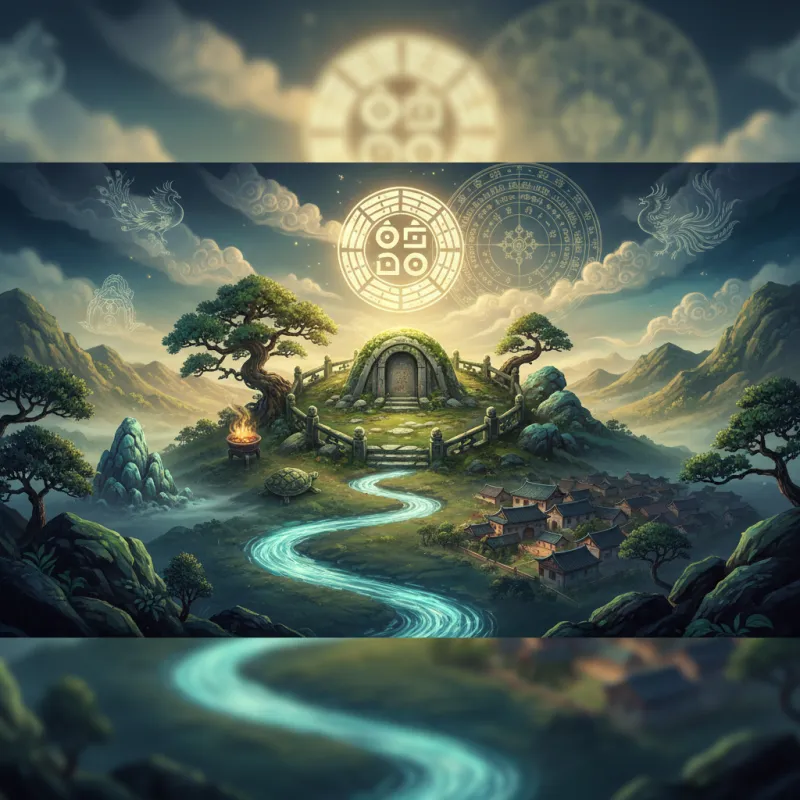
Your grandfather dies. The family gathers, grief-stricken, to make funeral arrangements. But in traditional Chinese culture, there's another concern weighing on everyone's mind: where exactly will you bury him? Choose the wrong spot, and your children might struggle financially for generations. Choose correctly, and your family line could produce scholars, officials, and wealthy merchants. This isn't superstition to believers—it's ancestral responsibility.
The Bones That Never Stop Working
Burial feng shui (阴宅风水, yīnzhái fēngshuǐ—literally "yin dwelling feng shui") operates on a premise that modern rationalism finds absurd: your ancestor's skeleton continues to function as a spiritual antenna after death. The bones don't just decay—they receive, process, and transmit qi (气, qì) to living descendants through what practitioners describe as a bloodline resonance.
Think of it as a biological radio connection. The grave site acts as the receiver, picking up environmental qi from mountains, water, and earth formations. The ancestor's remains serve as the transmitter, broadcasting this energy to anyone who shares their DNA. Good location, good transmission. Bad location, and you're essentially cursing your own children.
This explains why wealthy Chinese families historically spent fortunes on grave site selection, sometimes hiring multiple feng shui masters and waiting years to find the perfect spot. The Qing Dynasty (1644-1912) saw entire family fortunes rise and fall based on burial decisions. When a family suddenly produced a string of successful imperial examination candidates, neighbors would whisper about their ancestral graves. When a once-prosperous clan fell into poverty, people blamed poor burial feng shui.
What Makes a Site Powerful
Form School feng shui (峦头派, luántóu pài) provides the clearest criteria for burial sites. The ideal location sits in what's called the "armchair position"—a spot cradled by mountains on three sides, with a gentle slope facing water. The mountain behind (靠山, kàoshān) provides support and protection. The mountains to the left and right (青龙白虎, qīnglóng báihǔ—Azure Dragon and White Tiger) embrace the site like arms. The water in front (明堂, míngtáng—bright hall) collects and holds beneficial qi.
But here's where it gets specific: the mountain behind should be taller than the side mountains, creating a natural throne. The water should meander gently, not rush straight—fast-moving water drains qi away. The slope should be gradual enough that qi accumulates but not so flat that it stagnates. The soil should be firm but not rocky, moist but not waterlogged.
Master Yang Yunsong (杨筠松, Yáng Yúnsōng), the Tang Dynasty feng shui expert who wrote the foundational texts, emphasized that the "dragon vein" (龙脉, lóngmài)—the flow of qi through mountain ridges—must terminate at the burial site. You're not just looking for a pretty hillside. You're looking for the exact point where cosmic energy pools and concentrates, like finding the eye of a hurricane.
The Compass School Adds Complexity
While Form School focuses on landscape, Compass School feng shui (理气派, lǐqì pài) introduces temporal calculations that make burial site selection exponentially more complex. The grave's orientation must align with the deceased's birth data—their bazi (八字, bāzì) or "eight characters" derived from birth year, month, day, and hour.
A grave facing the wrong direction can block beneficial qi or, worse, channel harmful energy. The 24 Mountains system divides the compass into 24 directions, each with different qualities. Some directions bring wealth, others produce scholars, still others generate military leaders. The feng shui master must calculate which direction harmonizes with both the deceased's bazi and the family's needs.
Then there's timing. The burial date itself matters enormously. Certain days in the Chinese almanac are considered auspicious for burial, others catastrophic. Some practitioners insist the burial must occur during specific hours to maximize qi transmission. I've read accounts of families keeping a body unburied for weeks, waiting for the cosmically correct moment.
This is why traditional Chinese funerals sometimes involve temporary burials. The family buries the deceased quickly to fulfill social obligations, then exhumes and reinters the bones years later once they've found the perfect site and calculated the optimal timing. It sounds macabre, but from the feng shui perspective, you're giving your ancestor—and your descendants—the best possible chance.
Historical Evidence and Family Legends
Every region in China has stories about burial feng shui proving itself. The most famous involves the Ming Dynasty founder Zhu Yuanzhang (朱元璋, Zhū Yuánzhāng). Legend says his family was desperately poor, and when his father died, they couldn't afford a proper burial. They carried the body to a hillside, but a sudden storm made the ground too muddy to dig. Exhausted, they left the body temporarily and returned the next day to find a landslide had naturally buried it—in what feng shui masters later identified as an extraordinarily powerful dragon vein terminus. Zhu Yuanzhang went on to overthrow the Mongol Yuan Dynasty and establish the Ming.
Skeptics dismiss this as retroactive mythology—of course people invent auspicious burial stories about successful emperors. But the pattern repeats across Chinese history. The Qing imperial tombs (清东陵, Qīng Dōng Líng) took decades to site and construct, with multiple feng shui masters verifying the locations. The Forbidden City's orientation and the tomb locations were considered inseparable from Qing legitimacy.
More interesting are the negative examples. Families that relocated ancestral graves and subsequently experienced disasters. Clans that ignored feng shui advice and watched their fortunes decline within a generation. These stories persist because they're harder to fabricate—nobody wants to advertise their family's bad luck.
Modern Practice and Skepticism
Contemporary burial feng shui exists in a strange space. In mainland China, the Communist government officially rejects it as feudal superstition, yet wealthy families still quietly hire feng shui masters for burial site selection. In Taiwan, Hong Kong, and overseas Chinese communities, the practice continues openly. Singapore's Chinese cemeteries show clear feng shui principles in their layout.
The practice has adapted to modern constraints. Urban cemeteries with fixed plots force practitioners to focus more on burial timing and grave orientation than ideal landscape features. Columbarium niches for cremated remains present new challenges—how do you apply mountain-and-water principles to a wall of small compartments? Some masters have developed modified systems; others insist cremation fundamentally breaks the qi transmission mechanism.
Scientific skepticism is obvious and justified. There's no measurable mechanism for bones to transmit energy to living relatives. Correlation between grave location and family fortune can be explained by wealth (rich families can afford better burial sites and also provide better opportunities for children), confirmation bias, and selective memory.
Yet the practice's persistence suggests something deeper than simple superstition. Perhaps it's about maintaining family connection across death, giving descendants a sense of ongoing relationship with ancestors. Perhaps it's about forcing families to think long-term, to consider how their decisions affect future generations. The feng shui framework might be metaphorical rather than literal—a way of encoding values about family, continuity, and responsibility.
The Practical Reality
If you're considering burial feng shui for a family member, here's the practical situation: finding a genuinely skilled practitioner is difficult. The field attracts charlatans who memorize a few principles and charge enormous fees. Authentic masters who've studied the classical texts and apprenticed for years are rare, especially outside Chinese-speaking regions.
The costs can be substantial. Not just the master's fees, but potentially the land itself—sites with good feng shui characteristics command premium prices in areas where private burial land is available. Then there's the possibility of needing to relocate graves later if family fortunes decline, which some practitioners recommend.
There's also family conflict. Different feng shui masters often give contradictory advice. Siblings may disagree about whether to follow feng shui principles at all. Modern family members educated in Western science may resist what they see as expensive superstition, while traditional family members insist on proper practice.
For those interested in exploring further, understanding Yin House Feng Shui Principles provides essential foundation, while examining Feng Shui and Ancestor Worship reveals the broader cultural context.
The Unanswerable Question
Does burial feng shui actually work? That's the wrong question. The better question is: what does it mean for something to "work" in this context? If a family believes their ancestor's grave location affects their fortune, that belief itself shapes behavior. They might work harder, take calculated risks, or maintain stronger family bonds—all of which genuinely affect outcomes.
The feng shui framework provides a language for discussing family legacy, environmental harmony, and intergenerational responsibility. Whether the mechanism is literal qi transmission or psychological motivation, the effects on family behavior are real. Your grandfather's bones might not literally broadcast energy, but the care you take in honoring him—including burial site selection—reflects and reinforces family values that do transmit across generations.
That's perhaps the deepest truth of burial feng shui: it forces the living to think carefully about death, ancestry, and legacy. In a culture that often avoids discussing mortality, it provides a structured way to engage with these fundamental human concerns. Whether the qi is real or metaphorical, the attention and intention certainly are.
Related Reading
- Famous Tombs and Their Feng Shui
- Burial Feng Shui: The Ancient Art of Grave Placement
- How to Choose a Burial Site
- Burial Feng Shui vs Modern Cremation
- Jade in Chinese Culture: More Than a Pretty Stone
- Harnessing the Power of Flying Stars in Feng Shui and I Ching
- Unlocking the Ancient Arts: Feng Shui, I Ching, and the Mysteries of Chinese Metaphysics
Explore Chinese Culture
- Explore Daoist philosophy and practice
- Explore traditional Chinese customs
- Explore ancient Chinese cosmology