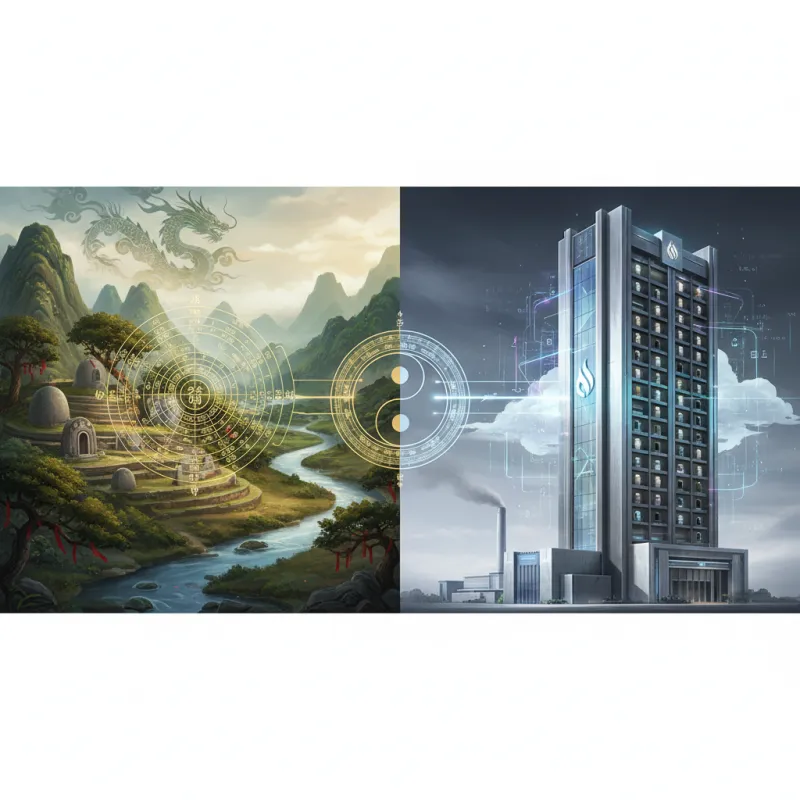
Your grandmother's bones are supposed to be gathering qi from the earth right now. Instead, they're in an urn on a shelf in a columbarium, reduced to ash by a 1,800-degree furnace. Does this mean your family's feng shui protection just went up in smoke?
This question haunts millions of Chinese families caught between ancient practice and modern policy. Since the 1990s, cremation has been mandatory in most Chinese cities—a direct collision with 阴宅风水 (Yīn Zhái Fēng Shuǐ), or burial feng shui, which explicitly requires intact bones to channel earth energy to descendants. The government says it's about land conservation. Traditional practitioners say it's severing the energetic lifeline between ancestors and living family members.
The stakes are real. In 2014, authorities in Jiangxi province dug up thousands of graves to enforce cremation policies, sparking protests and even suicides among elderly villagers who'd spent their savings on burial plots. One 79-year-old woman drank pesticide rather than see her pre-purchased grave site destroyed. These aren't just sentimental attachments—these are people who believe their children's prosperity depends on proper burial.
The Bone Theory: Why Traditional Feng Shui Requires Burial
Classical feng shui texts are unambiguous about this. The 葬书 (Zàng Shū), or "Book of Burial," attributed to Guo Pu during the Jin Dynasty (276-324 CE), states: "气乘风则散,界水则止" (qì chéng fēng zé sàn, jiè shuǐ zé zhǐ)—"Qi disperses when riding wind, stops when encountering water." The entire premise is that bones act as receivers for earth qi, which then transmits to descendants through blood connection.
This isn't metaphorical. Traditional practitioners believe the skeletal structure—particularly the skull and major bones—maintains a resonance with living descendants. The bones must remain intact and positioned correctly within earth that has good qi flow. The location and orientation of the grave determines what type of qi the bones collect: wealth qi, health qi, career qi, or descendant qi.
When you cremate a body, you're not just changing the form—you're destroying the receiver. Bone becomes calcium oxide and phosphate salts. The crystalline structure that supposedly holds energetic patterns is obliterated. From a traditional perspective, this is like smashing your radio and expecting it to still pick up broadcasts.
Master Yang Yunsong, the legendary Tang Dynasty feng shui master whose texts still guide practitioners today, never addressed cremation because it simply wasn't practiced in his cultural context. His 撼龙经 (Hàn Lóng Jīng), or "Shaking Dragon Classic," assumes you're working with buried bones in earth. The entire diagnostic system—reading dragon veins, finding the qi pocket, positioning the coffin—becomes theoretically meaningless if there's no intact skeleton to receive the energy.
The Cremation Compromise: Urn Feng Shui
Faced with mandatory cremation, modern practitioners have developed workarounds. The most common is treating the urn as a miniature grave site, applying burial feng shui principles to columbarium placement or home altar positioning.
In Hong Kong and Taiwan, where cremation is common but not mandatory, expensive columbarium niches are marketed using feng shui principles. A south-facing niche on a higher floor costs significantly more than a north-facing ground-level spot. Families pay feng shui consultants to select auspicious placement dates and optimal niche locations within the columbarium building.
But here's the problem: even practitioners who offer these services often privately admit they're working with a compromised system. One Hong Kong master I spoke with in 2019 put it bluntly: "It's like trying to do acupuncture through thick clothing. You might get some effect, but it's not the same as direct contact with the meridians."
The theoretical justification goes like this: while the bones are destroyed, the ashes still contain trace elements from the body. These ashes, if placed in a location with good qi, can still provide some benefit to descendants. It's a significant downgrade from traditional burial feng shui, but it's better than nothing.
Some practitioners recommend mixing the ashes with earth and burying them in a small plot, essentially creating a miniature grave. This is illegal in many Chinese cities but happens anyway. Others suggest keeping a small amount of ash in a jade container at home, positioned according to the deceased's favorable directions based on their 八字 (Bā Zì), or birth chart.
What the Classics Actually Say (and Don't Say)
Here's where it gets interesting: while modern practitioners claim cremation destroys feng shui benefits, the classical texts never actually explain why bones are necessary. They assume it, but they don't theorize the mechanism.
The 葬书 talks about qi gathering and dispersing, about water and wind, about mountain formations and dragon veins. It describes how to identify good burial sites and how to position the coffin. But it never says "the calcium phosphate crystalline structure of bones resonates with earth magnetic fields" or provides any mechanism for how bones specifically interact with qi.
This matters because it leaves room for interpretation. If the classical masters didn't explain the mechanism, maybe the mechanism isn't what we think it is. Maybe the bones aren't receivers but markers. Maybe the important thing is the location and the ritual intention, not the physical form of the remains.
Some contemporary scholars argue that burial feng shui is fundamentally about the living, not the dead. The elaborate site selection, the expensive grave construction, the ongoing maintenance—these create a psychological and social framework that binds families together and maintains ancestral reverence. From this perspective, cremation doesn't destroy the feng shui; it just requires adapting the ritual framework.
But try telling that to a traditional practitioner who's spent decades studying dragon vein formations and qi pockets. They'll point out that if location and intention were enough, you could just bury an empty coffin or a photograph. The fact that classical texts insist on proper burial of the actual body suggests the physical remains matter.
The Government's Position: Superstition vs. Land Use
The Chinese government's official stance is that burial feng shui is feudal superstition with no scientific basis. The push for cremation is framed entirely in practical terms: China has limited arable land, a large population, and can't afford to dedicate vast areas to graveyards.
The numbers support this. Traditional Chinese graves, especially those following feng shui principles, take up significant space. A proper burial site might occupy 10-20 square meters, and wealthy families historically claimed entire hillsides. With 10 million deaths annually in China, traditional burial would consume roughly 100-200 square kilometers of land each year.
Cremation reduces the space requirement dramatically. A columbarium niche might be 0.5 square meters, and a single building can house tens of thousands of urns. From an urban planning perspective, cremation makes perfect sense.
But the government's approach has been heavy-handed. The 1997 "Regulations on Funeral and Interment Management" gave local authorities broad powers to enforce cremation, leading to grave destruction campaigns that traumatized rural communities. In 2018, Jiangxi province officials forcibly exhumed and cremated bodies from existing graves, claiming they were implementing central government policy.
These campaigns backfire. They reinforce the perception that the government is attacking traditional culture, and they drive burial practices underground. Wealthy families pay bribes to secure illegal burial plots. Rural families bury loved ones secretly in remote locations. The black market for burial land thrives.
Regional Variations: Where Burial Still Happens
Cremation isn't universal in China. Rural areas, especially in provinces like Yunnan, Guizhou, and parts of Guangdong, still practice traditional burial. The government allows exceptions for ethnic minorities and in regions where cremation facilities don't exist.
This creates a class divide. Urban, educated Chinese must cremate. Rural, traditional Chinese can still bury. Wealthy Chinese can sometimes buy their way into burial through connections or by purchasing land in rural areas where enforcement is lax.
Hong Kong and Taiwan present interesting contrasts. Hong Kong has limited land and high cremation rates (around 90%), but burial remains legal for those who can afford it. A burial plot in Hong Kong can cost over HK$300,000 (US$38,000), making it a luxury good. Taiwan has a cremation rate around 95%, driven more by land scarcity and cost than government mandate.
Overseas Chinese communities generally maintain burial practices where land permits. In Malaysia, Singapore, and parts of Southeast Asia, Chinese cemeteries still operate according to feng shui principles. These communities see themselves as preserving authentic traditions that mainland China has abandoned.
The Practical Reality: What Families Actually Do
Most Chinese families today navigate a middle path. They comply with cremation requirements but try to maintain some feng shui considerations. Common practices include:
Timing the cremation: Choosing an auspicious date based on the deceased's birth chart and the Chinese almanac. Even if the body must be cremated, families want the cremation to happen at a favorable time.
Columbarium feng shui: Selecting niche placement based on direction, floor level, and surrounding features. South-facing niches with "mountain" (higher floors) behind and "water" (open space) in front are preferred.
Ash burial: Where possible, burying the urn in a small plot and treating it like a miniature grave. This is technically illegal in many cities but widely practiced.
Split remains: Keeping some ashes at home in a favorable location while placing the rest in a columbarium. This hedges bets—if urn feng shui works, you get benefits from both locations.
Delayed cremation: In some cases, families temporarily bury the body, wait several years for the flesh to decompose, then exhume the bones for cremation. This allows some period of traditional burial feng shui before complying with cremation requirements.
The last practice is particularly interesting because it suggests families believe even temporary burial provides some benefit. If the bones interact with earth qi for a few years, perhaps that's better than immediate cremation.
Does It Actually Matter? The Uncomfortable Question
Here's what nobody wants to say out loud: there's no way to test whether burial feng shui actually works, so there's no way to test whether cremation destroys it.
Traditional practitioners point to family success stories—the businessman whose fortunes improved after relocating his grandfather's grave, the student who passed exams after her family fixed their ancestral burial site. But these are anecdotes, not evidence. Successful families might have good burial feng shui, or they might have good business sense, strong work ethics, and favorable economic conditions.
The belief in burial feng shui is unfalsifiable. If your family prospers, the burial site gets credit. If your family struggles, the explanation is that the feng shui needs adjustment, or that other factors are interfering, or that the benefits will come in the next generation. There's always a reason why the theory still holds.
Cremation creates an interesting test case. If families who cremate experience no difference in fortune compared to families who bury, that suggests burial feng shui might be psychological rather than energetic. But measuring this is nearly impossible—too many variables, too much cultural bias, too long a timeframe.
What we can say is that the belief itself has power. Families who feel they've properly honored their ancestors experience less guilt and anxiety. Families who believe their burial site is auspicious feel more confident and optimistic. These psychological effects are real, even if the energetic mechanism is questionable.
The Future: Adaptation or Extinction?
Burial feng shui is adapting, not dying. As cremation becomes universal in China, practitioners are developing new theories and methods. Some claim that DNA in the ashes maintains the energetic connection. Others focus on the burial site's location rather than the form of the remains, arguing that placing an urn in a good feng shui location still provides benefits.
Technology is entering the picture. Some Chinese companies now offer "virtual graves" with online feng shui consultations. Others are developing biodegradable urns designed to be buried and allow ashes to mix with earth over time, creating a hybrid between cremation and burial.
The most interesting development is the reframing of burial feng shui as cultural heritage rather than superstition. UNESCO's recognition of feng shui as intangible cultural heritage has given the practice new legitimacy. Scholars now study it as traditional ecological knowledge and spatial planning wisdom, separating the cultural practice from supernatural claims.
This academic legitimization might be burial feng shui's survival strategy. If it's cultural heritage, it deserves preservation even if the government considers it superstitious. If it's traditional knowledge, it can be studied and adapted rather than suppressed.
But this comes at a cost. Burial feng shui as cultural heritage is different from burial feng shui as living practice. It becomes something to preserve in museums and textbooks rather than something that guides actual burial decisions. The practice becomes performance, tradition becomes tourism.
For families caught between mandatory cremation and ancestral obligations, the question remains urgent and personal. Your grandmother's ashes sit in that columbarium niche. You chose the location carefully, consulted the almanac, followed what feng shui principles you could. Is it enough? Will your children still receive her blessings? Or did the government's cremation policy sever something that can't be restored?
The honest answer is that nobody knows. The practitioners who claim certainty are selling something. The government officials who dismiss it all as superstition are ignoring something. The truth is probably somewhere in between—burial feng shui matters because people believe it matters, and that belief shapes behavior, family cohesion, and cultural identity in ways that are real regardless of whether the qi theory is literally true.
What's certain is that this tension between tradition and modernity, between ancestral obligation and state policy, between ancient practice and contemporary reality, will continue to shape how Chinese families honor their dead for generations to come.
Related Reading
- Burial Feng Shui Explained: Ancestral Graves and Family Fortune
- How to Choose a Burial Site
- Burial Feng Shui: The Ancient Art of Grave Placement
- Famous Tombs and Their Feng Shui
- Unlocking the Secrets of Feng Shui and I Ching: A Journey Through Chinese Metaphysics
- Unlocking the Wisdom of Feng Shui and I Ching: A Journey Through Chinese Metaphysics
- Feng Shui Front Door and Entryway Essentials
Explore Chinese Culture
- Explore Daoist philosophy and practice
- Explore traditional Chinese customs
- Explore ancient Chinese cosmology