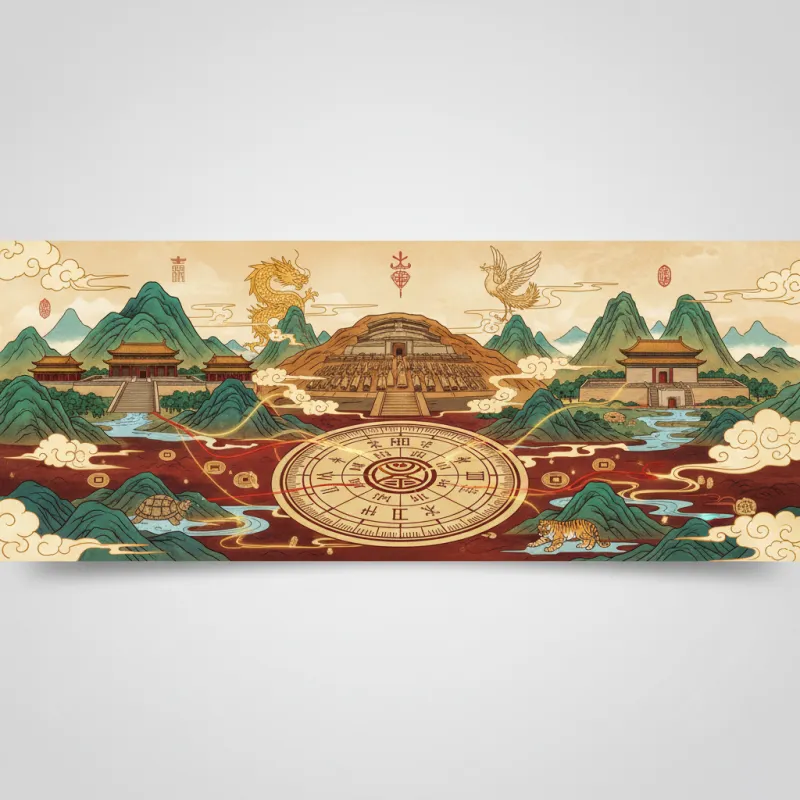
The tomb of Qin Shi Huang, China's first emperor, sits beneath a man-made mountain in Shaanxi Province. According to historical records, mercury rivers flow through the burial chamber, mimicking the Yangtze and Yellow Rivers. Crossbows were rigged to fire automatically at intruders. The ceiling was studded with pearls representing stars. And somewhere in that underground palace lies the emperor himself, surrounded by the 8,000 terracotta warriors we've excavated so far. But here's what matters for feng shui: the tomb faces east, backs against Mount Li, and commands a view of the Wei River valley. It's textbook 龙穴 (lóng xué) — dragon's lair — the most auspicious burial configuration in classical feng shui theory.
Whether you believe feng shui works or not, the fact remains: China's most powerful rulers spent fortunes and decades selecting tomb sites. They weren't being superstitious. They were being strategic. In a culture where ancestor veneration was the foundation of social order, the tomb wasn't just a grave. It was a power generator for the living lineage.
The Ming Tombs: Thirteen Emperors, One Perfect Valley
The 明十三陵 (Míng Shísān Líng) — Ming Thirteen Tombs — occupy a valley 50 kilometers north of Beijing. When the Yongle Emperor's feng shui masters surveyed the site in 1407, they found what they called a 天造地设 (tiān zào dì shè) location — "heaven-made, earth-set." The valley opens south, protected by mountains on three sides forming a natural armchair. The 靠山 (kào shān) — backing mountain — is Tianshou Mountain, solid and imposing. Two ridges extend forward like arms, creating the classic 左青龙右白虎 (zuǒ qīng lóng yòu bái hǔ) formation — Azure Dragon on the left, White Tiger on the right.
What makes this site exceptional isn't just the landform. It's the water. A stream enters from the northwest, curves through the valley in a gentle S-shape, and exits southeast. This is called 玉带环腰 (yù dài huán yāo) — jade belt around the waist — one of the most auspicious water patterns in burial feng shui. The water moves slowly, allowing 气 (qì) to accumulate rather than rush away.
Thirteen Ming emperors chose to be buried here over 230 years. The Qing Dynasty, which conquered the Ming, deliberately avoided the site. They understood that using a predecessor's auspicious ground might transfer legitimacy to the old regime's descendants.
Genghis Khan's Hidden Tomb: The Ultimate Feng Shui Mystery
Nobody knows where Genghis Khan is buried. That's not an accident — it's by design.
According to Mongol tradition, the funeral procession killed everyone they encountered to prevent the location from being revealed. The burial party itself was then executed. Some accounts say 2,000 horses trampled the site to erase all traces. Others claim a river was diverted over the grave. The Mongols understood something profound about feng shui: the most powerful tomb is the one nobody can disturb.
Modern archaeologists have theories. Some point to the Burkhan Khaldun mountain in Mongolia's Khentii Province, where Genghis supposedly hid as a young man. The mountain fits classical feng shui principles — it's the highest peak in the range, commands vast territory, and has water sources at its base. But here's the twist: by keeping the location secret, the Mongols created a tomb that exists everywhere and nowhere. Every mountain in Mongolia could be the Khan's resting place. The psychological effect on descendants was immense — the ancestor's power became omnipresent rather than localized.
This approach contradicts Chinese feng shui orthodoxy, which requires precise location and orientation. But it reveals a deeper truth: feng shui isn't just about landforms and compass directions. It's about the relationship between the living and the dead, and how that relationship shapes collective identity.
The Qing Eastern Tombs: When Feng Shui Becomes Theater
The 清东陵 (Qīng Dōng Líng) — Qing Eastern Tombs — in Hebei Province are feng shui as imperial propaganda. The site was selected in 1661 by the Shunzhi Emperor's feng shui team, and it checks every classical requirement. The 来龙 (lái lóng) — incoming dragon vein — descends from the Yanshan Mountains in a series of undulating ridges. The 明堂 (míng táng) — bright hall, the open space in front of the tomb — is vast and level. Water flows from both sides, converging in front before exiting through a narrow gap, creating the 聚水局 (jù shuǐ jú) — water-gathering formation.
But the Qing emperors didn't just follow feng shui principles. They amplified them. They built a 6-kilometer spirit way lined with stone animals and officials. They constructed elaborate gate towers and sacrificial halls. They carved the mountains themselves, creating artificial peaks and valleys to "improve" the natural landform. The message was clear: we command not just the empire, but the earth itself.
The irony? The Qing Dynasty fell in 1912, just 251 years after the first tomb was built. Compare that to the Ming Dynasty's 276 years, or the Han Dynasty's 400 years. Did the feng shui fail? Or did the theatrical excess — the attempt to force auspiciousness through sheer architectural will — violate the fundamental feng shui principle of 顺应自然 (shùn yìng zì rán) — according with nature?
Mao's Mausoleum: The Anti-Feng Shui Statement
Mao Zedong's mausoleum sits in the center of Tiananmen Square, directly on the north-south axis of Beijing. From a feng shui perspective, this is catastrophic. The location violates nearly every principle of proper burial site selection.
There's no 靠山 (kào shān) — backing mountain. The site is flat, exposed, and surrounded by hard pavement rather than earth. There's no water flow, no protective embrace of landforms, no 藏风聚气 (cáng fēng jù qì) — hiding wind and gathering qi. The body isn't even buried in the ground — it's displayed in a crystal coffin, preserved with chemicals, exposed to artificial light and the gaze of millions of visitors.
This wasn't ignorance. It was deliberate rejection. Mao spent his life fighting "feudal superstition," and his mausoleum's placement was a final statement: the Communist Party answers to the people, not to heaven or earth. The feng shui establishment would say this explains China's turbulent decades after Mao's death. The Communist Party would say it proves feng shui is nonsense — China became a superpower anyway.
Both interpretations miss the point. The mausoleum's power comes precisely from its violation of tradition. It's a monument to rupture, to the possibility of building a new world on the ruins of the old. Whether that's good or bad feng shui depends on what you think feng shui is for.
The Terracotta Army: Feng Shui as Cosmic Blueprint
Let's return to Qin Shi Huang's tomb, because the terracotta warriors reveal something crucial about feng shui thinking. The army isn't randomly arranged. It's positioned east of the tomb mound, facing east — the direction of sunrise, renewal, and the 青龙 (qīng lóng) Azure Dragon. The warriors are organized in battle formation, but they're also organized according to the 五行 (wǔ xíng) — Five Elements system.
Infantry represents 土 (tǔ) — earth, the center, stability. Cavalry represents 火 (huǒ) — fire, movement, aggression. Chariots represent 金 (jīn) — metal, cutting force, authority. The arrangement creates a microcosm of the universe, with the emperor at the center commanding not just an army but the fundamental forces of nature.
This is feng shui at its most ambitious — not just selecting a good location, but constructing an entire cosmological system in physical form. The tomb wasn't meant to be a passive resting place. It was meant to be an active power center, continuously generating 旺气 (wàng qì) — prosperous qi — for the emperor's lineage.
Did it work? The Qin Dynasty collapsed 15 years after the emperor's death. But the tomb itself has lasted 2,200 years, and we're still talking about it. Maybe that's the real feng shui success — not political longevity, but cultural immortality.
What Famous Tombs Teach Us About Feng Shui
Every famous tomb tells two stories. The official story is about landforms, water flow, and compass directions. The unofficial story is about power, legitimacy, and the relationship between the living and the dead.
The Ming emperors chose their valley because it had perfect feng shui. But they also chose it because it was far from Beijing's political center, creating a sacred space separate from daily governance. Genghis Khan's hidden tomb worked because secrecy itself became a form of power. The Qing tombs succeeded as propaganda even if they failed as feng shui. Mao's mausoleum derives its significance from violating every rule.
Here's what this means for understanding feng shui: the landforms matter, but they're not the whole story. A tomb's feng shui is inseparable from its cultural context, its political meaning, and the stories people tell about it. The 气 (qì) that flows through a burial site isn't just environmental energy. It's the accumulated weight of history, memory, and collective belief.
The best feng shui masters understood this. They weren't just reading landforms. They were reading culture. They knew that a tomb's power came not just from its location, but from its ability to anchor a lineage's identity and aspirations. That's why tomb selection could take decades — they weren't just finding good land, they were finding land that could carry the weight of a dynasty's dreams.
The Modern Question: Do These Tombs Still Work?
Walk through the Ming Tombs today and you'll see Chinese families burning incense, not to the emperors, but to the general concept of ancestors. The specific lineage connection is gone, but the ritual remains. Does the feng shui still function?
According to classical theory, feng shui benefits flow through blood lineage. When a family line ends, the tomb's power dissipates. But there's another interpretation: these tombs have become part of China's collective ancestral landscape. They generate 文化气场 (wén huà qì chǎng) — cultural qi field — that affects everyone who visits, regardless of bloodline.
This might sound like mystical nonsense, but consider the practical effects. Millions of Chinese people visit these tombs and absorb, consciously or not, lessons about power, mortality, and the relationship between humans and landscape. They see that their ancestors took feng shui seriously enough to spend decades selecting burial sites. That shapes how they think about space, place, and the invisible forces that connect past and future.
Whether you call that feng shui or cultural transmission doesn't matter. The effect is real. These tombs continue to teach, to inspire, and to anchor Chinese identity in physical landscape. That might be the ultimate feng shui success — not blessing a specific lineage, but blessing an entire civilization's relationship with the earth.
Related Reading
- Burial Feng Shui Explained: Ancestral Graves and Family Fortune
- Burial Feng Shui vs Modern Cremation
- How to Choose a Burial Site
- Color Theory in Feng Shui: Why Red Means Luck and White Means Death
- Unlocking the Secrets of Feng Shui and I Ching: A Journey Through Chinese Metaphysics
- Exploring Feng Shui, I Ching, and Chinese Metaphysics in Bazi Practice
Explore Chinese Culture
- Explore Daoist philosophy and practice
- Explore traditional Chinese customs
- Explore ancient Chinese cosmology