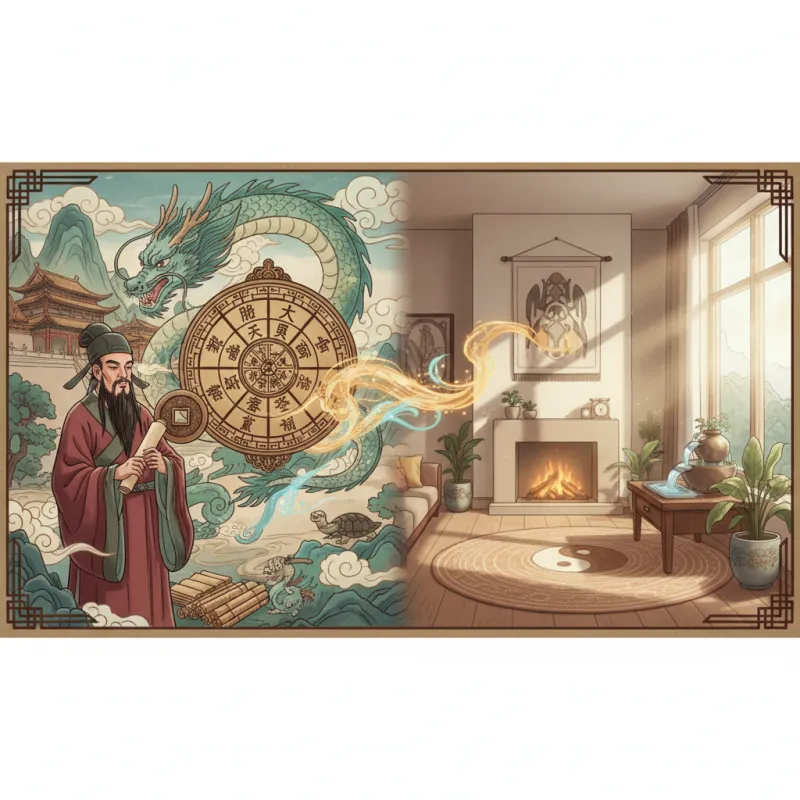
Picture this: It's 4,000 years ago in the Yellow River valley, and a grieving family stands on a windswept hillside, trying to decide where to bury their patriarch. They're not just picking a pretty spot—they're choosing the exact location that will determine whether their children prosper or starve, whether their grandchildren rise to power or fade into obscurity. This is where feng shui was born, and it had nothing to do with your bedroom mirror placement.
It Started with the Dead
The practice we now call feng shui (风水 fēngshuǐ, literally "wind-water") didn't begin with living rooms and desk placement. It began with graves. The earliest form of feng shui was yin house feng shui (阴宅风水 yīnzhái fēngshuǐ)—the art of finding the perfect burial site so the deceased ancestor's bones would rest in a location where earth qi (气 qì) was most concentrated, thereby blessing the living descendants with prosperity, health, and good fortune.
This might sound strange to modern ears, but the logic is internally consistent: if qi flows through the earth along dragon veins (龙脉 lóngmài), and if your ancestor's remains sit at a point where that qi is strong, then the energetic connection between ancestor and descendant channels that beneficial energy forward through the bloodline. The stakes were enormous. A well-placed grave could elevate an entire clan to imperial status. A poorly chosen site could doom generations to poverty and misfortune.
The archaeological evidence backs this up. Neolithic burial sites from the Yangshao culture (5000-3000 BCE) show deliberate orientation and placement considerations. By the Shang Dynasty (1600-1046 BCE), oracle bone inscriptions reveal that diviners were already consulting about auspicious locations for tombs. This wasn't superstition—it was the cutting edge of environmental science, ancestor veneration, and political strategy rolled into one.
The Compass That Changed Everything
Fast forward to the Han Dynasty (206 BCE - 220 CE), and feng shui practitioners got their game-changing tool: the luopan (罗盘 luópán), or feng shui compass. But calling it a "compass" undersells what this instrument actually does. The luopan is a cosmological calculator, a device that maps the relationship between magnetic directions, temporal cycles, and cosmic forces onto physical space.
The earliest compasses weren't used for navigation—they were used for feng shui. The Chinese discovered magnetic north around the 4th century BCE, but they used this knowledge first to align buildings and graves with cosmic forces, not to find their way across the ocean. The luopan typically contains anywhere from 7 to 40 concentric rings, each encoding different layers of information: the eight trigrams (八卦 bāguà) from the I Ching, the 24 mountains (二十四山 èrshísì shān), the 28 lunar mansions, the five elements (五行 wǔxíng), and much more.
This wasn't just mysticism—it was an attempt to create a unified field theory of how heaven, earth, and humanity interact. The luopan encoded centuries of astronomical observation, geographical knowledge, and philosophical insight into a single handheld device. A skilled feng shui master could look at a landscape, take compass readings, and tell you not just whether a site was auspicious, but why, and for whom, and when.
Two Schools, One Art
By the Tang Dynasty (618-907 CE), feng shui had split into two major schools, each with its own methodology and emphasis. The Form School (峦头派 luántóu pài) focused on the physical landscape—the shape of mountains, the flow of water, the contours of the land. Form School masters were essentially geomancers who could "read" the earth like a text, identifying where dragon veins converged, where qi accumulated, where protective formations like the four celestial animals (四灵 sì líng) naturally occurred.
The Compass School (理气派 lǐqì pài), by contrast, emphasized temporal and directional factors. They used the luopan extensively, calculating how the invisible forces of qi moved through time and space according to mathematical formulas derived from the I Ching and other classical texts. Where the Form School asked "What does this landscape look like?", the Compass School asked "What cosmic forces are active here, and when?"
Here's what's fascinating: both schools were right, and serious practitioners eventually learned to integrate both approaches. The best feng shui analysis considers both the visible topography and the invisible temporal-directional factors. It's like the difference between looking at a photograph and watching a video—one captures the spatial dimension, the other adds the temporal dimension.
The Song Dynasty (960-1279 CE) saw an explosion of feng shui texts attempting to systematize and reconcile these approaches. Wang Ji's "Discourse on Siting" and Lai Wenjun's writings became foundational texts that practitioners still study today. This was feng shui's golden age of theory-building, when the practice evolved from folk tradition into a sophisticated technical discipline with its own literature, terminology, and professional standards.
When Emperors Consulted the Compass
Feng shui wasn't just for peasants worried about their ancestors' graves. Imperial courts took it deadly seriously. The Forbidden City in Beijing, constructed during the Ming Dynasty (1368-1644 CE), is essentially a massive feng shui diagram rendered in wood, stone, and tile. Every gate, every hall, every garden was positioned according to feng shui principles. The entire complex sits on a north-south axis, backed by the protective "mountain" of Jingshan Hill (artificially constructed for this purpose), facing south to receive yang energy, with water features positioned to capture and circulate qi.
The Ming Tombs, where 13 Ming emperors are buried, represent perhaps the most elaborate application of yin house feng shui in history. The site selection took years. Feng shui masters surveyed the mountains north of Beijing, looking for the perfect convergence of dragon veins. When they found it—a valley surrounded by mountains in a horseshoe formation, with a river flowing through—they knew they'd discovered an imperial burial ground. The main tomb, Changling, sits at the precise point where multiple dragon veins converge, ensuring maximum qi concentration for the emperor's remains.
But feng shui could also be weaponized. There are historical accounts of rival clans hiring feng shui masters to identify and sabotage each other's ancestral graves. If you could disrupt the qi flow to your enemy's burial site—by digging a well in the wrong place, or redirecting a stream—you could theoretically undermine their family's fortune. Whether this actually worked is beside the point; people believed it worked, which made feng shui a tool of political intrigue.
The Journey West
Feng shui remained largely unknown in the West until the 19th century, when European colonizers and missionaries encountered it in China and Southeast Asia. Their reactions ranged from dismissive mockery to genuine fascination. Some Western observers recognized feng shui as a sophisticated system of environmental design; others saw it as primitive superstition holding China back from modernization.
The term "feng shui" itself didn't enter English until the 1850s, when it appeared in missionary accounts and travel writings. But these early Western descriptions were often wildly inaccurate, filtered through cultural misunderstanding and colonial condescension. Feng shui was reduced to quirky Chinese beliefs about "lucky directions" and "bad spirits," stripped of its philosophical depth and practical applications.
The real Western feng shui boom didn't happen until the 1970s and 1980s, when New Age spirituality and Asian cultural influences converged in places like California. This is where things get complicated. Western feng shui often bears only a passing resemblance to classical Chinese practice. The five elements got simplified, the luopan got abandoned, and feng shui morphed into a kind of interior decorating philosophy focused on decluttering, color schemes, and crystal placement.
I'm not saying Western feng shui is worthless—many people find it helpful for creating harmonious living spaces. But it's important to understand that what most Westerners call "feng shui" is actually a modern hybrid, a creative reinterpretation that borrows some classical concepts while discarding others and adding new elements that would baffle a traditional Chinese master. The bagua map overlaid on floor plans, for instance, is a 20th-century innovation that has no precedent in classical texts.
What Got Lost, What Survived
Classical feng shui was inseparable from a broader worldview that included ancestor veneration, the I Ching, Chinese astrology (bazi 八字), and a cosmology where heaven, earth, and humanity formed an interconnected triad. You can't really practice traditional feng shui without understanding this larger context. The luopan readings don't make sense without knowledge of the stems and branches (天干地支 tiāngān dìzhī), the five elements, and the 64 hexagrams.
Modern practice, especially in the West, has largely severed these connections. Feng shui became portable, something you could apply without believing in qi or dragon veins or ancestral spirits. This made it more accessible but also more shallow. The depth of analysis possible with classical methods—where a master might spend days calculating the temporal factors affecting a site—got replaced with quick consultations focused on furniture arrangement.
Yet something essential did survive the translation: the core insight that our physical environment affects our wellbeing in ways both obvious and subtle. Whether you believe in qi or not, the idea that the layout of your space, the flow of movement through it, the quality of light and air, the symbolic resonance of objects—that all of this matters—remains valid. Classical feng shui masters understood this 2,000 years ago. We're still catching up.
From Burial Grounds to Living Rooms
So how did we get from choosing burial sites in ancient China to rearranging furniture in modern apartments? The shift from yin house to yang house feng shui (阳宅风水 yángzhái fēngshuǐ)—feng shui for the living—happened gradually over centuries. As feng shui principles proved their worth in siting graves, people naturally wondered: if this works for the dead, why not apply it to the living?
By the Tang Dynasty, yang house feng shui had become a distinct specialty. The principles were similar but the applications different. Instead of finding the perfect mountain valley for a tomb, you were finding the best location and orientation for a house, shop, or palace. Instead of ensuring qi flowed to ancestral bones, you were ensuring it flowed through living spaces to benefit the occupants.
The fundamental concepts remained: identify the dragon veins, find where qi accumulates, position the building to capture beneficial flows while deflecting harmful ones, balance yin and yang, harmonize with the five elements. But yang house feng shui added new considerations: how people move through space, where they sleep and work, how rooms relate to each other, how to optimize for specific activities and life goals.
This is the feng shui that eventually made its way West and evolved into the practice most people know today. The journey from ancient burial grounds to your living room took 4,000 years and crossed continents, picking up new interpretations and shedding old ones along the way. What remains is a practice that's simultaneously ancient and modern, Chinese and global, mystical and practical—a testament to the enduring human desire to live in harmony with the forces, visible and invisible, that shape our world.
Related Reading
- What Is Feng Shui? A Complete Beginner's Guide
- Chi Energy Flow: How to Keep It Moving
- Feng Shui Colors: What Every Color Means and Where to Use It
- Your Feng Shui Is Probably Wrong: Common Mistakes Westerners Make
- Yin and Yang Balance in Home Design
- Chinese Meditation: A Guide to Daoist and Buddhist Practices
- Unlocking the Ancient Arts: Feng Shui, I Ching, and the Mysteries of Chinese Metaphysics
- Harnessing the Power of Flying Stars in Feng Shui and I Ching
Explore Chinese Culture
- Explore Daoist philosophy and practice
- Explore traditional Chinese customs
- Explore ancient Chinese cosmology