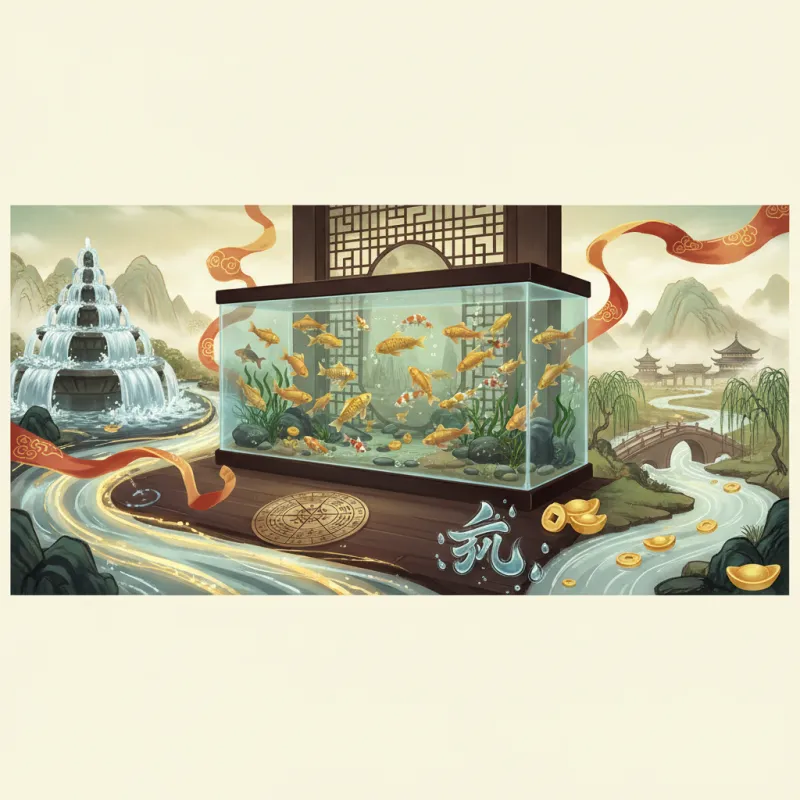
Picture a Ming dynasty merchant standing at his shop entrance at dawn, watching the canal water lap gently against his doorstep. He's not admiring the view — he's checking the water level, the direction of flow, the way morning light catches the ripples. His fortune depends on it. In feng shui, water (水, shuǐ) isn't just a symbol of wealth. It is wealth, flowing in liquid form through your space, and every ripple, every drop, every direction matters.
Why Water Carries Wealth
The connection between water and money runs deeper than metaphor. In classical feng shui texts like the Qing Nang Jing (青囊經, Qīng Náng Jīng, "Classic of the Azure Bag"), water is described as the blood of the earth, carrying qi (氣, qì) — life force — through the landscape. Where water pools, qi accumulates. Where qi accumulates, prosperity follows.
This isn't mystical thinking. It's observation. Ancient Chinese cities grew along rivers because water meant trade, agriculture, irrigation, transportation. The wealthiest neighborhoods in Beijing, Suzhou, and Guangzhou have always hugged waterways. Even today, Hong Kong's most expensive properties overlook Victoria Harbour. The feng shui principle simply codified what everyone already knew: water brings opportunity, and opportunity brings wealth.
But here's where it gets specific. Not all water brings wealth. Stagnant water breeds disease. Fast-rushing water erodes foundations. The wrong placement can drain your finances faster than a stock market crash. Understanding how to work with water — its placement, movement, and quality — separates amateur feng shui from the real thing.
The Three Forms of Wealth Water
Traditional feng shui recognizes three primary ways to introduce water for wealth: natural water features, fountains, and aquariums. Each has distinct properties and rules.
Natural water — rivers, lakes, ponds — carries the strongest qi because it's connected to the earth's natural flow. If you're lucky enough to have natural water near your property, your main job is not to screw it up. The water should approach your front door in a gentle curve, what feng shui calls "jade belt water" (玉带水, yùdài shuǐ). Think of a river that bends around your property like an embrace. Avoid "bow water" (反弓水, fǎngōng shuǐ), where the curve bends away from you like a drawn bow ready to shoot — this configuration actively repels wealth.
Fountains are the most popular modern solution because you control everything: placement, flow direction, sound, and timing. A fountain in your wealth corner (the far left corner from your entrance, based on the bagua map) activates money luck. But the water must flow toward your building's center, not toward the door where it symbolically carries wealth out. The sound matters too — gentle bubbling attracts wealth; aggressive splashing scatters it.
Aquariums combine water with living creatures, adding the element of movement and life force. The classic feng shui aquarium has nine fish: eight gold or red ones (representing prosperity) and one black one (to absorb negative energy). Place it in your living room or office where you can see it from the entrance, but never in the bedroom — water in sleeping areas disrupts rest and can lead to financial loss through poor decision-making.
The Direction of Flow
Here's where most people get it wrong. They install a beautiful fountain, fill an aquarium, and wonder why their finances don't improve. The problem? Water flowing in the wrong direction.
Water should always flow toward the center of your home or business, never toward the exit. Imagine your front door as a mouth — you want water (wealth) flowing in, not flowing out. This is why traditional Chinese shops often had water features at the back of the store, with subtle grading that directed water toward the entrance. The symbolism was clear: wealth flows in and stays.
For fountains, check the pump direction. For aquariums, position the filter output so water circulates toward the room's interior. Even the way you position a decorative water bowl matters — the open side should face inward, not toward windows or doors.
The Shui Long Jing (水龍經, Shuǐ Lóng Jīng, "Water Dragon Classic") from the Tang dynasty specifies that water approaching from the east or southeast brings the best wealth luck, as these directions align with the wood element, which water nourishes. Water from the north is acceptable — north is water's home direction. But water approaching from the south (fire direction) or west (metal direction) creates elemental conflicts that can destabilize finances.
Curves, Not Straight Lines
Fast water is dangerous water. A straight river, canal, or even a straight fountain jet creates "sha qi" (煞氣, shà qì) — attacking energy that can damage wealth instead of building it. This is why every classical Chinese garden has winding streams, not straight channels.
The principle applies to modern water features too. Choose fountains with multiple tiers where water cascades and curves. Avoid single-jet fountains that shoot straight up. For aquariums, create visual interest with plants and decorations that break up straight sight lines through the water.
There's a practical reason for this beyond symbolism. Curved water flows more slowly, allowing qi to accumulate. Straight, fast water rushes through without depositing beneficial energy. Think of a meandering river depositing rich sediment in its curves versus a flash flood that strips everything away.
Maintenance Is Non-Negotiable
Dirty water is worse than no water. A neglected fountain with algae-covered stones doesn't attract wealth — it attracts stagnation, illness, and financial problems. The same goes for cloudy aquarium water or a pond choked with dead leaves.
I've consulted for businesses that installed expensive water features and then let them deteriorate. Within months, their revenue declined. The correlation isn't mystical — it's psychological and energetic. Dirty water signals neglect, and neglect in one area spreads to others. Customers sense it. Employees feel it. The business suffers.
Clean your water features weekly. Change aquarium water regularly. Remove debris from ponds. Keep pumps functioning. If you can't maintain a water feature properly, don't install it. A well-maintained small fountain beats a neglected large one every time.
Timing and Activation
Water features work best when activated during auspicious periods. In Flying Star feng shui, certain years and months favor water placement in specific directions. The current Period 9 (2024-2043) favors water in the north, as this activates the wealth star.
But you don't need to wait for perfect timing to start. The best time to install a water feature is when you're ready to commit to maintaining it. Turn on fountains during business hours or when you're home — running water 24/7 wastes energy and can create too much yang energy at night when you need rest.
Some practitioners recommend adding coins to fountains or placing them under aquariums to "seed" the wealth energy. Use Chinese coins with square holes (representing earth containing heaven) or coins from prosperous years. This is optional but adds intentionality to your setup.
Common Mistakes to Avoid
Bedroom water features. Never place fountains or aquariums in bedrooms. Water in sleeping areas creates excessive yin energy, leading to health problems and financial anxiety. The only exception is a small, still water bowl for humidity, and even that should be covered at night.
Too much water. More isn't better. An oversized fountain in a small space overwhelms the room's energy. Match water feature size to room size — a small tabletop fountain for an office, a larger outdoor fountain for a courtyard.
Neglecting the wealth corner. The southeast corner of your home or office is the traditional wealth area. If you're only installing one water feature, this is where it should go. But make sure the area is clean and clutter-free first — water amplifies whatever energy is already present.
Ignoring elemental conflicts. Don't place water features in the south (fire area) or near fireplaces and stoves. Water and fire clash, creating instability. Similarly, avoid placing water directly under overhead beams, which create oppressive energy.
The Di Li Bian Zheng (地理辨正, Dì Lǐ Biàn Zhèng, "Correct Principles of Geography") warns against "water that sees fire," meaning water features visible from the kitchen. This configuration can lead to wealth that comes and goes unpredictably, like water evaporating over flame.
Beyond the Physical
The most powerful aspect of water feng shui isn't the fountain or aquarium itself — it's your relationship with it. Water responds to attention and intention. When you clean your fountain, you're not just removing algae; you're renewing your commitment to prosperity. When you feed your fish, you're nurturing the wealth energy in your space.
This is why traditional feng shui masters spent time meditating near water features, why classical gardens included pavilions positioned for water contemplation. The practice of observing water — its movement, sound, and reflection — trains your mind to recognize and attract opportunity.
Modern life moves fast. We install water features and forget about them, checking our phones instead of watching the ripples. But wealth, like water, requires attention. The merchant at his canal didn't just glance at the water — he studied it, understood it, worked with it. That's the real secret of water feng shui: not just placing water correctly, but engaging with it consciously.
For more on how water interacts with other elements in your space, see Five Elements and Water Balance. And if you're working with natural water features on your property, Landscape Water Features covers rivers, ponds, and streams in detail.
Related Reading
- Swimming Pools and Feng Shui: Wealth Feature or Energy Drain?
- Water in Feng Shui: Ponds, Fountains, and Aquariums
- Rainwater Collection and Feng Shui: Catching Wealth from the Sky
- Feng Shui Aquarium Fish: Types, Numbers, and Placement Rules
- Annual Feng Shui Cures and Enhancers: What to Place Where
- Exploring Feng Shui, I Ching, and Chinese Metaphysics: Symbols of Ancient Divination and Geomancy
- Jade in Chinese Culture: More Than a Pretty Stone
Explore Chinese Culture
- Explore Daoist philosophy and practice
- Explore traditional Chinese customs
- Explore ancient Chinese cosmology