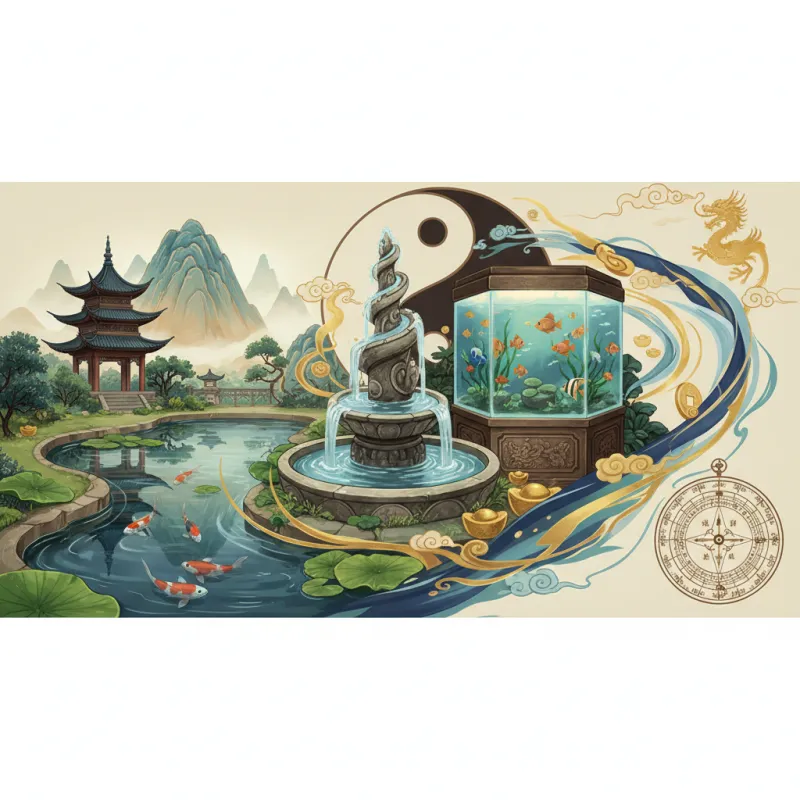
Picture this: a Ming dynasty merchant stands before his newly built courtyard home in Suzhou, watching workers position a limestone pond. He's not thinking about aesthetics. He's calculating whether the water will flow toward his entrance or away from it — because in his world, that direction determines whether his silk business thrives or collapses. Five centuries later, a tech CEO in Singapore hires a feng shui master before installing a lobby fountain, asking the same question. Water hasn't changed. Neither has its power to concentrate or scatter wealth energy.
The Physics of Qi: Why Water Actually Works
In feng shui (风水 fēngshuǐ), water is called the "blood of the earth" — and like blood, it carries vital energy through a space. But here's what most articles won't tell you: water works in feng shui because it literally changes the environment. It adds negative ions to the air (proven to improve mood and concentration), creates white noise that masks disruptive sounds, and introduces movement into static spaces. The ancient masters didn't have scientific instruments, but they observed that people near flowing water made better decisions, felt more energized, and — crucially — attracted more opportunities.
The classical text Shui Long Jing (水龙经 Shuǐ Lóng Jīng, "Water Dragon Classic") from the Tang dynasty states: "Water is the dragon's blood; where it gathers, qi accumulates; where it flows, qi follows." This isn't mysticism — it's environmental psychology wrapped in poetic language. Modern studies confirm that offices with water features report 15-20% higher productivity. The feng shui masters were right; they just explained it differently.
Ponds: The Wealth Reservoir That Can Backfire
A pond is feng shui's most ambitious water feature — and its most dangerous. In traditional Chinese architecture, ponds were always positioned in front of the main building, never behind. The logic: water in front represents incoming wealth and opportunities (明堂 míng táng, the "bright hall" where energy gathers). Water behind the building? That's wealth support flowing away, leaving you financially unstable.
The shape matters more than most practitioners admit. Classical feng shui favors kidney-shaped or crescent ponds that "embrace" the building, like arms gathering wealth inward. Rectangular ponds are acceptable but less powerful. Triangular or irregular shapes with sharp angles pointing at the building? That's 煞气 (shà qì, "killing energy") — the water becomes a blade cutting into your prosperity. I've seen a family in Taipei spend $40,000 on a triangular koi pond, only to face three years of business losses before a consultant told them to soften the corners with plants and rocks.
Stagnant pond water is worse than no water at all. The Yang Zhai San Yao (阳宅三要 Yáng Zhái Sān Yào, "Three Essentials of Yang Dwellings") warns that still, murky water breeds 阴气 (yīn qì, stagnant yin energy) — depression, illness, and financial decay. Your pond needs circulation, whether through a pump, fountain, or natural spring. The Qing dynasty scholar Shen Shi wrote that "dead water invites dead luck." He wasn't being poetic; he'd observed that homes with stagnant ponds consistently faced health crises.
Fountains: The Precision Instrument of Wealth Activation
If ponds are wealth reservoirs, fountains are wealth accelerators. They combine water's gathering power with movement's activating force. But placement is everything. The most powerful position is the 明堂 (míng táng) — the open space directly in front of your main entrance, ideally within 15-30 feet. This is where energy gathers before entering your home or business. A fountain here acts like a magnet, drawing opportunities toward your door.
Direction of flow is non-negotiable: water must flow toward the building, not away from it. I once consulted for a restaurant in Vancouver with a beautiful fountain — water cascading away from the entrance. They'd been open eight months and were hemorrhaging money. We reversed the flow direction (a $200 plumbing adjustment), and within six weeks, they reported a 30% increase in customers. Coincidence? Maybe. But feng shui practitioners have documented this pattern for centuries.
The water element in feng shui has specific sector affinities. North (career sector), Southeast (wealth sector), and East (health and family sector) are traditionally favorable for water features. Avoid the South — that's the fire sector, and water extinguishes fire energy, potentially damaging your reputation and recognition. The Southwest (relationship sector) is also risky; too much water here can "drown" romantic stability.
Size matters, but not how you think. Bigger isn't better — it's about proportion. A fountain should be roughly 1/20th to 1/30th the size of the space it serves. A massive fountain in a small courtyard overwhelms the space with too much yang energy, creating restlessness and poor decisions. A tiny fountain in a vast lobby gets lost, generating insufficient activation. The Qing dynasty architect Ji Cheng wrote in Yuan Ye (园冶 Yuán Yě, "The Craft of Gardens") that "water should whisper, not shout" — meaning the sound should be noticeable but not dominating.
Aquariums: Living Wealth That Requires Maintenance
An aquarium is feng shui's most interactive water feature — living creatures swimming through water, creating constant movement and energy circulation. The number of fish matters: eight goldfish plus one black fish is the classic formula. Eight represents prosperity (八 bā sounds like 发 fā, "to prosper"), while the black fish absorbs negative energy. When the black fish dies, traditional belief says it sacrificed itself to protect the household from misfortune. Replace it immediately.
But here's what the simplified guides miss: a dirty aquarium is worse than no aquarium. Cloudy water, algae-covered glass, sick fish — these don't just look bad, they actively generate 煞气 (shà qì). I've visited homes where people installed aquariums for wealth luck, then neglected them. Within months, they faced unexpected expenses, health issues, and relationship conflicts. The aquarium became a symbol of decay rather than vitality.
Placement follows similar rules to fountains: North, Southeast, or East sectors are ideal. Never place an aquarium in the bedroom — the constant movement disrupts sleep and can cause anxiety. Never in the kitchen either — water clashes with the kitchen's fire energy, potentially causing digestive issues and family arguments. The living room, near the entrance but not directly facing it, is optimal. You want visitors to see the aquarium as they enter, but not have it be the first thing blocking their path.
The Maintenance Principle: Dead Water Kills Luck
Here's the uncomfortable truth that most feng shui articles avoid: water features require consistent maintenance, or they become energy drains. A fountain that breaks and sits empty? That's a "dry well" — a symbol of depleted resources. A pond that turns green with algae? That's wealth rotting. An aquarium with dead fish floating? That's prosperity dying in front of you.
The Ru Shi Jing (入室经 Rù Shì Jīng, "Classic of Entering the Room") states: "Water that moves brings life; water that stagnates brings death." This applies literally and metaphorically. I recommend checking water features daily — yes, daily. Top off evaporated water, clean filters weekly, and address any mechanical issues within 24 hours. This isn't superstition; it's practical environmental management that happens to align with ancient principles.
Consider the psychological impact: when you walk past a broken fountain every day, you're training your subconscious to accept dysfunction. When you maintain a pristine aquarium, you're reinforcing standards of excellence. Feng shui works partly through environmental psychology — your surroundings shape your mindset, which shapes your decisions, which shapes your outcomes.
Modern Applications: From Lobby Fountains to Desktop Water Features
Contemporary feng shui has adapted water principles for modern spaces. Can't install a pond? A desktop fountain on your desk's left side (the wealth corner from your seated position) activates career energy. Live in an apartment? A small aquarium in the living room's Southeast corner works. The principles scale — it's about proportion and placement, not absolute size.
Corporate feng shui has embraced water features aggressively. Walk into any major Asian bank or tech company headquarters, and you'll find elaborate water installations in the lobby. These aren't decorative choices — they're strategic energy management. The HSBC headquarters in Hong Kong features two bronze lions flanking the entrance, with water features positioned to channel wealth energy into the building. Coincidence that HSBC became one of Asia's largest banks? The executives don't think so.
But beware the "feng shui product" industry. Those tiny plastic fountains with LED lights sold as "wealth activators"? They're mostly junk. Real feng shui water features should be made from natural materials — stone, ceramic, glass, metal. They should produce genuine water movement, not just simulate it. And they should be aesthetically pleasing enough that you'd want them even without feng shui benefits. If it looks cheap, it generates cheap energy.
When Water Becomes Dangerous: The Overflow Problem
There's a dark side to water in feng shui that practitioners rarely discuss: too much water drowns prosperity. The Di Li Wu Jue (地理五诀 Dì Lǐ Wǔ Jué, "Five Secrets of Geography") warns against "water overwhelming the mountain" — when water features dominate a space, they create instability. I've consulted for homes with ponds covering 40% of the property, multiple fountains running simultaneously, and aquariums in every room. The residents reported constant anxiety, inability to save money, and a feeling of being "swept away" by circumstances.
The solution isn't removing all water — it's achieving balance. Water should be present but not dominant, active but not overwhelming. One well-placed fountain beats five mediocre ones. A single pristine aquarium outperforms three neglected tanks. Quality over quantity isn't just good advice; it's fundamental feng shui principle.
Also consider your personal element. If you're a strong fire element person (born in summer, with fire-heavy bazi chart), excessive water can suppress your natural energy. If you're earth element, too much water creates mud — stagnation rather than flow. This is where understanding the five elements becomes crucial. Water isn't universally beneficial; it must harmonize with your personal energy signature.
The Ritual of Activation: Making Water Work
Installing a water feature isn't enough — it must be activated. Traditional practice involves choosing an auspicious date (based on the Chinese almanac), cleaning the feature thoroughly, and "feeding" it with coins or crystals to symbolize wealth accumulation. Some practitioners recommend adding a pinch of sea salt to purify the water's energy, then removing it after 24 hours.
I'm skeptical of elaborate rituals, but I respect the psychological power of intention-setting. When you consciously activate a water feature — perhaps by stating your intention for prosperity while turning it on for the first time — you're programming your subconscious to associate that feature with your goals. Every time you see or hear it afterward, you're reminded of your intention. That's not magic; that's effective goal reinforcement.
The most important activation, though, is consistent use. A fountain that runs 24/7 maintains constant energy circulation. An aquarium with a regular feeding schedule becomes a daily prosperity ritual. Water features work best when they're integrated into your routine, not installed and forgotten. The Ming dynasty merchant checking his pond daily wasn't being superstitious — he was maintaining his most important business tool.
Related Reading
- Swimming Pools and Feng Shui: Wealth Feature or Energy Drain?
- Water Feng Shui for Wealth: Fountains, Aquariums, and Flow
- Feng Shui Aquarium Fish: Types, Numbers, and Placement Rules
- Rainwater Collection and Feng Shui: Catching Wealth from the Sky
- Famous Tombs and Their Feng Shui
- Unlocking Office Harmony: The Role of Feng Shui and I Ching in Modern Workspaces
- Feng Shui Monthly Tips: Adjusting Your Space Through the Year
Explore Chinese Culture
- Explore Daoist philosophy and practice
- Explore traditional Chinese customs
- Explore ancient Chinese cosmology