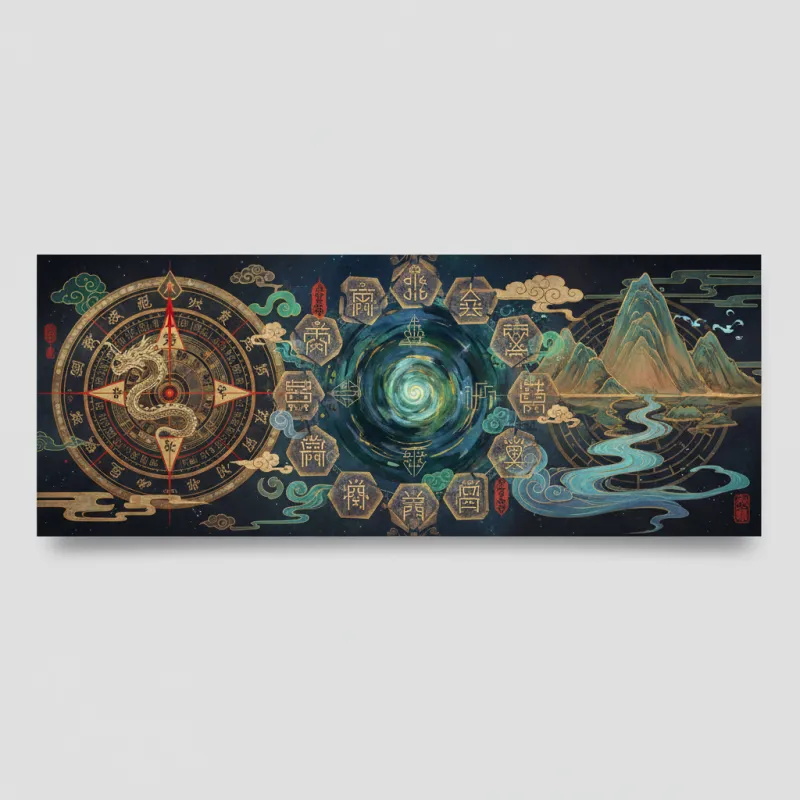
You throw three coins six times. Or you divide forty-nine yarrow stalks according to an ancient procedure that takes fifteen minutes. Either way, you end up with six numbers that form a hexagram—a stack of six horizontal lines, some solid, some broken. You look up this hexagram in a three-thousand-year-old book. You read a few cryptic sentences about crossing rivers or meeting foxes or keeping still like a mountain. And somehow, impossibly, these sentences speak directly to your situation.
This is how people use the I Ching (易经, Yìjīng), the Book of Changes. But here's what almost everyone gets wrong: they think it's fortune-telling. They think it predicts the future. It doesn't. What it actually does is far stranger and more interesting.
The Divination Trap
When Westerners first encountered the I Ching in the 17th century through Jesuit missionaries, they immediately classified it as a fortune-telling manual. This makes sense—you ask a question, perform a ritual, get an answer. That's divination, right?
Wrong. Or at least, incomplete. The I Ching doesn't tell you what will happen. It tells you what's happening—the pattern of change you're currently inside. There's a massive difference.
Fortune-telling assumes a fixed future that can be revealed. The I Ching assumes the opposite: that reality is constantly changing, that you're embedded in flows and transformations, and that the most useful thing isn't to know what's coming but to understand the nature of the change you're experiencing right now.
Think of it this way: a weather forecast tells you it will rain tomorrow. The I Ching tells you that you're in a "rain-like" situation—gathering, descending, nourishing, potentially flooding. It describes the quality of the moment, not the events of the future.
A Book About Pattern Recognition
The 64 hexagrams of the I Ching are not prophecies. They're a catalog of change patterns. Each hexagram describes a particular configuration of forces, a specific way that yin (阴, yīn) and yang (阳, yáng) can arrange themselves.
Hexagram 3, Zhun (屯, Zhūn), "Difficulty at the Beginning," describes the pattern of new things struggling to emerge—like a blade of grass pushing through hard earth. Hexagram 11, Tai (泰, Tài), "Peace," describes the pattern when heaven and earth are in proper relationship, when things flow naturally. Hexagram 12, Pi (否, Pǐ), "Standstill," describes the opposite—when heaven and earth pull apart and nothing moves.
These aren't predictions. They're descriptions of recurring patterns in nature, society, and personal life. The genius of the I Ching is recognizing that these patterns repeat. The same dynamics that govern how water flows or how seasons change also govern how projects develop, how relationships evolve, how political situations unfold.
When you consult the I Ching, you're not asking "what will happen?" You're asking "what pattern am I in?" And once you know the pattern, you know how to move within it. This connects deeply to the principles of wuxing, the five elements theory, where understanding the current phase of transformation guides appropriate action.
The Strangeness of Synchronicity
Here's where it gets truly weird. How does tossing coins or dividing yarrow stalks connect you to the right hexagram? The traditional Chinese answer is ganying (感应, gǎnyìng)—resonance or sympathetic response. The universe is interconnected. Your question, your mental state, the moment you ask, the way the coins fall—all of this is part of one unified field of change.
Carl Jung, who wrote a famous introduction to the Richard Wilhelm translation of the I Ching, called this "synchronicity"—meaningful coincidence. He argued that the I Ching works not through causality but through acausality. The hexagram you get doesn't cause anything or predict anything. It simply reflects the pattern of the moment.
This is almost impossible for the modern Western mind to accept. We want mechanisms. We want cause and effect. The I Ching offers something else: a worldview where meaning and pattern are fundamental features of reality, not things we project onto it.
Not Advice, But Perspective
When you read a hexagram, you're not getting advice in the normal sense. You're getting a perspective—a way of seeing your situation that you hadn't considered.
Say you're stuck in a difficult negotiation. You consult the I Ching and get Hexagram 15, Qian (谦, Qiān), "Modesty." The text says: "Modesty creates success. The superior man carries things through." It talks about mountains hidden beneath the earth, about lowering oneself to rise higher.
This isn't telling you what to do. It's offering a lens. What if you approached this negotiation not by asserting your position but by genuinely lowering yourself, by finding the humble path? The hexagram doesn't say this will work. It says: this is the nature of the pattern you're in. Modesty is the key that fits this lock.
Sometimes the hexagram confirms what you already suspected. Sometimes it completely reframes your understanding. But it never simply says "yes, do it" or "no, don't." That's fortune-telling. The I Ching does something more subtle and more powerful.
The Changing Lines
Here's another layer of strangeness: when you consult the I Ching, some of the lines in your hexagram may be "changing lines"—lines that transform from yin to yang or yang to yin. These changing lines generate a second hexagram, showing how your situation is evolving.
So you might get Hexagram 3, "Difficulty at the Beginning," with changing lines that transform it into Hexagram 8, Bi (比, Bǐ), "Holding Together." This tells you: you're in a difficult beginning phase, but it's moving toward a pattern of alliance and union. The difficulty isn't permanent. It's transforming.
This is why the I Ching is called the Book of Changes. It doesn't show you static situations. It shows you transformations in progress. Every hexagram contains the seeds of other hexagrams. Every pattern is already becoming something else. This dynamic view of reality is central to Chinese metaphysics and appears throughout practices like bazi analysis, where the transformation of elements over time reveals destiny.
A Mirror, Not a Crystal Ball
The best metaphor for the I Ching is a mirror—but a very strange mirror. It doesn't show you your face. It shows you the invisible pattern you're standing in, the flow of change you're part of.
When people say the I Ching is "accurate," they usually mean the hexagram they received seemed to describe their situation perfectly. But this isn't prediction. It's recognition. The I Ching helped them see what was already there but hidden.
This is why the book has survived three thousand years. Not because it predicts the future—fortune-telling books come and go. But because it offers something more valuable: a way of seeing change itself, a language for describing transformation, a tool for recognizing patterns.
Living With Uncertainty
The deepest teaching of the I Ching might be this: you cannot control the future, but you can understand the present. You cannot stop change, but you can move with it skillfully. You cannot know what will happen, but you can know what kind of moment you're in.
This is the opposite of fortune-telling, which promises certainty. The I Ching offers something better: wisdom in the face of uncertainty. It teaches you to read the signs, to sense the patterns, to move with the flow rather than against it.
The Zhou Dynasty scholars who compiled the I Ching weren't trying to predict the future. They were trying to understand change itself—how it works, what patterns it follows, how to navigate it. Three thousand years later, we're still using their book because change hasn't changed. The patterns are still the same. We're still trying to figure out how to move through a world that never stops transforming.
That's not fortune-telling. That's something much stranger and much more useful: a manual for living in a universe made entirely of change.
Related Reading
- Unlocking the Mysteries of Feng Shui and the I Ching: A Journey into Chinese Metaphysics
- The I Ching: The World's Oldest Book of Wisdom (And How to Actually Use It)
- How to Consult the I Ching: A Beginner's Guide
- What Is the I Ching? A Complete Guide to the Book of Changes
- The 64 Hexagrams: A Complete Overview
- Bedroom Feng Shui: Better Sleep Through Design
- Unlocking the Secrets of Feng Shui and I Ching: A Journey Through Chinese Metaphysics
- Unlocking Office Harmony: The Role of Feng Shui and I Ching in Modern Workspaces
Explore Chinese Culture
- Explore Daoist philosophy and practice
- Explore traditional Chinese customs
- Explore ancient Chinese cosmology